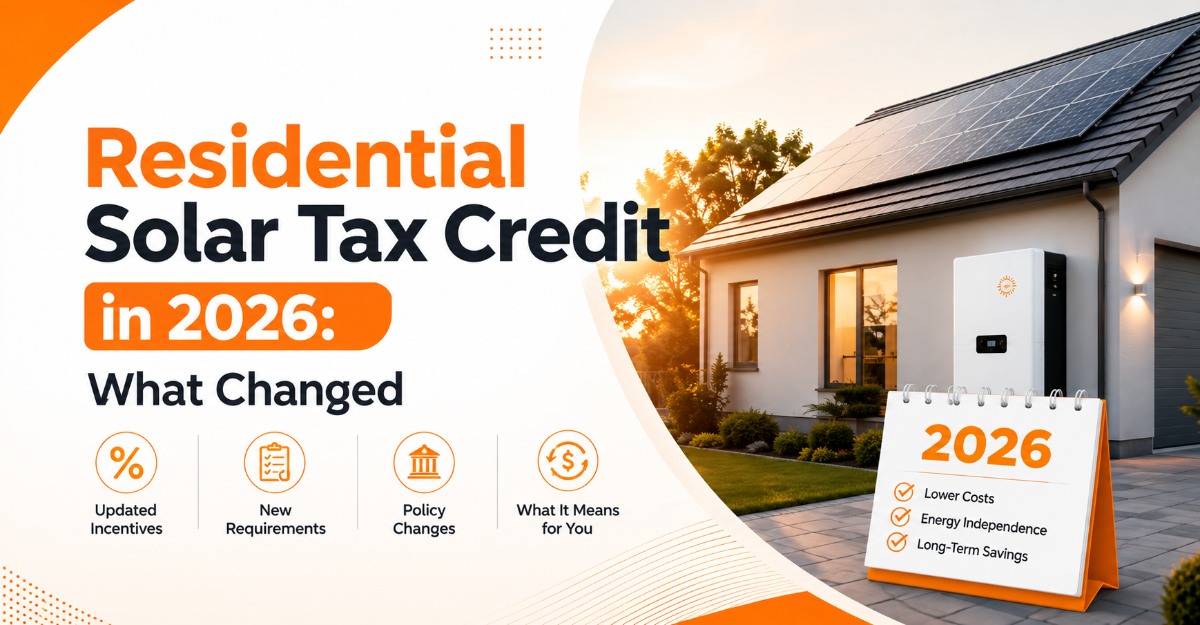
The residential solar tax credit, formally the Residential Clean Energy Credit under Internal Revenue Code Section 25D, gave homeowners a 30% federal credit on qualified solar installations. The One Big Beautiful Bill Act, signed July 4, 2025, ended it for systems placed in service after December 31, 2025. The direct homeowner credit is now 0% in 2026.
That single change reshapes every solar buying decision this year. Owning your panels no longer triggers a federal tax break, but the 30% incentive did not vanish from the market. It moved. Third-party developers who own leased systems now claim it through the commercial Section 48E credit, and homeowners who installed before the deadline can still carry unused amounts forward. The rest of this guide explains where the money went, what solar now costs without the credit, and how each type of buyer should respond.
At a Glance: The 2026 Reality
What Is the Residential Solar Tax Credit?
The residential solar tax credit was a nonrefundable federal credit under Section 25D that let homeowners subtract 30% of a qualifying solar system’s cost from their federal income tax. It covered solar panels, inverters, wiring, mounting hardware, permitting, labor, and battery storage rated at 3 kWh or greater. The Inflation Reduction Act of 2022 set the 30% rate and originally scheduled it to run through 2032 before stepping down.
The credit applied to your primary or secondary U.S. home, not to rental properties you never live in. Eligible costs went on IRS Form 5695, and the credit reduced tax owed dollar for dollar. Because it was nonrefundable, it could zero out a tax bill but never generate a cash refund on its own. Any excess carried forward to later years.
How Does the Solar Tax Credit Work in 2026?
In 2026 the residential solar tax credit is 0% for any customer-owned system placed in service on or after January 1, 2026, because the One Big Beautiful Bill Act repealed Section 25D early. There is no 26% or 22% step-down as under prior law. The 30% simply ended for new owned installs, though two large exceptions preserve real value: historical carryforwards and third-party ownership through the commercial credit.
The distinction that now controls your outcome is ownership. If you buy the panels, you claim the (now zero) homeowner credit. If a developer owns them and you lease the output, the developer claims a separate 30% commercial credit and can price your contract accordingly. Timing matters as much as ownership, so the three points below decide most cases.
What happened to the 30% credit under the OBBBA?
The One Big Beautiful Bill Act terminated the Section 25D homeowner credit for property placed in service after December 31, 2025. Congress moved the cutoff forward roughly seven years from the Inflation Reduction Act schedule. A system installed and operational by year-end 2025 still qualifies for 30% on the 2025 return; one that reaches Permission to Operate in January 2026 does not.
Here is a practitioner caution the promotional materials skip: 25D hinges on when the system is “placed in service,” which the IRS has historically tied to completed installation, not utility interconnection. A project finished in December 2025 but interconnected in 2026 sits in genuinely gray territory. Keep dated installation records, and confirm treatment with a CPA before claiming.
Can you still carry forward an unused solar credit?
Yes. If you installed solar by December 31, 2025 but lacked enough tax liability to absorb the full 30% credit, the unused balance legally carries forward into 2026 and beyond. The OBBBA repealed the credit for new installs but did not cancel credits already earned. This matters because 25D carryforward behaves differently from the Section 25C efficiency credit, which never allowed carryforward.
A homeowner with a $9,000 credit and only $4,000 of 2025 tax liability applies $4,000 this year and rolls $5,000 forward. You document the remainder on Form 5695 each year until it is exhausted. There is no published expiration on the carryforward while the property remains in service.
How do leases and PPAs still capture the 30% credit?
Solar leases and Power Purchase Agreements still capture the 30% federal credit because the installer, not the homeowner, owns the equipment and claims the Section 48E Clean Electricity Investment Credit. Developers can add 10% for domestic content and 10% for qualifying energy communities, reaching up to 50% in stacked cases. They recover that value and, in principle, pass part of it back through lower monthly rates.
Under the OBBBA, many solar projects must begin construction by July 4, 2026 or be placed in service by December 31, 2027 to lock in the full commercial credit, and new foreign-entity sourcing rules apply. Treat “the developer passes you the savings” as a claim to verify in the contract, not a guarantee.
Financing Options and Who Receives the Tax Credit
Two financing paths now split sharply on who receives the tax credit: with ownership you get a 0% federal credit, and with a lease or PPA the developer captures 30% instead. Ownership still wins on lifetime savings and home equity, while third-party ownership wins on zero upfront cost and offloaded maintenance. The table below sets the trade-offs against shared criteria.
| Criterion | Cash or Solar Loan (owned) | Lease or PPA (third-party) |
|---|---|---|
| Who claims federal credit | Homeowner (0% in 2026) | Developer (30% via 48E) |
| Upfront cost | $15,000-$35,000 cash, or $0 down loan | $0 |
| Equipment ownership | You | Provider |
| Home equity impact | Increases valuation | Neutral, can complicate a sale |
| Maintenance and insurance | Your responsibility | Provider’s responsibility |
| Contract length | None (cash) or 10-25 yr loan | 20-25 years |
| Lifetime savings share | 100% | Reduced, escalators 0-3.9%/yr |
One insight most homeowners miss: many $0-down solar loans embed a “dealer fee” of roughly 15% to 30% of system cost to fund a below-market interest rate. With the 30% federal credit gone, that fee is no longer offset by a tax refund, so a cash price or a credit-union loan often beats a promoted solar loan. Ask for the cash price and the loan price side by side before signing.
How Much Does Residential Solar Cost and What Is the ROI?
A typical 8 kW to 10 kW residential system costs $20,000 to $35,000 gross before incentives, and payback runs about 6 to 9 years in high-utility states even with no federal credit. Pricing lands near $2.50 to $3.50 per watt installed, varying with roof complexity, panel tier, and region. Adding battery storage raises both cost and payback.
| System size | Typical gross cost | Est. annual bill savings (high-rate state) | Payback without federal credit |
|---|---|---|---|
| 6 kW | $15,000-$21,000 | $1,400-$2,000 | 8-11 years |
| 8 kW | $20,000-$28,000 | $1,900-$2,600 | 7-10 years |
| 10 kW | $25,000-$35,000 | $2,400-$3,200 | 6-9 years |
| 10-13 kWh battery add-on | +$9,000-$15,000 | Backup value, arbitrage | Extends payback 2-4 years |
Figures are typical ranges, not guarantees. The single largest driver of payback is your utility rate. At $0.35 per kWh in California or the Northeast, solar economics stay strong without the federal credit; at $0.11 per kWh in a low-rate market, the loss of the 30% credit can push payback past 12 years and weaken the case for buying.
How Do You Claim the Credit for a Pre-2026 Install?
If your system was placed in service by December 31, 2025, you claim the 30% credit on your 2025 return using IRS Form 5695, then transfer the result to Schedule 3 of Form 1040. The same form logs any carryforward into future years. The four-stage flow below matches the IRS sequence.
Work the steps in order:
- Gather documentation. Collect all receipts including equipment, permitting, shipping, and labor. Roof structural work does not count.
- Verify manufacturer status. Confirm components came from a qualified manufacturer and record the required product identification (QM) code.
- Complete Form 5695. Enter gross project cost on Line 1, multiply by 0.30 on Line 6b, then cap the amount at your current-year tax liability.
- Apply to your return. Move the allowable credit to Schedule 3 (Form 1040), Line 5.
- Log any carryforward. Record the unused remainder on Form 5695 to roll it into next year.
This is general information, not tax advice. IRS forms and instructions change annually, so verify the current-year Form 5695 lines and consult a tax professional for your situation.
State Solar Incentives That Still Apply in 2026
With the federal homeowner credit at 0%, state tax credits, utility rebates, and net metering now carry the economics for buyers. Several state programs remain independent of the OBBBA and can recover thousands of dollars. Values below are typical and subject to change, so confirm current terms on the DSIRE database before you commit.
| State | Program (typical) | Value |
|---|---|---|
| New York | Solar Energy System Equipment Credit | 25% of cost, up to $5,000 |
| Massachusetts | Residential Renewable Energy Credit | 15% of cost, up to $1,000 |
| South Carolina | Solar Energy Tax Credit | 25% of cost, up to $3,500/yr |
| California | No state credit; NEM 3.0 net billing + SGIP battery rebate | Rebate varies by utility |
| New Jersey | SuSI (SREC-II) program | Fixed $/MWh over 15 years |
Net metering policy often matters more than any rebate. States with full retail net metering let excess production offset your bill at the same rate you pay, while net-billing structures like California’s NEM 3.0 credit exports at a lower wholesale-style rate. That single policy difference can swing payback by several years.
Common Mistakes and Edge Cases
The most expensive 2026 mistake is claiming a personal 30% credit on a system placed in service this year, which the IRS will reject. Outdated ads still promise “30% back on your taxes,” but for owned installs that ended December 31, 2025. Three failure modes account for most rejected or disappointing claims.
- Confusing nonrefundable with a refund. If you owe $0 in federal tax, Form 5695 issues no check. The credit only reduces an active bill to zero and carries the rest forward, which frequently traps retirees and low-income filers.
- Including roof replacement costs. Standard reroofing and structural reinforcement do not enter the solar tax basis. Only the solar components qualify, though integrated solar shingles that generate power can count.
- Assuming lease savings are fixed. Many PPAs carry annual escalators of 2.9% to 3.9%, so a rate that beats the utility in year one can lag it by year ten. Read the escalator clause before signing a 25-year contract.
Recommendations by Homeowner Type
The right move in 2026 depends on tax liability, cash position, and utility rate, and the answer genuinely differs by persona rather than defaulting to one option. Below are directional recommendations for four common situations.
High-income owners in high-rate states (CA, NY, MA): Buy with cash or a low-fee loan despite the 0% federal credit. High grid rates plus state credits and net metering still produce a 6 to 9 year payback and full equity.
Budget-conscious homeowners wanting immediate savings: Lean toward a lease or PPA so a well-capitalized developer monetizes the 48E credit and you avoid a down payment, but verify the escalator and the buyout terms.
Retirees and low-tax-liability owners: Avoid buying for a “tax windfall” that no longer exists and that you may not have the liability to use. A lease lets the developer capture the incentive instead.
Low-utility-rate markets: Reconsider timing. Without the 30% credit and with cheap grid power, payback can exceed 12 years, so model the numbers before proceeding.
Frequently Asked Questions
Is the residential solar tax credit really gone in 2026? For homeowner-owned systems, yes. The OBBBA set the Section 25D credit to 0% for property placed in service after December 31, 2025. The 30% now flows only to third-party owners through the commercial 48E credit, not to buyers.
Does the credit apply to solar batteries? Under the old 25D rules, standalone or paired battery storage rated 3 kWh or greater qualified for 30% through 2025. In 2026 batteries in owned systems get no homeowner credit, though developers can still claim storage under the commercial credit.
Can renters or second homes qualify? Second homes you live in part of the year could qualify under 25D for pre-2026 installs, but pure rental property you never occupy could not. Renters were never eligible because the credit required ownership of the installed system.
What is Form 5695 used for? Form 5695 calculates residential energy credits, including the pre-2026 solar credit, and produces the amount transferred to Schedule 3 of Form 1040. It also tracks unused credit carried forward into future tax years.
Do solar loans still make sense without the tax credit? Sometimes, but scrutinize the pricing. Many solar loans hide a 15% to 30% dealer fee that was previously offset by the 30% credit. Compare the cash price against the loan price before choosing financing.
Is the residential solar tax credit refundable? No. It was always nonrefundable, meaning it could reduce federal tax owed to zero but never generate a direct cash payment. Any excess above your tax liability carried forward rather than being refunded.