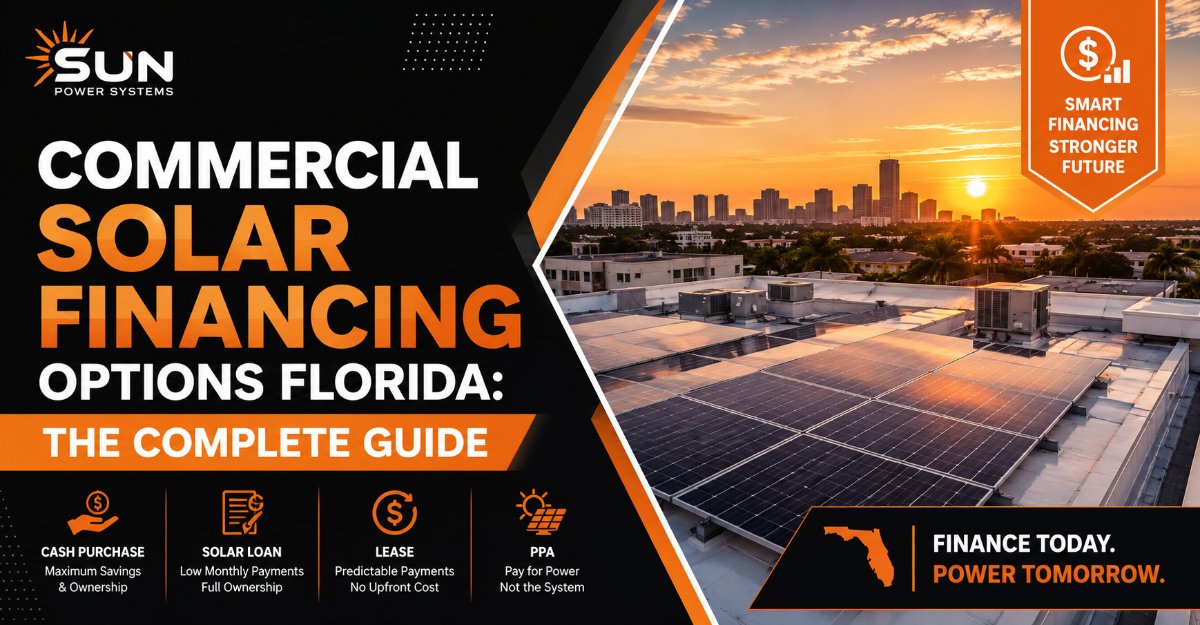
Commercial solar financing in Florida allows businesses, agricultural entities, and non-profits to acquire solar energy systems through structured financial products that leverage federal tax incentives, net metering, and specialized regional lending to achieve day-one positive cash flow. Because Florida utilities operate under distinct regulatory frameworks, commercial solar is less about retail electricity sales and more about optimizing capital expenditures, debt covenants, and corporate tax liability.
Key Facts / At a Glance
- Average Commercial Scale: Projects range from $150,000 to over $1,500,000 depending on roof footprint and peak demand profiles.
- Primary Financing Pathways: Direct solar loans, operating leases, structured solar services agreements (PPAs), and Commercial PACE (C-PACE).
- Tax Intersect: Businesses can leverage the 30% baseline Section 48E Investment Tax Credit (ITC) alongside 100% first-year MACRS bonus depreciation.
- Payback Horizon: Typical cash-flow-positive payback periods span 5 to 8 years across Florida investor-owned utility (IOU) territories.
- Regulatory Nuance: Third-party retail power sales face strict state caps, making structured Solar Services Agreements essential for PPA deployment.
Quick Verdict: Which Financing Option Fits Your Enterprise?
Choosing the right commercial solar financing structure depends entirely on your corporate tax appetite, balance sheet constraints, and real estate ownership status.
- For Tax-Rich Corporations & Manufacturers: Commercial Solar Loans deliver the highest internal rate of return (IRR) by capturing 100% of the 30% ITC and MACRS depreciation.
- For Asset-Light Retailers & Moderate Credit Profiles: Solar Operating Leases provide predictable, off-balance-sheet utility reduction without tying up revolving credit lines.
- For Non-Profits, Municipalities, & Tax-Exempt Entities: Solar Services Agreements (PPAs) or Direct Pay (Section 6417) models bypass the barrier of zero federal tax liability.
- For Real Estate Investors & Multi-Tenant NNN Properties: C-PACE Financing aligns long-term capital costs directly with property tax assessments, enabling seamless pass-through to tenants.
Comprehensive Comparison of Florida Commercial Solar Financing Options
The matrix below evaluates the four core pathways available to Florida businesses across eight critical financial and operational criteria.
| Evaluation Criterion | Solar Loan (Capital Purchase) | Solar Lease (Operating Lease) | Solar Services Agreement (PPA) | C-PACE (Property Assessed) |
| Asset Ownership | Business owns asset immediately. | Third-party financier owns equipment. | Third-party developer owns/manages. | Business owns asset via specialized debt. |
| Upfront Capital Outlay | $0 down options or 10% to 20% equity. | $0 down typical; minor security deposit. | $0 down; pay strictly for consumed kWh. | $0 down; 100% project cost covered. |
| Federal Tax Monetization | Kept by business (30%+ ITC & MACRS). | Kept by lessor; passed down via lower rates. | Kept by developer; lowers contract kWh rate. | Kept by business (30%+ ITC & MACRS). |
| Operation & Maintenance (O&M) | Borne by the business or service contractor. | Handled completely by leasing company. | Handled completely by developer. | Borne by the business. |
| Balance Sheet Impact | Adds fixed asset and matching term debt. | Right-of-use (ROU) asset & liability (ASC 842). | Off-balance-sheet operational expense. | Non-recourse debt tied to property tax bill. |
| Underwriting Timeline | 2 to 4 weeks via commercial green banks. | 2 to 3 weeks via specialized lessors. | 4 to 6 weeks for legal/credit vetting. | 6 to 12 weeks for title & mortgage consent. |
| Typical Term Length | 10 to 20 years (up to 30.5 available). | 7 to 15 years with annual escalators. | 15 to 25 years with fixed escalation rates. | 20 to 30 years fixed assessment. |
| Florida Regulatory Friction | Low (standard commercial lending rules). | Low (equipment finance lease structure). | High (requires structured service formatting). | Moderate (requires primary mortgage consent). |
1. How Do Commercial Solar Loans Maximize Long-Term Equity?
Commercial solar loans function as traditional corporate equipment financing where a specialized clean-energy lender provides capital secured by the solar installation and corporate balance sheet. Fixed APRs typically range from 5.5% to 8.5% over terms spanning 10 to 20 years, with regional institutions like Climate First Bank offering extended structures up to 30.5 years in Florida.
- The Equity Advantage: Because your business holds direct title to the asset, you retain 100% eligibility for the federal Section 48E Investment Tax Credit (ITC) worth 30% of project costs baseline alongside 100% first-year MACRS bonus depreciation.
- Underwriting Metrics: Lenders evaluate your corporate debt-service coverage ratio (DSCR), typically requiring a minimum threshold of 1.25 alongside 2 to 3 years of audited financials.
- Trade-Offs: Loans consume corporate borrowing capacity and place long-term operations and maintenance (O&M) obligations directly onto your facility management team.
2. Why Choose a Commercial Solar Lease for Balance Sheet Flexibility?
A commercial solar lease is an equipment rental agreement where a third-party lessor installs the system on your Florida facility in exchange for a fixed monthly payment over a 7 to 15-year term. These agreements frequently incorporate annual escalators of 1.5% to 2.9% to account for inflation.
- Accounting Treatment: Under modern ASC 842 lease accounting standards, operating leases require companies to record a right-of-use (ROU) asset and a corresponding lease liability, though they often avoid adding heavy corporate debt relative to direct bank loans.
- Risk Mitigation: The leasing entity retains full responsibility for system performance guarantees, inverter replacements, and proactive O&M.
- Trade-Offs: Lifetime financial returns are lower compared to direct ownership, and at the end of the term, you must exercise a fair-market-value buyout option or negotiate equipment removal.
3. How Do Solar Services Agreements (PPAs) Navigate Florida Regulation?
Strict state utility regulations in Florida restrict direct third-party retail electricity sales, meaning traditional Power Purchase Agreements (PPAs) cannot operate unaltered. Instead, commercial solar developers utilize specialized Solar Services Agreements or tolling structures. Under this framework, a developer installs a system on your roof at zero upfront cost, and you purchase the generated solar electricity at a pre-negotiated per-kWh rate—typically $0.07 to $0.10/kWh, compared to the standard utility grid rate of $0.12 to $0.15/kWh.
- Operational Simplicity: All technical, operational, and maintenance risk is transferred to the developer, turning your solar expense into a predictable operational expenditure (OpEx).
- Tax Pass-Through: The developer monetizes the federal tax credits and depreciation, passing those savings directly to you through a deeply discounted energy rate over a 15 to 25-year contract.
- Trade-Offs: Long-term contracts lock your facility into multi-decade commitments that require careful legal review if you plan to sell the commercial real estate property.
4. What Makes C-PACE Financing Unique for Florida Real Estate?
Commercial Property Assessed Clean Energy (C-PACE) provides 100% upfront financing for 100% of solar project costs—including necessary structural roof reinforcements—by attaching the debt to your property as a voluntary, non-ad valorem tax assessment. Fixed interest rates run between 7% and 10% with amortization schedules extending up to 30 years.
- Transferability on Sale: Because the debt is tied to the real property rather than corporate credit, the assessment automatically transfers to a new owner if you sell the building before the loan matures.
- Active Florida Programs: Active administrators such as CounterPointeSRE, RenewPACE, and county-backed entities (e.g., Miami-Dade PACE) facilitate these non-recourse transactions.
- Trade-Offs: C-PACE requires explicit, written consent from your primary mortgage holder because the assessment establishes a senior tax lien position. Securing this consent can add 4 to 8 weeks to your transaction timeline.
⏱️ What Are the Typical Financial Benchmarks and Timelines?
Navigating Florida commercial solar requires aligning capital deployment with realistic operational milestones:
- Levelized Cost of Energy (LCOE): Commercial solar delivers clean energy at an LCOE of $0.05 to $0.08 per kWh over a 25-year lifespan.
- Underwriting Duration: Specialized green bank loans take 2 to 4 weeks, whereas C-PACE programs require 6 to 12 weeks due to title searches and mortgage-holder notifications.
- Execution Lifecycle: From initial financing commitment and engineering design to utility Permission to Operate (PTO) issued by FPL, Duke Energy, or TECO, the total project execution timeframe spans 6 to 9 months.
🏗️ What Is the Step-by-Step Financing Process?
Executing a commercial solar financing package requires a disciplined, six-step corporate workflow:
- Energy Profiling: Compile 12 to 24 consecutive months of commercial utility bills to isolate peak demand charges ($/kW) from volumetric consumption charges ($/kWh).
- Feasibility & Engineering Modeling: Commission structural load studies, shade analyses, and production degradation forecasts from a licensed Florida contractor.
- Tax Capacity Audit: Partner with your corporate CPA to evaluate your federal tax liability and determine whether your firm can monetize the 30% ITC internally.
- Term Sheet Procurement: Solicit parallel bids from regional green banks, equipment lessors, and C-PACE capital providers.
- Underwriting Approval: Submit standard corporate documentation, including 3 years of financials, organizational documents, and proof of a debt-service coverage ratio (DSCR) exceeding 1.25.
- Closing & Notice to Proceed (NTP): Execute funding agreements, lock fixed interest rates, and authorize engineering procurement and construction (EPC) permits.
❌ Common Financing Mistakes and How to Avoid Them
- Ignoring Corporate Tax Liability Limits:
- The Pitfall: Selecting a standard commercial loan to claim the 30% ITC, only to discover your corporate structure generated zero federal tax liability for the tax year.
- Recovery: Pivot immediately to a Solar Lease or Solar Services Agreement where the third-party financier absorbs the tax credits, or utilize Section 6417 Direct Pay if your entity is a qualified tax-exempt organization.
- Failing to Secure Mortgage Lender Consent Early in C-PACE:
- The Pitfall: Spending months engineering a C-PACE package only to have your primary commercial mortgage holder block the assessment due to lien priority rules.
- Recovery: Initiate mortgage holder outreach during step three of your underwriting process, utilizing specialized legal counsel experienced in Florida C-PACE subordination agreements.
- Underestimating Utility Demand Charges:
- The Pitfall: Assuming solar generation will eliminate 100% of a commercial power bill without accounting for peak demand spikes that occur outside daylight hours.
- Recovery: Mandate that your developer model solar production against time-of-use demand metrics, and integrate commercial battery energy storage systems (BESS) into your financing package if demand charges exceed 40% of your baseline billing.
❓ Frequently Asked Questions
Can Florida non-profits and municipalities access solar financing?
Yes. Non-profits, municipal buildings, and public schools in Florida utilize tax-exempt municipal leases, specialized green bank loans, and Solar Services Agreements. Under the Inflation Reduction Act, tax-exempt entities can also leverage Section 6417 “Direct Pay” to receive a direct cash refund from the IRS equivalent to the value of the 30% Investment Tax Credit.
How does Florida net metering impact my financing returns?
Florida net metering mandates investor-owned utilities—including Florida Power & Light and Duke Energy—to credit businesses for excess solar energy exported to the grid at retail rates. This net crediting significantly accelerates cash-flow-positive payback periods by offsetting daytime consumption charges dollar-for-dollar.
What happens to my solar financing agreement if I sell my building?
The outcome depends entirely on your financing structure. With a direct commercial loan or C-PACE financing, the debt can either be paid off from sale proceeds or transferred automatically with the real property (in the case of C-PACE). With a solar lease or PPA, the contract can be assigned to the new creditworthy property buyer, or the system can be bought out at fair market value during closing.
Are there special incentives for Florida agricultural businesses?
Yes. Agricultural producers and rural small businesses in Florida routinely combine commercial solar loans or C-PACE financing with USDA REAP (Rural Energy for America Program) grants, which can cover up to 50% of total project capital costs for eligible renewable energy systems.
What credit score or financial health metrics do solar lenders require?
Commercial solar lenders evaluate corporate financial health rather than personal credit scores. They typically require a minimum debt-service coverage ratio (DSCR) of 1.25, positive operating cash flow over the trailing 24 months, and corporate credit profiles demonstrating stable liquidity across multi-year balance sheets.