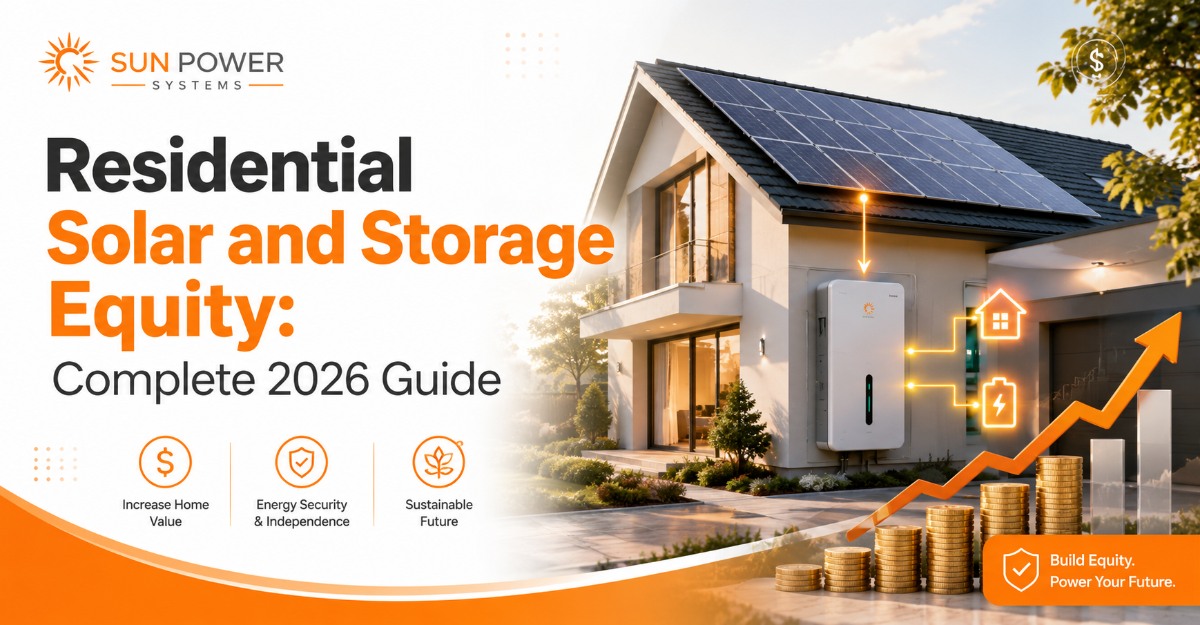
Residential solar and storage equity refers to targeted state and federal financial programs that fully subsidize renewable energy hardware for low-to-moderate-income households. These initiatives deploy solar arrays and battery backups at zero upfront cost to participants, directly reducing severe energy financial burdens. By prioritizing historically under-resourced communities, this framework ensures vulnerable populations retain critical power during grid failures while permanently lowering their monthly utility obligations.
How Does the System Work?
Equity systems operate using the exact same premium hardware as commercial installations, but the financial architecture sends the incentive directly to the installer to bypass the homeowner’s cash limitations. The physical mechanics rely on a closed-loop microgrid setup. During the day, the roof-mounted solar array generates direct current electricity, which the hybrid inverter converts to alternating current to power the home.
Excess midday energy flows directly into the localized battery storage rather than returning to the public utility grid. This storage capture prevents the homeowner from selling power at low daytime wholesale rates. In the evening, the system executes Time-of-Use peak shaving. The home stops pulling expensive public electricity and instead discharges the stored battery power. If the public grid crashes, a specialized automatic transfer switch physically severs the connection to the street. This action, known as islanding, allows the solar and battery to power the home’s essential load subpanel safely without sending lethal voltage back down the lines to utility repair crews.
Hardware Lifecycle Specifications
Understanding hardware longevity allows homeowners to accurately gauge the true value of their subsidized grant.
| Component Class | Expected Operational Lifespan | Primary Failure Mechanism | Warranty Standard |
| Solar Photovoltaic Panels | 25 to 30 years | Micro-cracks from thermal expansion | 25-year linear performance |
| Hybrid Inverter Units | 10 to 15 years | Capacitor degradation over time | 10 to 12 years |
| Energy Storage Batteries | 10 to 15 years | Chemical cell degradation (capacity loss) | 10 years (or minimum cycle count) |
| Automatic Transfer Switch | 20 to 25 years | Mechanical contact wear | 10 years |
Battery Types and Sizing Rules
Programs strictly regulate authorized hardware configurations to guarantee the taxpayer-funded systems actually perform for the full decade. Lithium Iron Phosphate batteries remain the gold standard for equity deployments. They offer remarkable thermal stability, eliminating the fire risks associated with older chemistries, and allow users to drain them to zero without damaging the internal cells.
Administrators explicitly ban older technologies like Absorbent Glass Mat lead-acid batteries. These archaic units require frequent maintenance, vent dangerous gases, and only permit a 50 percent depth of discharge. Lithium Nickel Manganese Cobalt offers a smaller physical footprint for tight garages, but it remains highly sensitive to extreme heat and degrades much faster under daily cycling demands.
Hardware Capacity Matrix
Installers must right-size the equipment based on historical 12-month utility data. Programs strictly limit total capacity to prevent over-subsidization and grid strain.
| Household Size Profile | Required Solar Capacity | Minimum Battery Storage | Average Daily Production |
| 1 to 2 Bedroom Home | 4.0 kilowatts | 5.0 to 10.0 kilowatt-hours | 16 to 20 kilowatt-hours |
| 3 Bedroom Standard Home | 6.0 to 8.0 kilowatts | 10.0 to 15.0 kilowatt-hours | 24 to 32 kilowatt-hours |
| Large Home (4+ Bedrooms) | 10.0 kilowatts | 15.0 to 20.0 kilowatt-hours | 40 to 50 kilowatt-hours |
| Medical Baseline Household | 12.0+ kilowatts | 20.0 to 25.0 kilowatt-hours | 48 to 60 kilowatt-hours |
Step-by-Step Implementation Process
The deployment of residential solar and storage equity requires strict adherence to bureaucratic and engineering workflows. Homeowners do not buy these systems off the shelf, they apply for state-sponsored infrastructure integration.
Step 1: Income and Geographic Qualification
Homeowners prove eligibility using recent tax returns, enrollment in low-income utility programs, or geographic verification. Living in a state-designated Disadvantaged Community often bypasses individual income checks entirely.
Step 2: Engineering and Site Audit
An approved developer visits the property to verify structural integrity. They assess roof rafter spacing, measure annual shading metrics using localized software, and calculate the existing electrical main panel capacity. Upgrading an outdated 100-amp panel to a 200-amp panel is usually covered by the equity grant.
Step 3: Incentive Capacity Reservation
The developer files the comprehensive engineering packet to the state administrator. The program then locks in the funding. Advanced mechanisms frequently release half of the grant upfront, allowing the installer to purchase the physical batteries without charging the low-income client.
Step 4: Physical Installation
Crews mount the racking, panels, conduit, and heavy battery units over two to three days. Municipal building inspectors must physically visit the site afterward to confirm compliance with local fire codes and electrical safety standards.
Step 5: Permission to Operate
The local utility company reviews the final municipality sign-off and programs the smart meter. They issue the official Permission to Operate document, permanently linking the new hardware to the public grid.
How Much Does the Program Pay?
Residential solar and storage equity programs execute massive wealth transfers through direct infrastructure investment. The benchmark incentives entirely remove the financial barriers that typically lock low-income residents out of the renewable transition.
California’s benchmark metrics supply $1,100 per kilowatt-hour of storage installed. A standard 13.5 kilowatt-hour battery yields a $14,850 direct grant. The solar production side pays $3.10 per installed watt, bringing another $18,600 for a modest 6-kilowatt array. When installers stack these state funds with the federal Solar for All initiatives, the average system value hits $25,000 to $30,000. Qualified low-to-moderate-income participants pay exactly $0 out of pocket.
Timeline and Administrative Expectations
| Implementation Phase | Typical Duration Range | Primary Bottleneck Risk |
| Application and State Approval | 4 to 8 weeks | Administrator queue volume |
| Permitting and Engineering | 3 to 6 weeks | Municipal building department revisions |
| Physical Installation | 2 to 3 days | Material supply chain delays |
| Utility Permission to Operate | 2 to 4 weeks | Final grid interconnection inspection |
Cost-Benefit Comparison
Understanding the structural differences between equity grants, standard purchases, and lease agreements prevents homeowners from signing away their financial security.
| Financing Configuration | Upfront Out of Pocket | 10-Year Ownership Value | Emergency Backup Power |
| Subsidized Equity Grant | $0 | High (Full asset retained) | Yes (Automatic islanding) |
| Standard Cash Purchase | $25,000 to $30,000 | Very High (No restrictions) | Yes (If battery included) |
| Third-Party Solar Lease | $0 | None (Installer owns system) | Variable (Often solar only) |
| Standard Solar-Only System | $15,000 to $20,000 | Moderate (Grid reliance) | No (Shuts down in blackout) |
Common Mistakes and Pitfalls
Predatory sales organizations constantly attempt to intercept equity program funds by misleading eligible homeowners. The most devastating mistake involves signing over ownership blindly through a Power Purchase Agreement. In these traps, the installer claims the $30,000 state grant, keeps the battery, and locks the homeowner into a 25-year contract with escalating monthly energy payments.
Homeowners also frequently ignore the mandatory 10-year operational rule. Equity programs consider the battery a public grid asset. If a homeowner disconnects the system from the home internet router, the state loses visibility into the battery’s performance. Failing to maintain this connection, or physically removing the system during a roof repair without notifying the state, triggers massive financial clawbacks that the state will enforce via property liens. Furthermore, the battery must execute a minimum number of discharge cycles annually (typically 52 cycles) to prove it is actively relieving grid congestion.
How Do You Troubleshoot Basic Faults?
Even premium residential hardware occasionally experiences software conflicts or grid communication errors. Resolving these issues quickly prevents equity program administrators from flagging the system for non-compliance.
If the system generates solar but the battery refuses to charge, the internal Battery Management System likely tripped an over-temperature safety protocol. Homeowners must check the main inverter interface and execute a hard restart: flip the battery breaker off, disconnect the solar direct current feed, turn off the alternating current main, wait five minutes, and reverse the process.
If the battery drains rapidly during daytime non-peak hours, the Time-of-Use programming contains an error. Users must access their configuration application, verify their specific utility rate code, and lock the operating profile into cost savings mode. When the equity administrator flags a loss of communication, the home router has likely dropped the connection. Power-cycling the gateway usually restores the telemetry data feed to the state servers.
Strategic Expert Recommendations
Navigating state-level energy programs requires distinct strategies depending on the applicant’s living situation and medical requirements.
For standard low-to-moderate-income homeowners, the primary directive is strict vendor vetting. Never engage with door-to-door sales teams unless they physically present their active registration number with the state’s public utilities board. Demand written confirmation that your project utilizes the Advanced Payment Program so you never cover upfront permitting fees.
Medical baseline users require a specialized engineering approach. Budgets highly favor individuals dependent on life-support machinery or refrigerated medication. Work closely with the lead electrician to split the home’s wiring. Move the medical outlets and central cooling to the critical load subpanel, while isolating non-essential drains like electric ovens. This targeted load shedding extends emergency battery run-time from hours to days.
Multifamily affordable housing property managers must pursue virtual net metering. This allows a single massive commercial battery on the roof to match its output to individual tenant meters down below. The state will only issue the equity grant if the legal framework guarantees the utility bill reductions directly benefit the low-income renters rather than padding the landlord’s operational margins.
Frequently Asked Questions
Can I sell my house with a subsidized solar and storage system?
Yes, you can sell the property, but the 10-year operational contract transfers to the new buyer. You must legally disclose this commitment during the escrow process. If the buyer refuses to maintain the internet connection, the original program administrator may attempt to claw back the grant funds.
Are off-grid configurations allowed under these state programs?
No, equity programs strictly forbid true off-grid designs. The state funds these batteries specifically to support the public utility grid during peak evening hours. If you sever the permanent grid connection, you immediately violate the terms of the grant and forfeit the equipment.
Do these energy systems require annual maintenance?
Lithium batteries and solid-state inverters require zero physical maintenance. However, homeowners should hose off the solar panels twice a year to remove dust buildup, which can degrade daily production by 10 to 15 percent.
What happens if the installation company goes bankrupt?
Because you own the hardware outright through the equity grant, developer bankruptcy does not impact your daily operation. The hardware warranties remain held by the original equipment manufacturers, allowing any certified local electrician to service the system if parts fail.
Does the battery cover heavy appliances like air conditioners?
During a grid blackout, a single 13.5 kilowatt-hour battery will drain in less than three hours if forced to run a central air conditioning compressor. Installers deliberately exclude these heavy 240-volt loads from the critical backup panel to preserve power for refrigerators and medical devices.
Securing your residential solar and storage equity setup transforms a vulnerable household into an energy-resilient asset. By understanding the sizing rules, avoiding predatory lease agreements, and maintaining the mandatory compliance metrics, you guarantee a decade of stabilized electricity costs and total blackout protection.