Florida Power & Light (FPL) net metering is a billing mechanism that allows solar customers to receive a 1:1 retail credit for excess electricity sent to the grid. As of 2026, despite past legislative challenges, FPL continues to compensate residential solar exports at the full retail rate of approximately $0.13 to $0.15 per kilowatt-hour.
Key Facts / At a Glance
- Compensation Rate: 100% retail rate (1:1 credit) for all excess energy sent to the grid.
- Annual True-Up: Unused credits are cashed out every January at an avoided-cost wholesale rate (~$0.02-$0.03/kWh).
- Minimum Bill: Customers must pay a fixed base charge of ~$25-$30 monthly; a $0.00 bill is impossible.
- System Sizing Limit: FPL restricts system size to produce no more than 115% of your annual historical kilowatt-hour (kWh) usage.
- Tier 1 Exemption: Systems under 10 kW AC require no application fee and no mandatory liability insurance.
How FPL Net Metering Works in 2026
The Monthly Balancing Act
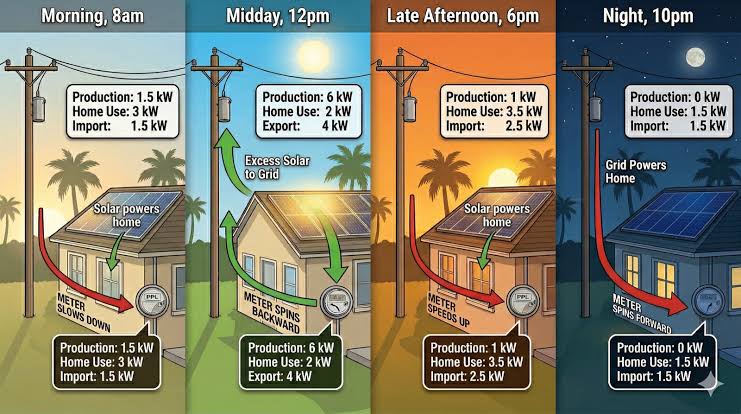
Net metering balances your home’s energy production against its consumption on a continuous monthly basis. When your solar panels generate more power than your home draws during peak daylight hours, the surplus flows backward into the FPL grid. FPL tracks this outbound power via a bi-directional meter and banks it as a retail-rate credit.
At night or during heavy cloud cover, your home pulls electricity from the grid. FPL deducts from your stored credit bank first. If you exported 500 kWh but imported 400 kWh over a billing cycle, your net usage is zero, and you roll 100 kWh over to the next month.
The January True-Up Reset
Every January, FPL zeroes out your accumulated credit bank. Any leftover credits are converted to a cash payment applied to your bill. However, this payout is calculated at FPL’s avoided-cost rate (essentially wholesale), netting you only two to three cents per kWh. Because this rate is significantly lower than retail, oversizing your system purely to sell power back to FPL yields a terrible financial return.
2026 Rate Hikes and Financial Impact
With FPL’s new four-year rate plan taking effect in 2026, base electricity rates have increased. For a standard 1,000-kWh residential customer in Peninsular Florida, the estimated bill has risen to $142.37. Paradoxically, higher retail electricity prices increase the return on investment for solar owners, because every kilowatt-hour you avoid buying (or bank as a credit) is now worth more money.
Solar Savings Calculator
| System Metric | Status/Value |
|---|---|
| System Rating (AC) | 4.25 kW |
| Classification | Tier 1 |
| Liability Insurance | Not Required |
| FPL Application Fee | $0 |
Expert Insight: If you have built up massive solar credits by December, use them. Lower your AC temperature or run an electric pool heater. Using the power yourself is worth ~$0.14/kWh, whereas letting FPL cash it out in January is only worth ~$0.02/kWh.
System Tiers and Insurance Requirements
FPL categorizes net-metered solar arrays into three distinct tiers based on alternating current (AC) capacity. Because solar panels produce direct current (DC), you must convert the rating. To find your AC rating, multiply your system’s total DC panel rating by 0.85 (accounting for standard inverter clipping).
| Tier Level | AC Capacity | Application Fee | Liability Insurance Required | Disconnect Switch |
| Tier 1 | 0 – 10 kW | $0 | None | Not required |
| Tier 2 | >10 – 100 kW | $400 | $1 Million Personal Liability | Mandatory, visible |
| Tier 3 | >100 – 2 MW | $1,000 | $2 Million General Liability | Mandatory |
Why Staying in Tier 1 Matters
For budget-conscious homeowners, remaining in Tier 1 is highly advantageous. By keeping your inverter capacity strictly at or below 10.0 kW AC, you avoid the $400 application fee and, more importantly, the state mandate to carry a $1 million personal liability insurance policy naming FPL as an additional insured. This insurance requirement typically adds $300 to $500 to your annual homeowner’s premium, eating directly into your solar savings.
How to Apply for FPL Net Metering
1.System Sizing and Pre-Approval:Do not exceed 115% of usage.
Your solar contractor must review your past 12 months of FPL bills to design a system that produces no more than 115% of your annual consumption. Submit the Interconnection Application through FPL’s portal before physical installation begins.
2.Installation and Permitting:Local jurisdiction approval required.
Install the solar array. The system must meet the National Electrical Code and pass a final electrical inspection by your local municipality (Authority Having Jurisdiction).
3.Document Submission:Varies by tier.
Upload the finalized municipal permit to FPL. If you are installing a Tier 2 system, you must also provide proof of the $1 million liability insurance policy and pay the $400 fee at this stage.
4.Bi-Directional Meter Swap:Crucial waiting period.
Once approved, FPL will dispatch a technician (usually within 2–4 weeks) to replace your standard utility meter with a bi-directional unit capable of tracking outward flow. You will know it worked when FPL grants official Permission to Operate (PTO).
Warning: Never activate your solar system before this meter swap. Older analog meters cannot distinguish direction and will actually charge you for the electricity you export to the grid.
Frequently Asked Questions
Why did my FPL bill not go down to zero?
FPL charges a mandatory base bill of roughly $25 to $30 per month to cover grid maintenance and connection costs. No amount of solar production can offset this fixed charge; it is the price of remaining connected to the grid.
Will my solar panels provide power during a hurricane?
No, unless you have a coupled battery storage system. Grid-tied inverters feature an anti-islanding safety mechanism that automatically shuts the system down during a blackout. This prevents your panels from sending live voltage backward into the grid, which could electrocute line workers repairing the wires.
Should I oversize my system for a future electric vehicle (EV)?
Yes, but carefully. A standard EV consumes an additional 3,000 to 4,000 kWh annually. If this pushes your proposed system size into Tier 2 (above 10 kW AC), you must calculate whether your gasoline savings outweigh the mandatory $1 million liability insurance premium you will incur.
What happens to my FPL credits if I sell my house?
Net metering agreements and banked credits are tied to the specific customer account, not the physical property. When you close your FPL account, any remaining credits are cashed out at the low wholesale rate. The new homeowner must submit a new interconnection agreement to resume net metering.