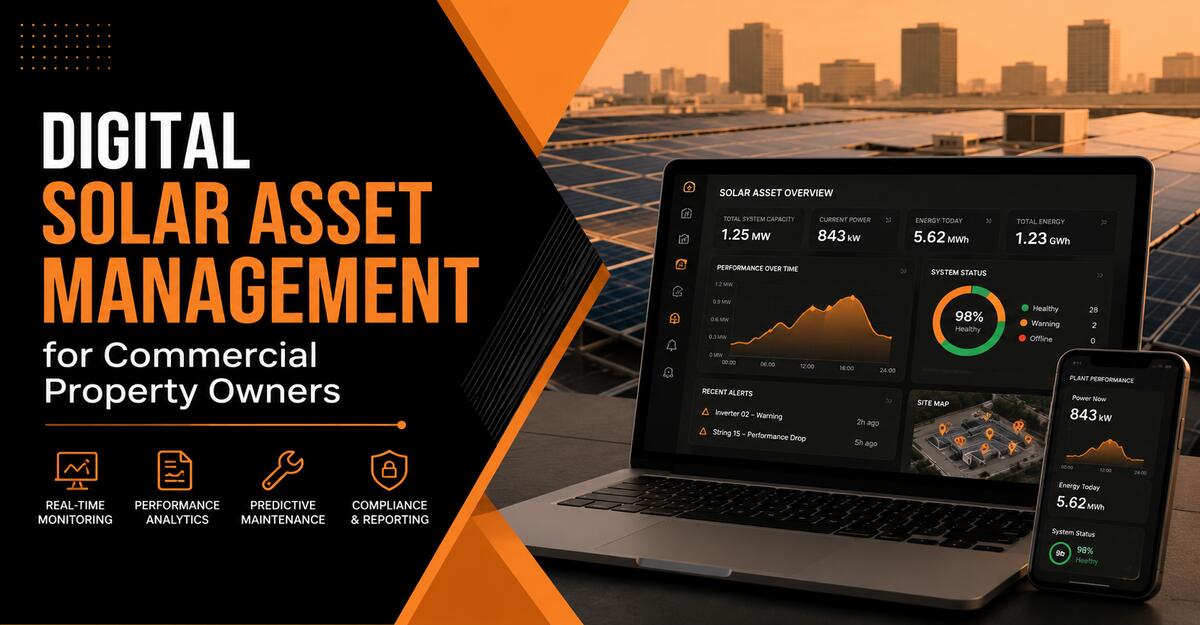
Digital Solar Asset Management (DSAM) is the centralized, data-driven optimization of commercial and industrial (C&I) solar photovoltaic systems and battery storage using cloud software, IoT sensors, and artificial intelligence. For commercial property owners, it converts inverter-level engineering metrics into automated tenant billing, debt-covenant reporting, and portfolio-wide ESG compliance across every rooftop and ground-mount asset.
Key Facts at a Glance
- DSAM software for mid-sized C&I portfolios typically costs €400 to €700 per MW per year (roughly $430 to $760), dropping to €300 to €600 per MW per year at large scale.
- A digital twin calculates expected minute-by-minute generation from local irradiance, so any deviation triggers a prioritized fault event instead of a raw hardware alarm.
- AI-driven platforms cut physical site visits by an estimated 70% and filter out up to 90% of non-actionable alert noise.
- API-based onboarding of one commercial site takes 2 to 4 weeks; legacy hardware retrofits with cellular gateways take 2 to 3 months.
- The financial layer automates PPA invoicing, lease recharges, and real-time Debt Service Coverage Ratio (DSCR) monitoring that manual spreadsheets cannot sustain.
- Total physical plus digital O&M in mature markets runs €7 to €26 per kWp per year.
What Is Digital Solar Asset Management?
Digital Solar Asset Management is a software ecosystem that treats a solar portfolio as a financial asset class, not just a set of monitored panels. A basic monitoring dashboard tells you an inverter is producing 45 kW. A DSAM platform tells you that inverter is producing 12% below its irradiance-adjusted baseline, that the shortfall equals €18 of lost tenant revenue per day, and that the loss threatens the DSCR covenant on the loan financing that roof.
The distinction matters for property owners because a rooftop array is rarely the core business. It is an embedded income stream governed by contracts: a Power Purchase Agreement with a tenant, a rooftop lease, a green-lease service charge, or a self-consumption offset against demand charges. DSAM exists to enforce those contracts automatically and to surface underperformance in euros or dollars rather than in volts and amps.
How Does Digital Solar Asset Management Work?
DSAM works by coordinating four connected layers that pull raw electrical data upward and push commercial calculations back down. Each layer performs one job, and the value compounds as data moves from the panel to the profit-and-loss statement.
Layer 1: Data Ingestion and Normalization
The ingestion layer continuously pulls raw data points such as DC voltage, AC current, and cell temperature from string inverters, weather stations, and revenue-grade utility meters. Modern sites connect over cloud-to-cloud APIs; older sites use a cellular edge gateway speaking Modbus TCP or SunSpec into the local SCADA loop. The software normalizes these disparate feeds into a single time-series database so a Huawei inverter and an SMA inverter report against the same schema.
Interoperability is where most projects stumble. Modbus register maps are not standardized between manufacturers, SunSpec adoption is uneven, and utility-grade meters may speak IEC 61850 or DNP3. A good DSAM vendor maintains a driver library for hundreds of device firmware versions; a weak one leaves you paying an integrator to hand-map registers per site.
Layer 2: The Digital Twin and AI Engine
The digital twin is an AI-driven mathematical model of the physical array that calculates what the system should produce at any given minute from live local irradiance. When actual output drops below this expected baseline, the platform logs a prioritized event rather than a raw alarm, ranking the €200-per-day loss above the sensor that flickered once.
The engine is only as trustworthy as its baseline. If historical calibration data is thin, or if the nearest irradiance source is a satellite pixel rather than an on-site pyranometer, the twin generates false positives on cloudy days. Practitioners calibrate against at least twelve months of on-site data before trusting automated availability guarantees.
Layer 3: The Financial and Commercial Ledger
Technical generation data feeds directly into billing, accounting, and lease-tracking systems. This automates dynamic tenant invoicing, applies escalating PPA rates and inflation clauses, and monitors DSCR in real time. For a property owner, this layer is the reason to buy the platform at all: it turns kilowatt-hours into invoices without a person copying meter reads into a spreadsheet on the last day of the month.
What Data and Protocols Does DSAM Rely On?
DSAM relies on time-series electrical telemetry, meteorological data, and contract metadata, moved over industrial protocols. Understanding the protocol stack prevents you from buying a platform that cannot read your hardware.
| Data or protocol | Purpose | Where it appears |
|---|---|---|
| Modbus TCP/RTU | Raw inverter and meter register reads | Almost every C&I inverter |
| SunSpec | Standardized inverter data model | Modern IEC-compliant inverters |
| IEC 61850 / DNP3 | Substation and revenue-meter data | Larger ground-mount and grid-tied sites |
| MQTT | Lightweight cellular uplink from gateway to cloud | Legacy-site edge deployments |
| IEEE 1547 | Grid interconnection and ride-through settings | US interconnection compliance |
| Irradiance feeds | Digital-twin baseline | On-site pyranometer or satellite model |
The single most common integration failure is assuming SunSpec compliance guarantees plug-and-play. It does not. Verify that the vendor already supports your exact inverter model and firmware before signing.
What Types of DSAM Platforms Are Available?
Commercial owners choose from three architectures: traditional SCADA, cloud SaaS monitoring, and AI-powered autonomous platforms. The right one depends on portfolio size and whether you need financial automation or only technical visibility.
| Criterion | Traditional SCADA | Cloud SaaS Monitoring | AI-Powered Autonomous |
|---|---|---|---|
| Primary focus | Hardwired site control, raw logging | Fleet aggregation, dashboards | Optimization, prediction, financials |
| Typical vendors | Schneider, ABB, Siemens | AlsoEnergy, GPM Horizon, meteocontrol | Power Factors, SenseHawk, QBi |
| Data refresh | Real-time, 1-second | 5 to 15-minute loops | Continuous, event-driven |
| Financial capability | None | Manual export only | Automated PPA billing, DSCR, ESG |
| Best fit | Single large industrial site | Multi-site technical oversight | Institutional portfolios with contracts |
SCADA verdict: unbeatable for isolated physical control, useless for portfolio economics. SaaS verdict: the pragmatic default for technical visibility, but it still leaves you invoicing by hand. AI-autonomous verdict: the only tier that closes the loop from telemetry to invoice, at a higher recurring cost.
How Much Does DSAM Cost and How Long Does It Take?
Expect software subscriptions of €400 to €700 per MW per year (about $430 to $760) for mid-sized portfolios, falling to €300 to €600 per MW per year for holdings above roughly 100 MW. Total physical plus digital O&M runs €7 to €26 per kWp per year in mature markets.
On ownership models, a self-hosted CAPEX deployment in a firm’s own cloud costs roughly €35,000 to €55,000 over five years for a 100 MW pool, versus €87,000 to €145,000 for an equivalent pure-SaaS subscription. SaaS costs more over time but removes the internal DevOps burden, which is why most property owners under institutional scale still choose it.
Deployment timing splits cleanly by connectivity. API-based cloud-to-cloud onboarding takes 2 to 4 weeks per site. A legacy retrofit requiring an installed cellular gateway on a Modbus network takes 2 to 3 months. The hidden ROI driver is billing accuracy: manual PPA invoicing across dozens of tenants typically leaks 2% to 5% of revenue to under-metering, missed escalations, and estimation errors, an amount that often exceeds the software subscription itself.
How Do You Implement DSAM Across a Portfolio?
Implementation follows four stages. The factor that most determines success is data hygiene at handover: garbage telemetry produces a garbage digital twin.
Step 1: Asset auditing and data mapping. Complete a full hardware inventory of inverter brands, string counts, meter models, and battery capacities, then digitize warranties, interconnection agreements, and PPA contracts. You will know this step worked when every asset has a verified nameplate rating and a linked contract in the system.
Step 2: System architecture and integration. Configure cloud-to-cloud API handshakes for modern sites, or install cellular IoT gateways into the SCADA or Modbus network for legacy sites. The checkpoint: live data arrives in the platform for every device, with no unmapped registers.
Step 3: Digital twin training and baseline modeling. Map the geospatial array layout from CAD files or high-resolution satellite imagery, then feed at least twelve months of historical generation and local weather to calibrate the predictive model. Success looks like an expected-versus-actual curve that tracks within a few percent on clear days.
Step 4: Commercial automation setup. Define billing parameters, utility tariffs, and inflation escalators, and assign permission tiers for property managers, external O&M contractors, and tenants. The checkpoint: a test invoice generates automatically and matches a manual calculation.
How Does DSAM Handle Battery Storage and PPAs?
DSAM manages battery storage by optimizing dispatch against demand charges and time-of-use tariffs while tracking cell degradation against warranty thresholds. For a commercial owner, the battery’s economic value is peak shaving: discharging during the fifteen-minute demand peak that sets a monthly bill can cut demand charges by 20% to 40%, and the platform automates that dispatch schedule.
The degradation angle is what monitoring dashboards miss. Lithium batteries lose capacity with each cycle, and a warranty typically guarantees a retained capacity percentage at a stated cycle count. DSAM logs actual throughput so you can file a warranty claim with evidence before the guarantee lapses, rather than discovering degradation after it is uncontestable.
On the contract side, the ledger applies PPA escalators, indexed tariff clauses, and lease recharges automatically. It can enforce availability guarantees by measuring uptime against a contractual threshold and calculating liquidated damages owed by an O&M provider when performance falls short. This turns a legal clause into an automatic financial line item.
Is Your Data Secure and Who Owns It?
Data security is a first-order risk in DSAM because every site becomes an internet-connected industrial endpoint. A cellular gateway on a Modbus network is a potential intrusion path into operational technology, so require the vendor to isolate the monitoring VLAN from any control function and to disable write access unless remote control is contractually needed.
Data ownership is the quieter trap. Read the contract for who owns the historical performance record, because if the platform owns it and you switch vendors, you can lose the multi-year trend lines that underpin asset valuation and warranty claims. Insist on a data-export clause in an open format such as CSV or a documented API, and confirm you can extract raw time-series data, not just PDF reports, on exit.
Which DSAM Platform Fits Your Portfolio Size?
The right platform scales with your portfolio, because a 15 MW rooftop owner and a 500 MW institution have different failure modes and different cost tolerances.
Small Portfolios Under 20 MW
Focus on minimizing soft costs. Use the free native cloud dashboards from your inverter maker (Huawei FusionSolar, SMA Sunny Portal, or SolarEdge) and layer automated monthly consumption reports on top. Paid DSAM rarely pays back below this threshold unless you have complex tenant billing.
Medium Portfolios of 20 to 100 MW
Prioritize automating manual work. Adopt an agile cloud SaaS platform with built-in billing modules, such as QBi Solutions or PowerHub, and connect performance streams directly to your accounting or ERP system to eliminate manual invoicing. This is the band where billing automation alone justifies the subscription.
Large Institutional Portfolios Above 100 MW
Prioritize risk, compliance, and asset value. Deploy a fully automated AI-driven platform such as Power Factors or GPM Horizon, integrated with local energy markets, automated regulatory reporting, and continuous battery optimization. At this scale, lenders and investors expect audit-ready DSCR and ESG reporting that only the top tier produces.
What Are the Most Common DSAM Mistakes?
The most damaging DSAM mistakes are procedural, not technical, and each is avoidable.
- Reacting blindly to alarm noise. Uncalibrated thresholds cause alarm fatigue and expensive emergency dispatches for sensor blips with zero financial impact. Fix: tune alarms to financial materiality, not raw fault codes.
- Accepting unvalidated construction handovers. Onboarding a new EPC-built site without string-level and thermal-drone testing means inheriting hidden engineering faults as your problem. Fix: make a clean digital handover a condition of final EPC payment.
- Leaving historical data siloed. Failing to migrate historical records when switching installers or platforms permanently breaks long-term trend lines. Fix: export and preserve raw time-series data at every transition.
How Do You Troubleshoot an Underperforming System?
Troubleshooting starts by separating a data fault from a physical asset fault, because the fixes are entirely different.
Diagnosing data disconnections. If a site drops off the map, determine whether it is a communication error or an equipment blackout. If weather sensors report active sun but the inverter reads zero, check for a tripped breaker or inverter error code. If data is simply blank, look for a dropped cellular link or an expired API credential.
Isolating silent losses. When a system stays online but drifts below expected efficiency, inspect individual string arrays. A single disconnected string or localized soiling hides inside aggregated building metrics but stands out clearly on a string-level dashboard.
Pinpointing hotspots. When output dips across a whole rooftop with no inverter error, run thermal drone imagery through the platform to isolate micro-cracks or failed bypass diodes against the array layout.
What Is DSAM Not Good For?
DSAM is not a fix for bad hardware or thin data, and pretending otherwise wastes money. If a site lacks revenue-grade metering or a reliable irradiance reference, the digital twin produces confident but wrong baselines, and automation multiplies the error across every invoice. Small single-site owners with one tenant and a fixed tariff gain little from a paid platform, since a native dashboard plus a monthly report covers them.
DSAM also does not replace physical O&M. It tells you a diode failed; a technician still climbs the roof. The value is in dispatching that technician only when the loss justifies the truck roll, not in eliminating maintenance.
Frequently Asked Questions
Is DSAM the same as solar monitoring? No. Monitoring reports what hardware is doing; DSAM adds a digital twin that defines what hardware should be doing, plus a financial layer that turns that gap into invoices, DSCR alerts, and ESG reports. Monitoring is a subset of DSAM.
What is DSCR monitoring in a solar context? Debt Service Coverage Ratio compares an asset’s net operating income to its debt payments. Real-time DSCR monitoring in DSAM flags when a generation shortfall threatens a loan covenant, giving owners time to act before a default, which manual quarterly reporting cannot.
Can DSAM automate tenant billing under a PPA? Yes. The commercial ledger applies contracted PPA rates, escalators, and tariffs to metered generation and issues invoices automatically. This is the core reason multi-tenant property owners adopt paid platforms, since it removes 2% to 5% of revenue leakage from manual billing.
Does DSAM support battery storage optimization? Yes. Platforms optimize battery dispatch for peak shaving and time-of-use arbitrage, cutting demand charges by 20% to 40%, and they track cycle-based degradation against warranty thresholds so claims can be filed with evidence.
What ESG reports can DSAM produce? DSAM generates avoided-emissions figures, renewable-generation totals, and audit-ready data for frameworks such as GRESB, CSRD, and CDP disclosures. Automating this replaces manual data collection that institutional investors and lenders increasingly require annually.
How do I choose a DSAM vendor? Confirm driver support for your exact inverter models and firmware, demand a raw-data export clause in an open format, verify operational-technology security isolation, and require billing automation if you have PPA or lease income. Test these against a single site before committing the portfolio.