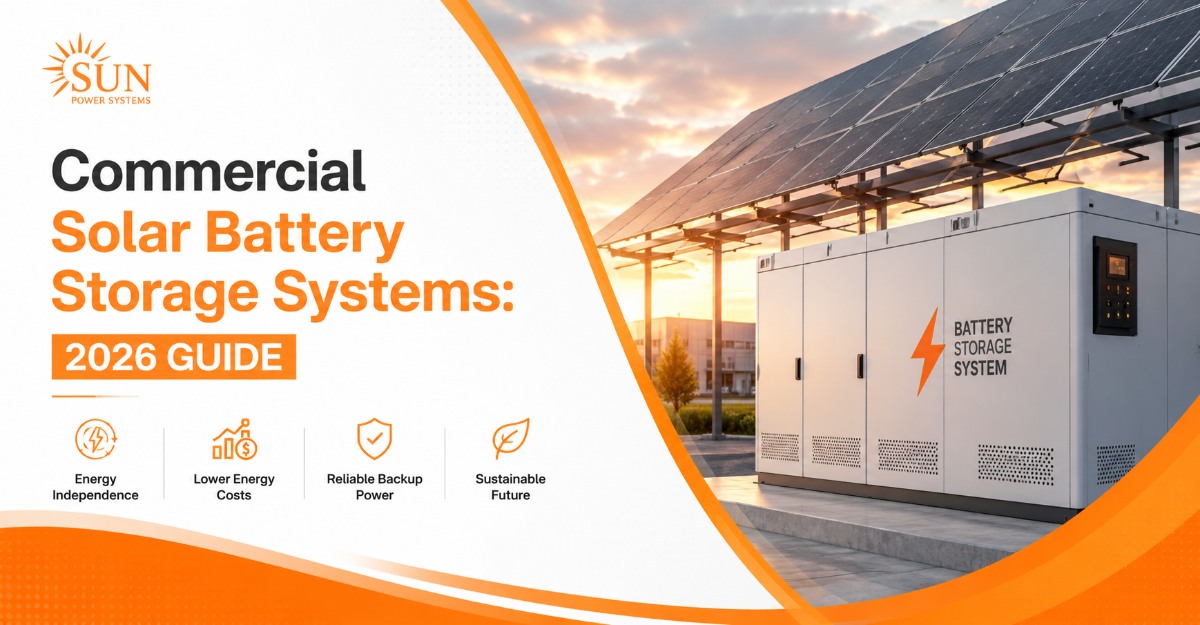
A commercial solar battery storage system is an integrated hardware and software assembly that captures surplus electricity from onsite solar panels, stores it in high-voltage battery racks, and discharges it on command to cut demand charges, shift load into cheaper hours, and supply backup power during grid outages.
- Dominant chemistry: LFP holds roughly 90% of new commercial and grid-scale lithium projects (reported 2024-2025).
- Installed cost: about $200 to $700 per kWh, falling as system size rises (2026 typical).
- Round-trip efficiency: 85% to 92% at the system level for LFP.
- Payback: typically 4 to 8 years where demand charges and incentives stack.
- Core US codes: NFPA 855 for installation, UL 9540 and UL 9540A for the product.
What is a commercial solar battery storage system?
A commercial solar battery storage system is a behind-the-meter energy asset that pairs solar photovoltaic generation with an electrochemical battery, power electronics, and control software to store energy on site and release it when it delivers the most value. The battery holds solar output that would otherwise be exported at a low rate, then discharges during expensive utility periods or outages. Most 2026 installations run lithium iron phosphate cells inside modular cabinets (roughly 50 to 500 kWh) or outdoor containers (500 kWh to several MWh). Under the US Inflation Reduction Act, standalone and solar-paired storage of 5 kWh or larger became eligible for the federal Investment Tax Credit through Section 48E, which reshaped project economics. The asset earns its return by lowering demand charges, arbitraging time-of-use rates, and, in many markets, selling grid services.
How does a commercial solar battery storage system work?
A commercial solar battery storage system works by converting, storing, and re-dispatching electricity through five coordinated layers, with software deciding every charge and discharge based on price signals and facility load. Solar direct current (DC) either feeds building loads through an inverter or charges the battery; stored energy is released when the tariff or a power outage makes it worthwhile. The intelligence sits in the energy management system, which weighs utility rates, load forecasts, and battery state of charge second by second. Hardware moves the power. Software decides when.
The five hardware and software layers
- Battery module layer (DC): Cells grouped into modules and wired into racks that form strings at 400 V to 1,200 V DC to reduce current and cabling losses.
- Battery management system (BMS): Cell-level monitoring of voltage, temperature, and state of charge; balances cells and trips the system before thermal or overcharge faults escalate.
- Power conversion system (PCS): Bidirectional inverters that turn DC into grid-synchronous AC and back, sized in kW to set discharge speed independent of stored kWh.
- Energy management system (EMS): The control brain that ingests real-time pricing, meter data, and forecasts, then dispatches the PCS. This is also where controls vendor lock-in and cybersecurity exposure live, two factors the typical spec sheet ignores.
- Balance of system and safety layer: Liquid cooling or HVAC, deflagration venting, gas detection, and fire suppression inside a rated enclosure that must satisfy UL 9540A test data.
raw DC power
DC ↔ AC
AC consumption
cell safety and balance
stored energy
export or import
The daily dispatch sequence
- Generate: The PV array produces DC electricity whenever irradiance is available.
- Offset load first: Power flows through the PCS to AC and immediately covers active building loads, the cheapest use of every solar kWh.
- Capture surplus: When production exceeds demand, the EMS routes the excess into the battery instead of exporting it at a low feed-in rate.
- Discharge on peak: During the facility’s highest 15-minute demand interval or the utility’s peak price window, the battery carries load and cuts the metered draw the utility bills against.
- Export last: Only when the battery is full and solar still exceeds load does surplus flow to the grid under the prevailing net-metering or net-billing tariff.
Here is the practitioner detail that changes everything about step 4: many commercial tariffs include a demand ratchet, where your billed demand for the next 11 months is set by your single worst spike. Miss one peak because the battery was already depleted, and the savings model breaks for a year.
Which battery chemistries dominate commercial storage?
Lithium iron phosphate (LFP) dominates commercial storage, accounting for roughly 90% of new stationary lithium projects in 2024-2025 per industry trackers such as BloombergNEF, because it balances safety, cycle life, and cost. Nickel manganese cobalt (NMC) has retreated to space-constrained premium sites, while vanadium flow and sodium-ion serve specific long-duration or safety-driven niches. Chemistry choice sets your footprint, fire profile, warranty cycles, and levelized cost, so it belongs at the front of the design, not the end.
| Attribute | LFP (LiFePO4) | NMC | Vanadium Flow (VRFB) | Sodium-ion (emerging) |
|---|---|---|---|---|
| Energy density | 120-160 Wh/kg | 150-250 Wh/kg | 15-25 Wh/kg | 100-160 Wh/kg |
| Cycle life (80% DoD) | 4,000-10,000+ | 1,500-3,000 | 15,000-20,000+ | 3,000-6,000 (early data) |
| Thermal runaway onset | ~270 C | 150-210 C | Non-flammable | ~High, non-Li fire path |
| Typical cell/pack cost | Low, $/kWh benchmark | Higher, cobalt exposure | High capital per kWh | Trending below LFP |
| Best fit | Daily peak shaving, load shift | Tight urban footprints | 6+ hour, microgrids | Cold climates, cost-driven |
Lithium iron phosphate (LFP)
LFP is the default commercial chemistry because it tolerates daily deep cycling, avoids cobalt, and resists thermal runaway until roughly 270 C. A well-managed LFP system holds 90% to 100% usable depth of discharge and delivers 6,000 or more cycles under warranty, which supports 15 years of once-daily use. The trade-off is physical: LFP needs more space than NMC for the same kWh, and its charge acceptance drops in sub-freezing cold without preconditioning.
Nickel manganese cobalt (NMC)
NMC packs more energy into less volume (150-250 Wh/kg), so it survives where footprint is the binding constraint, such as rooftop plant rooms or dense urban basements. That density carries two costs: a lower thermal runaway threshold (150-210 C) and cobalt supply exposure that adds price volatility. Most new commercial buyers now pick NMC only when square footage, not budget, drives the decision.
Vanadium redox flow (VRFB)
VRFB stores energy in liquid vanadium electrolyte pumped through a membrane stack, which decouples power (kW, set by stack size) from capacity (kWh, set by tank size). It is effectively non-flammable and degrades almost imperceptibly across 15,000 or more cycles, so a 20-year microgrid can run one flow system where lithium would need one augmentation or a full replacement. Standalone round-trip efficiency is lower, near 70% to 75%, and the tanks are bulky, which rules VRFB out for tight sites.
Sodium-ion and other emerging options
Sodium-ion has moved from lab to early commercial deployment, led by manufacturers such as CATL, offering cold-weather performance and a supply chain free of lithium and cobalt. Early cycle life sits around 3,000 to 6,000 cycles, below top LFP, but per-kWh cost is trending competitive. Lithium titanate (LTO) fills a separate niche: very fast charge and 15,000+ cycles for high-power, short-duration duty, at a premium price that limits it to specialized industrial loads.
AC-coupled vs DC-coupled architecture
DC-coupled systems share one inverter between the PV array and battery on a common DC bus, reaching around 95% round-trip efficiency and recapturing energy that would otherwise be clipped by inverter limits on sunny days. AC-coupled systems give the battery its own inverter tied to the AC panel, landing near 88% to 90% after double conversion but retrofitting into an existing solar field in days rather than weeks. The rule most integrators use: DC-couple new builds for the efficiency gain, AC-couple retrofits to avoid rewiring a live PV array.
How much does commercial solar battery storage cost in 2026?
Installed commercial solar battery storage costs roughly $200 to $700 per kWh in 2026, with price per kWh falling sharply as system size rises. A 100 kWh cabinet for a retail store runs a different unit economics than a 2 MWh container for a factory, and turnkey pricing bundles the battery, PCS, enclosure, engineering, permitting, and interconnection. Hardware is now often the minority of total cost; soft costs and interconnection increasingly dominate.
| System tier | Installed cost per kWh | Typical total range | Common application |
|---|---|---|---|
| Small commercial (50-200 kWh) | $450-$700 | $40,000-$110,000 | Offices, retail, schools |
| Medium industrial (200-500 kWh) | $350-$550 | $110,000-$230,000 | Warehouses, light manufacturing |
| Large multi-MWh (1 MWh+) | $200-$350 | $250,000+ | Plants, microgrids, campuses |
On timeline, engineering and design take 4 to 8 weeks, procurement and delivery 8 to 16 weeks, physical install 2 to 4 weeks, and commissioning 1 to 2 weeks. The real schedule risk is none of these. Permitting and utility interconnection can run 12 to 24 weeks or longer, and in congested grids the interconnection queue, not the hardware, sets your go-live date.
What incentives cut the net cost?
Federal incentives can cut the net cost of a US commercial solar battery storage system by 30% to 50% or more, primarily through the Section 48E Investment Tax Credit and accelerated depreciation. Under the Inflation Reduction Act, standalone storage of 5 kWh and up earns a base ITC (30% when prevailing-wage and apprenticeship rules are met on larger projects), with potential energy-community and domestic-content adders. MACRS depreciation lets a business recover much of the remaining basis over five years, and many states or utilities layer their own rebates or performance payments on top.
| Incentive | Mechanism | Typical value | Caveat |
|---|---|---|---|
| Section 48E ITC | Federal tax credit on eligible cost | 30% base, adders possible | 2025 budget law changed some clean-energy timelines |
| MACRS depreciation | 5-year accelerated depreciation | Recovers much of net basis | Reduced by half the ITC basis |
| State/utility programs | Rebates, SGIP-style, demand response | Varies widely by territory | Often capacity-limited, first come |
| Financing (ESA/lease) | Third party owns, you buy service | $0 down, monetizes credits | Third party captures the tax benefits |
Verify current ITC percentages and eligibility with a tax advisor, because 2025 US budget legislation altered timelines and phase-outs for several clean-energy credits and the rules continue to move.
What performance numbers actually matter?
Four numbers drive commercial storage performance: C-rate (speed), round-trip efficiency (loss), depth of discharge (usable capacity), and augmentation cadence (how you keep capacity over 15 years). Vendors quote nameplate kWh; the metrics below determine what you actually get on day one and in year ten.
| Metric | Typical value | Why it matters |
|---|---|---|
| C-rating | 0.5C to 1.0C | 100 kWh at 0.5C gives 50 kW for 2 hours; at 1.0C, 100 kW for 1 hour |
| Round-trip efficiency | 85%-92% (LFP, system level) | Energy recovered vs energy stored; drifts down 1-3 points over life |
| Depth of discharge | 90%-100% for LFP | Usable share of nameplate per cycle without accelerating fade |
| Operating voltage | 400V-1,200V DC | High-voltage strings cut current and copper losses |
| Augmentation | Add modules every 3-7 years | Restores faded capacity instead of oversizing on day one |
Two practitioner notes the spec sheet buries. First, round-trip efficiency is measured fresh; after several thousand cycles and with parasitic HVAC load, real-world RTE runs lower than the datasheet, so model 85% for LFP unless you have field data. Second, capacity fades whether you cycle or not, so a system sized exactly to today’s load is undersized by year five. Plan augmentation or accept a shrinking safety margin.
How do these systems make or save money?
Commercial solar battery storage makes money by stacking several value streams onto one asset, with demand charge reduction usually the largest single line for behind-the-meter sites. A battery that shaves 200 kW off a facility’s monthly peak at a $15/kW demand charge saves $36,000 a year before any other benefit. Layer time-of-use arbitrage, backup value, and grid-service payments on top, and payback typically lands at 4 to 8 years where tariffs and incentives cooperate.
| Value stream | Mechanism | Typical annual value |
|---|---|---|
| Demand charge reduction | Discharge during monthly peak interval | $8-$25 per kW of peak shaved |
| Energy arbitrage | Charge cheap, discharge at TOU peak | $20-$60 per kW-year, market-dependent |
| Demand response / capacity | Utility or ISO pays for dispatchable kW | $30-$100 per kW-year in active markets |
| Backup / avoided outage | Value of uninterrupted operation | Site-specific, often the deciding factor |
| Virtual power plant (VPP) | Aggregated dispatch under FERC Order 2222 | Emerging, varies by aggregator |
The expensive mistake here is sizing on kWh instead of kW. Businesses model average monthly energy and buy a battery that cannot deliver enough instantaneous power to flatten the peak, so the demand charge, the biggest prize, barely moves. Size the inverter and C-rate to the peak first, then size kWh to the duration of that peak.
What safety standards and codes apply?
Commercial solar battery storage in the US must satisfy an interlocking stack of codes: NFPA 855 for installation spacing and fire protection, UL 9540 for the complete system, UL 9540A for cell-to-module thermal runaway propagation testing, and IEEE 1547 for grid interconnection. NFPA 855 sets separation distances from lot lines, occupied spaces, and exits, and it caps stored energy per group without extra protection. Authorities having jurisdiction (AHJs) increasingly demand UL 9540A test data before permitting, and skipping this early is the most common reason a project stalls at inspection.
International projects reference IEC 62933 for the same ground. LFP’s higher thermal runaway threshold (around 270 C versus 150-210 C for NMC) is a real safety margin, which is part of why insurers and code officials favor it for occupied commercial buildings. None of this replaces a site-specific fire and emergency response plan coordinated with the local fire department.
What are the most common design and engineering mistakes?
The most common commercial storage mistakes trace to one root: designing around energy averages instead of the facility’s real power behavior and lifecycle. Each error below is one integrators see repeatedly, and each is expensive to fix after commissioning.
- Sizing on kWh, not kW: A system built to average consumption cannot shave short peak spikes, so the demand-charge savings that justified it never materialize.
- Ignoring parasitic HVAC load: Container cooling draws real power. Leaving it out of the model inflates projected round-trip efficiency and overstates savings.
- Bolting storage on after the solar: A PV design with no reserved pad space, breaker capacity, or controls routing forces costly rework to add a battery later.
- Skipping UL 9540A and NFPA 855 clearances: Insufficient separation from property lines or occupied space halts projects at inspection.
- Ignoring warranty cycle limits and augmentation: Cycling harder than the warranty allows voids coverage; sizing with no augmentation plan leaves the system short by year five.
- Overlooking controls lock-in: A proprietary EMS that cannot integrate with the building management system or new revenue programs strands the asset when tariffs change.
How do you troubleshoot common faults?
Most commercial storage faults reduce to three causes: heat, communication loss, or cell imbalance. The table maps the symptom an operator sees to its probable root and the first corrective action, drawn from field maintenance practice.
| Symptom | Probable cause | First corrective action |
|---|---|---|
| Accelerated capacity (SoH) loss | Sitting at 100% SoC in high enclosure heat | Cap top-of-charge near 95% in the EMS; lower HVAC setpoint |
| No discharge during utility peak | Lost link between revenue meter and EMS | Check and cycle Modbus/CAN wiring; confirm IP assignments |
| Sudden module shutdowns | High voltage spread across cell strings | Run a slow top-balancing charge through the BMS |
| Reduced capacity in cold snaps | Rising cell impedance at low temperature | Inspect thermal management for blocked intakes or blower failure |
Which system fits your facility?
The right commercial solar battery storage system depends on whether your priority is demand charge reduction, power quality, or off-grid resilience, and each profile maps to a distinct chemistry, size, and C-rate. Match the configuration to the load behavior, not to a generic kWh target.
| Facility profile | Primary objective | Recommended configuration | Chemistry and C-rate |
|---|---|---|---|
| Offices, retail, schools | Demand charges, daytime shift, basic backup | AC-coupled cabinets, 50-200 kWh | LFP, 0.5C, BMS-friendly EMS |
| Heavy industry, manufacturing | Shave motor-surge peaks, power quality, backup | Containerized blocks, 500 kWh-2 MWh+ | LFP, 1.0C, high transient tolerance |
| Remote microgrids, agriculture | Long-duration autonomy, self-consumption | Flow system or oversized DC-coupled LFP | VRFB or LFP, low HVAC dependence |
What commercial solar battery storage is not good for
Commercial solar battery storage is not a fit for every site, and pretending otherwise is how buyers end up with stranded assets. It rarely pays back on flat tariffs with no demand charge and no time-of-use spread, because the two biggest value streams simply do not exist. It is poor at seasonal shifting: a battery moves energy across hours, not months, so it cannot bank a sunny summer for a dark winter the way the marketing sometimes implies. Deep multi-day resilience needs so much lithium capacity that a generator or flow system usually wins on cost. And in a facility with cheap, stable, high-uptime grid power and no sustainability mandate, the honest answer is often that the money is better spent elsewhere first, such as on efficiency or on the solar array itself.
Frequently Asked Questions About commercial solar battery storage systems
How long do commercial solar batteries last? A quality LFP commercial battery lasts 10 to 15 years or 6,000 to 10,000 cycles under warranty, whichever comes first. Capacity fades gradually, so many systems are augmented with extra modules around year 5 to 10 rather than fully replaced, extending useful life toward 20 years.
Can a battery power a business fully off-grid? Rarely on lithium alone. True off-grid operation requires oversized capacity plus a generator or flow battery to cover multi-day low-solar periods. Most commercial systems are grid-tied and use the battery for backup during outages and daily savings, not permanent islanding.
What size battery does my business need? Size to your peak power (kW) and the duration of that peak first, then to daily solar surplus. A site with a 300 kW peak lasting two hours needs roughly 600 kWh of usable capacity and matching inverter output, not a figure derived from monthly kWh.
Is battery storage worth it without high demand charges? Usually not by itself. Demand charges and time-of-use spreads drive most behind-the-meter returns. On flat rates, value comes mainly from backup power and grid-service payments where available, which extends payback well beyond the typical 4 to 8 years.
How much maintenance does a commercial system need? LFP systems are largely passive, needing periodic inspection of cooling, connections, and firmware, plus BMS-guided balancing. Budget for HVAC filter service and a controls software subscription. Flow batteries need pump and electrolyte maintenance but tolerate far more cycling.
What happens to the battery at end of life? At end of life, commercial LFP packs are typically recycled to recover lithium, iron, and copper, or repurposed into lower-demand second-life applications. Plan for decommissioning cost and a recycling pathway at procurement, since disposal rules and take-back programs vary by jurisdiction.
Conclusion
A commercial solar battery storage system earns its keep when the design starts from your facility’s peak power, tariff structure, and resilience needs rather than a round kWh figure. LFP will fit most sites, the economics hinge on demand charges and the Section 48E ITC, and the real schedule risk is interconnection, not hardware. Size the inverter to the peak, plan for augmentation, verify current incentive rules, and the payback typically lands inside 8 years.