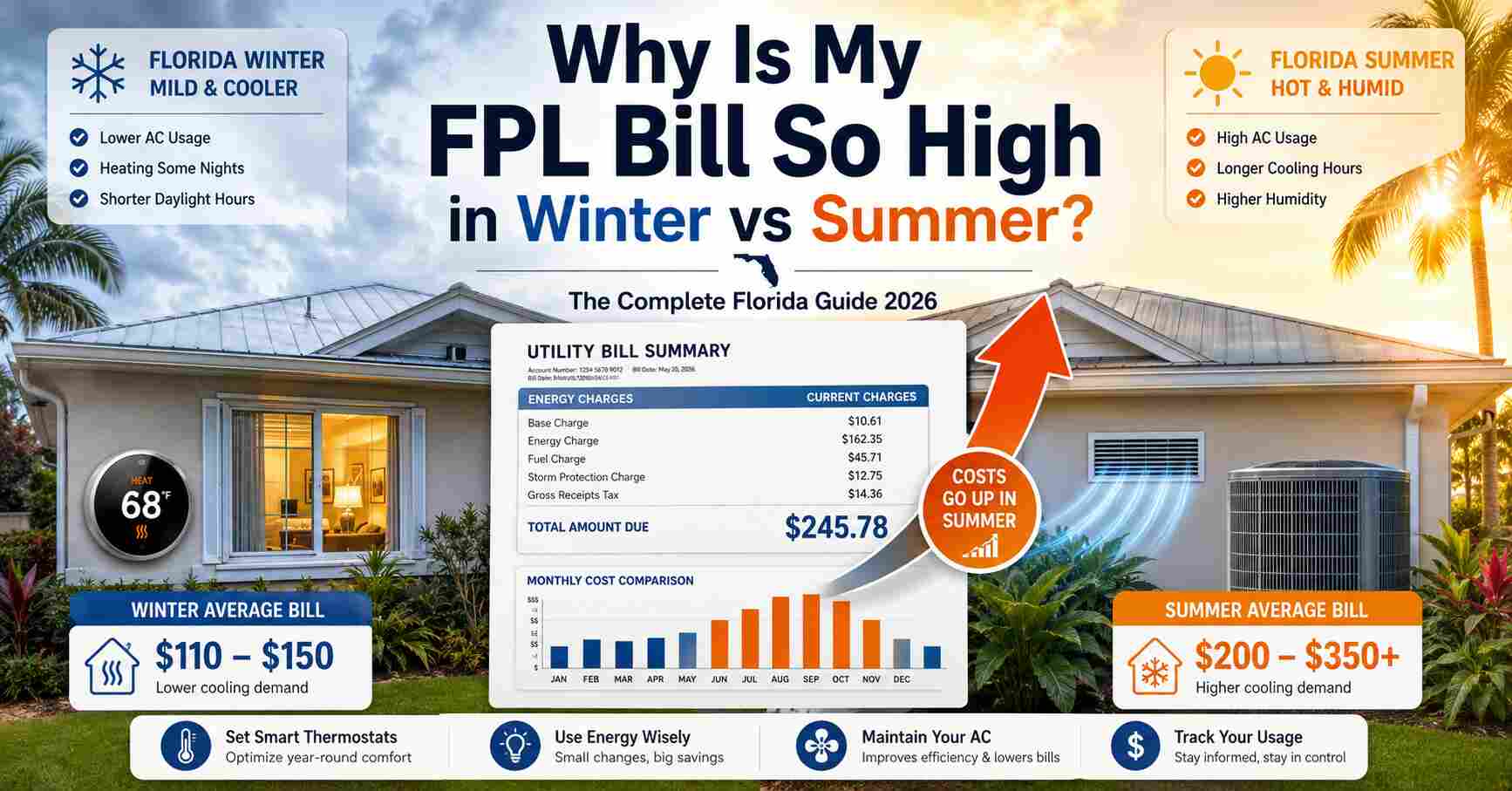
Most Florida homeowners brace for the August electric bill. Almost nobody braces for the February one. Then a cold front pushes through, the bill lands, and it is somehow higher than the one from the hottest month of the year.
That reaction is not a billing error, and you are not imagining it. In a state built around air conditioning, the single most expensive thing your home can do is heat itself with electricity. When Florida Power and Light customers see a winter bill jump past their summer peak, the cause is almost always a specific piece of equipment doing something invisible and expensive in the wall behind them.
This guide breaks down exactly what happens to your FPL bill between summer and winter, shows you the math on what each heating source actually costs per hour, and walks you through how to confirm the cause using the free tools already attached to your FPL account. Everything here is written for a residential customer with a normal Florida home, not an engineer.
The Short Answer, Before Anything Else
Your FPL bill is higher in winter than summer because electric resistance heat, not your heat pump, is doing most of the work during cold snaps, and resistance heat costs roughly three times more per degree of comfort than air conditioning does.
Three secondary factors stack on top of that:
- The temperature gap your system fights in winter is far wider than the one it fights in summer.
- FPL’s tiered rate charges you more per kilowatt-hour above 1,000 kWh in a month, and heating spikes push you over that line.
- A billing cycle that happens to catch two cold fronts will always beat a cycle that caught none.
Here is the comparison most people never see:
| Factor | Typical Summer Day | Typical Cold Snap Day |
|---|---|---|
| Outdoor temperature | 92 F | 38 F |
| Thermostat setting | 78 F | 70 F |
| Temperature gap the system fights | 14 degrees | 32 degrees |
| Primary equipment | Heat pump in cooling mode | Heat pump plus electric heat strips |
| Efficiency (energy delivered per unit consumed) | About 3 to 1 | About 1 to 1 when strips engage |
| Approximate power draw | 3.5 kW | 10 to 15 kW |
The gap is more than twice as wide, and the equipment closing it is roughly a third as efficient. Those two facts multiplied together are the entire answer.
Winter vs Summer Energy Use in Florida: Why the Math Flips
FPL’s own warm weather materials note that cooling makes up about 59 percent of an average Florida home’s electricity use, with water heating at 14 percent, kitchen at 9 percent, electronics at 7 percent, other at 7 percent and laundry at 4 percent. For a 1,500 square foot single-family home with average insulation and weather stripping, FPL estimates cooling at roughly $4.66 per day, or $139.80 per month, during peak summer conditions.
That is the number people anchor to. It is also the number that makes a winter bill feel impossible.
The flip happens because of how heating and cooling work differently.
Cooling moves heat. Your air conditioner does not create cold. It picks up heat from inside the house and drops it outside. Moving energy is cheap. For every unit of electricity a modern heat pump consumes in cooling mode, it moves roughly three units of heat energy.
Electric resistance heating creates heat. A heat strip is a coil of wire that glows when electricity passes through it, exactly like the element in a toaster or a hair dryer. There is no multiplier. One unit of electricity in produces one unit of heat out, and not one bit more. Physics allows no better.
Your heat pump can also run in reverse and move heat into the house, which is efficient and cheap. The problem is that it only does this well down to a certain outdoor temperature. Below that point, or when you demand a large temperature jump quickly, the system stops relying on the efficient method and switches on the expensive one.
The Temperature Gap Nobody Accounts For
In summer, a Florida home rarely fights more than a 15 degree difference between outside and the thermostat. In winter, during an actual cold front, that gap can double or triple. A 70 degree indoor target against a 35 degree morning is a 35 degree gap.
Heating and cooling load scale roughly with that gap. Doubling the gap roughly doubles the work. Then the efficiency penalty of resistance heat multiplies on top. A home that costs $4.66 a day to cool in August can plausibly cost $12 to $18 a day to heat during a genuine cold snap, which is precisely how a February bill outruns an August bill even though Florida winters are short.
The Five Real Drivers of a High FPL Winter Bill
1. Auxiliary and Emergency Heat Strips (The Single Biggest Cause)
If you learn one thing from this article, make it this one.
Almost every Florida home with central air uses a heat pump, and almost every heat pump has a backup electric resistance heater built into the air handler. Depending on the thermostat and the brand, it shows up as auxiliary heat, aux heat, emergency heat, or em heat. It is typically sized at 5, 10, 15 or 20 kilowatts.
Here is what that means in money. Assuming an all-in residential rate of roughly 14 cents per kWh:
| Heat source | Power draw | Cost per hour | Cost per 10 hours |
|---|---|---|---|
| Heat pump, compressor only (3 ton) | ~3.0 kW | $0.42 | $4.20 |
| Heat pump plus 10 kW aux strips | ~13.0 kW | $1.82 | $18.20 |
| Emergency heat only, 10 kW strips | ~10.0 kW | $1.40 | $14.00 |
| Emergency heat only, 20 kW strips | ~20.0 kW | $2.80 | $28.00 |
| One 1,500 W portable space heater | 1.5 kW | $0.21 | $2.10 |
| Central A/C in summer (3 ton) | ~3.5 kW | $0.49 | $4.90 |
Florida news coverage during the early 2026 cold snaps reported that running auxiliary heating can add roughly $15 per day to a household’s electric bill. The table above shows why that figure is realistic rather than alarmist. A 10 kW strip pack running through a cold morning and evening will land almost exactly there.
Now multiply. Five cold days in one billing cycle at an extra $15 per day is $75 added to a single bill. Ten cold days is $150. That is the entire mystery of the high winter bill, sitting in one row of a table.
How to check if this is happening to you: look at your thermostat during cold weather. Most display “AUX HEAT” or “EM HEAT” when the strips are energized. If yours has been showing that for hours at a stretch, you have found your answer.
2. The Thermostat Setback Trap
This is the counterintuitive part, and it is where well-intentioned savers accidentally spend more.
With a gas furnace or an air conditioner, turning the thermostat back while you sleep or while you are out saves money reliably. With a heat pump, a large setback can backfire. When you return and raise the temperature by several degrees at once, the thermostat interprets the large gap as an emergency and calls for auxiliary heat to catch up quickly. You just paid resistance-heat prices for the recovery.
Practical rules for Florida heat pumps:
- Raise the setting in increments of two degrees or less, waiting for the house to catch up between adjustments.
- Keep overnight setbacks modest, generally no more than three or four degrees.
- Set winter thermostats to 68 F or lower where comfortable. FPL recommends this directly.
- Never leave the thermostat in Emergency Heat mode as a default. That mode locks out the efficient compressor entirely and runs strips alone. It exists for when the heat pump has failed, not for cold days.
- If your thermostat has an “auxiliary heat lockout” setting, ask your HVAC technician about configuring it.
3. FPL’s Tiered Rate Structure Above 1,000 kWh
FPL residential bills use a tiered rate structure. Energy consumption and fuel are charged at one rate up to 1,000 kWh in a month, and at a higher rate for everything above 1,000 kWh. FPL describes this structure as designed to encourage energy efficiency. Whatever the intent, the effect on a winter bill is compounding: the extra kilowatt-hours your heat strips generate are also your most expensive kilowatt-hours.
A worked example makes the compounding visible:
| Scenario | Total monthly kWh | kWh in higher tier | Effect on bill |
|---|---|---|---|
| Mild month, no heating | 950 | 0 | Baseline |
| One cold snap, moderate aux use | 1,250 | 250 | Higher usage AND higher per-kWh price on the overage |
| Extended cold, heavy aux use | 1,700 | 700 | Steep increase, disproportionate to the usage jump |
This is why the percentage increase on your bill often looks larger than the percentage increase in your usage. You did not just buy more electricity. You bought more electricity at a higher unit price.
4. Billing Cycle Days and Cold Snap Timing
FPL billing cycles are not calendar months. They typically run 29 to 35 days, and the length varies month to month.
Two consequences follow, and both are frequently mistaken for billing errors:
- A 35 day cycle contains roughly 20 percent more days than a 29 day cycle. Even with identical daily usage, the bill is meaningfully higher.
- Cold fronts in Florida arrive in clusters. If two fronts fall inside one cycle and none fall inside the next, you get one shocking bill followed by a normal one, with no change in your behavior.
Before assuming something is wrong, check the number of service days printed on the bill and compare it to the previous month. Then compare the average daily kWh rather than the total. That single comparison resolves a large share of “my bill doubled” cases.
5. Water Heating, Pool Heaters and the Holiday Effect
Cooling gets the attention, but winter quietly raises several other loads at once:
- Water heating. Incoming water is colder in winter, so the tank works longer to reach the same setpoint. Showers also get longer when the house is cold. FPL estimates water heating at roughly $33.30 per month in warm weather conditions, and winter pushes that upward.
- Pool heaters. A heated pool in a Florida January is one of the largest discretionary electric loads a residential customer can have, easily rivaling the HVAC system.
- Occupancy and holidays. Late November through early January brings houseguests, more cooking, more laundry, more hot water and holiday lighting. More people in the house also means more doors opening and more thermostat disagreements.
- Shorter days. Lights run longer on both ends of the day.
None of these alone explains a doubled bill. Together they add a layer on top of the heating spike that keeps the bill elevated even in weeks without a hard freeze.
What Florida Homeowners Actually Say About Winter FPL Bills
Community discussion on Reddit threads such as r/florida, r/tampa, r/orlando and r/HVAC, along with Facebook neighborhood groups, surfaces the same handful of themes every winter. The pattern is consistent enough to be useful diagnostically:
- “My bill doubled and I barely used the heat.” Usually resolved when the poster discovers the thermostat was showing AUX or EM heat, or that emergency heat had been switched on weeks earlier and never switched back.
- “Space heaters were supposed to be cheaper.” They are cheaper only when they let you heat one room and leave the central system off. Running three space heaters while the central heat pump still runs increases total usage. Three 1,500 W units running eight hours a day is about 36 kWh, or roughly $5 per day added.
- “I thought turning it off while at work would save money.” The heat pump recovery problem described above. Several posters report bills dropping after they stopped doing deep setbacks.
- “The meter must be broken.” Very rarely true. The FPL usage dashboard almost always shows a usage curve that maps cleanly onto the cold days on the calendar.
- “Newer builds handle it better.” Homes with recent attic insulation, sealed ducts and a variable-speed heat pump report noticeably smaller winter swings, which is consistent with how the technology works.
How to Diagnose Your Own High FPL Bill in 15 Minutes
Work through these in order. Most people find their answer at step two or three.
- Read the bill’s service days. Compare this cycle’s day count to last cycle’s. Then divide total kWh by days to get average daily usage. Compare daily numbers, not monthly totals.
- Open the FPL Energy Dashboard. Log in at FPL.com or the FPL mobile app and view usage by day and by hour, in either dollars or kilowatt-hours. Overlay the spikes against the dates of cold fronts. If the two line up, the case is closed.
- Look for the flat-topped days. Hourly data showing a sustained high plateau in the early morning hours is the classic fingerprint of resistance heat strips, not a normal heat pump cycle.
- Check the thermostat mode. Confirm it is set to Heat, not Emergency Heat. Note whether AUX appears during operation and for how long.
- Run the FPL Energy Checkup / Online Home Energy Survey. Go to FPL.com/energycheckup or FPL.com/EnergyManager, log into your residential account, select Take Survey, and answer questions about home size, insulation and appliances. The Energy Analyzer then shows a usage breakdown by appliance so you can see which devices are working hardest.
- Escalate if the numbers still do not make sense. FPL offers a phone energy survey with a representative, and a free in-home energy evaluation where an expert inspects systems, insulation and air sealing. Schedule by calling 1-800-DIAL-FPL (1-800-342-5375).
How to Lower Your FPL Winter Bill, Ranked by Impact
The moves below are ordered by how much they typically matter, not by how easy they are.
| Action | Effort | Typical impact | Why it works |
|---|---|---|---|
| Stop deep thermostat setbacks; adjust in 2 degree steps | Free, immediate | High | Prevents aux heat from engaging during recovery |
| Set winter thermostat to 68 F or lower | Free, immediate | High | Narrows the temperature gap the system fights |
| Confirm system is not stuck in Emergency Heat | Free, immediate | Very high if applicable | Restores the efficient compressor |
| Add attic insulation (FPL rebate available) | Moderate cost | High, permanent | Attic is the largest loss path in most Florida homes |
| Lower water heater from 140 F to 120 F | Free, 10 minutes | About $7 per month | Less standby and reheat loss |
| Wash laundry in cold water | Free | About $8 per month | Water heating is most of a wash cycle’s cost |
| Change HVAC filters monthly | Low cost | Moderate | Restricted airflow makes strips engage sooner |
| Open interior doors for airflow | Free | Moderate | Closed doors pressurize rooms and reduce return airflow |
| Open blinds on south-facing windows in daytime, close at dusk | Free | Moderate | Free solar gain during the day, less loss at night |
| Reduce or cover pool heater use | Free to low | High if applicable | One of the largest discretionary loads |
| Replace a refrigerator older than 10 years | High cost | About $3.60 per month | Old compressors run constantly |
| Use ceiling fans in reverse (clockwise, low) | Free | Low to moderate | Pushes warm ceiling air down without heating |
FPL’s own estimate is that following its core energy saving tips lowers a bill by roughly $31 per month. In winter, the thermostat and aux heat items on this list can be worth several times that during a cold month.
When It Is Not the Weather
If your usage dashboard does not line up with cold days, look at these:
- A stuck or failed heat pump reversing valve or defrost board. A malfunctioning heat pump will fall back on strips continuously, even in mild weather. This is a service call, and it pays for itself fast.
- A leaking hot water tank or a stuck heating element. Constant reheating is invisible until the bill arrives.
- A pool pump running on a summer schedule. Winter needs fewer circulation hours.
- A new electric vehicle. Home charging can add 200 to 400 kWh per month, which alone can push a household past the 1,000 kWh tier line.
- Duct leakage into the attic. If a third of your heated air is delivered to the attic, the system runs continuously and the strips engage constantly.
- A rate change. FPL implemented a base rate adjustment effective January 1, 2026, with a typical 1,000 kWh residential bill moving to roughly $136.64 from about $134.14 in 2025. A rate change alone does not double a bill, but it does shift the baseline you are comparing against.
If You Need Help Paying a High Winter Bill
A high bill is sometimes a budgeting emergency, not just a curiosity. Options exist and they are underused:
- Call 211 for financial assistance resources available in your area.
- Request a payment extension using the FPL app or the FPL self-service line at 1-800-225-5797.
- Review regional assistance programs at FPL.com/help.
- Ask about budget billing, which averages your annual usage into level monthly payments and removes the seasonal shock entirely.
Calling before the due date generally opens more options than calling after.
Frequently Asked Questions
Is it normal for an FPL bill to be higher in winter than summer? Yes, particularly in North and Central Florida and particularly in a month containing multiple cold fronts. Electric resistance backup heat consumes far more power per hour than air conditioning, so a handful of cold days can outweigh a month of moderate cooling.
What is auxiliary heat and why is it so expensive? Auxiliary heat is an electric resistance coil that supplements your heat pump when it cannot keep up. It converts electricity to heat at a one-to-one ratio, while a heat pump moves roughly three units of heat per unit of electricity. Running 10 kW of strips costs about $1.40 per hour at typical residential rates.
Should I use space heaters to lower my FPL bill? Only if a space heater lets you keep the central system off and heat a single occupied room. A 1,500 W heater costs roughly $0.21 per hour, or about $3 per day with heavy use. Running several while the central system also runs increases your bill.
Why did my bill go up when my usage barely changed? Check the service day count on the bill and whether you crossed 1,000 kWh. A longer cycle plus a small tier crossing can move a bill noticeably without a dramatic behavior change.
What temperature should I set my thermostat to in winter in Florida? FPL recommends 68 F or lower. Just as important, raise it in small increments so you do not trigger auxiliary heat.
How do I see my hourly FPL usage? Log into your account on FPL.com or the FPL mobile app and open the Energy Dashboard, which shows usage by hour, day or month in dollars or kilowatt-hours.
Conclusion
A high FPL winter bill is rarely a mystery once you know what to look at. Florida homes are built and equipped for cooling, so when a cold front arrives, the backup system that switches on is the least efficient appliance in the house. Layer on a wider temperature gap, a tiered rate that penalizes the extra kilowatt-hours, and a billing cycle that happened to catch the cold, and a February bill beating an August bill stops being surprising.
The good news is that the two highest-impact fixes cost nothing. Confirm your system is not running in Emergency Heat, and stop making large thermostat jumps. Those two changes alone resolve a meaningful share of winter bill spikes, and they take about five minutes.
Next Step
Open your FPL account and run the free Energy Checkup at FPL.com/energycheckup, then pull up the Energy Dashboard and compare your hourly usage against the cold days on your calendar. You will see your own answer in about ten minutes. If the numbers still do not add up, schedule a free in-home energy evaluation by calling 1-800-DIAL-FPL (1-800-342-5375) and have an expert inspect your heat pump, ducts and insulation before next winter’s first cold front.