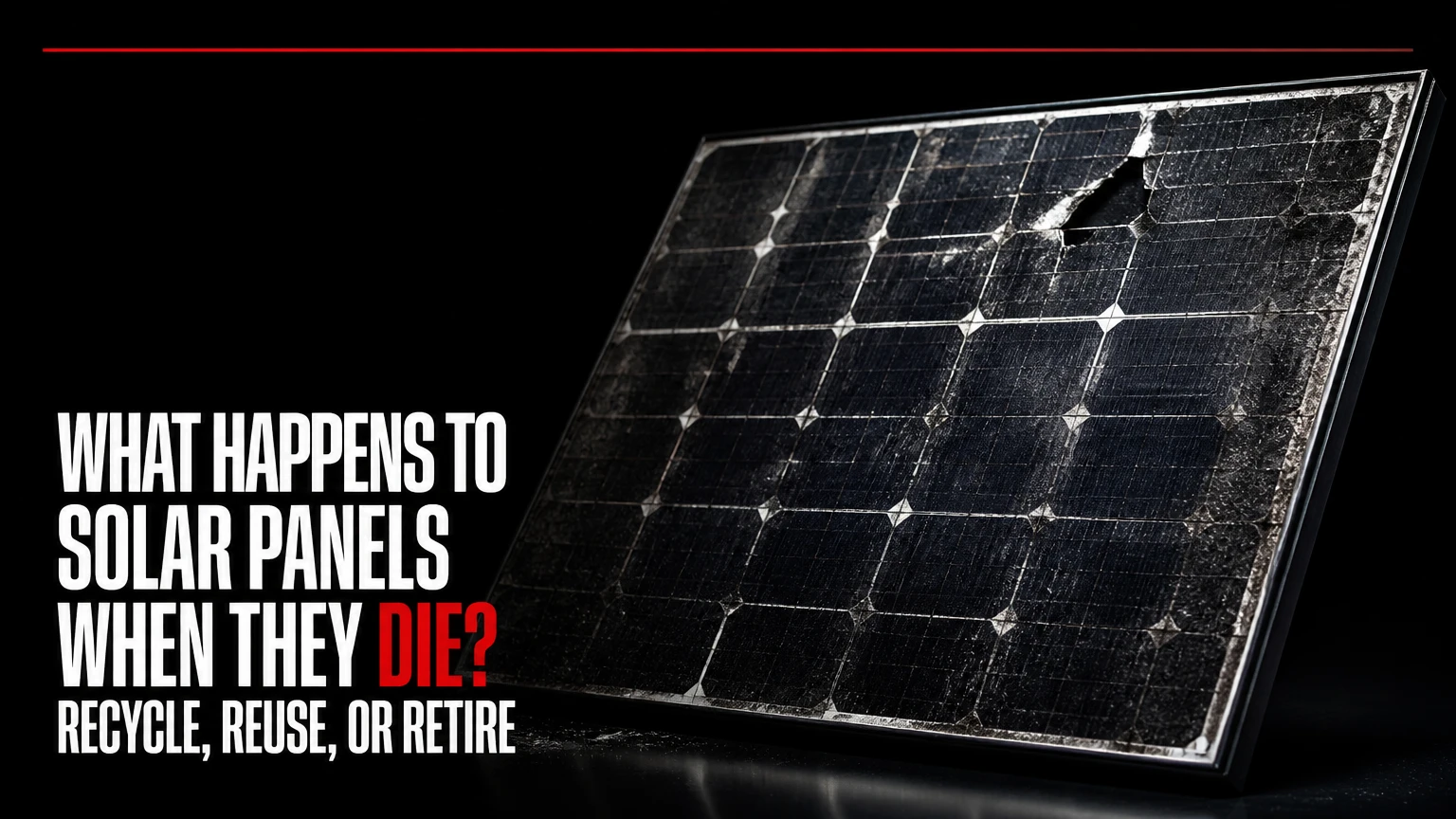
When solar panels die, they usually lose electrical output gradually rather than stop instantly. Ultraviolet exposure, heat cycles, moisture, electrical stress, cracked cells, and corroded connections reduce production until repair, continued use, resale, recycling, or disposal becomes the sensible choice. A panel producing 80% of its original rated power may be degraded, but it is still generating electricity.
Key Facts at a Glance
- Most crystalline-silicon solar panels have a useful service life of approximately 25-35 years.
- A typical photovoltaic module loses about 0.3%-0.8% of its power output per year, depending on design, climate, and installation conditions.
- The common 80% figure is a warranty or economic benchmark, not a universal physical definition of death.
- A functioning old panel can often be reused for low-power loads, sold as tested equipment, or installed in a smaller system.
- Solar panels contain valuable glass, aluminum, silicon, copper, and small quantities of silver, while some thin-film modules contain cadmium compounds.
- Homeowners should never disconnect or remove a photovoltaic module themselves because sunlight can keep exposed conductors energized.
What Does “Dead” Mean for a Solar Panel?
A “dead” solar panel is a module that produces too little power, has unsafe physical damage, or costs more to keep operating than its electricity is worth. Solar professionals use the term in three different ways: below a contractual power guarantee, electrically failed, or economically obsolete.
The 80% threshold needs careful interpretation. A module rated at 400 watts that has degraded to 320 watts still produces electricity, but a manufacturer may define that output as the end of its guaranteed performance period. The panel may remain useful for a shed, battery charger, water pump, or small off-grid load.
The National Renewable Energy Laboratory reported that degradation varies substantially by module technology and climate, with approximately 0.5% annual degradation often used as a planning assumption for crystalline-silicon systems. At that rate, a 400-watt module might produce about 362 watts after 20 years under a simple compound estimate, before accounting for shading, dirt, inverter losses, and weather damage.
What Happens to Output Over Time?
| Module age | Example output at 0.5% annual degradation | Status | Typical decision |
|---|---|---|---|
| New | 400 W | Rated output | Install and monitor |
| 10 years | 380 W | 95% of rating | Continue operating |
| 20 years | 362 W | 90.5% of rating | Continue or repurpose |
| 25 years | 353 W | 88.2% of rating | Compare replacement economics |
| 40 years | 327 W | 81.7% of rating | Test, reuse, or retire |
The table is a planning illustration, not a guarantee. A hot roof, poor ventilation, salt exposure, snow loading, or a defective batch can produce faster deterioration.
How Do Solar Panels Die?
Solar panels die when materials inside the module lose optical, mechanical, or electrical performance. The main mechanisms are ultraviolet degradation, thermal cycling, moisture ingress, cell cracking, corrosion, potential-induced degradation, and failures in the junction box or bypass diodes.
A photovoltaic module is a laminated stack. Tempered glass protects the front, an encapsulant holds the cells in place, silicon cells convert light, conductors carry current, and a backsheet or second glass layer protects the rear. Repeated heating and cooling expand these materials at different rates, creating stress at solder joints and cell connections.
Moisture is especially damaging after the encapsulant, edge seal, or backsheet loses integrity. Corrosion increases resistance, reduces current flow, and can create hot areas that accelerate nearby damage. The International Electrotechnical Commission addresses design qualification and testing for crystalline-silicon modules through IEC 61215, but qualification testing does not guarantee that every module will reach the same field life.
Which Parts Usually Fail First?
| Failure mechanism | Visible or measured symptom | Main consequence | Possible response |
|---|---|---|---|
| Encapsulant yellowing | Brown or yellow laminate | Lower light transmission | Continue if output remains safe |
| Delamination | Cloudy or lifting layers | Moisture and insulation risk | Professional inspection |
| Cell microcracks | Hotspots or irregular current | Local heating and lower output | Replace affected module |
| Backsheet cracking | White lines or brittle rear layer | Moisture and shock risk | Isolate and replace |
| Junction-box failure | Zero or intermittent output | Open circuit or arcing risk | Qualified repair assessment |
| Potential-induced degradation | String output falls unevenly | Reduced voltage and power | Test system and investigate |
A panel with a small cosmetic stain is not automatically unsafe. A panel with exposed conductors, severe delamination, a burned junction box, or large hotspots requires isolation by a qualified technician.
Does 80% Mean a Panel Is Dead?
An 80% power rating means a panel has reached a common warranty endpoint, not that it has stopped working. A 400-watt module at 80% still produces approximately 320 watts under the same test conditions, so the correct decision depends on safety, replacement cost, available roof space, and the value of its remaining electricity.
Manufacturers commonly provide a product warranty and a separate performance warranty. The product warranty covers manufacturing defects for a stated period, while the performance warranty establishes a minimum retained output after a specified number of years. Warranty language differs by manufacturer and model.
A useful field decision compares lost production with replacement cost. Replacing a 400-watt module that has fallen from 400 to 330 watts may add only 70 watts of capacity, while a modern replacement may create mismatch issues in a string inverter system. A microinverter or module-level power electronics system can make replacement more practical.
Practitioner rule: never condemn a module from its age or nameplate percentage alone. Compare measured current, voltage, insulation resistance, thermographic condition, and the output of neighboring modules.
Why Did the Panel Stop Suddenly?
A sudden loss of output is more often caused by the inverter, isolator, fuse, wiring, monitoring equipment, shading, or a bypass diode than by normal panel degradation. Gradual degradation reduces production over months or years; a sudden zero reading points toward a discrete system fault.
A qualified technician should compare the affected module or string with adjacent strings under similar sunlight. The technician may inspect inverter fault codes, DC voltage, connector condition, fuses, insulation resistance, and thermal images. Owners should not open connectors or test live DC circuits.
| Symptom | More likely cause | Panel status | Appropriate action |
|---|---|---|---|
| Entire system shows zero | Grid outage or inverter shutdown | Often still functional | Check monitoring and inverter code |
| One string is low | Fuse, connector, shading, or wiring fault | Uncertain | Electrical diagnosis |
| One module is low | Diode, cell, connector, or crack failure | Possibly failed | Module-level testing |
| Brown hotspot | Cracked cell or high-resistance connection | Potentially unsafe | Isolate and inspect urgently |
| Cloudy laminate | Delamination or moisture ingress | Degraded or unsafe | Plan professional replacement |
| Lower output only in heat | Thermal derating or ventilation issue | Usually functional | Check temperature and inverter |
Replacing a panel before diagnosing the system can waste money. A failed bypass diode may be repairable, while a failed inverter can make an entire healthy array appear dead.
Do All Panel Types Die the Same Way?
Crystalline-silicon modules generally degrade slowly and follow established glass, aluminum, silicon, copper, and polymer recycling routes. Cadmium telluride and copper indium gallium selenide thin-film modules use different semiconductor layers, so their collection and chemical processing requirements differ.
| Panel type | Typical field life | Typical degradation range | End-of-life consideration |
|---|---|---|---|
| Monocrystalline silicon | 25-35 years | 0.3%-0.6% per year | High-volume glass and aluminum recovery |
| Polycrystalline silicon | 20-30 years | 0.4%-0.8% per year | Similar processing to monocrystalline modules |
| Cadmium telluride thin-film | 20-30 years | 0.3%-0.6% per year | Specialized collection and semiconductor recovery |
| CIGS thin-film | 20-30 years | 0.4%-1.0% per year | Copper, indium, gallium, and selenium separation |
| Glass-glass silicon | 30-40 years possible | 0.2%-0.5% per year | Durable design, but delamination is harder to process |
Thin-film modules should not be treated as ordinary glass scrap. The U.S. Environmental Protection Agency notes that some solar panels may be regulated as hazardous waste because of lead or cadmium, although the classification depends on the module and the jurisdiction.
Can a Dead Solar Panel Be Reused or Sold?
A panel that still passes electrical and insulation tests can often be reused or sold, even when it no longer meets a new-system warranty threshold. Reuse usually preserves more value than recycling because the buyer receives a complete generating device rather than separated commodities.
Second-life panels are suitable for applications where low cost matters more than maximum wattage. Examples include a 12-volt battery charger, electric fencing, remote telemetry, agricultural pumps, lighting, and small workshops. They are less suitable for a code-compliant rooftop expansion if the voltage, current, dimensions, or connector type do not match the existing array.
A responsible seller should disclose the model number, age, measured open-circuit voltage, operating current, visible damage, and test conditions. Do not advertise a module as “400 watts” if testing shows 320 watts under comparable conditions.
| Second-life use | Typical power demand | Suitable panel condition | Main limitation |
|---|---|---|---|
| Electric fence energizer | 5-20 W average | Intact glass and stable output | Needs a charge controller |
| Remote lighting | 10-100 W daily load | 60% or more retained output | Battery sizing matters |
| Small water pump | 50-300 W | Tested current and voltage | Starting current can be high |
| Shed battery charging | 50-500 W | No hotspots or insulation faults | Requires compatible controller |
| Utility-scale repowering | 300-600 W per module | Matched electrical characteristics | Old modules may lack warranty |
Reuse is a poor choice for a panel with exposed wiring, shattered glass, severe delamination, burn marks, or insulation failure. A cheap module is not a bargain if it creates a fire or shock hazard.
What Happens at a Solar Panel Recycling Facility?
Solar panel recycling begins with inspection, safe electrical handling, frame and junction-box removal, size reduction or delamination, and separation of glass, polymers, metals, and semiconductor materials. Advanced facilities may use thermal and chemical processes to recover higher-purity silicon, copper, silver, or thin-film compounds.
The material mix explains the economics. A typical crystalline-silicon module is mostly glass by weight, followed by polymer encapsulant, aluminum, silicon, copper, and small quantities of silver. Glass and aluminum are comparatively easy to recover, while separating bonded silicon cells from polymers requires more energy and specialized equipment.
How Are Solar Panels Recycled?
- Receive and classify the module. The recycler records the chemistry, manufacturer, damage condition, and regulatory category.
- Make the module safe. Technicians isolate electrical leads and manage broken glass, sharp frames, and possible hazardous constituents.
- Remove the frame and junction box. Aluminum enters a metal stream, while copper cables and electrical components are separated.
- Separate the laminate. Crushing, heating, or mechanical delamination breaks the bond among glass, encapsulant, cells, and backsheet.
- Sort the material fractions. Screens, magnets, eddy-current separators, and optical systems separate glass, ferrous metals, nonferrous metals, and plastics.
- Recover specialty materials. Chemical or thermal treatment may extract silicon, silver, copper, or thin-film semiconductor compounds.
- Document the final destination. A responsible recycler records whether materials became cullet, metal feedstock, aggregate, new components, or residual waste.
Recycling claims need a defined denominator. “95% recovered” may mean 95% of the glass stream by mass, not 95% of the original module converted into new photovoltaic cells.
| Material in a typical silicon module | Approximate share by weight | Common recovery route | Value or difficulty |
|---|---|---|---|
| Glass | 70%-80% | Cullet, fiberglass, containers | High mass, lower unit value |
| Aluminum | 8%-12% | Secondary aluminum smelting | Established recovery market |
| Polymers | 5%-10% | Energy recovery or residual waste | Difficult to separate cleanly |
| Silicon | 3%-5% | Cell or metallurgical recovery | Purity determines value |
| Copper | 1%-2% | Nonferrous metal recycling | Relatively recoverable |
| Silver and other metals | Less than 0.1% | Specialized refining | High value, low mass |
The IEA Photovoltaic Power Systems Programme identifies recycling, repair, reuse, and design for disassembly as parts of a broader photovoltaic circular-economy strategy. Recycling prevents material loss, but current facilities do not always return recovered silicon directly to new solar cells.
How Much Does End-of-Life Solar Panel Management Cost?
Typical residential end-of-life costs range from about $20-$60 per panel for basic handling to $100-$300 per panel when removal, transport, testing, and specialized recycling are included. Large commercial projects can reduce the per-panel cost through palletized transport, contracted take-back programs, and centralized processing.
These are practical planning ranges, not universal prices. Roof access, labor rates, panel weight, distance to a recycler, broken glass, local hazardous-waste rules, and the number of modules can change the invoice substantially.
| Service | Typical residential range | Typical time | What the price includes |
|---|---|---|---|
| Output and safety inspection | $150-$400 per visit | 1-3 hours | Testing and fault diagnosis |
| Module removal | $20-$75 per panel | 10-30 minutes each | Labor after system shutdown |
| Local transport | $100-$500 per load | Same day to 1 week | Packaging and short-distance haul |
| Recycling fee | $20-$100 per panel | 1-4 weeks | Processing, excluding difficult freight |
| Full replacement visit | $250-$900 plus equipment | 1 day | Removal, new installation, commissioning |
A recycling fee that exceeds the resale value can still be environmentally preferable to landfill disposal. Ask whether the quote covers downstream recycling, because a collection company may transfer modules to another processor.
Can Solar Panels Go in a Landfill?
Solar panels should not be placed in household trash, mixed scrap metal, or an ordinary glass recycling bin. Whether a panel may legally enter a landfill depends on its chemistry, failed-waste testing, and local rules, while some jurisdictions require separate collection or producer responsibility.
The European Union classifies photovoltaic panels within the Waste Electrical and Electronic Equipment framework, which creates collection and treatment obligations for covered equipment. In the United States, EPA guidance explains that discarded panels may be regulated under federal hazardous-waste rules or state-specific requirements, depending on the materials and test results.
Landfill disposal also loses aluminum, glass, silicon, copper, and silver that required energy and mining to produce. Broken modules can release lead-containing solder or cadmium compounds under inappropriate handling conditions, although the actual environmental risk depends on module construction and landfill controls.
What Rules Apply in Different Locations?
| Location | Main framework or authority | Typical requirement | Owner action |
|---|---|---|---|
| European Union | WEEE Directive | Separate collection and treatment | Use approved WEEE channel |
| United States | EPA and state agencies | Rules vary by chemistry and state | Check state waste authority |
| United Kingdom | WEEE Regulations | Producer responsibility and approved treatment | Use authorized collector |
| Australia | State and territory systems | Rules vary by jurisdiction | Ask council or licensed recycler |
| Canada | Provincial stewardship programs | Province-specific collection | Check provincial program |
A recycler should provide its legal business name, accepted module types, destination facility, and a receipt or material-tracking document. Those records matter for commercial operators, warranty claims, environmental reporting, and property transactions.
Should You Repair, Replace, Reuse, or Recycle?
Repair the surrounding system when the panel is healthy, replace the module when damage is localized and unsafe, reuse it when output remains stable, and recycle it when testing shows a dangerous or uneconomic module. The best pathway depends on fault type rather than age alone.
Repair the System When
- The inverter reports a fault while neighboring modules perform normally.
- A loose mounting component or cable causes intermittent production.
- Shading, vegetation, dirt, or a failed optimizer explains the low output.
- A qualified technician identifies a replaceable junction-box or diode problem.
Replace the Module When
- Thermal imaging finds a persistent hotspot.
- Glass is shattered or the backsheet exposes electrical insulation.
- Delamination admits moisture around active cells.
- The module has failed insulation testing or creates an arc-fault risk.
Reuse or Sell the Module When
- The glass, frame, junction box, and cables remain intact.
- Voltage and current measurements are documented.
- The buyer accepts the reduced output and connector specification.
- The installation complies with local electrical and structural rules.
Recycle the Module When
- Repair costs exceed the module’s remaining value.
- No safe second-life application exists.
- The panel contains damaged thin-film semiconductor layers.
- The module fails electrical safety tests or has severe physical damage.
Safe Removal and Transport Rules
Solar panel removal requires a qualified solar electrician or installer because photovoltaic modules produce DC voltage whenever light reaches them. Turning off the inverter does not automatically make rooftop modules or their conductors safe.
Before collection, keep modules intact where possible. Do not smash glass to reduce volume, cut energized cables, stack loose panels face-to-face without separators, or leave modules in direct public access. Covering a panel can reduce generation during handling, but covering alone is not an electrical isolation procedure.
Use a recycler or installer that can answer four questions:
- Does the company accept crystalline-silicon and thin-film modules?
- Does the quoted fee include transport and downstream processing?
- Will the company provide a receipt or recycling certificate?
- Does the company follow local hazardous-waste and electrical-safety rules?
Common Mistakes That Increase Waste
Replacing by calendar age alone: A 15-year-old panel can still produce useful power. Test output before retirement.
Confusing inverter failure with panel failure: A dead inverter can make every panel appear inactive. Read fault codes and compare DC measurements.
Selling without electrical data: A buyer needs real voltage, current, dimensions, connectors, and measured condition.
Breaking modules before transport: Crushing creates mixed glass, polymer, and metal waste and can reduce material recovery options.
Mixing panels with scrap metal: Aluminum frames may be recyclable, but complete modules contain laminated materials and electrical components.
Ignoring roof and mounting hardware: End-of-life work includes rails, clamps, cable management, optimizers, inverters, and batteries, each with separate recycling routes.
The End-of-Life Decision Path
Start with diagnosis, not disposal. Confirm whether the problem affects one module, a string, the inverter, or the entire array, then record the panel model, installation year, warranty terms, physical condition, and measured output.
Next, compare four values: repair cost, replacement cost, remaining annual electricity value, and safe resale or recycling cost. A module operating at 88% with no safety defect may be more valuable in service than after recycling, especially where labor and freight dominate the economics.
Finally, choose a documented pathway. Reuse preserves the most embedded manufacturing value, recycling recovers materials when reuse is unsafe or impractical, and landfill disposal should be treated as a last-resort route permitted only after local classification requirements are satisfied.
Frequently Asked Questions
Do Solar Panels Stop Producing Electricity After 25 Years?
No. Twenty-five years is commonly associated with performance warranties, not an automatic shutdown date. A crystalline-silicon panel may continue producing electricity for 30 years or longer, although output can fall because of encapsulant aging, cell cracks, corrosion, and electrical losses. Safety defects matter more than age alone.
Are Old Solar Panels Worth Anything?
Old solar panels may have resale value if their glass, frame, junction box, and electrical insulation remain intact. Buyers typically pay based on tested wattage, model compatibility, age, shipping cost, and quantity. A documented 300-watt output is more useful than an unsupported claim that an old 400-watt panel is still fully rated.
Can a Cracked Solar Panel Still Work?
A cracked panel can still produce electricity, but cracks may isolate cells and create localized hotspots. Small cell cracks require professional testing, while shattered glass, exposed conductors, burn marks, or moisture inside the laminate justify immediate isolation and replacement. Do not glue a damaged module and return it to a rooftop circuit.
Are Solar Panels Hazardous Waste?
Some discarded solar panels qualify as hazardous waste under applicable rules because they may contain lead or cadmium, while others do not after regulatory testing. The answer depends on panel chemistry and jurisdiction. EPA recommends checking federal, state, and local requirements before disposal rather than assuming every module has the same classification.
What Happens to Solar Panel Frames and Inverters?
Aluminum frames usually enter established metal-recycling streams after removal. Inverters, optimizers, batteries, cables, and junction boxes are separate electrical products and should not automatically follow the module’s route. A decommissioning contractor should inventory each component and identify its appropriate electronics, battery, or metal processor.
Is Recycling Better Than Reusing a Solar Panel?
Reuse is usually preferable when a panel passes safety testing because it preserves the complete product and avoids additional manufacturing. Recycling is better when the panel has shattered glass, insulation failure, severe delamination, dangerous hotspots, or no practical buyer. The environmentally strongest choice is safe continued operation followed by documented material recovery.
The Bottom Line
What happens to solar panels when they die depends on how they failed. A low-output but safe module may continue operating or serve a second-life application, while a cracked, delaminated, overheated, or electrically unsafe panel should be professionally removed and sent through an approved recycling or waste-management route. The 80% threshold signals declining economic performance, not instant physical death.