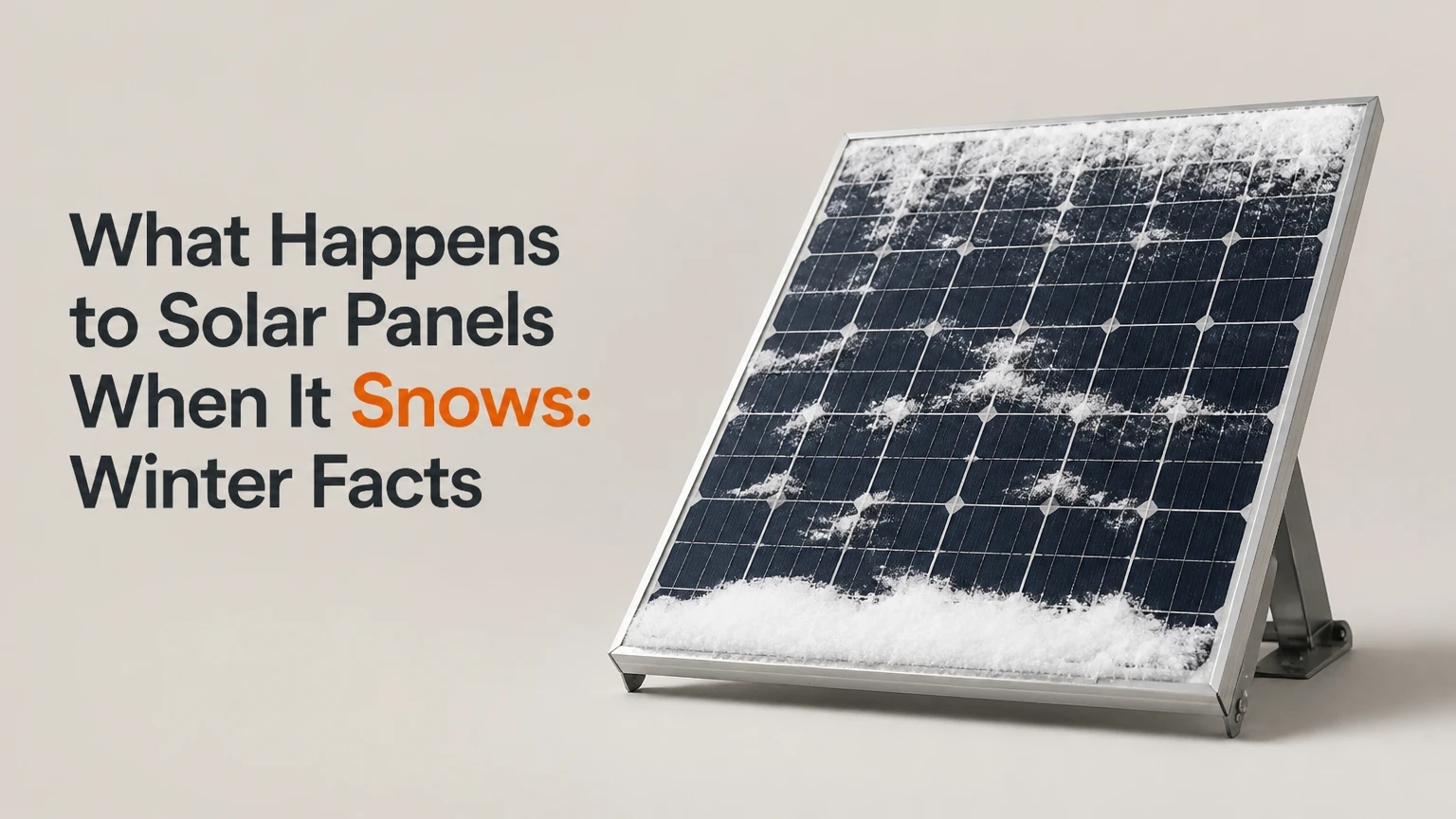
Solar panels usually keep working during snow and cold weather, but snow covering their glass temporarily reduces or stops electricity production by blocking sunlight. Clear panels can operate efficiently in cold air, and reflected light from surrounding snow can help, yet neither benefit offsets a fully covered photovoltaic module.
Key Facts at a Glance
- Snow on a solar panel reduces output according to its coverage, thickness, density, and persistence.
- A fully covered panel may produce little or no useful electricity until light reaches the cells.
- Cold photovoltaic cells generally produce higher voltage than hot cells, although cold does not create sunlight.
- Snow often slides from tilted panels after partial melting, but wind, ice, panel frames, and roof pitch determine whether shedding occurs.
- Owners should not climb onto a snow-covered roof or scrape panels with metal tools.
- Annual snow-related losses vary substantially because snow duration matters more than snowfall totals alone.
Do Solar Panels Work When Snow Is on Them?
Solar panels work through winter, but their output depends on whether sunlight reaches the photovoltaic cells. A thin, translucent layer may allow limited generation, while wet snow, compacted snow, or an ice crust can block nearly all usable irradiance.
Solar modules do not need warm weather to generate electricity. Photovoltaic cells respond to photons, so a cold, sunny panel can produce power even when outdoor temperatures are below freezing. The panel’s inverter, cables, batteries, and roof access can still impose separate cold-weather limitations.
The Energy Department’s Federal Energy Management Program identifies winter weather as a resilience concern because snow, ice, wind, and extreme cold can affect both photovoltaic modules and balance-of-system equipment. That distinction matters: “solar panels work in winter” describes the technology, not guaranteed production after every storm.
How Much Does Snow Reduce Solar Output?
| Panel condition | Approximate light access | Typical immediate effect | Main determining factor |
|---|---|---|---|
| Frost or thin dusting | 70-100% | 0-15% reduction | Frost opacity and cell temperature |
| Loose powder, partial coverage | 20-70% | 15-80% reduction | Coverage pattern and string layout |
| Wet snow, 1-2 inches | 0-30% | 70-100% reduction | Density and transparency |
| Compact snow or ice crust | 0-10% | 90-100% reduction | Adhesion and thickness |
| Complete opaque coverage | 0-5% | Near-zero useful generation | No direct irradiance at cells |
These ranges are practical operating estimates, not a universal performance standard. Snow texture, solar angle, module spacing, bypass-diode design, and whether the array uses microinverters all change the measured result. A two-inch threshold can be useful as a warning, but no thickness guarantees exactly 100 percent blockage on every module.
A snowstorm can therefore cause a sharp daily loss without causing an equivalent annual loss. If sun, wind, and panel heat clear the array by midday, the system may lose only the morning’s production. If snow remains for four cloudy days, the energy loss becomes much larger.
Why Can Cold Solar Panels Be More Efficient?
Cold photovoltaic cells generally produce more voltage because semiconductor voltage falls as cell temperature rises. Most modules use a temperature coefficient listed on their datasheet, commonly around -0.25% to -0.40% per degree Celsius for maximum-power voltage, although the exact coefficient varies by technology and model.
Standard Test Conditions rate modules at 25°C cell temperature, 1,000 watts per square meter of irradiance, and a defined air-mass spectrum. Actual winter cells can be colder or hotter than the surrounding air because sunlight, wind, mounting, and dark surfaces change cell temperature.
| Operating condition | Cell temperature example | Electrical consequence | Practical interpretation |
|---|---|---|---|
| Hot summer roof | 55-70°C | Lower voltage | Heat reduces voltage efficiency |
| STC reference | 25°C | Nameplate comparison point | Laboratory rating condition |
| Clear winter day | 0-25°C | Higher voltage than STC | Cold can improve conversion performance |
| Snow-covered module | -5 to 10°C | Potentially favorable voltage | Blocked light still limits current |
| Cold, shaded module | -15 to 5°C | High voltage, little current | Voltage alone does not mean useful output |
The important electrical rule is that photovoltaic power depends on both voltage and current. Cold may improve voltage, but snow reduces current by blocking photons. A clear winter panel can outperform expectations per unit of sunlight; a covered panel cannot use that advantage.
Does Snow Reflect More Sunlight Onto Panels?
Snow-covered ground can reflect substantial sunlight toward a panel, a phenomenon called albedo. The reflected contribution is strongest when the ground is clean and bright, the panel is elevated, and the sun reaches the surrounding snow at a favorable angle. Sources commonly cite reflectance values approaching 80 percent for bright snow surfaces, but actual array gain is lower and site-specific.
Reflected light does not melt a thick opaque snow layer reliably. It helps only when the module surface is already clear or partially clear. A steep, unobstructed bifacial array may benefit more because bifacial modules collect light from the rear, whereas a conventional front-only rooftop module receives little useful advantage from rear reflection.
How Does Snow Leave a Solar Panel?
Snow leaves a solar panel through gravity, wind, warming, sliding, and meltwater, often in combination. A dark module may warm above air temperature in sunlight, but the panel does not always heat evenly enough to release a bonded snow layer.
The common sequence is:
- Sunlight warms exposed glass and uncovered cells.
- Meltwater forms between the snow layer and glass or frame.
- Gravity pulls the weakened layer downward.
- Wind or vibration initiates movement.
- The snow slides, breaks apart, or remains trapped at the lower frame.
The AI Overview’s “cell self-heating followed by avalanche shedding” model is too definite. A covered module receives little sunlight, so it cannot be assumed to heat rapidly from -5°C to +10°C or shed the entire snowpack in one hour. Snow may slide from a 40-degree array under favorable conditions, while wet snow can remain bonded on a steeper array after refreezing.
Which Conditions Encourage Natural Shedding?
| Condition | Shedding tendency | Main risk | Owner response |
|---|---|---|---|
| Dry powder, 30-45° tilt | High after wind or sun | Falling snow below array | Keep paths and gutters clear |
| Wet snow, 20-35° tilt | Moderate to low | Heavy static load | Monitor load and accumulation |
| Ice crust, under 20° tilt | Low | Bonded weight and refreezing | Use installer assessment |
| Clear sun after storm | Moderate to high | Sudden slide | Keep people away from drip line |
| Freeze-thaw cycle | Variable | Ice dams and frame blockage | Inspect from ground level |
| Flat commercial roof | Low without design measures | Persistent drift accumulation | Follow structural snow plan |
Panel tilt is only one variable. Module frame geometry, rail position, roof friction, snow guards, wind exposure, and nearby obstructions can prevent movement. Snow guards may improve pedestrian safety by restraining sliding snow, but they can also increase retention and load near the lower edge.
Should You Remove Snow From Solar Panels?
Most homeowners should allow light snow to clear naturally rather than manually cleaning a roof-mounted array. Snow removal becomes more reasonable when a system is off-grid, a storm has created prolonged coverage, the array is ground-mounted, or an installer has provided a safe maintenance method.
Never trade a few hours of generation for a fall hazard. Roof pitch, ice, hidden skylights, brittle snow crust, and energized equipment make rooftop access dangerous even when the panels look intact.
What Is the Safest Removal Method?
A soft, non-abrasive solar snow rake operated from the ground is generally safer than climbing onto the roof. Use a tool designed for photovoltaic glass, keep the rake head parallel to the module surface, and pull loose snow downward without striking the glass or forcing material under the frame.
| Method | Typical cost | Best use | Main limitation |
|---|---|---|---|
| Natural shedding | $0 | Light snow and grid-connected homes | May take 1-5 days |
| Ground-based foam rake | $30-$75 | Accessible low roof or ground array | Reach and leverage limits |
| Soft solar brush | $25-$80 | Loose powder and light frost | Poor against bonded ice |
| Professional service | About $0.50-$1.00/ft² typical | High, steep, or critical arrays | Availability and access cost |
| Electrical snow-melting system | Hundreds to thousands per array | Specialized new installations | Energy use and refreezing risk |
Do not use a metal shovel, hard broom, car ice scraper, pressure washer, or hot water. Metal can scratch anti-reflective glass, pressure can damage seals, and hot water can create thermal shock in cold tempered glass. Chemical de-icers can attack seals, coatings, roofing materials, or vegetation.
A practitioner rule is simple: remove loose snow only when you can do so from the ground without contact force. Ice is an installer problem.
What Happens When Only Part of a Panel Is Covered?
Partial snow coverage can reduce output more than the visible covered area suggests because photovoltaic cells are electrically connected in groups. A shaded cell group can activate a bypass diode, reducing the voltage contribution of that section and sometimes reducing the output of the entire module.
String inverters connect multiple modules to a shared maximum-power-point tracker. A heavily shaded module can influence the operating point of neighboring modules, although modern inverter algorithms and bypass diodes limit some losses. Microinverters isolate module-level power conversion, which can reduce cross-module impact, but they cannot make a covered module produce sunlight.
| System architecture | Snow effect on one module | Monitoring detail | Best winter advantage |
|---|---|---|---|
| String inverter | Can affect string operating point | Array or string data | Lower equipment cost |
| Power optimizers | Module-level optimization with central inverter | Module-level data varies by platform | Better shade visibility |
| Microinverters | Mostly isolated to covered module | Module-level production | Easier fault identification |
| Battery-backed off-grid system | Lost production also reduces charging | State of charge and load data | Better resilience planning |
A narrow snow stripe across the lower edge is not automatically a dangerous hot spot. Bypass diodes are designed for partial shading, but repeated shading, damaged diodes, cracked cells, or poor connectors can create faults. Monitor output and inspect abnormal behavior instead of scraping aggressively.
Can Snow Damage Solar Panels or the Roof?
Normal design snow loads should not damage a properly installed solar array, but the module rating does not prove that the roof, attachment points, rails, or local structure can carry every snow condition. Manufacturers commonly publish front-load ratings around 2,400 pascals, approximately 50 pounds per square foot, but ratings differ and installation rules determine the allowable site load.
The AI Overview’s claim that all tier-one modules handle 20-50 pounds per square foot is too broad. A module’s certification may describe test pressure, while local building codes, wind exposure, drift accumulation, rail spans, and attachment spacing govern the installed system.
| Component or condition | What to verify | Typical consequence if ignored |
|---|---|---|
| Module front-load rating | Datasheet value in pascals | Glass or frame damage |
| Rail span | Installer structural plan | Rail deflection |
| Roof framing | Local snow-load calculation | Roof stress |
| Attachment flashing | Seal and fastener condition | Water intrusion |
| Snow drift zone | Roof geometry and nearby walls | Concentrated load |
| Lower-edge ice | Drainage and frame clearance | Refreezing and leakage |
Snow can also damage adjacent property when it slides from a steep array. Installers may add snow guards above walkways, entrances, cars, and lower roofs. Guards do not remove the load; they redistribute or retain it, so the racking plan must account for the resulting accumulation.
How Should You Read Winter Solar Performance?
Compare winter production with local irradiance and snow duration, not with summer production alone. A December system may produce less energy because days are shorter and the sun is lower, while a clear cold day can still show strong instantaneous efficiency.
Use the monitoring portal to separate three patterns:
- Storm-related loss: output falls during snowfall and recovers after clearing.
- Seasonal loss: output follows shorter days, lower sun angle, and cloud cover.
- Equipment fault: output stays abnormal after the array is visibly clear.
Snow-related annual losses can range from approximately 1 percent to more than 10 percent in snowy regions, but the range is not a universal benchmark. The Sandia National Laboratories snow-photovoltaic research literature emphasizes that snow loss depends on snow depth, irradiance, module tilt, climate, and the duration of coverage.
What Should Off-Grid Owners Do After a Storm?
Off-grid owners should treat snow as a battery-management issue, not only a panel-maintenance issue. Check state of charge, essential loads, generator readiness, and the number of clear hours expected before deciding whether safe ground-level clearing is worthwhile.
A practical sequence is:
- Confirm whether the array is producing any power.
- Reduce nonessential loads if battery state of charge is falling.
- Check for a safe, reachable clearing method.
- Clear only loose snow from a ground position.
- Start backup generation before low-voltage protection disconnects loads.
- Recheck charging current after sunlight returns.
A steep winter tilt can improve shedding and low-sun capture, but a fixed angle cannot eliminate snow retention. Variable ground racks add mechanical complexity, wind exposure, and maintenance requirements, so they make most sense where winter energy has high operational value.
What Changes on Commercial or Flat Roof Arrays?
Commercial flat-roof arrays need a site-specific snow and drift plan because low tilt reduces natural shedding and roof parapets can create deeper drifts. Operators should follow the structural engineer’s snow-load limit, inspect drains, and coordinate any removal with electrical and fall-protection procedures.
Electrical heating systems that reverse current through a module are specialized equipment, not a routine homeowner solution. They consume energy, can create uneven melting, and may leave refreezing at frames or lower edges. Snow retention, vertical module layouts, or planned access paths may be more reliable design responses for some facilities.
How Do You Troubleshoot Zero Output After Snow?
Zero output during complete coverage is normal; zero output after the array is clear is not automatically normal. First verify sunlight, module visibility, inverter status, grid availability, and monitoring timestamps before resetting equipment.
| Symptom | Likely explanation | Safe check | Escalation point |
|---|---|---|---|
| Zero output during storm | Opaque snow coverage | View array from ground | Wait for clearing |
| Low output after partial clearing | Remaining snow or shade | Compare visible coverage | Monitor one daylight cycle |
| Inverter fault code | Grid, insulation, or equipment issue | Record exact code | Contact installer |
| Repeated restart cycles | Low irradiance or electrical fault | Check status log | Service diagnosis |
| Ground fault after melt | Moisture or damaged wiring | Do not open equipment | Qualified electrician |
| One module underperforming | Snow, optimizer, or module fault | Use monitoring data | Installer inspection |
Do not open junction boxes, disconnect energized connectors, or force a reboot repeatedly. If an inverter reports a ground fault, arc fault, insulation fault, or water intrusion, turn to the manufacturer procedure and installer support. Binocular inspection from the ground can identify displaced cables, broken glass, or warped frames without creating a fall risk.
Which Winter Strategies Fit Different Users?
| User situation | Recommended strategy | Avoid | Decision trigger |
|---|---|---|---|
| Grid-connected homeowner | Natural clearing and monitoring | Roof climbing | Array clears within several days |
| Low-slope rooftop owner | Installer assessment and safe rake plan | Metal scraping | Snow remains bonded |
| Off-grid cabin | Ground array, backup generation, battery reserve | Waiting until battery cutoff | Forecast shows prolonged cloud |
| Farm or business | Structural plan and drain inspection | Unplanned crew access | Drift or roof-load alert |
| New snowy-climate installation | Snow-load design, tilt, access, guards | Generic rack selection | Local code review |
Snow guards deserve special attention. They protect people and property from sudden slides, but they can reduce self-shedding and increase snow retention above the guard. Place them through an engineered design rather than adding hardware after observing one storm.
Common Snow Maintenance Mistakes
Scraping the glass
Hard tools can create scratches that scatter light and weaken the surface. A visible scratch is also evidence that the cleaning method exceeded the panel manufacturer’s intended maintenance conditions.
Pouring hot water over frozen modules
Hot water can produce rapid temperature differences across tempered glass. The glass may crack immediately, or seals and frames may experience damage during repeated freeze-thaw cycles.
Clearing only the upper modules
Removing snow above a lower frozen ridge can concentrate meltwater and create a block at the frame or gutter. Clear drainage paths only through a safe, manufacturer-approved process.
Assuming a steep panel always sheds
A 40-degree panel often sheds more readily than a 15-degree panel, but ice adhesion, snow guards, wind, and roof obstructions can defeat gravity. Treat tilt as a probability factor, not a guarantee.
Confusing low output with equipment failure
A covered array may show a normal inverter status while producing almost nothing. Diagnose hardware only after checking whether sunlight reaches the modules.
Using electrical heating as a default fix
Reverse-current heating can consume valuable energy and create refreezing problems. It belongs in specialized engineered systems, not as an improvised homeowner modification.
FAQ
Will snow melt faster on black solar panels?
Black solar modules may absorb sunlight efficiently once exposed, which can warm clear areas faster than surrounding snow. A completely covered module receives little direct sunlight, so melting speed depends more on air temperature, sun angle, wind, snow density, and conductive heat from the roof.
Can solar panels heat themselves to remove snow?
Solar panels do not normally use their generated electricity to heat themselves. Specialized reverse-current systems can send electricity through modules for snow melting, but they consume power, require compatible equipment, and can cause uneven melting or refreezing.
Does snow make solar panels more efficient?
Snow does not make a covered panel more efficient. Cold temperatures can improve photovoltaic voltage, and bright snow can reflect additional light onto a clear panel, but those benefits apply only when the cells receive sufficient irradiance.
Should solar panels be installed at a steeper angle in snowy regions?
A steeper angle often improves snow shedding and can improve winter solar access, but the best angle depends on latitude, roof geometry, wind, structural loads, and annual energy goals. Snow guards, nearby obstructions, and ice formation can matter as much as tilt.
Can snow cause solar panels to crack?
Snow alone usually does not crack a correctly installed module within its rated load, but concentrated drifts, impact from falling ice, frame stress, installation defects, and rapid thermal shock can cause damage. Cracked glass requires professional inspection because moisture can reach electrical components.
Do solar batteries solve winter snow losses?
Solar batteries shift energy from sunny periods into later hours, but batteries cannot replace production lost during prolonged panel coverage. Off-grid systems still need load control, adequate storage, and backup generation for extended snow and cloud conditions.
The Bottom Line
What happens to solar panels when it snows depends mainly on coverage duration, snow type, panel tilt, and system design. Snow temporarily blocks photovoltaic production, while cold temperatures and reflected light can improve the performance of clear modules. Most grid-connected owners should monitor the array, avoid unsafe roof access, and allow natural shedding unless a qualified installer recommends another method.
For new installations, specify local snow loads, drainage, access, snow guards, inverter monitoring, and winter energy needs before selecting equipment. For an active system, treat persistent zero output after clearing, cracked glass, ground faults, and damaged wiring as service issues rather than cleaning problems.