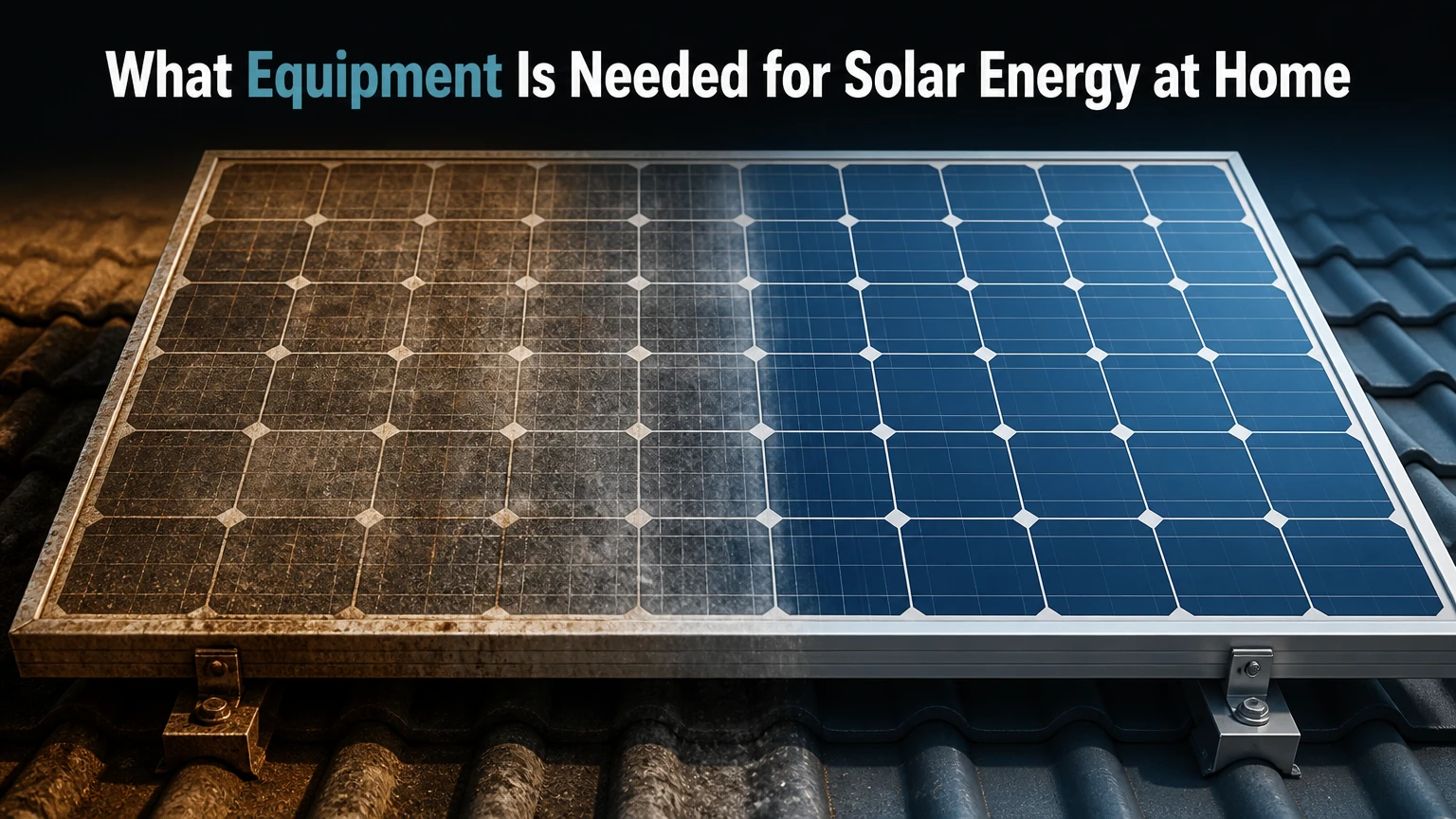
Solar energy systems need solar photovoltaic panels, an inverter, mounting hardware, electrical conductors, disconnects, overcurrent protection, grounding, and monitoring equipment. Grid-tied systems also need utility-interconnection equipment, while hybrid and off-grid systems add batteries and, usually, a charge controller or battery-capable inverter. The exact list depends on whether the system must operate during outages.
Key Facts at a Glance
- Solar panels produce direct-current electricity, while ordinary household circuits normally use alternating-current electricity.
- A grid-tied system usually needs panels, an inverter, racking, wiring, disconnects, protection equipment, and a utility meter.
- Batteries are optional for bill reduction but necessary for solar power during a normal grid outage.
- A battery’s usable energy is lower than its nameplate capacity because manufacturers specify operating limits and reserve capacity.
- Solar panels commonly carry 25-30-year performance warranties, while many string inverters have shorter replacement horizons.
- Electrical code, utility interconnection rules, roof structure, shading, and local weather determine the final equipment specification.
What Equipment Is Needed for Solar Energy?
A complete residential solar installation contains four equipment groups: generation, power conversion, electrical infrastructure, and control or monitoring hardware. The minimum grid-connected package normally includes PV modules, an inverter, roof or ground racking, DC and AC wiring, disconnects, breakers, grounding, surge protection, and a bidirectional utility meter.
A battery system adds a battery enclosure, battery-management system, compatible inverter or charge controller, communications wiring, and a method for isolating backup circuits from the utility grid. An off-grid installation also needs energy-management controls and a backup source, such as a generator, when prolonged cloudy weather could exhaust stored energy.
The U.S. Department of Energy explains that photovoltaic cells convert sunlight directly into electricity through semiconductor materials, usually silicon. The panel is therefore only the generator. The inverter, protection equipment, structure, and operating controls determine whether generated electricity can be used safely in a building.
Core Equipment by System Type
| Equipment | Grid-tied home | Hybrid home | Off-grid cabin |
|---|---|---|---|
| PV modules | Required | Required | Required |
| Inverter type | String or microinverter | Hybrid inverter | Off-grid inverter |
| Battery bank | Optional | Required for backup | Required |
| Charge controller | Usually integrated | Integrated or DC-coupled | Usually required |
| Utility meter | Bidirectional meter | Bidirectional meter | None |
| Backup generator | Optional | Optional | Often recommended |
| Critical-load panel | Not usually needed | Usually needed | Main distribution panel |
How Does Solar Equipment Work Together?
Solar equipment follows a defined energy path: sunlight reaches the PV array, the panels produce DC power, the inverter converts or manages that power, and the electrical panel distributes usable AC power to building loads. Surplus electricity charges a battery or flows through the utility meter to the grid, depending on system design and control settings.
Photons transfer energy to electrons inside semiconductor cells. Internal electric fields direct the resulting charge flow through conductive contacts, producing DC voltage and current. Panels connect in series to increase voltage and in parallel to increase current, but the resulting string must remain within the inverter’s operating voltage and maximum-current limits.
The inverter performs more than DC-to-AC conversion. Its maximum power point tracking function continually adjusts operating voltage to capture the array’s available power as sunlight, module temperature, and shade change. Grid-connected inverters also monitor utility voltage and frequency and disconnect when the grid falls outside permitted conditions. IEEE Standard 1547 governs important interconnection behavior for distributed energy resources in the United States.
The Typical Energy Sequence
- PV modules generate DC electricity.
- String wiring or module electronics collect and condition the output.
- A DC disconnect provides a service-isolation point where required.
- The inverter converts DC to AC or manages DC battery charging.
- An AC disconnect and breakers protect the building-side circuit.
- The main service panel supplies household or site loads.
- Surplus energy charges batteries or passes through a bidirectional meter.
- Backup controls isolate selected circuits during a grid failure.
Electricity does not automatically follow a universal priority of “loads first, batteries second, grid third.” The inverter’s programming, battery state of charge, utility tariff, export rules, and backup reserve setting determine power flow. That distinction matters when a homeowner expects a battery to charge before solar electricity serves daytime loads.
Which Solar Panels Should You Use?
Monocrystalline silicon panels are the usual residential choice because they produce more watts per square meter than older polycrystalline designs. Panel selection should consider rated power, efficiency, temperature coefficient, mechanical load rating, degradation warranty, dimensions, connector type, and whether the roof has enough unshaded area.
Panel efficiency describes the share of incoming sunlight converted under standardized test conditions. It does not equal the percentage of annual sunlight converted on a roof because heat, snow, wiring losses, inverter losses, orientation, and shade reduce real-world output. The National Renewable Energy Laboratory’s PVWatts tool models these site-specific effects rather than treating panel nameplate power as annual energy production.
| Panel type or feature | Typical specification | Best fit | Main limitation |
|---|---|---|---|
| Monocrystalline silicon | 19%-23% module efficiency | Space-constrained roofs | Higher purchase price than basic modules |
| Polycrystalline silicon | Historically 15%-18% efficiency | Older budget installations | More roof area for equal output |
| N-type TOPCon | Often 20%-23% efficiency | New residential projects | Product quality and warranty terms vary |
| Bifacial module | 5%-20% rear-side gain in favorable layouts | Ground mounts with reflective surfaces | Little benefit on opaque, close roof surfaces |
| 400-450 W residential module | Approximately 1.7-2.1 m² per module | Typical home arrays | Large modules can be difficult on complex roofs |
Bifacial modules do not automatically deliver a 10%-20% increase. Rear-side gain depends on ground reflectivity, row spacing, module elevation, shading, and the amount of exposed rear surface. On a dark shingle roof with little rear light, a conventional high-quality module may produce a better value.
How Many Panels Are Needed?
A residential array commonly ranges from 5 kW to 12 kW, but panel count must come from annual energy use, local solar resource, roof geometry, and utility rules. A 7.2 kW array using 400 W modules requires 18 panels before design adjustments.
A practical first estimate is:
Panel count = target array size in watts ÷ panel wattage
Annual production requires a site model. PVWatts accounts for weather data, tilt, azimuth, system losses, temperature, and shading, so a production estimate based only on “sun hours” can materially misstate the required array size.
Which Inverter Does a Solar System Need?
A solar system needs an inverter that matches the array voltage, maximum current, desired backup function, electrical phase, and local interconnection requirements. String inverters centralize conversion, microinverters convert at each module, and hybrid inverters coordinate PV generation, batteries, loads, and the grid.
| Inverter type | Conversion location | Typical warranty horizon | Best application | Important limitation |
|---|---|---|---|---|
| String inverter | One central enclosure | 10-15 years | Simple, unshaded roof | String output can suffer from shade |
| Microinverter | Behind each module | 20-25 years | Multiple roof orientations | More roof electronics and replacement labor |
| Hybrid inverter | Central DC and battery interface | 10-15 years | Battery backup and energy shifting | Requires compatible battery controls |
| Off-grid inverter | Site-level AC bus | 5-15 years | Independent cabins and remote loads | Must handle surge and generator coordination |
String inverters are often economical when modules share a similar orientation and receive consistent sunlight. Microinverters reduce the effect of one shaded or poorly oriented module on neighboring modules, although they do not eliminate shading losses from the affected module itself.
Hybrid inverters can be AC-coupled or DC-coupled. An AC-coupled battery has its own battery inverter, while a DC-coupled design sends PV energy through a shared hybrid inverter before battery storage. The correct architecture depends on retrofit conditions, battery location, backup loads, and whether the system must start without the utility grid.
A common design error is pairing a high-power array with an inverter whose voltage window or current rating is unsuitable. Moderate DC-to-AC oversizing can be intentional, but excessive oversizing causes clipping during high-production periods. The designer should calculate annual clipping, not judge the ratio from a marketing label.
Do Solar Panels Need Batteries?
Solar panels do not need batteries to reduce electricity purchases in a grid-connected system, but batteries are needed to provide solar-powered backup after the utility grid disconnects. A grid-tied inverter normally shuts down during an outage to prevent energized lines from endangering utility workers.
| Battery chemistry | Usable discharge practice | Typical cycle life | Strength | Limitation |
|---|---|---|---|---|
| LFP lithium-ion | Commonly 80%-100% design range | Approximately 4,000-8,000 cycles | Long life and strong thermal stability | Higher upfront cost |
| NMC lithium-ion | Commonly 80%-90% design range | Approximately 2,000-5,000 cycles | Compact and energy dense | More demanding thermal management |
| AGM lead-acid | Commonly about 50% for long life | Approximately 500-1,200 cycles | Lower initial price | Heavy and less usable capacity |
| Flooded lead-acid | Commonly about 50% for long life | Approximately 500-1,500 cycles | Repairable and established | Ventilation and maintenance required |
LFP batteries are widely favored for stationary storage because they combine long cycle life with comparatively stable chemistry. “100% usable” should not be assumed from a product label, however. The battery-management system, inverter reserve, warranty conditions, temperature limits, and emergency shutdown settings determine the energy available to loads.
Battery capacity should be specified in both kilowatt-hours and power output. A 10 kWh battery that can deliver only 5 kW cannot operate a 7 kW motor startup, even though its stored energy may be sufficient for several hours of smaller loads.
How Large Should the Battery Be?
Battery size depends on the loads that must operate, their runtime, and the desired reserve. A refrigerator, internet modem, lighting circuit, and gas furnace controls may require 1-2 kW of continuous power, while a heat pump, electric range, well pump, or air conditioner can sharply increase inverter and battery-power requirements.
Use this basic calculation:
Required battery energy = critical-load watts × backup hours ÷ 1,000 ÷ system efficiency
For example, 1,200 watts of average critical load for 10 hours at 90% overall efficiency requires about 13.3 kWh of nameplate storage before reserve adjustments. Motor starting current and peak loads require a separate inverter surge calculation.
What Balance-of-System Equipment Is Required?
Balance-of-system equipment includes every component that supports, connects, protects, grounds, and controls the PV array. These parts often determine inspection approval and long-term reliability even though they do not generate electricity.
| BOS component | Typical function | Specification to verify | Common failure |
|---|---|---|---|
| Roof attachments and rails | Transfer module loads to structure | Wind, snow, roof type, corrosion rating | Water intrusion or uplift |
| PV wire and connectors | Carry DC current outdoors | Voltage, ampacity, UV rating, connector compatibility | Heat damage or loose connection |
| Combiner box | Combines parallel strings | Fuse size, enclosure rating, SPD provision | Incorrect fuse or moisture entry |
| DC and AC disconnects | Isolate circuits for service | Voltage, current, accessibility, code location | Inaccessible or mismatched switch |
| Grounding and bonding | Reduce shock and fault risk | Equipment grounding conductor and bonding method | Floating metalwork or poor continuity |
| Surge protective device | Divert transient overvoltage | DC or AC rating and installation location | Failure after lightning event |
| Rapid-shutdown equipment | Reduce array voltage during emergency | Module and inverter compatibility | Noncompliant shutdown behavior |
| Monitoring gateway | Reports production and faults | Network, cellular, or local communications | Lost data or unavailable alerts |
PV connectors should not be mixed casually across brands, even when they resemble one another. The connector, crimp, conductor, and tool must form a compatible assembly. Poor crimps create resistance and heat, while incompatible mating pairs can fail after years of thermal cycling.
Roof racking must account for attachment spacing, wind uplift, snow load, roof age, flashing, and structural members. A structurally adequate module array can still damage a roof when attachments are installed outside the manufacturer’s permitted locations.
What Additional Equipment Is Needed for Backup Power?
Backup solar requires an automatic transfer or backup gateway, a battery-capable inverter, a protected critical-load panel, and equipment that prevents unintended grid energization. The system must decide which circuits remain powered because most residential batteries cannot support every electric load indefinitely.
| Backup load | Typical running power | Starting or peak concern | Battery suitability |
|---|---|---|---|
| Refrigerator | 100-300 W | Compressor startup | Usually suitable |
| Internet equipment | 10-40 W | Minimal | Highly suitable |
| LED lighting circuit | 50-300 W | Minimal | Highly suitable |
| Gas furnace blower | 300-800 W | Motor startup | Usually suitable with surge margin |
| Well pump | 700-2,000 W | High motor surge | Requires careful inverter sizing |
| Central air conditioner | 1,500-5,000 W | Very high startup current | Often needs load management |
| Electric water heater | 3,000-5,500 W | Sustained high demand | Usually excluded from small backups |
A critical-load panel is better than connecting every household circuit to a small battery. The electrician can place refrigeration, lighting, communications, medical equipment, and selected outlets on the backed-up panel while leaving electric heating and large resistance loads on the nonbackup panel.
A battery does not guarantee uninterrupted power for every appliance. Backup duration falls rapidly when electric resistance heating, vehicle charging, pool pumps, or air conditioning operate continuously.
What Equipment Is Needed for Off-Grid Solar?
An off-grid solar system needs PV modules, a charge controller or hybrid inverter, a battery bank, an off-grid inverter, distribution equipment, monitoring, and usually a generator. Because no utility can supply energy during a prolonged cloudy period, off-grid systems must be sized for both daily consumption and weather-related autonomy.
| Off-grid design item | Typical planning value | Why it matters |
|---|---|---|
| Battery autonomy | 1-3 days | Covers low-sun periods |
| Inverter continuous rating | 3-12 kW for many cabins | Supports simultaneous loads |
| Inverter surge rating | 2-3 times continuous rating | Starts pumps and compressors |
| Charge-controller input | Array voltage and current matched | Prevents overvoltage or overheating |
| Generator capacity | 5-15 kW typical residential range | Recharges batteries during extended storms |
| Critical load budget | 1-5 kW average depending on site | Controls battery depletion |
Off-grid systems should begin with a load inventory, not a panel purchase. Record each appliance’s watts, operating hours, seasonal use, startup demand, and whether it can be scheduled for sunny periods. Water pumping, refrigeration, communications, and heating controls deserve separate attention because their timing affects both battery size and generator runtime.
A three-day autonomy target is not universally economical. In a mild, sunny location with a reliable generator, one day of storage may cost less than several additional battery modules. In a remote winter property, larger storage and more PV may be justified because fuel delivery and generator maintenance are difficult.
Grid-Tied, Hybrid, or Off-Grid: Which System Fits?
Grid-tied solar is usually the lowest-cost choice for bill reduction, hybrid solar is the practical choice for outage protection, and off-grid solar is appropriate only when grid extension is unavailable or independence has unusually high value. The best configuration follows the required service level rather than the panel technology.
| Decision factor | Grid-tied | Hybrid | Off-grid |
|---|---|---|---|
| Utility connection | Required | Required in most homes | Not required |
| Battery | Optional | Required for backup | Required |
| Normal installed complexity | Low | Medium-high | High |
| Blackout operation | No | Selected circuits or whole home | Yes |
| Typical battery autonomy | 0 hours | 4-24 hours | 1-3 days |
| Generator requirement | Optional | Optional | Often advisable |
| Best economic purpose | Lower bills | Bills plus resilience | Remote power |
| Main constraint | Utility export rules | Equipment compatibility | Energy budgeting |
For a Typical Urban or Suburban Home
Choose a grid-tied system when the utility is reliable and export compensation is favorable. Use a string inverter on a simple, unshaded roof, or microinverters when roof planes face different directions or contain unavoidable shade.
Do not add a battery solely because a salesperson describes it as essential. Battery value depends on outage frequency, time-of-use rates, export compensation, demand charges, and the cost of replacing the battery or inverter.
For a Home With Frequent Outages
Choose a hybrid inverter, LFP battery, backup gateway, and critical-load panel when refrigeration, medical equipment, communications, or heating controls must remain available. Specify continuous power, surge power, battery reserve, and recharge capability rather than comparing storage capacity alone.
For a Remote Cabin or Homestead
Choose an off-grid inverter, MPPT charge controller, appropriately sized LFP bank, ground-mounted or roof-mounted array, generator integration, and a strict load-management plan. Electric heating, large pumps, and vehicle charging can make an off-grid system disproportionately expensive.
How Much Does Solar Equipment Cost?
Typical equipment-only pricing ranges from approximately $0.25-$0.45 per watt for modules, $1,000-$3,500 for a residential inverter, $4,000-$10,000 for 10 kWh of installed-quality lithium storage, and $1,000-$3,000 for racking and BOS hardware. Labor, design, permits, structural work, service upgrades, taxes, and interconnection can exceed the hardware cost.
| Equipment category | Typical equipment-only range | Main price driver | Replacement horizon |
|---|---|---|---|
| PV modules | $0.25-$0.45/W | Wattage, efficiency, warranty | 25-30 years |
| String inverter | $1,000-$3,500 | Power rating and monitoring | 10-15 years |
| Microinverters | $150-$300 per module | Module count and warranty | 20-25 years |
| LFP battery | $4,000-$10,000 per 10 kWh | Power rating and enclosure | 10-15 years typical |
| Racking and BOS | $1,000-$3,000 home system | Roof, ground, code hardware | 25-30 years |
| Generator integration | $1,000-$5,000 | Transfer controls and wiring | 10-20 years |
U.S. Department of Energy guidance emphasizes that solar costs vary with system size, location, financing, roof condition, and permitting, so national averages cannot replace a site-specific proposal. Equipment prices also change with tariffs, supply, battery chemistry, and manufacturer availability.
Installation commonly takes 1-3 days after design and permitting, but the complete project can take several weeks to several months because utility approval and inspection schedules control the final connection date. A service-panel upgrade or roof replacement can add substantial time and cost.
What Safety and Compliance Equipment Matters?
Solar installations require listed equipment, correctly sized conductors, overcurrent protection, grounding and bonding, accessible disconnects, and emergency shutdown provisions required by the applicable electrical code. In the United States, designers commonly reference National Electrical Code Article 690, local amendments, UL standards, and utility interconnection requirements.
Important checks include:
- Confirming module string voltage at the site’s lowest expected temperature.
- Verifying conductor ampacity at the highest expected operating temperature.
- Matching DC fuses and breakers to module and conductor ratings.
- Installing rapid-shutdown equipment when required by the adopted code.
- Providing labels that identify energized circuits and disconnect locations.
- Checking battery ventilation, clearances, fire separation, and indoor-location rules.
- Confirming inverter certification for the local grid-interconnection standard.
- Inspecting roof penetrations, torque values, and equipment grounding continuity.
DIY installation is especially risky when it involves service-panel work, roof penetrations, battery enclosures, or utility interconnection. A homeowner may be able to compare equipment and document loads, but a licensed electrician or qualified solar contractor should verify the final design and connections.
Common Design Mistakes and Troubleshooting
The most damaging solar design mistakes involve incompatible voltages, inadequate structural analysis, incorrect battery assumptions, and failure to separate backup loads from whole-home loads. These errors can reduce production, void warranties, create fire hazards, or leave a battery unable to start the equipment it was intended to support.
| Symptom | Likely cause | Safe first action |
|---|---|---|
| Inverter is completely dark | AC or DC disconnect open, tripped breaker, communications failure | Check status indicators and owner-accessible breakers |
| Midday production suddenly falls | Shade, soiling, inverter clipping, grid curtailment | Compare monitoring data with weather and prior days |
| Grid-voltage fault | Utility voltage outside inverter limits | Record the fault and contact installer or utility |
| Battery will not charge fully | Reserve setting, temperature limit, communication fault | Check settings and manufacturer temperature limits |
| One module underperforms | Connector, optimizer, shade, or module fault | Use monitoring and request qualified diagnosis |
| Repeated breaker trips | Overcurrent, loose termination, or equipment fault | Leave the circuit off and call a qualified electrician |
Never open energized inverter, combiner, or battery equipment to reset a fault. Solar modules can produce voltage whenever light reaches them, even after the utility supply is disconnected.
One counterintuitive rule matters: cleaning panels may have little financial value in a rainy climate but may materially improve output in dusty, dry regions. Before scheduling cleaning, compare monitoring data and inspect the array from ground level. Abrasive brushes, pressure washers, and walking on modules can cause more damage than ordinary soiling.
Another practitioner rule is to design the roof layout before choosing the inverter architecture. A roof with three orientations, a chimney shadow, and a future dormer may justify module-level electronics even when a string inverter would be cheaper on a blank roof.
Frequently Asked Questions
Can a solar system work without an inverter?
A solar system can produce DC electricity without an inverter, but ordinary household appliances and utility circuits generally require AC power. Direct-DC applications such as small pumps, telecom equipment, and battery charging can use a DC controller, although voltage regulation and protection remain necessary.
What equipment is needed for a small solar system?
A small system usually needs one or more PV modules, a charge controller, a battery, appropriately rated DC wiring, fuses, connectors, mounting hardware, and an inverter if AC appliances are required. A 12-volt recreational setup differs substantially from a code-compliant residential rooftop system connected to a service panel.
Can solar panels power a house during a power outage?
Solar panels can power a house during an outage only when the installation has an approved islanding-capable inverter, battery or other stabilizing source, transfer controls, and suitable backup circuits. A standard grid-tied inverter shuts down during an outage to protect utility workers and grid equipment.
Is a battery or a larger solar array better?
A larger array improves energy production, while a battery shifts energy over time and supplies backup power. A homeowner with favorable daytime solar production and poor battery economics may prefer more panels, whereas a homeowner with evening demand, time-of-use pricing, or frequent outages may obtain greater value from storage.
How long do solar panels and inverters last?
Solar modules commonly operate for 25-30 years, with performance warranties often guaranteeing roughly 80%-90% of initial output near year 25. String inverters commonly have shorter service lives of about 10-15 years, while microinverters may carry warranties closer to the module’s expected operating period.
What should be checked before buying solar equipment?
Check annual electricity use, roof age, structural condition, shading, service-panel capacity, local utility export rules, equipment certifications, warranty exclusions, battery usable capacity, inverter surge rating, and installer workmanship coverage. A proposal that lists panel wattage but omits voltage, protection, backup circuits, and production assumptions is incomplete.
Conclusion: Match Equipment to the Job
The equipment needed for solar energy depends on the job: grid-tied panels and an inverter reduce utility purchases, hybrid equipment adds outage protection, and off-grid equipment adds substantial storage, controls, and usually a generator. Start with energy use, peak loads, roof conditions, local sunlight, and utility rules, then specify panels, inverter, battery, BOS hardware, and protection as one coordinated system.