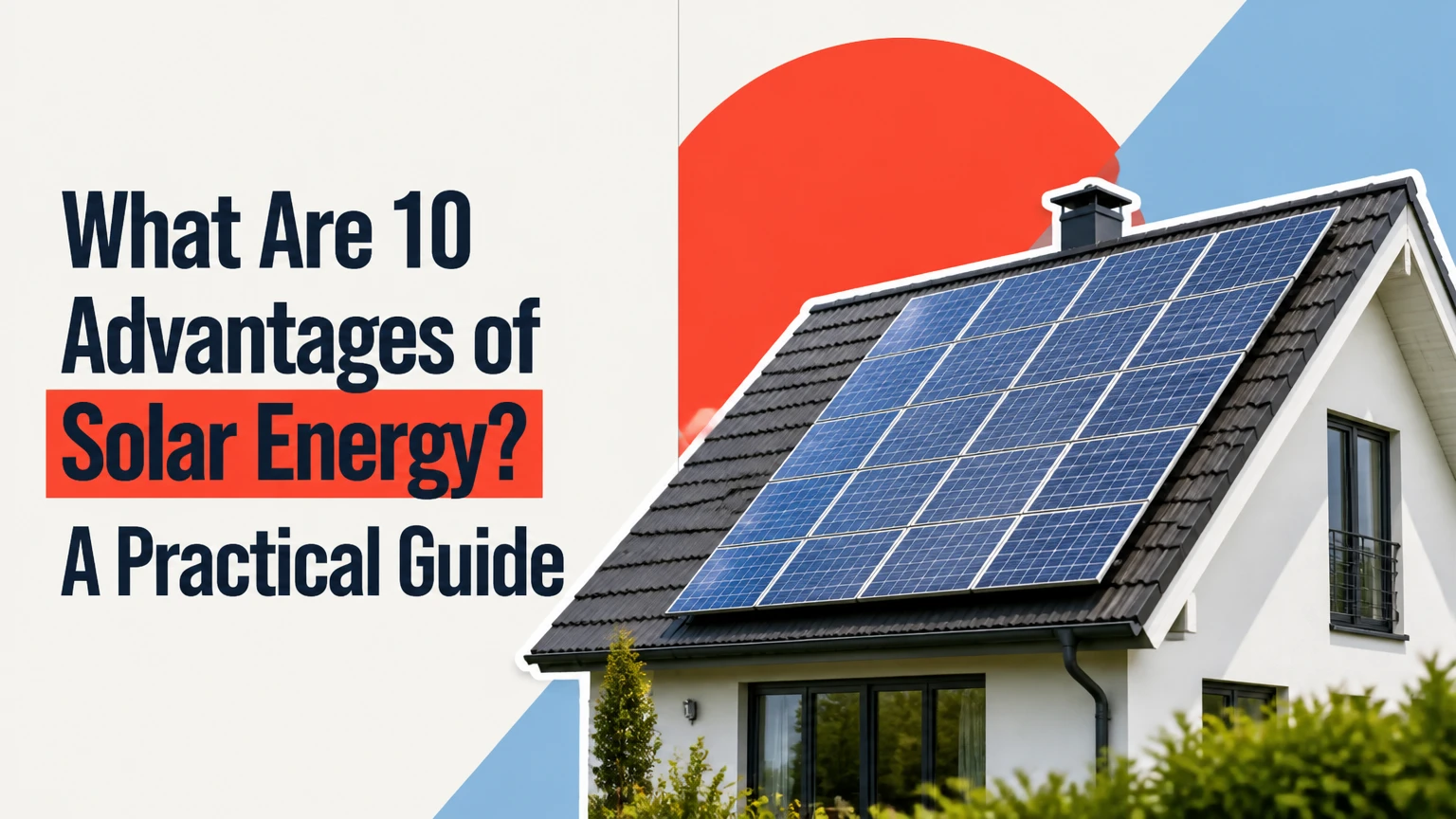
Solar energy has 10 major advantages: it can reduce electricity costs, produce no operational air pollution, improve energy-price stability, increase energy independence, require little maintenance, support backup power, reduce peak-rate purchases, scale across property sizes, operate for decades, and add value in some housing markets. The actual benefit depends on sunlight, tariffs, roof conditions, incentives, and system design.
Key Facts at a Glance
- Photovoltaic panels convert sunlight into direct-current electricity, and an inverter converts that electricity into household alternating current.
- A typical U.S. residential solar array is approximately 6-10 kilowatts, although household usage and local sunlight determine the correct size.
- Solar panels usually carry 25-30-year performance warranties, while inverters commonly have shorter service lives.
- Grid-tied solar normally shuts down during a utility outage unless a battery system or approved backup inverter creates an isolated, energized circuit.
- Solar has no fuel cost during operation, but installation, financing, replacement equipment, insurance, and utility rules affect total savings.
- Solar output changes with season, cloud cover, shading, panel orientation, temperature, and snow or dirt accumulation.
What Is Solar Energy?
Solar energy is usable heat or electricity produced from sunlight. Photovoltaic, or PV, systems convert light directly into electricity, while solar-thermal systems use sunlight to heat water, air, or another fluid.
The U.S. Department of Energy describes the sun as “the most abundant energy resource on earth”. Abundance does not mean every property is equally suitable. A south-facing, unshaded roof with strong midday exposure can produce substantially more electricity than a similarly sized roof shaded by trees or neighboring buildings.
Solar electricity is usually generated by silicon PV cells assembled into modules and arrays. Solar-thermal collectors are different equipment: they transfer heat rather than generate household electricity. Concentrated solar power plants use mirrors and thermal receivers, generally at utility scale, rather than rooftop panels.
| Solar application | Main equipment | Output | Typical setting |
|---|---|---|---|
| Rooftop PV | Silicon modules, inverter, racking | AC electricity | Homes and small businesses |
| Community solar | Shared PV array, meters, utility billing | Electricity credits | Renters and apartment residents |
| Solar thermal | Collectors, pump, storage tank | Heated water or air | Homes, hotels, industrial sites |
| Concentrated solar power | Mirrors, receiver, turbine, thermal storage | Utility-scale electricity | High-sunlight deserts |
How Does Photovoltaic Solar Energy Work?
Photovoltaic solar energy works by converting photon energy into an electrical current inside semiconductor cells. Silicon absorbs usable portions of sunlight, releases charge carriers, and directs those charges through an external circuit.
The process begins when photons strike a PV cell. Photons with enough energy transfer energy to electrons in the semiconductor, creating mobile charge carriers. A built-in electric field at the junction between semiconductor layers separates those charges and encourages current to flow in one direction.
The cell produces direct current, or DC. Household outlets and the utility grid use alternating current, or AC, so an inverter changes the electrical form. Modern inverters also monitor voltage, frequency, and grid conditions; a standard grid-tied inverter disconnects during an outage to protect utility workers.
| Component | Physical function | Electrical role | Common failure symptom |
|---|---|---|---|
| PV cell | Absorbs photons | Produces small DC current | Cell-level mismatch |
| Solar module | Combines cells under glass | Raises usable voltage and power | Cracks or hot spots |
| Inverter | Converts DC to AC | Synchronizes with household circuits | Error code or shutdown |
| Racking and wiring | Holds and connects modules | Transfers current safely | Loose connection or corrosion |
What Are 10 Advantages of Solar Energy?
The 10 advantages of solar energy are lower electricity purchases, no operational emissions, long-term financial value, reduced fuel-price exposure, low routine maintenance, potential property-value benefits, outage support with storage, peak-rate management, flexible scale, and long operating life. These advantages are real, but each requires the right system configuration.
1. Solar Can Reduce Electricity Bills
Solar lowers a utility bill by supplying electricity at the property instead of buying every kilowatt-hour from the grid. A well-sized system can offset a large share of annual consumption, but the percentage depends on daytime demand, export-credit rules, fixed charges, and battery use.
An 8-kilowatt system might produce roughly 9,000-12,000 kilowatt-hours annually in a favorable U.S. location, while the same system produces less in a cloudy climate. Net-metering or export-credit policies determine what excess electricity is worth after the home’s immediate loads are met.
The often-repeated claim that solar cuts bills by 80-90% applies only to particular tariffs and system designs. A utility may retain connection fees, reduce export compensation, or impose time-based charges.
2. Solar Produces No Operational Air Pollution
PV electricity generation produces no direct carbon dioxide, nitrogen oxides, sulfur dioxide, or particulate emissions at the point of generation. That distinction matters because fossil-fuel power plants emit pollutants while burning coal, gas, or oil.
Solar panels still have lifecycle impacts from mining, semiconductor processing, manufacturing, shipping, installation, and end-of-life treatment. The International Energy Agency reports that lifecycle greenhouse-gas emissions from solar PV are far lower than those from coal and natural gas generation. Solar is therefore low-emission energy, not impact-free energy.
3. Solar Offers a Long-Term Financial Return
Solar can generate a financial return after the initial investment because sunlight has no per-kilowatt-hour fuel charge. The return is strongest when a property has high electricity prices, good solar exposure, favorable export rules, and an owned system.
A simple payback estimate divides net installed cost by first-year bill savings. For example, a $18,000 system producing $2,400 in first-year savings has a basic payback of 7.5 years before financing, maintenance, degradation, and future tariff changes.
| Financial factor | Typical value or range | Effect on return |
|---|---|---|
| Residential array size | 6-10 kW | Determines annual production capacity |
| Gross installed cost | $15,000-$25,000 | Sets initial capital requirement |
| Simple payback | 6-12 years | Varies with tariffs and incentives |
| Performance warranty | 25-30 years | Protects long-term output expectations |
4. Solar Reduces Dependence on Volatile Energy Prices
Solar reduces exposure to utility fuel costs because PV generation requires no delivered coal, gas, or diesel. A homeowner still pays grid charges, but producing some electricity on-site can make future energy spending more predictable.
Solar does not make a property fully energy independent by itself. A grid-tied home remains dependent on the utility when panels produce too little, and an off-grid home needs enough storage and backup generation to cover prolonged low-sun periods.
5. Solar Requires Little Routine Maintenance
Solar panels have no rotating turbine, piston, or combustion engine, so routine maintenance is usually limited to monitoring, visual inspection, vegetation control, and occasional cleaning. Rain removes ordinary dust in many locations, although pollen, bird droppings, ash, and agricultural dust can reduce output.
The array should be inspected after severe weather and checked periodically for damaged glass, exposed wiring, water entry, and unusual production changes. Inverters contain power electronics and may require replacement before the panels reach the end of their service life.
6. Solar May Increase Property Value
An owned solar system can contribute to a home’s market value when buyers recognize the system’s remaining production, warranty, and utility savings. A 2019 analysis by the U.S. Department of Energy’s Lawrence Berkeley National Laboratory found that buyers in several states paid premiums for homes with PV systems, although premiums varied by location, system age, and ownership structure.
The commonly cited 4% increase is not a universal rule. A leased system, unresolved lien, transferable loan, or poorly documented installation can complicate a sale. Appraisers and buyers need system ownership records, production history, warranties, and utility-bill evidence.
7. Solar Plus Batteries Can Provide Outage Support
Solar panels alone usually do not keep a grid-connected home powered during a blackout. A battery, backup-capable inverter, transfer equipment, and a correctly designed critical-load panel are required to isolate the home safely from the utility.
Battery capacity determines how long selected loads can run. A 10-kilowatt-hour battery might support a refrigerator, lights, internet equipment, and efficient heating controls overnight, but it may not run an electric resistance furnace, central air conditioner, range, and water heater for an extended outage.
| Configuration | Grid connection | Blackout behavior | Typical use |
|---|---|---|---|
| Grid-tied PV | Yes | Shuts down during outage | Lowest-cost bill reduction |
| Hybrid PV | Yes | Powers selected circuits with battery | Outage-prone homes |
| Off-grid PV | No | Runs from battery and backup generator | Remote properties |
| PV plus generator | Usually yes | Generator extends low-sun resilience | Long winter outages |
8. Solar Can Reduce Peak-Rate Purchases
Solar can reduce peak-rate purchases when the utility charges more during hours when PV is producing. The benefit is strongest for buildings with daytime cooling, refrigeration, pumps, or industrial loads.
Commercial customers may also pay demand charges based on their highest short-interval power draw. Batteries can shift solar electricity into late afternoon or evening periods, but storage economics depend on the tariff, battery cycle life, and demand-charge rules.
9. Solar Scales From Small Devices to Power Plants
Solar technology scales across many applications. A small panel can charge a sensor or communications device, a residential array can serve a home, and a utility project can supply electricity to thousands of customers.
Scale changes the design priorities. Residential systems prioritize roof area, aesthetics, fire access, and household load shape. Utility arrays prioritize land, grid capacity, tracker design, module cost, operations, and curtailment risk.
10. Solar Panels Operate for Decades
Most modern PV modules carry performance warranties lasting 25-30 years. Panel output gradually declines rather than stopping at the warranty date, and many modules continue producing electricity beyond 30 years at reduced capacity.
A practical design must account for degradation, inverter replacement, roof replacement, storm risk, and component availability. A panel warranty does not guarantee a specific annual bill reduction because weather, shading, utility rates, and household consumption remain outside the manufacturer’s control.
Which Solar Technology Fits the Site?
Monocrystalline silicon panels are usually the best residential choice when roof space is limited, while thin-film modules fit lightweight or unusual surfaces and bifacial modules perform best where rear-side reflected light is available. Polycrystalline modules remain a lower-efficiency option with limited modern residential use.
| Technology | Typical module efficiency | Main advantage | Main limitation |
|---|---|---|---|
| Monocrystalline silicon | 19%-23% | High output per square meter | Usually higher module price |
| Polycrystalline silicon | 15%-18% | Historically lower cost | Requires more area for equal output |
| Thin-film | 11%-19%, by material | Lightweight and flexible formats | Larger area for equal capacity |
| Bifacial silicon | Site-dependent rear gain | Captures reflected rear light | Needs elevated, reflective installation |
Bifacial modules do not automatically produce 25% more electricity. Rear-side gain depends on ground reflectivity, module elevation, row spacing, tilt, and shading. Light gravel or snow can improve albedo, while a dark roof often provides little rear illumination.
What Does a Solar System Cost?
A typical U.S. residential solar installation costs approximately $15,000-$25,000 before incentives for a 6-10-kilowatt system, although local labor, roof complexity, equipment, permitting, financing, and market conditions can move the price substantially.
Batteries add a separate cost category. A residential battery installation commonly ranges from approximately $10,000-$20,000 before incentives, depending on usable capacity, power rating, backup circuits, electrical upgrades, and installation complexity. Cost per kilowatt-hour alone is not enough because a battery’s power output determines which appliances it can run.
| Cost item | Typical residential range | What changes the amount |
|---|---|---|
| PV modules and inverter | $8,000-$14,000 | Array size and equipment brand |
| Labor and racking | $4,000-$8,000 | Roof height, pitch, and structure |
| Permits and electrical work | $1,000-$3,000 | Local code and service upgrades |
| Battery installation | $10,000-$20,000 | Capacity, power, and backup scope |
The federal Residential Clean Energy Credit in the United States has historically provided a 30% credit for qualifying solar and storage expenditures, subject to current law and eligibility requirements. Tax rules change, so property owners should verify current requirements with the Internal Revenue Service and a qualified tax professional.
When Does Solar Pay for Itself?
Solar commonly reaches simple payback in approximately 6-12 years, but the result depends mainly on net cost, annual production, electricity prices, export compensation, financing, and system degradation. A low-cost system in a high-rate market can pay back faster than an expensive system in a low-rate market.
Use a location-specific model rather than a national average. The model should include at least 12 months of interval or monthly consumption, local irradiance, roof shading, utility tariffs, fixed charges, export credits, battery dispatch, incentives, loan interest, insurance, and estimated inverter replacement.
A practitioner rule is to compare the system’s levelized cost of electricity with the utility’s avoided purchase cost, not with the utility’s entire bill. Fixed connection charges remain after solar installation.
How Is a Solar System Installed?
A professional solar installation normally takes several weeks to several months from contract to permission to operate. The physical roof work may take one to three days, but engineering, permitting, utility review, inspection, and interconnection often control the schedule.
- Assess the site. Review 12 months of bills, interval load data, roof age, structural condition, electrical service, tree growth, orientation, tilt, and shading.
- Design the system. Select module wattage, inverter architecture, racking, wiring paths, rapid-shutdown equipment, battery capacity, and critical loads.
- Obtain approvals. Submit engineering documents for building, electrical, fire, and utility interconnection review.
- Install equipment. Mount racking, attach modules, route conductors, install inverters, connect grounding, and complete battery or service-panel work.
- Inspect and commission. Pass local inspection, receive utility permission to operate, verify monitoring, and document warranties and as-built equipment.
The most important success checkpoint is not the number of panels. It is a design that matches hourly consumption with the utility’s compensation rules.
How Weather, Shade, and Orientation Affect Output
Clouds reduce solar production but do not stop it, because diffuse daylight still reaches the cells. Shade is often more damaging than a uniform cloudy sky when a chimney, tree, or nearby building affects one string or module repeatedly during high-production hours.
Hot weather also reduces crystalline silicon module efficiency. Panels receive more sunlight in summer, but elevated cell temperature offsets part of that gain. Snow can temporarily stop production when it covers the module, although tilted roofs and melting can shorten the interruption.
| Site condition | Typical production effect | Design response | Monitoring signal |
|---|---|---|---|
| Unshaded south-facing roof | Baseline reference | Standard string or microinverter design | Stable midday curve |
| Partial chimney shade | 5%-30% local loss, site-dependent | Module-level electronics or redesign | Repeating midday dip |
| Heavy tree canopy | 20% or more possible loss | Pruning, alternate roof, or no-go decision | Seasonal decline |
| Snow cover | Near-zero while covered | Steeper tilt and safe clearing policy | Abrupt winter outage |
How Does Solar Compare With Alternatives?
Solar is usually the strongest choice for on-site electricity where a property has usable roof or land, while utility electricity remains simpler and wind or solar thermal may fit different resource profiles. The best alternative depends on whether the objective is electricity, hot water, backup, or emissions reduction.
| Option | Fuel source | Typical site requirement | Main limitation |
|---|---|---|---|
| Rooftop PV | Sunlight | Unshaded roof or ground area | Variable daily output |
| Utility electricity | Grid generation mix | Utility service connection | Retail-rate exposure |
| Small wind | Wind resource | Tower clearance and strong wind | Noise, zoning, turbulence |
| Solar thermal | Sunlight | Collector area and hot-water demand | Produces heat, not general electricity |
Solar thermal can be more efficient than PV for hot-water production when the building has steady demand. It is not a direct substitute for PV when the priority is powering appliances, motors, electronics, or electric vehicles.
Who Benefits Most From Solar?
Solar tends to benefit owner-occupiers with a sound roof, substantial electricity use, good solar exposure, and a long expected stay. The economics become less attractive for renters, heavily shaded buildings, properties with imminent roof replacement, or customers with very low electricity rates.
Renters can consider community solar where available, but contract terms, cancellation rules, subscription discounts, and credit portability require review. Apartment owners may use shared systems, building-level PV, or utility programs rather than installing an individual rooftop array.
Solar is not a good solution for every roof. Replacing a roof within five years, accepting a poor export tariff, or financing an oversized system can erase much of the expected benefit.
What Are Solar Energy’s Limitations?
Solar energy is variable, site-dependent, and capital-intensive. PV output falls at night and during poor weather, while batteries add cost, capacity limits, fire-code requirements, and eventual replacement considerations.
Manufacturing requires energy and raw materials, and end-of-life management must address glass, aluminum, silicon, polymers, and electronic components. The International Renewable Energy Agency identifies recycling and material recovery as important parts of PV industry development.
Common decision errors include these:
- Ignoring hourly use: Annual kWh alone cannot reveal whether daytime solar will meet the load.
- Installing on an old roof: Roof replacement beneath a new array increases labor and removal costs.
- Trusting a sales estimate: Production models should disclose shading assumptions, degradation, and weather data.
- Oversizing for exports: Excess generation may receive a lower credit than electricity purchased at retail.
- Sizing batteries by energy only: A battery can have enough kilowatt-hours but insufficient kilowatts for a pump or compressor.
- Skipping installer verification: Check licensing, insurance, references, workmanship coverage, and utility experience.
How Can Solar Problems Be Diagnosed?
Low solar production usually results from shade, soiling, snow, inverter shutdown, wiring faults, communications failures, or unusual weather. Compare current output with the same season’s historical data before assuming the panels have failed.
Check the monitoring portal for a system-wide drop or a single-device alert. Inspect accessible areas for new shade, debris, visible damage, or tripped breakers, but never open energized equipment or attempt unqualified electrical repairs.
| Symptom | Likely cause | Safe first action | Escalation point |
|---|---|---|---|
| Zero production | Breaker, inverter, or grid outage | Check utility status and monitoring alert | Contact installer |
| Gradual output decline | New shade, dirt, degradation | Compare weather and shade history | Request production test |
| Red inverter warning | Ground fault or temperature issue | Follow manufacturer shutdown procedure | Licensed technician |
| Battery not backing up | Reserve setting or overload | Check backup mode and load list | Installer or electrician |
Frequently Asked Questions
Do solar panels work in winter?
Solar panels work in winter whenever sunlight reaches the cells, although shorter days, low sun angles, clouds, and snow can reduce total production. Cold temperatures can improve module efficiency, but that gain does not usually offset reduced winter sunlight. A site-specific model should use monthly production rather than annual output alone.
How many solar panels does a house need?
A typical home may need approximately 15-25 modern panels for a 6-10-kilowatt array, assuming panels rated around 350-450 watts each. The correct number depends on annual electricity use, roof area, local sunlight, panel wattage, shading, and the desired offset percentage rather than household size alone.
Are solar panels worth it without batteries?
Solar panels can be worthwhile without batteries when daytime consumption is high, export credits are favorable, or the goal is reducing annual grid purchases. Batteries become more valuable when outage protection, time-of-use shifting, or low export compensation matters. A battery does not automatically improve financial payback.
Can solar panels power an electric vehicle?
Solar panels can supply electricity for an electric vehicle, but charging speed and timing matter. A home charger may draw 7-12 kilowatts, which can exceed instantaneous rooftop output, so the vehicle may use a mixture of solar and grid electricity. Scheduled daytime charging increases direct solar consumption.
What happens to solar panels after 25 years?
Solar panels generally continue producing after their 25-year performance warranty, with reduced output from gradual degradation. Owners can keep operating them, replace failed components, or repower the array with newer modules. Recycling options vary by location, and aluminum frames and glass are among the more recoverable materials.
The Bottom Line
The 10 advantages of solar energy are lower electricity purchases, low operational emissions, long-term financial potential, reduced exposure to fuel-price changes, limited maintenance, possible property-value gains, battery-supported resilience, peak-rate savings, scalable deployment, and decades of operation. Solar is most compelling when the roof is sound and unshaded, electricity rates are high, and the owner evaluates hourly usage, export rules, financing, and battery needs before signing a contract.