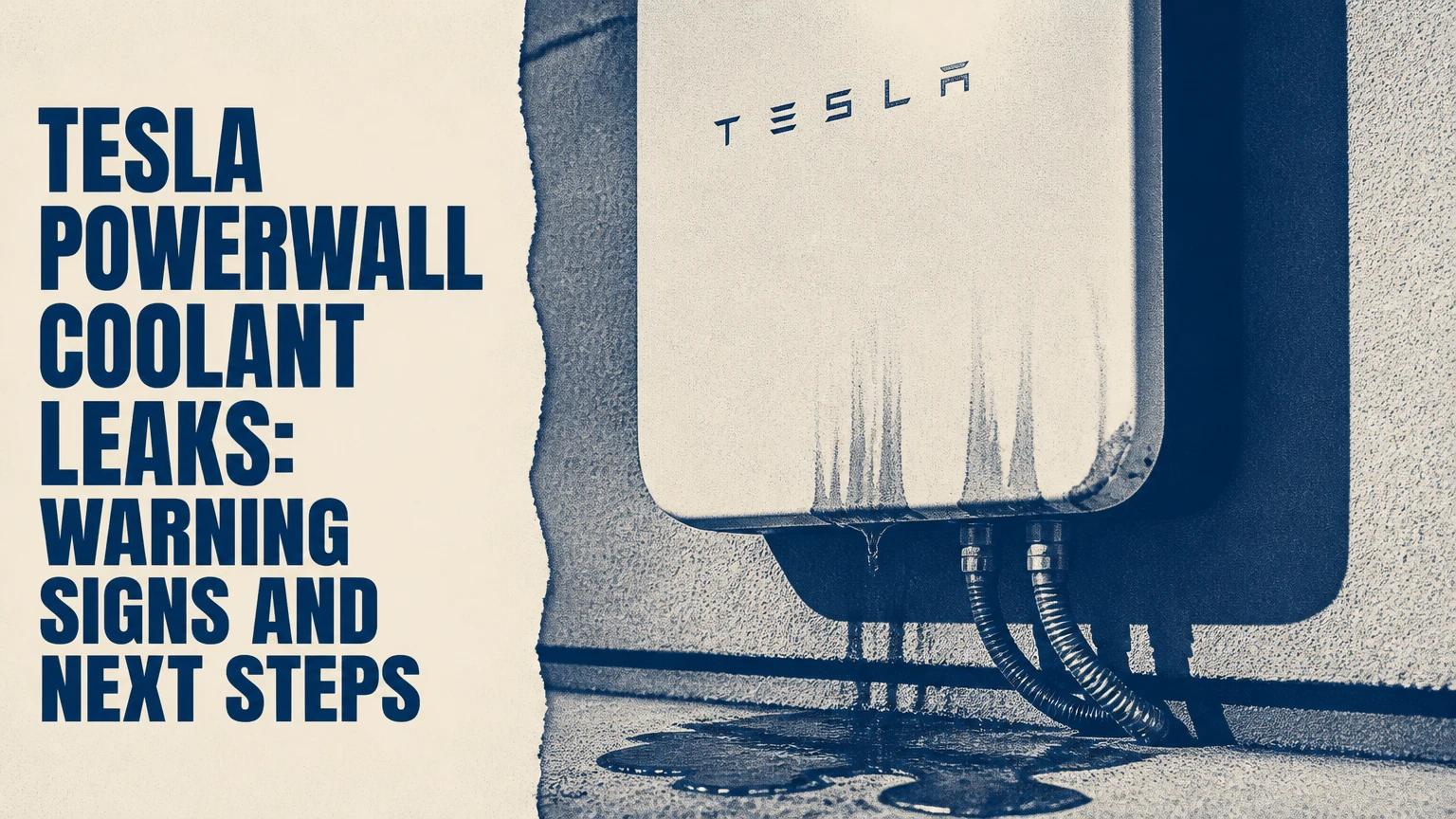
Tesla Powerwall coolant leaks usually appear as blue or blue-green fluid, dried residue, abnormal fan operation, thermal limits, or a Tesla app service alert. Stop treating the issue as routine maintenance if fluid is recurring, the enclosure is damaged, or the battery output is restricted. Document the evidence, use Tesla’s troubleshooting workflow, and arrange qualified service without opening the enclosure.
Key Facts at a Glance
- A Powerwall coolant leak can reduce thermal capacity and trigger charging or discharging limits.
- Blue fluid under a Powerwall is a strong warning sign, but irrigation water and cleaning products can look similar.
- Owners should not remove the Powerwall cover, disconnect coolant lines, or refill an unidentified reservoir.
- A service technician must identify the leaking component, assess pressure loss, and check for heat-related damage.
- Typical out-of-warranty repair estimates range from about $800 to $2,500 or more, depending on parts and labor.
- A recurring leak is different from a one-time spill because repeated fluid indicates an active loss of system coolant.
What Does a Tesla Powerwall Coolant Leak Mean?
A Tesla Powerwall coolant leak is the unintended loss of fluid from the battery’s thermal-management circuit. The fluid carries heat away from battery components so the system can maintain safe operating temperatures during charging, discharging, and hot-weather operation.
Tesla has not published a complete consumer-facing parts diagram or a universal owner procedure for every Powerwall generation. For that reason, references to G48 coolant, exact pressure thresholds, and component-level repair methods should be confirmed against the specific model and Tesla service procedure rather than applied automatically.
The commonly cited fluid is an ethylene-glycol-based coolant used in a closed thermal loop. Automotive G48 products are not automatically interchangeable with Powerwall coolant, because concentration, additives, contamination control, and service compatibility all matter. The correct fluid specification belongs to the service procedure for the installed unit.
Why does Powerwall need liquid cooling?
Powerwall batteries produce heat through electrical resistance in their cells, busbars, power electronics, and conversion hardware. High ambient temperature, sustained high output, and repeated full-depth cycling increase the amount of heat the system must reject.
A liquid circuit can move heat more consistently than enclosure air alone. The pump moves coolant through thermally connected components, and a heat exchanger or radiator transfers that heat to air moved by fans. Sensors then report temperatures and operating conditions to the battery-management and control systems.
Tesla’s Powerwall troubleshooting material directs owners to use the Tesla app and contact support when automated steps do not resolve a fault. Tesla’s published owner guidance is more reliable for escalation decisions than generic advice written for Tesla vehicles, because Powerwall hardware and service access differ from vehicle systems.
Which Warning Signs Point to a Leak?
The strongest combination is recurring blue fluid plus an app alert or new thermal-performance limit. A single damp patch does not prove a Powerwall leak, because roof runoff, irrigation, condensation, and nearby maintenance chemicals can create similar evidence.
Visual signs
Inspect the ground and the lower exterior without removing panels. Fresh coolant may look glossy and blue, while dried deposits can appear pale blue, white, or greenish and may collect around a lower seam, fitting, drain path, or enclosure edge.
Do not taste, touch, or deliberately smear the fluid. Ethylene glycol is toxic if swallowed, and pets can be attracted to its sweet odor. Keep children and animals away from the area and photograph the material from above.
| Observation | More consistent with coolant | Alternative explanation to check |
|---|---|---|
| Bright blue, oily-looking puddle | Active coolant loss | Windshield fluid or colored cleaner |
| White-blue crust at a lower seam | Dried coolant residue | Mineral deposits from hard water |
| Clear water after rain | Condensation or runoff | Roof drainage or irrigation |
| Fluid returning after cleanup | Ongoing leak | Repeated sprinkler overspray |
| Wetness near cable entry | Possible internal or external path | Drainage directed toward enclosure |
Operating signs
A Powerwall may run its fans more often when ambient temperatures rise or when the battery is working hard. Fan noise alone is therefore weak evidence. It becomes more concerning when the fan runs unusually long during moderate demand, the battery stops accepting normal charge, or the app reports a thermal or service condition.
Thermal throttling can reduce charge acceptance or discharge output before a complete shutdown. The same symptoms can also result from grid events, backup-reserve settings, firmware behavior, high ambient temperature, or a separate inverter fault. Record the exact time and operating state instead of assuming every power limit is coolant-related.
| Symptom in the Tesla app or home | Possible meaning | Useful evidence |
|---|---|---|
| Reduced discharge power | Thermal limit or electrical fault | Power limit, temperature, timestamp |
| Reduced charging speed | Thermal limit, grid setting, or full battery | Charge source and reserve setting |
| Fan operating for long periods | Heat rejection demand | Outdoor temperature and load |
| Service Required alert | Fault requiring diagnosis | Alert wording and event history |
| Powerwall unavailable | Protection shutdown or communication fault | Gateway status and outage condition |
Is a Powerwall Coolant Leak Dangerous?
A coolant leak demands prompt service, but visible fluid is not the same as an imminent battery fire. The immediate hazards are toxic coolant exposure, electrical energy, slippery surfaces, and possible overheating if the system loses thermal control.
If you see smoke, flames, charring, bulging, hissing, a burning odor, or unusual heat from the enclosure, move away and call emergency services. Do not spray water onto energized equipment or open the unit. During a grid outage, avoid manipulating the Powerwall because backup circuits may remain energized.
For a non-emergency puddle, keep people and pets away, avoid contact, and contact Tesla through the app or an authorized service channel. If fluid reaches soil or a drain, follow local hazardous-material and spill-reporting rules. Cleanup requirements vary by jurisdiction and spill quantity.
Can you keep using Powerwall after finding fluid?
Continued operation should be decided by Tesla or a qualified battery-storage technician, not by the puddle size alone. A minor external seep and a rapid internal pressure loss can look similar to an owner, while the risk to thermal control differs substantially.
| Situation | Owner action | Operating decision |
|---|---|---|
| Smoke, fire, burning smell | Leave area and call emergency services | Do not operate or inspect |
| Fresh recurring blue fluid | Photograph and request service | Ask Tesla whether shutdown is required |
| App thermal limitation | Save alert and usage data | Avoid high-load testing |
| One dry stain, no alert | Check for external water source | Monitor without opening enclosure |
| Powerwall offline during outage | Follow Tesla emergency guidance | Do not disconnect equipment |
How Should You Check the Unit Safely?
A safe owner inspection takes about 10-15 minutes and requires a phone, flashlight, and disposable gloves. The inspection should remain external: owners can document symptoms, but they should not remove covers, probe connectors, loosen fittings, or access a coolant reservoir.
Step 1: Check the surroundings
Look above and beside the Powerwall for gutters, irrigation heads, hose bibs, roof edges, pressure-washing paths, and HVAC condensate. Note whether the fluid appears only after rain or watering.
You will know this step is useful when you can separate a repeatable moisture source from fluid that returns during dry conditions. A common mistake is cleaning the area before taking photographs, which removes evidence of color and location.
Step 2: Photograph the evidence
Take wide photographs showing the whole unit and close photographs showing the puddle, residue, seams, ground slope, and nearby plumbing. Add the date, weather conditions, and whether the Powerwall was charging or discharging.
Do not place paper towels, probes, or containers against the enclosure. Photos preserve evidence without introducing contamination or creating an electrical hazard.
Step 3: Record Tesla app information
Capture the alert text, operating mode, state of charge, power flow, backup reserve, and any displayed power limitation. Record whether the home had grid power and whether another Powerwall in the same installation behaved differently.
Tesla Support’s owner workflow includes app-based troubleshooting and service escalation. The app record gives the technician a timeline that a verbal description often cannot provide.
Step 4: Request service
Submit the photos, serial number, installation address, alert screenshots, and a concise timeline. State whether the fluid is recurring, whether output is limited, and whether the unit is hot, noisy, or damaged.
You will know the request is complete when a technician can understand the event without asking you to open the enclosure. The common mistake is requesting “a coolant refill” before anyone has confirmed that coolant is the problem.
How Does a Technician Confirm the Leak?
A technician confirms a Powerwall coolant leak through a controlled visual inspection, system diagnostics, and a leak or pressure test appropriate to the installed hardware. The technician may inspect hoses, fittings, valves, pump operation, radiator or heat-exchanger paths, and evidence of fluid reaching electrical areas.
Some third-party summaries cite a pressure test near 50 psi for four minutes with a specified pressure-loss limit. Those numbers are service-procedure details, not a universal owner test, and they should not be reproduced with shop air or improvised fittings. The correct pressure, fluid, adapter, and acceptance limit depend on the Powerwall version and Tesla procedure.
What components can leak?
A thermal loop can lose fluid at more than one point. A technician must locate the source before estimating repair cost, because replacing a valve does not correct a cracked hose or a damaged heat exchanger.
| Component group | Typical failure evidence | Diagnostic consequence |
|---|---|---|
| Hose or fitting | Wet joint or residue at connection | May require line, seal, or fitting replacement |
| Pump assembly | Noise, flow fault, or leakage near pump | Requires flow and electrical checks |
| Valve or manifold | Residue around valve body | May need component isolation |
| Radiator or heat exchanger | Fluid near heat-rejection area | Often increases parts and labor time |
| Internal cold-plate path | Pressure loss without external source | Greater risk of invasive repair |
| Sensor or wiring area | Corrosion or contamination | Requires electrical safety assessment |
A technician should also determine whether the leak is active, historical, or caused by fluid introduced from outside. The word “coolant” in an app note does not identify the failed part.
What Coolant Should a Powerwall Use?
Powerwall coolant should match the Tesla service specification for the exact unit, not a generic antifreeze label. G48 is commonly described as a phosphate-free, nitrate-free ethylene-glycol coolant family, but product chemistry and pre-mix concentration still vary between manufacturers.
Never mix an unidentified automotive coolant into the system. Additives can affect corrosion protection, conductivity, seals, and material compatibility. A 50/50 mixture is often cited for battery thermal systems, yet the correct concentration must come from Tesla documentation or the servicing provider.
| Coolant decision | Recommended action | Reason |
|---|---|---|
| Fluid identity unknown | Do not top off | Mixing can create compatibility problems |
| Suspected active leak | Repair and test first | Refill alone loses fluid again |
| Correct product confirmed by technician | Use specified quantity | Concentration affects heat transfer |
| Generic green antifreeze available | Do not substitute | Color does not identify chemistry |
| System contaminated | Request flushing procedure | Residue may affect pump and sensors |
Color is an identification clue, not a specification. Blue coolant from one manufacturer can have different additives from another manufacturer’s blue coolant.
How Much Does Powerwall Leak Repair Cost?
Typical out-of-warranty Powerwall coolant-leak costs range from approximately $800 to $2,500 or more, while covered repairs may have no owner charge under applicable warranty terms. The final amount depends on diagnosis, access, failed components, travel, shipping, taxes, and whether battery modules or power electronics were affected.
Published Tesla warranty terms and the owner’s purchase documents control coverage. Tesla’s Powerwall warranty commonly provides a 10-year limited warranty, but coverage conditions, installation requirements, geographic terms, and exclusions matter. Confirm the installed product version and warranty status directly with Tesla.
| Repair scenario | Typical out-of-warranty range | Approximate scheduling |
|---|---|---|
| Diagnostic visit only | $150-$500 | 2-14 days |
| Hose, seal, or valve repair | $800-$1,500 | 1-3 weeks |
| Pump or heat-exchanger repair | $1,200-$2,500 | 1-4 weeks |
| Internal contamination assessment | $2,000-$4,000+ | 2-6 weeks |
| Major battery replacement estimate | $5,000+ in some reports | Parts dependent |
These are planning ranges, not Tesla price quotes. Online vehicle repair reports and owner forum discussions cannot establish a standard Powerwall price, because labor rates and hardware differ by product and location.
What determines the repair bill?
The largest cost drivers are the failed part, access requirements, travel distance, warranty status, and evidence of coolant reaching electronics or battery modules. A simple external connection can cost far less than an internal leak that requires extensive disassembly or replacement.
Ask for a written estimate that separates diagnosis, labor, parts, shipping, disposal, and any temporary operating restrictions. Also ask whether the technician will perform a post-repair pressure or leak verification rather than merely adding fluid.
Is Coolant Leakage Covered by the Powerwall Warranty?
Powerwall coolant-leak coverage depends on the warranty in force and the cause of failure. A manufacturing defect may qualify, while unauthorized modification, incorrect installation, physical damage, environmental exposure, or non-approved service may affect coverage.
Do not assume that opening the enclosure or adding automotive coolant automatically voids every warranty term, because the actual effect depends on the warranty language and the event. However, unauthorized work can complicate diagnosis and give the provider a legitimate reason to investigate exclusions.
Prepare these records:
- Powerwall serial number and model generation.
- Installation date and installer details.
- Photos of fluid, residue, and enclosure condition.
- Tesla app alerts with timestamps.
- Weather, outage, and operating conditions.
- Prior service invoices and coolant-related work.
Tesla’s warranty page should be treated as the controlling source for current coverage, not a repair blog or forum post.
Which Repair Path Should You Choose?
Tesla service is the preferred first path for an in-warranty unit or a fault involving internal battery components. A qualified energy-storage contractor may be useful for local inspection and coordination on an out-of-warranty system, but the contractor must have documented experience with Tesla Powerwall equipment.
DIY repair is unsuitable for most owners. A Powerwall contains hazardous stored energy, high-voltage circuits, sealed thermal hardware, and warranty-sensitive components. Vehicle coolant skills do not qualify someone to service a stationary battery enclosure.
| Repair path | Best use case | Main benefit | Main limitation |
|---|---|---|---|
| Tesla Support | In-warranty or app-diagnosed fault | Factory records and model-specific workflow | Appointment availability |
| Tesla-authorized technician | Covered component repair | Approved parts and procedures | Geographic coverage varies |
| Qualified storage contractor | Out-of-warranty local assessment | Potentially faster local response | Must verify Powerwall experience |
| General automotive shop | Vehicle cooling systems | Familiarity with G48 products | Usually unsuitable for Powerwall service |
| DIY owner repair | External documentation only | No service cost for inspection | Unsafe for internal work |
A practitioner rule is simple: if the proposed fix begins with removing the front cover, stop and verify authorization, training, and the correct service manual.
What Mistakes Make a Leak Worse?
The most damaging mistake is treating a low-fluid symptom as the root problem. Replacing lost coolant without locating the leak can produce repeated thermal faults, pump operation without adequate fluid, and additional contamination.
Mistake 1: Topping off from a bottle
Do not pour coolant into an unverified opening. Powerwall owners may not have an accessible consumer refill port, and adding fluid can introduce air, dirt, or the wrong chemistry.
Mistake 2: Using color as proof
Blue fluid is suggestive, but color does not prove G48 compatibility. Verify the exact product and concentration through Tesla or the servicing technician.
Mistake 3: Testing under extreme load
Do not deliberately run high-power appliances to see whether the battery overheats. A controlled diagnostic test belongs to the technician, especially when the system already reports a thermal limit.
Mistake 4: Washing the enclosure
Pressure washing can force water toward seals, vents, cable entries, or connectors. Clean only the surrounding ground using a method that cannot spray the battery.
Mistake 5: Ignoring a dry residue
Dried deposits can represent a previous leak that has stopped temporarily. The absence of a current puddle does not prove that the thermal loop is healthy.
How Can You Prevent Future Thermal-System Problems?
Owners cannot perform routine internal coolant maintenance safely, but they can reduce environmental stress and identify changes early. Keep drainage away from the enclosure, avoid direct sprinkler spray, maintain clear airflow around the unit, and inspect the surrounding area twice yearly.
Tesla Powerwall operating specifications vary by model and installation configuration. The owner manual for the installed generation should control clearance, temperature, weather exposure, and cleaning instructions. Shading may reduce solar heating, but shade structures must not block ventilation or violate installation clearances.
| Preventive check | Suggested interval | Specific observation |
|---|---|---|
| Ground and enclosure inspection | Every 6 months | Blue residue, wet seams, impact damage |
| Irrigation and drainage review | Every 6 months | Spray direction and standing water |
| App alert review | Monthly | Repeated thermal or service events |
| Ventilation clearance check | Seasonally | Leaves, nests, or stored objects |
| Warranty record update | After service | Invoice, diagnosis, replaced part |
Two expert rules matter here. First, a shaded Powerwall is not automatically a cooler Powerwall if shade blocks the radiator airflow. Second, repeated thermal throttling during summer can expose a marginal pump or leak that remains hidden during mild weather.
What If the Fluid Is Not Blue?
Fluid color changes the diagnosis, but it does not make the situation safe. Clear water is more consistent with condensation or runoff, amber or brown liquid may indicate dirt or corrosion contamination, and bright green fluid may come from another coolant product or a nearby vehicle system.
Do not identify liquid by smell or skin contact. Photograph it, check nearby sources, and report the color and recurrence to Tesla or the technician.
| Fluid appearance | Possible source | Next action |
|---|---|---|
| Clear and watery | Rain, condensation, irrigation | Trace source and monitor recurrence |
| Bright blue | Coolant or cleaning fluid | Request service if recurring |
| Blue-green crust | Dried coolant or mineral deposit | Photograph before cleaning |
| Brown or oily | Contamination or unrelated fluid | Keep away and escalate |
| Pink, orange, or green | Other coolant chemistry | Do not mix or top off |
Multiple Powerwalls require extra care. A leak beneath one unit can spread across a shared pad, while a shared gateway alert may not identify the affected enclosure. Photograph each unit separately and label the images by serial number or position.
How Long Does Powerwall Leak Repair Take?
A typical repair takes 1-3 weeks from service request to completion when scheduling and parts are straightforward. Remote triage may occur within hours or several days, while a component shipment, warranty approval, or module-level assessment can extend the timeline to 4-6 weeks.
Ask whether the system will remain available, partially limited, or shut down while waiting. If the Powerwall supports backup power, ask how the home will behave during a grid outage and whether a temporary operating change is recommended.
The most useful timeline question is not “When can someone visit?” It is “What condition requires immediate shutdown before the visit?” That answer determines household risk during the waiting period.
What Should You Do Today?
Tesla Powerwall coolant leaks should be handled through evidence collection and qualified service, not owner repair. Photograph the fluid and enclosure, save Tesla app alerts, check for rain or irrigation sources, keep people and pets away, and contact Tesla Support or an appropriately trained storage technician.
Do not open the enclosure, refill unidentified fluid, apply shop pressure, or test the system under unusually heavy load. Treat smoke, burning odor, visible heat damage, or fire as an emergency rather than a maintenance issue.
FAQ
Can a Powerwall coolant leak stop by itself?
A visible puddle can disappear through evaporation, absorption, or simple drainage, but an active leak has not been repaired because the ground is dry. Dried blue or white residue may remain after the fluid leaves. Photograph the evidence and request diagnosis if the residue returns or the app reports a thermal fault.
How often should I inspect a Powerwall for leaks?
A practical owner inspection interval is every six months, with additional checks after severe weather, nearby construction, irrigation changes, or a new thermal alert. Inspect only the exterior and surrounding ground. Tesla’s model-specific manual and installation instructions take priority if they specify different maintenance guidance.
Can rain cause a false coolant-leak warning?
Rain can create a wet patch, mineral residue, or a temporary appearance that resembles coolant, especially where roof runoff reaches the lower enclosure. Rain does not normally create an internal coolant alert. Compare the fluid color, recurrence during dry weather, app messages, and drainage path before deciding.
Will a coolant leak damage Powerwall battery cells?
A coolant leak can reduce heat-transfer capacity and cause thermal limits or protective shutdown. Damage to cells is not automatic, because the battery-management system may restrict operation before temperatures become unsafe. The risk increases when the leak is ignored, the system is heavily loaded, or coolant reaches electrical components.
Can a general electrician repair a Powerwall coolant leak?
A general electrician may be qualified for some electrical work but may not have the training, parts, or procedure access required for a sealed battery thermal circuit. Use Tesla or a technician with documented Powerwall service experience, especially when the diagnosis involves internal components or warranty coverage.
Does a low Powerwall charge prove a coolant problem?
A low state of charge does not prove a coolant fault. Backup reserve settings, grid outages, solar production, utility controls, firmware, inverter faults, and household demand can all reduce stored energy. A coolant diagnosis becomes more plausible when low output appears with blue residue, abnormal fan behavior, or a thermal alert.