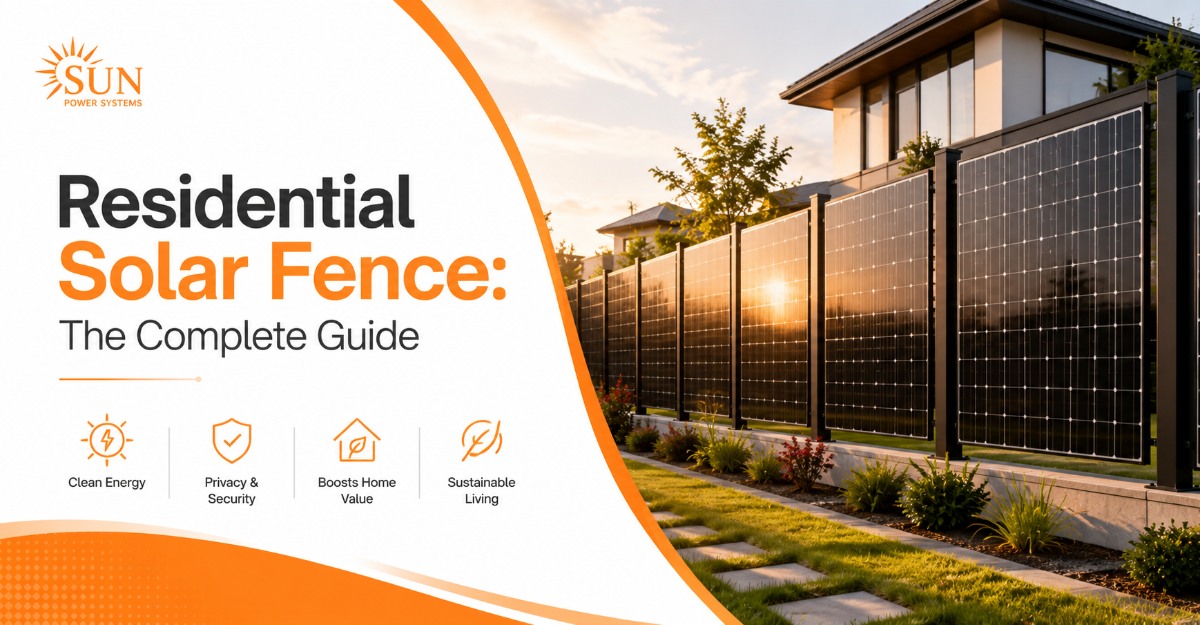
A residential solar fence is a perimeter boundary that mounts vertical bifacial photovoltaic panels along a property line, replacing wood or vinyl with power-generating modules. The residential solar fence supplies privacy, security, and grid-tied electricity from one structure, typically producing 8,000-9,500 kWh a year from a 6 kW run.
Key Facts at a Glance
- ◾ A residential solar fence costs $150-350 per linear foot installed.
- ◾ A 6 kW perimeter system runs $18,000-26,000 before incentives.
- ◾ Vertical east-west panels peak twice daily, morning and late afternoon.
- ◾ Winter output can beat pitched roof arrays by up to 70% on low sun.
- ◾ Optimal runs point north-to-south so panel faces catch east and west sun.
- ◾ Full glass-glass privacy runs cost roughly 3x cedar wood fencing.
What is a residential solar fence?
A residential solar fence is a vertical bifacial PV array built into a property boundary, generating electricity from both panel faces while acting as a privacy wall. It differs from a farm “solar fence” energizer, which uses a small panel only to power an electric-shock wire, not to offset household load.
That distinction matters because the search term collides two products. One is an architectural power plant that ties into your breaker panel. The other is a livestock containment system where a 10-20 watt panel charges a battery feeding a fence energizer. This guide treats the power-generating perimeter as the primary subject and covers the agricultural type as a separate class. Real manufacturers in the generation category include Next2Sun, effenso, and the eFence louvered blade system, each selling glass-glass or slatted modules rated for outdoor structural loads.
How does a solar fence generate power?
A solar fence generates power by mounting bifacial modules at a 90-degree vertical angle so the front face captures direct sun and the back face captures reflected, ground-bounced light called albedo. Oriented on a north-south run, the two faces point east and west, producing a dual-peak curve that mirrors home demand.
Standard rooftop arrays face south and spike once at solar noon. A vertical east-west fence instead climbs in the early morning as the east face lights up, dips at midday when the sun is edge-on, then climbs again in late afternoon on the west face. Those two peaks land near 7-9 a.m. and 5-7 p.m., the windows when families actually run appliances. Light-colored gravel or white pavers at the base can lift back-side yield by roughly 10-25% by raising albedo, which is the cheapest performance upgrade available.
Energy Flow of a Residential Solar Fence
Optional branch: DC also charges a LiFePO4 battery for evening and outage use.
The DC from each module runs to a microinverter clipped behind the panel or to one central string inverter, converting to AC for the house. Microinverters cost more per watt but isolate shading losses to a single panel, which suits a fence exposed to bushes, cars, and bins.
Does a solar fence work well in winter and cloudy climates?
A vertical solar fence often outperforms rooftop panels in winter because low-angle sun strikes the upright face nearly head-on, while snow slides off instead of stacking. Manufacturers report winter yield gains up to 70% over pitched arrays during the coldest months, though annual output still favors an unshaded roof at ideal tilt.
The mechanism is geometry. In December the sun sits low, hitting a flat roof at a shallow, inefficient angle and often under snow cover, while a vertical panel meets that same low sun closer to perpendicular and stays clear. Vertical modules also run cooler, avoiding the heat-induced voltage drop that trims summer roof output, so they hold voltage better. The honest trade-off: at the summer solstice a vertical fence loses to a tilted roof because high midday sun grazes the vertical face. Across a full year a well-sited 6 kW fence yields roughly 8,000-9,500 kWh, near or slightly below a comparable roof, but with the production shifted into the hours you use it.
Which types of residential solar fence exist?
Four residential solar fence types dominate the market, split by whether they generate household power or only energize a containment wire. The generation types (full-panel, louvered, hybrid) tie to your breaker panel, while the agricultural type runs off-grid to deter animals.
| Type | Core hardware | Best use | Typical price per foot |
|---|---|---|---|
| Full-panel privacy | Glass-glass bifacial, aluminum posts | Urban privacy plus max generation | $250-350 |
| Palisade / louvered (eFence Blade) | Adjustable vertical solar slats | High wind, tunable privacy | $200-320 |
| Hybrid structural | Iron/composite base, PV top tier | Meeting 6 ft limits with solar | $150-260 |
| Agricultural energizer | Wire, charge controller, LiFePO4, energizer | Livestock, pet, predator control | $8-20 |
The full-panel type gives the strongest yield and total privacy but acts as a wind sail, demanding deep footings. Louvered systems let wind pass between slats and let you tune pitch for winter sun or summer privacy. Hybrid designs solve the common HOA problem where a 6-foot height cap conflicts with a taller solar run, keeping conventional material low and solar high. The agricultural type is a different animal: a 10-40 watt panel charges a battery feeding a pulsed energizer, so buyers expecting whole-home offset from it will be disappointed.
How much does a residential solar fence cost?
A residential solar fence costs $150-350 per linear foot fully installed, and a standard 6 kW perimeter system totals $18,000-26,000 before incentives. That runs roughly 3x the cost of a cedar wood fence and about 2x premium PVC, because you are buying a structure and a power plant at once.
The premium buys dual function, so the fair comparison subtracts what you would have spent on a fence anyway. In the United States the federal residential clean energy credit has historically offset 30% of qualifying solar cost, though homeowners should confirm current eligibility and expiration with a tax professional, since these provisions change. Payback depends on local electricity price and yield.
| Cost line | Typical figure | Notes |
|---|---|---|
| Per linear foot installed | $150-350 | Varies by panel efficiency and post metal |
| 6 kW whole system | $18,000-26,000 | Before any tax credit |
| Fence you would have built | $3,000-8,000 | Subtract as sunk boundary cost |
| Annual bill savings | $1,100-1,900 | At 8,500 kWh and $0.15-0.22/kWh |
| Simple payback | 9-16 years | Faster with incentives and high rates |
The counterintuitive practitioner rule: solar fencing pencils out fastest for people who were already going to install an expensive privacy fence, because the marginal cost of adding PV is smaller than a standalone rooftop project. For a homeowner with a cheap chain-link boundary and a perfect south roof, rooftop solar is usually the better dollar.
How is a residential solar fence installed?
A residential solar fence installs in six professional stages over roughly 3-7 working days, and the single factor that most determines success is orientation: the fence line must run north-to-south so the panel faces catch east and west sun. Professional install is strongly advised because glass modules act as wind sails on structural footings carrying live PV wiring.
Before You Start
Time: 3-7 days · Difficulty: Professional
Permit lead time: 2-8 weeks (zoning + interconnection)
Need: 100×100 mm posts, concrete, bifacial modules, inverters, buffer zone
Step 1: Site analysis and permitting. Confirm the run points north-south, mark property lines, and file zoning plus a utility interconnection agreement. Mistake here: skipping interconnection and being unable to legally export power.
Step 2: Set foundations and posts. Anchor minimum 100×100 mm aluminum or galvanized steel posts in deep concrete point foundations. You will know it worked when posts resist a firm lateral push. Mistake: shallow footings that lean once the solid panels catch wind.
Step 3: Fit framing rails. Lock horizontal rails with rubber gaskets onto posts to form panel bays. Checkpoint: bays sit square and level. Mistake: gaskets pinched or missing, inviting later moisture.
Step 4: Integrate modules. Drop tempered glass-glass bifacial modules into bays and clamp mechanically. Mistake: over-torquing clamps and micro-cracking the glass.
Step 5: Route wiring. Fish PV cables invisibly through hollow posts and rails. Checkpoint: no cable is pinched at a rail joint. Mistake: leaving a wire that chafes and shorts.
Step 6: Connect inverters and grid. Tie cables to per-panel microinverters or a central string inverter, then into the main breaker panel. You will know it worked when the monitoring app shows the dual-peak curve.
Solar fence vs rooftop solar: which is better?
Rooftop solar wins on total annual kWh for a homeowner with an unshaded south roof, while a residential solar fence wins on production timing, ground-level maintenance, and using no roof or yard space. Neither is universally better; the answer turns on roof quality and when you use power.
| Criterion | Vertical solar fence | Rooftop solar | Verdict |
|---|---|---|---|
| Peak timing | Morning + late afternoon | Midday only | Fence fits home demand |
| Annual yield (6 kW) | 8,000-9,500 kWh | 8,500-11,000 kWh | Roof edges ahead |
| Winter output | Up to 70% higher | Snow-prone | Fence wins cold months |
| Maintenance access | Ground level | Ladders, harness | Fence safer |
| Snow/debris | Sheds naturally | Accumulates | Fence wins |
| Space used | Perimeter only | Roof only | Both free the other |
| Shading risk | Bushes, cars, bins | Chimneys, trees | Fence more exposed |
The practitioner takeaway: choose the fence when your roof is shaded, aged, oddly oriented, or off-limits, and when your heaviest use is morning and evening. Choose the roof when you have clean south exposure and want the most raw kilowatt-hours per dollar.
What are the common problems and how do you fix them?
The three most damaging residential solar fence problems are wrong orientation, micro-shading, and underbuilt footings, and each has a concrete fix. A single east-west run leaves one bifacial face pointing north at near-zero yield, so orientation errors are the costliest and are unfixable after posts are set.
| Symptom | Root cause | Fix |
|---|---|---|
| One side barely produces | Fence runs east-west, face points north | Re-plan run north-south before pouring |
| Mid-afternoon output drop | Parked car, bin, or bush shading west side | Keep a 3 ft clear buffer both sides |
| Shutdown after rain | Moisture into hollow-post wiring | Replace dry-rotted rubber entry seals |
| Front/back imbalance | Low albedo on one side | Lay light gravel or white pavers at base |
| Posts leaning over time | Wind load on solid glass, weak footings | Set deeper concrete point foundations |
The counterintuitive rule most owners miss: shading the bottom 10% of one vertical panel can choke the entire series string, because panels wired in series drop to the output of the weakest cell. That is why microinverters and a strict clear-buffer zone matter more on a fence than on a roof. Trimming perimeter landscaping twice a year is not cosmetic; it directly protects annual yield.
What a residential solar fence is not good for
A residential solar fence is a poor fit for shaded lots, tight urban plots that cannot spare a 3-foot buffer, and buyers chasing the absolute lowest cost per kilowatt-hour. It is also wrong for anyone whose HOA enforces a hard 6-foot boundary height, since optimal module runs often want more.
This honesty is the point. If a neighbor’s mature oaks shade your western line each afternoon, the dual-peak advantage collapses and a rooftop or ground mount elsewhere will pay back faster. If you only want privacy, cedar or vinyl at one-third the price does that job. The fence earns its premium only when boundary, privacy, and generation are all real needs on the same run, and when the site actually gets clean east and west sun.
Frequently asked questions
Does an HOA usually allow a solar solar fence? Many HOAs cap boundary fences at 6 feet, which conflicts with taller solar runs, but state “solar access” laws in places like California and Texas limit an HOA’s power to block solar outright. Submit a hybrid design and cite local solar rights statutes when applying.
How long does a residential solar fence last? Glass-glass bifacial modules typically carry 25-30 year performance warranties, degrading around 0.4-0.5% per year, while aluminum or galvanized posts outlast the panels. Microinverters usually warranty 15-25 years and are the most likely part to need replacement.
Can I install a solar fence myself? Structural power-generating fences should be installed professionally because of wind-load engineering, live PV wiring, and mandatory utility interconnection. The agricultural energizer type, by contrast, is genuinely DIY-friendly and installs in a weekend with a battery and charge controller.
How much power does one linear foot produce? A vertical bifacial run generates roughly 55-90 kWh per linear foot per year in favorable sun, so a 100-foot fence lands near 5,500-9,000 kWh annually. Actual figures fall with shading, latitude, and low ground albedo.
Is a solar fence the same as an electric fence? No. A residential solar fence generates household electricity from PV modules, while a solar-powered electric fence uses a tiny panel only to charge a battery that pulses a containment wire. They share a name and almost nothing else.
Does a solar fence add home value? Solar generally raises resale value, and a dual-purpose fence adds both a finished privacy boundary and an energy asset, though appraisers value it more conservatively than the install cost. Keep production records to support the valuation.
The bottom line
A residential solar fence turns a boundary you were going to build anyway into a power plant that produces when your household actually draws load. It shines on shaded-roof homes, cold climates, and lots where morning and evening demand is high, and it disappoints on shaded perimeters, tight budgets, and strict low-height HOAs. Run it north-to-south, keep a 3-foot clear buffer, brighten the base with light gravel, and the numbers hold.