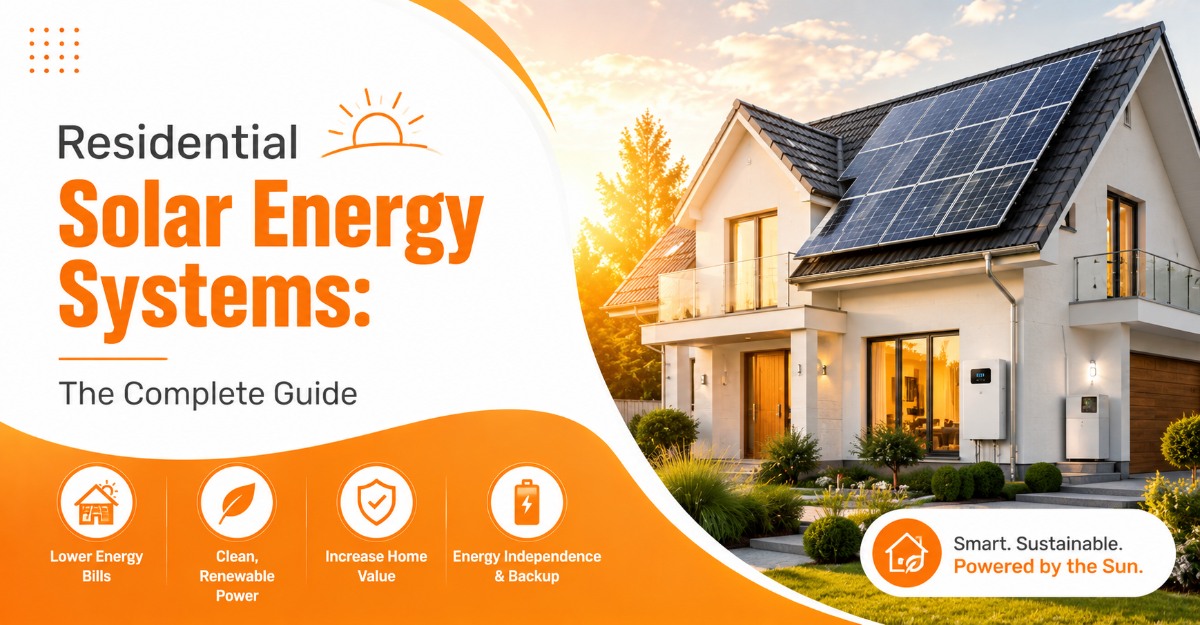
A residential solar energy system is a rooftop or ground-mounted photovoltaic (PV) installation that converts sunlight into household electricity using solar panels, an inverter, and a connection to your main electrical panel and the utility grid. A typical 8 kW home system costs $18,000 to $24,000 before incentives and offsets most or all of a household’s annual power use.
Key Facts at a Glance
- A standard residential PV system ranges from 5 kW to 12 kW, using 12 to 30 panels rated 380 to 450 watts each.
- Grid-tied systems cost the least, roughly $2.40 to $3.30 per watt installed; adding a battery adds $8,000 to $16,000.
- Monocrystalline panels dominate the market with 20% to 23% efficiency and 25-year product warranties.
- Payback periods typically run 7 to 12 years, while panels keep producing for 25 to 30-plus years.
- Panels degrade about 0.4% to 0.5% per year, retaining roughly 88% to 92% of original output at year 25.
- Grid-tied systems automatically shut off during a blackout (anti-islanding) unless paired with battery storage.
What Is a Residential Solar Energy System?
A residential solar energy system is an integrated set of hardware that captures sunlight and turns it into usable 120/240-volt alternating current (AC) for a single-family home. The core stack is four parts: photovoltaic panels, a DC-to-AC inverter, a racking and mounting structure, and the electrical balance-of-system that ties into your breaker panel and, in most cases, the utility grid.
The defining characteristic is scale and application. Unlike a utility solar farm rated in megawatts, a home system is sized to one household’s consumption, usually 5,000 to 15,000 kWh per year. It lives on a south-facing roof pitch in the Northern Hemisphere, or on a ground mount when roof space, orientation, or shading rules the roof out. Modern systems also include a monitoring gateway that reports production to a phone app at the panel or system level.
How Does a Home Solar System Work?
A home solar system works by using the photovoltaic effect to knock electrons loose inside silicon cells, producing direct current (DC) that an inverter converts to grid-compatible AC. The sequence takes microseconds and runs continuously whenever daylight hits the array.
Here is the flow from sunlight to socket:
When production exceeds demand, the surplus either charges a battery or flows backward through a bi-directional net meter to the grid, earning a bill credit. At night or during heavy cloud cover, the home pulls supplemental power from the grid or battery. One practitioner detail the AI Overview omits: installers deliberately oversize the panel array relative to inverter capacity, a DC-to-AC ratio of about 1.15 to 1.3, so the inverter runs near its efficient peak for more hours of the day.
What Are the Three Types of Residential Solar Systems?
The three types of residential solar systems are grid-tied, hybrid (solar-plus-storage), and off-grid, and they differ mainly in how they handle excess power and grid outages. Grid-tied is cheapest and most common, hybrid adds blackout protection, and off-grid cuts the utility cord entirely.
Grid-tied systems connect directly to the utility with no battery. They deliver the best return on investment but have zero blackout resilience because of anti-islanding: to protect line workers, code (IEEE 1547 and UL 1741 in the US) forces the inverter to shut down when grid voltage disappears, even at noon.
Hybrid systems add a battery and a hybrid inverter with an automatic transfer switch. During an outage the switch isolates the home into “island mode,” running critical loads off stored energy. This is the fix for the grid-tied blackout blind spot.
Off-grid systems have no utility connection at all, so they require an oversized array, a large battery bank, and usually a backup generator to survive multi-day storm stretches.
| Criterion | Grid-Tied | Hybrid (Storage) | Off-Grid |
|---|---|---|---|
| Typical installed cost (8 kW) | $18,000 to $24,000 | $28,000 to $40,000 | $40,000 to $65,000+ |
| Battery included | No | Yes (10 to 20 kWh) | Yes (20 to 40 kWh) |
| Backup during outage | None | Yes (critical loads) | Full (it is the only source) |
| Payback period | 7 to 12 years | 10 to 15 years | Not ROI-driven |
| Best for | Bill savings in serviced areas | Outage-prone or high-value homes | Remote, off-line properties |
What Components Make Up a Solar Energy System?
A residential solar energy system is built from five component categories: photovoltaic panels, an inverter, racking and mounting, an optional battery, and monitoring hardware. Panel and inverter choices drive most of the price and performance differences between quotes.
Which Solar Panel Type Should You Choose?
Monocrystalline panels are the right choice for nearly every residential roof in 2026, because their higher efficiency fits more wattage into limited roof area. Polycrystalline has been largely discontinued, and thin-film is a niche pick for RVs, boats, or weight-limited surfaces.
| Panel Type | Efficiency | Cost per Watt | Lifespan | Best Fit |
|---|---|---|---|---|
| Monocrystalline | 20% to 23% | $0.30 to $0.50 | 25 to 30+ yrs | Standard homes, small roofs |
| Polycrystalline | 15% to 17% | $0.25 to $0.40 | 23 to 27 yrs | Legacy, rarely sold new |
| Thin-film | 11% to 15% | $0.20 to $0.35 | 15 to 20 yrs | RVs, curved or light roofs |
Common residential panels now come from Qcells, REC, Maxeon (SunPower), Silfab, and Canadian Solar, typically rated 400 to 450 watts each.
String Inverter, Microinverter, or Power Optimizer?
Microinverters or power optimizers suit shaded or multi-pitch roofs, while a plain string inverter is the cheapest option for a simple, unshaded roof. The tradeoff is module-level performance versus cost.
| Inverter Type | Level | Shading Handling | Cost Impact | Named Example |
|---|---|---|---|---|
| String inverter | Whole system | Weakest panel drags the string | Lowest | Fronius Primo, SMA Sunny Boy |
| Microinverter | Per panel | Isolates each panel fully | +$1,000 to $3,000 | Enphase IQ8 |
| Power optimizer | Per panel + string | Isolates loss, cheaper than micro | Middle | SolarEdge with HD-Wave |
For batteries, lithium iron phosphate (LiFePO4) has become the standard chemistry because it tolerates 6,000-plus cycles and resists thermal runaway. Common units include the Tesla Powerwall 3, Enphase IQ Battery, and FranklinWH aPower.
How Much Do Residential Solar Systems Cost in 2026?
Residential solar costs $2.40 to $3.30 per watt installed in 2026 before incentives, so an 8 kW grid-tied system runs $18,000 to $24,000. Battery storage adds $8,000 to $16,000. These figures track benchmarks published by NREL and the EnergySage Marketplace, though pricing varies widely by state and installer.
| System Size | Homes It Fits | Gross Cost (grid-tied) | With 15 kWh Battery |
|---|---|---|---|
| 5 kW | Small, low-use home | $12,000 to $16,500 | $22,000 to $30,000 |
| 8 kW | Average US household | $18,000 to $24,000 | $28,000 to $38,000 |
| 12 kW | Large or all-electric home | $28,000 to $38,000 | $40,000 to $52,000 |
Two metrics govern the economics. Capacity factor, the share of nameplate output a system actually delivers over a year, runs 15% to 25% depending on local sun. (The AI Overview states this is measured against “full nameplate capacity 25 hours a day,” which is an error: the correct reference is 24 hours a day.) Degradation is the second: premium panels now warrant roughly 0.25% to 0.4% annual loss, so a modern panel still produces about 88% to 92% of day-one output at year 25, slightly better than the AI Overview’s 85% estimate.
Financing changes the real number. Paying cash yields the fastest payback; a solar loan at 6% to 9% APR spreads cost but adds interest; and a lease or power purchase agreement (PPA) means zero upfront cost but a third party owns the panels and keeps the incentives.
What Solar Incentives and Tax Credits Are Available?
Solar incentives fall into three buckets: federal tax credits, state and local rebates, and net metering. These can cut net cost by 30% to 50%, but the federal picture changed sharply in 2025, so verify current rules before you sign.
Under the 2022 Inflation Reduction Act, the federal Residential Clean Energy Credit (Section 25D) refunded 30% of an owned system’s cost. Legislation passed in 2025 ended that credit for systems placed in service after December 31, 2025. Homeowners installing in 2026 should confirm eligibility directly, since third-party owned lease and PPA systems may still access commercial-side credits even where the homeowner credit has lapsed. Because this is active policy that shifts, check the current IRS guidance or a tax professional rather than relying on any single date.
Net metering remains the quiet workhorse. It credits exported solar at or near retail rates, but many utilities have moved to lower “net billing” or time-of-use export rates (California’s NEM 3.0 is the widely cited example), which meaningfully changes the value of a battery versus a grid-tied-only system.
How Many Solar Panels Does a Home Need?
Most homes need 15 to 25 panels, or roughly a 6 kW to 10 kW system, to offset a typical 10,000 kWh annual bill. The exact count depends on your usage, your local peak sun hours, and panel wattage.
Use this practitioner formula. First, divide annual kWh by 365 to get daily use. Divide that by local peak sun hours (about 4 in the Northeast, 5.5 in the Southwest) to get required kW. Then divide system watts by panel watts for the count. A home using 30 kWh per day in a 5-sun-hour region needs about 6 kW, or roughly 15 panels at 400 watts each.
| Monthly Bill | Annual kWh | System Size | Panels (at 420 W) |
|---|---|---|---|
| $80 | ~7,000 | 5 to 6 kW | 12 to 15 |
| $150 | ~11,000 | 8 to 9 kW | 19 to 22 |
| $250 | ~18,000 | 12 to 14 kW | 29 to 34 |
A rule of thumb from field installers: size to your highest-consumption season, not your mildest. Modeling a system on a mild April bill leaves you short during peak summer air-conditioning or winter heat-pump loads.
How Long Does Solar Installation Take?
A residential solar installation takes 2 to 5 months from contract to switch-on, even though the physical build is only 1 to 3 days. Permitting and utility approval, not construction, consume most of the timeline.
The final bottleneck is Permission to Operate (PTO). The utility must inspect the grid isolation, install a bi-directional meter, and issue written approval before you may legally energize the system. In congested interconnection queues, PTO alone can stretch 4 to 8 weeks.
Are Residential Solar Systems Worth It?
Residential solar is worth it for most homeowners with a sunny roof, an electric bill above $100 a month, and plans to stay 8-plus years, because savings over a 25-year lifespan usually total $15,000 to $50,000. It is a weaker fit for heavily shaded roofs, very low bills, or homes about to be sold.
Two honest limitations deserve airtime. First, if your roof has under 8 years of shingle life left, budget $4,000 to $8,000 to remove and reinstall the array during a future re-roof, a cost that can erase early savings. Second, in regions that scrapped 1-to-1 net metering, oversizing beyond your own daytime use wastes money, because exported power now earns pennies rather than retail credit.
Common Mistakes When Going Solar
The most common solar mistakes involve sizing, roof condition, shading, and contract type. Each is avoidable with upfront diligence.
- Sizing on the wrong bill. Homeowners quote a mild-month bill and end up 20% short in summer. Size to peak-season load.
- Ignoring roof age. A 25-year array over a 5-year roof forces an expensive teardown later.
- Underestimating tree growth. A clear-in-winter roof can lose 15% to 30% of production once summer canopies fill in, and saplings become shade problems within five years.
- Signing a non-transferable lease or PPA. A 20-year third-party contract can stall a home sale when buyers refuse to assume it.
How to Troubleshoot a Home Solar System
Most home solar faults are minor and fall into four categories: total production loss, single-panel underperformance, monitoring dropouts, and false ground-fault alerts. Check the simplest cause first.
- Zero output, dark inverter screen (daytime): A grid surge likely tripped the AC disconnect or a breaker. Reset the solar disconnect and main breaker before calling anyone.
- One panel low on the app: Look for bird droppings, wet leaves, or grime. If the surface is clean, suspect a failed bypass diode or a loose MC4 connector.
- Monitoring offline, panels still producing: A changed Wi-Fi password or router usually caused it. Reconnect the inverter through its local setup app; production never stopped.
- Ground-fault alert during heavy rain: Moisture in worn insulation can trigger a temporary fault. If it clears once dry, ignore it; if it persists, a wire has likely chafed against the racking and needs an installer.
Which Solar System Is Right for You?
The right system depends on your goal: lowest cost, blackout protection, or full independence. Match your profile below.
If you are on the fence, the savings-seeker grid-tied setup is the default for a serviced suburban home, and you can add a battery later if outages become a concern.
Frequently Asked Questions
How long do residential solar panels last? Residential solar panels last 25 to 30-plus years and carry 25-year performance warranties. Output declines slowly at 0.25% to 0.5% per year, so a well-installed system still produces roughly 88% to 92% of its original power at year 25 before any hard failure.
Do solar panels work during a power outage? Grid-tied solar panels shut off during an outage because of anti-islanding safety rules, even in full sun. Only hybrid systems with a battery and automatic transfer switch keep powering your home during a blackout, and typically only the critical loads on a dedicated sub-panel.
How much maintenance do solar systems need? Solar systems need minimal maintenance: occasional rinsing of dust or pollen and an inverter check every few years. Budget a possible inverter replacement at year 10 to 15 for string models ($1,500 to $3,000). Microinverters usually carry 25-year warranties matching the panels.
Can I add a battery to an existing solar system? Yes, you can add a battery to an existing solar system, but a standard string inverter may require an AC-coupled battery or a hybrid inverter swap. Retrofits cost $9,000 to $18,000 depending on capacity and whether new electrical work or a sub-panel is needed.
Will solar panels increase my home value? Owned solar panels typically raise home value, with studies from Lawrence Berkeley National Laboratory finding a measurable price premium for PV homes. Leased systems can have the opposite effect, since buyers must agree to assume the remaining contract.
How many years until solar pays for itself? Most residential solar systems pay for themselves in 7 to 12 years through utility bill savings. Payback is fastest with high electricity rates, strong net metering, cash purchase, and abundant sun, and slowest with batteries, low bills, or reduced export credits.
The information above is general guidance, not financial or tax advice. Solar economics vary by state, utility, and roof, so get site-specific quotes.