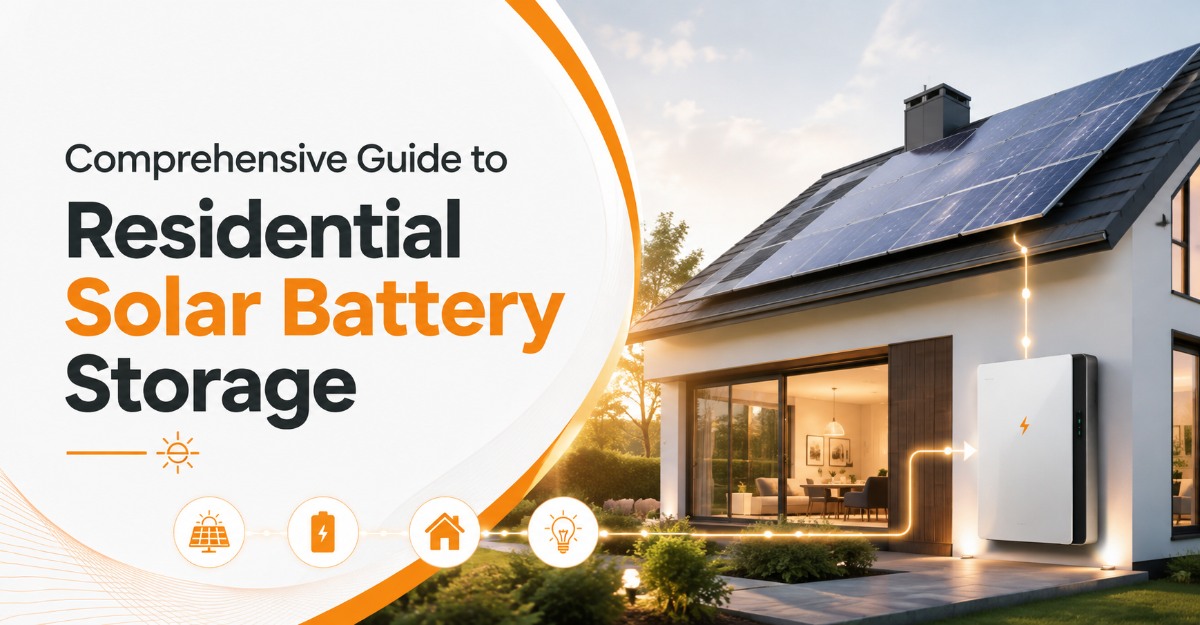
Residential solar battery storage is a hardware system that captures excess direct current electricity generated by photovoltaic panels and stores it chemically for future household use. This technology allows homeowners to maintain power during grid outages, avoid peak utility rates, and maximize self-consumption of renewable energy generation.
How Does a Home Energy Storage System Work?
A home energy storage unit functions by communicating with the solar inverter and main electrical panel to balance generation against household consumption. The network routes excess electricity into chemical cells during peak sunlight and reverses the electrical flow when panel production drops below the structural demand. This real-time balancing prevents excess power from exporting to the utility grid at low wholesale compensation rates. Advanced configurations monitor weather patterns and utility rate changes to optimize exactly when the unit charges or discharges.
The operational flow follows a strict five-step mechanical procedure:
- Generation: Photovoltaic silicon cells absorb sunlight and generate Direct Current (DC) electricity.
- Inversion and Routing: The system identifies immediate household demand. If the home requires power, the inverter converts the DC energy into Alternating Current (AC) for immediate appliance use.
- Surplus Charging: When solar panel production exceeds the current electrical demand of the house, the integrated gateway directs the excess DC energy to charge the chemical cells.
- Deficit Discharging: During evening hours or heavy cloud cover, the house draws stored energy. The equipment converts the stored DC power back into AC power to run household circuits smoothly.
- Grid Islanding: If the local utility grid fails, an automatic transfer switch isolates the house from external power lines in under 20 milliseconds. This mechanical disconnection prevents stored energy from backfeeding into the grid and injuring utility repair workers.
What Are the Primary Battery Chemistries?
Modern energy storage systems rely primarily on lithium iron phosphate and nickel manganese cobalt architectures for high energy density. Manufacturers have largely abandoned older lead-acid designs due to their low cycle limitations, excessive weight, and poor depth of discharge capabilities. The specific chemical composition dictates the thermal safety, overall footprint, and long-term financial viability of the equipment. Homeowners must select a chemistry that matches their local climate and spatial constraints.
- Lithium Iron Phosphate (LFP): This composition currently controls roughly 95 percent of the global home market, according to the Wood Mackenzie US Energy Storage Monitor (2024). LFP units lack cobalt, making them environmentally cleaner to produce and highly resistant to high temperatures. They experience zero thermal runaway below 500 degrees Fahrenheit. While slightly heavier and bulkier than alternatives, they routinely exceed 6,000 charge cycles before significant degradation occurs.
- Nickel Manganese Cobalt (NMC): Legacy systems often utilized NMC cells to pack maximum energy into compact wall-mounted enclosures. These units provide exceptional energy density for tight indoor installations. However, NMC chemistry degrades faster under daily cycling and carries a higher inherent risk of thermal runaway if physical cells are punctured or overheat.
- Lead-Acid (AGM and Gel): Off-grid cabins historically relied on large banks of lead-acid units. They cost significantly less upfront but suffer from severe inefficiencies. Lead-acid configurations cannot discharge below 50 percent of their total capacity without causing permanent chemical damage, requiring owners to purchase twice the required total capacity to meet their actual energy needs.
How Do AC and DC Coupled Systems Compare?
The difference between AC and DC coupling lies in where the storage unit connects to the overall electrical architecture and how many times the electricity must be inverted. DC coupling shares a central inverter with the solar panels, while AC coupling requires a dedicated inverter housed internally within the battery unit. Choosing the correct architecture depends entirely on whether the homeowner is installing a brand-new solar array or retrofitting storage onto an existing solar network.
DC-coupled architectures keep energy in its native Direct Current state as it moves from the roof panels into the storage cells. This single-inverter setup minimizes energy loss, resulting in a system efficiency rating of up to 97.5 percent. Furthermore, DC systems can capture “inverter clipping.” When panels generate more power than a standard inverter can process, a DC system redirects that excess raw power straight into the battery instead of wasting it.
AC-coupled architectures operate entirely downstream of the primary solar inverter. The energy travels from the panels, converts to AC for the house, converts back to DC to enter the battery, and finally converts to AC again when discharged. This quadruple conversion drops overall round-trip efficiency to roughly 89 percent. However, AC systems represent the best solution for retrofitting, as they integrate with any existing panel brand without requiring homeowners to replace their original hardware.
| Feature Comparison | DC-Coupled Architecture | AC-Coupled Architecture |
| Wiring Configuration | Panels and storage share one hybrid inverter. | Storage utilizes a separate, dedicated microinverter. |
| Typical Efficiency | 95 to 97.5 percent. | 87 to 90 percent. |
| Best Application | Entirely new solar and storage installations. | Retrofitting storage to existing solar panels. |
| Clipping Capture | Can store excess power beyond inverter limits. | Cannot capture clipped solar panel production. |
| Hardware Example | Tesla Powerwall 3. | Enphase IQ Battery 5P. |
Key Performance Metrics for Evaluation
Evaluating a home storage system requires reading past marketing materials to analyze exact kilowatt-hour capacities and continuous output specifications. A high storage capacity means nothing if the output rating cannot successfully start a heavy household appliance like a well pump. Buyers must match the physical metrics of the equipment directly to their specific household load calculations.
The primary measurement is usable capacity, measured in kilowatt-hours (kWh). This number represents the total volume of energy available for consumption. Most residential units offer between 10 kWh and 13.5 kWh of usable capacity. Depth of Discharge (DoD) indicates what percentage of that total capacity is safely accessible. Modern lithium systems feature a 100 percent DoD, meaning you can drain the entire 13.5 kWh without damaging the internal cell structure.
Continuous power output, measured in kilowatts (kW), dictates how many appliances can run simultaneously. A system with a 5 kW continuous rating can easily power lights, refrigerators, and televisions. However, starting a modern 4-ton central air conditioner requires massive instantaneous power. For this, buyers must examine the peak surge output. Some units offer 10 seconds of high-amperage output to handle the Locked Rotor Amps (LRA) required by heavy electric motors.
Leading Hardware Models on the Market
The residential market features heavy competition among centralized all-in-one enclosures and decentralized modular building blocks. Manufacturers optimize their hardware for different primary functions, ranging from maximum whole-home backup power to granular app-based automation. Comparing the market leaders reveals stark differences in integration strategies and warranty guarantees.
Tesla redefined the industry with the Powerwall series, and their latest iteration acts as a powerful central hub. It features built-in inverters and handles massive starting loads for whole-home backup. Conversely, Enphase takes a modular approach. By breaking storage into smaller 5 kWh increments, Enphase eliminates any single point of failure. If one Enphase module requires maintenance, the others continue running the house seamlessly. Newer entrants like FranklinWH focus specifically on smart load management, using proprietary relays to automatically shed non-essential loads during an outage.
| Hardware Model | Usable Capacity | Continuous Power | Chemistry | Architecture Type |
| Tesla Powerwall 3 | 13.5 kWh | 11.5 kW | LFP | DC Coupled Hybrid |
| Enphase IQ 5P | 5.0 kWh | 3.84 kW | LFP | AC Coupled Modular |
| FranklinWH aPower | 13.6 kWh | 5.0 kW | LFP | AC Coupled System |
| SolarEdge Home | 9.7 kWh | 5.0 kW | NMC | DC Coupled Hybrid |
How Much Does a Storage System Cost?
Homeowners can expect to pay between $8,000 and $15,600 fully installed for a standard 10 to 13.5 kilowatt-hour storage system. Permitting and interconnection approval require several weeks of administrative work, but the physical mounting process typically concludes within one or two days. Prices vary dramatically based on geographic location, local electrical labor rates, and the complexity of the main panel integration.
The raw hardware accounts for roughly half of the total project budget. The remaining costs cover the essential gateway device that allows for grid islanding, specialized electrical conduit, municipal permitting fees, and professional labor. Fortunately, the United States federal government offers the Residential Clean Energy Tax Credit, which effectively reduces the gross installation cost by 30 percent upon tax filing.
| Cost Category | Low-End Estimate | High-End Estimate | Percentage of Total |
| Battery Hardware | $4,500 | $7,500 | 50 percent |
| Gateway & Inverter | $1,500 | $2,500 | 18 percent |
| Professional Labor | $1,500 | $4,000 | 25 percent |
| Permits & Design | $500 | $1,600 | 7 percent |
Advanced Financial Returns and Grid Services
A modern energy storage unit generates financial returns by actively managing consumption timing against dynamic utility rate structures. Instead of merely waiting for grid failures, the hardware performs complex daily mathematical operations to minimize grid reliance. This daily cycling transforms a backup safety device into an active financial asset that accelerates the return on investment for the entire solar array.
The most common financial strategy is Time-of-Use (TOU) arbitrage. Many utility companies charge premium rates between 4:00 PM and 9:00 PM. A smart system will charge from cheap solar energy during the morning, then intentionally discharge that energy to power the house during the expensive evening window. If peak electricity costs 45 cents per kWh and off-peak costs 15 cents per kWh, the system saves the homeowner 30 cents for every single kWh shifted to battery power daily.
Beyond daily arbitrage, homeowners can enroll their equipment in Virtual Power Plant (VPP) programs. During extreme heatwaves when the electrical grid faces collapse, the utility company will pay homeowners a premium to discharge their stored energy back onto the public wires. A network of thousands of residential units acts as a decentralized power plant. The Lazard Levelized Cost of Storage (2023) indicates that participation in aggregated VPP events can reduce the payback period of home hardware by up to three years in dense urban markets.
Common System Design and Installation Mistakes
Failing to properly plan an installation results in failed municipal building inspections, excessive energy drain, and critical appliance failure during emergencies. Installers and homeowners must respect complex electrical codes and understand the physical limitations of structural mounting. Ignoring environmental constraints will void manufacturer warranties and create severe safety hazards.
The National Electrical Code (NEC) 2023 sets rigid placement mandates for high-capacity energy units. Homeowners frequently attempt to hide equipment inside small utility closets or heavily trafficked garages, only to fail inspection. Units require strict physical separation distances to prevent hypothetical localized fires from spreading. Furthermore, heavy lithium blocks often exceed 250 pounds. Mounting them to standard drywall without securing thick structural backing boards guarantees catastrophic wall damage.
| Code or Requirement | Measurement or Rule | Engineering Reasoning |
| NEC Unit Spacing | Minimum 3 feet between units. | Prevents cascading thermal events. |
| Bollard Protection | Required in garage vehicle paths. | Stops cars from puncturing chemical cells. |
| Structural Load | Mount to structural studs only. | 250-pound units will tear through drywall. |
| Essential Load Panel | Separate critical circuits physically. | Prevents water heaters from draining backup power. |
Frequently Asked Questions About residential solar battery storage
Can a battery power my home infinitely off-grid?
No, a standard residential unit cannot provide infinite off-grid power. Continuous power relies entirely on the daily weather conditions and solar production. A string of three heavily overcast days will deplete the storage cells faster than the solar panels can replenish them, eventually causing total system shutdown.
Will my solar panels work during a blackout without a battery?
Standard grid-tied solar panels automatically shut down during a utility blackout. This is a mandatory safety feature to prevent raw solar energy from traveling up the power lines and electrocuting line workers. You must install a battery with an islanding gateway to keep panels operational during outages.
How heavy is a standard energy storage unit?
A typical 10 to 13.5 kWh unit weighs between 250 and 350 pounds. Because of this extreme weight density, installation requires specialized lifting equipment and heavy-duty structural bracing. Installers frequently opt for floor-mount configurations to avoid the structural liability of hanging the equipment on residential stud walls.
Do these systems require active physical maintenance?
Modern lithium units require absolutely zero physical maintenance from the homeowner. They are sealed, solid-state enclosures with internal liquid or passive cooling systems. However, they do require active digital maintenance, meaning the homeowner must maintain a stable Wi-Fi connection to ensure the system receives vital software and firmware updates.
What happens to the equipment at the end of its life?
When the equipment degrades past 70 percent of its original capacity, the chemical cells are removed and transported to specialized recycling facilities. Current hydrometallurgical recycling processes can successfully recover over 95 percent of the raw lithium, iron, and copper, which manufacturers then process directly into brand-new cell architectures.