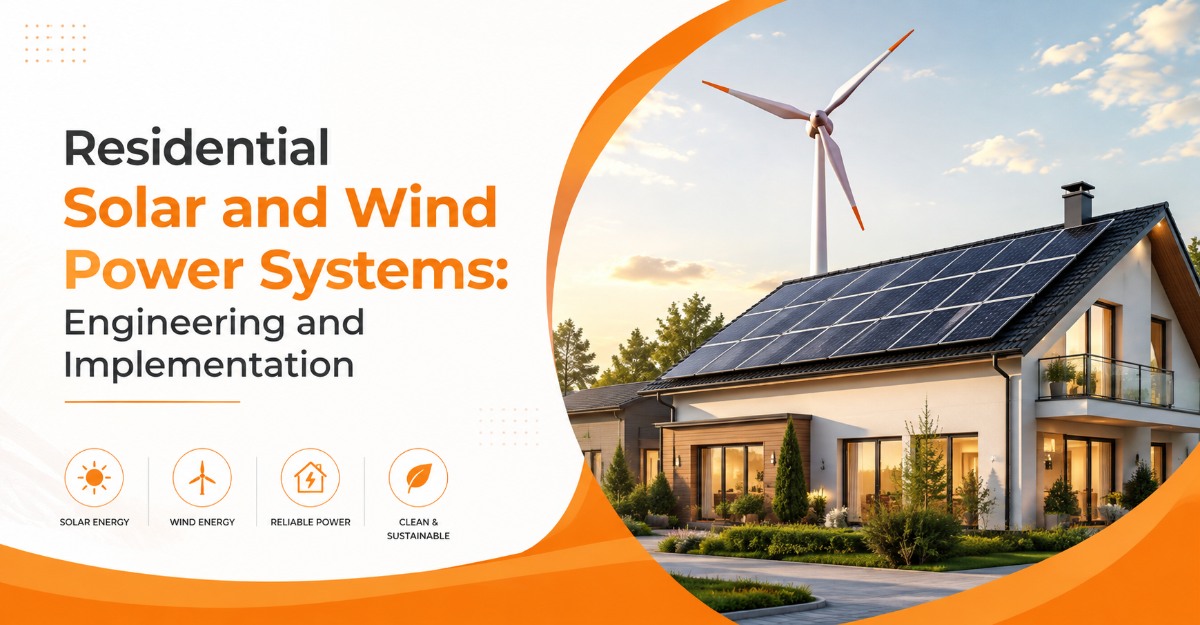
Residential solar and wind power systems are decentralized energy generation platforms that capture environmental photons and kinetic air movement to produce localized household electricity. These combined arrays allow property owners to offset municipal utility consumption, establish off-grid resilience during regional blackouts, and stabilize long-term energy expenditures through renewable mechanical and solid-state technology.
What Are Residential Solar and Wind Power Systems?
Residential solar and wind power systems combine photovoltaic module arrays with localized aerodynamic turbines to supply continuous electrical current to a domestic property. While solar energy relies on sunlight to excite electrons, wind energy utilizes moving air masses to spin an alternator. Integrating both technologies creates a complementary generation curve. Wind resources often peak during winter months and nighttime hours. Solar resources peak during summer days.
This complementary nature solves the primary weakness of standalone renewable setups. An isolated solar array produces zero energy after sunset, requiring heavy battery dependency. An isolated wind turbine sits idle on calm days. Combining them smooths the generation profile, lowering the total battery storage capacity required to keep a household operational 24 hours a day.
How Do Photovoltaic Solar Arrays Generate Electricity?
Photovoltaic arrays generate electricity by absorbing solar photons into silicon wafers, which knocks electrons loose from their atoms to create a flow of Direct Current (DC) electricity. This continuous electron flow travels through conductive wiring down to a central or micro-inverter. The inverter then converts the unstable DC power into synchronized 120V or 240V Alternating Current (AC). Standard household appliances require this AC format to function safely.
Modern panels typically utilize monocrystalline silicon cells. These cells offer efficiency ratings between 19% and 23%. They perform well in direct sunlight but suffer measurable output drops when partially shaded by trees or chimneys. To mitigate shading losses, installers frequently attach maximum power point tracking (MPPT) optimizers to the back of each panel. These devices ensure that one shaded panel does not drag down the performance of the entire electrical string.
How Do Micro-Wind Turbines Capture Kinetic Energy?
Micro-wind turbines capture kinetic energy by forcing moving air masses over aerodynamic fiberglass or carbon fiber blades, generating lift and rotational torque. This rotation spins a central drive shaft connected to a permanent magnet generator housed within the turbine nacelle. As the internal magnets spin past stationary copper coils, they induce an electrical current.
Unlike large industrial wind farms, residential turbines feature swept areas of 1.5 to 3 meters in diameter. They generally require cut-in wind speeds of at least 7 to 9 miles per hour (mph) to begin generating usable wattage. They reach their peak rated output at wind speeds between 25 and 30 mph. Most units incorporate automatic furling mechanisms. This safety feature physically turns the turbine blades away from the wind during severe gales to prevent catastrophic mechanical failure.
System Architectures: Grid-Tied, Off-Grid, and Hybrid
The foundation of any residential energy project lies in its relationship to the local municipal power grid. Engineers categorize installations into three primary architectures based on how they handle surplus electricity and backup storage.
Grid-tied architectures connect directly to the utility network without localized battery storage. They push excess daytime solar production outward to the grid, spinning the meter backward. The utility company credits the homeowner for this production, acting as a massive virtual battery. However, strict safety regulations require grid-tied inverters to shut down completely during a neighborhood power outage. This prevents the home system from back-feeding lethal voltage into power lines while utility workers attempt repairs.
Off-grid architectures sever all physical connections to the municipal utility. They rely entirely on massive, localized battery banks and liquid-fuel backup generators. If the solar array and wind turbine fail to produce enough energy to charge the batteries, the home loses power entirely. These setups demand strict electrical load management from the homeowner.
Grid-tied hybrid architectures combine the best of both approaches. They remain connected to the municipal grid for net metering benefits but include a moderately sized battery bank. When a blackout occurs, a specialized automatic transfer switch isolates the home from the grid. The system then pulls reserved energy from the batteries to power critical circuits like refrigerators and medical equipment.
| Architecture Type | Storage Mechanism | Blackout Resilience | Capital Cost Range | Ideal Property Profile |
| Pure Grid-Tied | Utility Grid (Net Metering) | None (System shuts down) | $12,000 – $22,000 | Urban/Suburban homes with stable grids |
| Off-Grid | Massive Battery Bank | Total Resilience | $35,000 – $70,000 | Remote cabins, rural homesteads |
| Grid-Tied Hybrid | Moderate Battery Bank | Powers critical loads only | $25,000 – $45,000 | Suburbs with frequent extreme weather |
| AC-Coupled Retrofit | Existing Grid + New Battery | Variable | $10,000 – $18,000 | Homes with pre-existing solar panels |
What Are the Core Hardware Components?
A reliable renewable energy installation requires specific hardware to capture, convert, and store raw voltage. Mismatching these components leads to severe efficiency losses and premature equipment failure.
The primary capture devices are the monocrystalline solar modules and the horizontal-axis wind turbine. However, the balance of system (BOS) components dictate how effectively that captured energy moves through the home.
Inverters dictate system capabilities. String inverters route all solar panels through a single central box, offering high reliability and low cost. Microinverters sit behind every individual solar panel, converting DC to AC on the roof. This microinverter approach prevents shading on one side of the house from impacting panels on the sunny side. Wind turbines require their own specialized charge controllers. These controllers include diversion loads (often resistive water heaters) to burn off excess voltage when the batteries reach full capacity. Without a diversion load, a spinning turbine could overcharge and destroy the battery bank.
Battery chemistry dominates the storage conversation. Lead-acid batteries present the lowest upfront cost but suffer from shallow depth-of-discharge limits (usually 50%). They require replacement every 3 to 5 years. Lithium Iron Phosphate (LiFePO4) batteries represent the modern standard. They allow an 80-95% depth of discharge and endure 4,000 to 6,000 charge cycles, easily lasting a decade or more under normal conditions.
| Component Category | Standard Hardware Option | Premium Hardware Option | Primary Function |
| Solar Modules | Polycrystalline (270W) | Monocrystalline PERC (400W+) | Converts photons to DC power |
| Inverter Technology | Central String Inverter | Microinverters (per panel) | Converts DC to household AC |
| Wind Generator | 400W 12V Turbine | 2kW 48V Turbine | Converts wind kinetic energy to DC |
| Storage Bank | Flooded Lead-Acid (FLA) | Lithium Iron Phosphate (LFP) | Stores excess energy for night use |
How to Size and Engineer a Hybrid Power Setup
Sizing a residential renewable energy system requires calculating the exact kilowatt-hour (kWh) consumption of the household and matching it against regional weather data. Guessing these numbers leads to drastically oversized, expensive hardware or chronically underpowered homes.
Engineers begin by conducting a load analysis. They review 12 months of utility bills to find the average daily kWh usage. A standard American home consumes roughly 30 kWh per day. Next, they factor in peak load. Peak load represents the maximum wattage the home might draw if the air conditioning, electric oven, and well pump all start simultaneously. The chosen inverter must handle this instantaneous surge without tripping a breaker.
Site evaluation dictates generation capacity. Solar potential relies on the concept of “peak sun hours.” A location in Arizona might receive 6 peak sun hours per day, while a home in Washington State might receive only 3. A 5-kilowatt (kW) solar array in Arizona will generate roughly 30 kWh daily (5 kW x 6 hours). That exact same array in Washington will only generate 15 kWh daily.
Wind resource evaluation requires aggressive scrutiny. Small turbines need smooth, non-turbulent laminar airflow. Ground clutter (trees and houses) creates turbulent air that robs the wind of its energy. A turbine placed on a standard residential roof will almost certainly fail to produce meaningful power due to roof-edge turbulence. Standard engineering practice dictates that the bottom of the turbine rotor must sit at least 30 feet above the tallest obstacle within a 500-foot radius.
What Is the Step-by-Step Installation Process?
Installing residential solar and wind power systems involves strict adherence to the National Electrical Code (NEC) and localized building standards. Attempting this workflow out of sequence often results in failed inspections and thousands of dollars in rework.
- Perform Site Feasibility and Shade Mapping: Technicians use tools like a Solar Pathfinder to digitally map exactly where tree shadows will fall across the roof in both summer and winter. For wind, they install a temporary anemometer to log localized wind speeds over a 90-day period.
- Execute Structural and Electrical Engineering: Draftsmen create detailed single-line electrical diagrams showing wire gauges, conduit sizes, and breaker ratings. A structural engineer reviews the roof trusses to ensure they can support the dead weight of solar panels (roughly 3 pounds per square foot).
- Acquire Interconnection Agreements and Permits: The homeowner submits the engineering plans to the local municipal building department for structural and electrical permits. Simultaneously, they file an interconnection application with the utility company to secure permission to back-feed power.
- Mount Structural Hardware: Installers locate the roof rafters and secure aluminum racking rails using waterproof flashing standoffs. For wind, a concrete foundation is poured for a freestanding monopole or guy-wired lattice tower.
- Run Conduit and DC Wiring: Heavy-gauge copper wiring is pulled through protective metal or PVC conduit from the roof and tower down to the main service panel location. Installers connect the solar modules in series or parallel strings depending on the inverter specifications.
- Install Inverters and Balance of System: The primary inverter, battery bank, and safety disconnect boxes are mounted to a fire-rated wall near the main electrical panel.
- Commission and Inspect the System: A municipal electrical inspector verifies grounding, wire sizing, and safety labels. Once passed, the utility company installs a bi-directional smart meter and issues formal Permission to Operate (PTO).
Financial Analysis and Return on Investment
Return on investment (ROI) depends entirely on the upfront capital expenditure, local utility rates, and available government incentives. Calculating ROI requires understanding the Levelized Cost of Energy (LCOE), which divides the total lifetime cost of the system by the total lifetime kilowatt-hours it will produce.
Most homeowners in the United States rely heavily on the federal Investment Tax Credit (ITC). According to Department of Energy (2024) guidelines, this credit allows taxpayers to deduct 30% of the total system cost from their federal income taxes. A $30,000 hybrid system immediately drops to an effective cost of $21,000 after applying the ITC.
The primary financial variable is the local net metering policy. Under traditional 1:1 net metering, the utility credits the homeowner at retail rates (e.g., 15 cents per kWh) for every unit exported. However, regions adopting policies like California’s NEM 3.0 only credit exported power at wholesale rates (often 3 to 4 cents per kWh). Under wholesale compensation models, the ROI on a standard grid-tied solar system plummets. To fix this, homeowners must purchase battery storage to self-consume their daytime energy rather than exporting it for pennies.
| System Configuration | Average Gross Cost | Net Cost (After 30% Tax Credit) | Est. Annual Savings | Typical Payback Period |
| 8kW Solar Only | $22,500 | $15,750 | $1,800 – $2,200 | 7 – 9 Years |
| 8kW Solar + 10kWh Battery | $33,000 | $23,100 | $2,000 – $2,400 | 9 – 11 Years |
| 2kW Wind Turbine (Tower Mount) | $18,000 | $12,600 | $900 – $1,300 | 11 – 15 Years |
| 10kW Hybrid (Solar + Wind + Battery) | $55,000 | $38,500 | $2,800 – $3,500 | 12 – 14 Years |
Data reflects typical national averages. Local labor rates and specific hardware choices will alter final figures.
How Do Local Zoning and Permitting Laws Affect Installations?
Navigating zoning ordinances represents the most significant non-technical hurdle in residential renewable deployments. Municipal governments heavily regulate structural alterations, aesthetic changes, and acoustic outputs in residential zones.
Solar installations generally enjoy protective legislation. Many states have enacted “Solar Access Laws.” These laws legally prohibit Homeowners Associations (HOAs) from banning rooftop solar panels. While an HOA might dictate that conduit pipes must be painted to match the roof, they cannot force a homeowner to place panels on the shaded north side of the house simply to hide them from street view.
Wind turbines face a far harsher legal landscape. Because effective turbines must clear the surrounding tree line by 30 feet, residential towers frequently exceed 60 to 80 feet in total height. Most suburban municipal zoning codes cap accessory structures at 35 feet. Securing a height variance requires attending public zoning board meetings and presenting engineering data. Furthermore, neighbors frequently file complaints regarding the acoustic noise. A typical residential turbine generates 45 to 55 decibels of noise at the base of the tower. This is comparable to the hum of a household refrigerator. To comply with noise ordinances, engineers must calculate the acoustic setback distance from the property line before breaking ground.
Routine Maintenance and Troubleshooting Protocols
All mechanical and electrical systems degrade over time. While solar arrays lack moving parts and require minimal oversight, wind turbines operate under immense physical stress and require aggressive preventive maintenance schedules. Ignoring these schedules leads to rapid bearing failure and blade delamination.
According to the National Renewable Energy Laboratory (2023) reliability reports, solar panel degradation averages 0.5% per year. The only physical maintenance required is periodic cleaning. Dust, pollen, and bird droppings block sunlight and cause localized heat buildup within the panel cells. Homeowners should safely rinse panels with water early in the morning when the glass is cool to prevent thermal shock and cracking.
Wind turbines require annual mechanical inspections. The vibrations caused by high wind speeds routinely loosen structural bolts and guy wires. Turbine owners must manually brake the blades, lower the tower using a mechanical winch, and inspect the leading edge of the fiberglass blades for erosion. Even minor blade damage throws the spinning rotor out of balance, amplifying vibrations that will eventually destroy the internal generator bearings.
Common Inverter and Battery Faults
When a residential system drops offline, the central inverter is usually the culprit. Inverters handle immense thermal loads while converting DC to AC power.
- Ground Fault Errors: This occurs when moisture enters a DC connector on the roof, allowing electricity to arc to the metal racking. The inverter instantly shuts down to prevent fires. Technicians must trace the roof wiring to locate and replace the compromised connector.
- Thermal Derating: If an inverter is installed in a garage that reaches 110 degrees Fahrenheit in the summer, it will intentionally throttle its power output to protect internal circuitry. Installers solve this by moving the inverter to a shaded exterior wall.
- Battery Voltage Imbalance: In lead-acid banks, individual battery cells can drift out of sync. This requires a monthly “equalization charge,” which intentionally overcharges the bank slightly to boil the battery acid and strip sulfation off the internal lead plates. Lithium batteries manage this automatically via built-in Battery Management Systems (BMS).
| Maintenance Task | Frequency | Applicable Technology | Action Required |
| Module Cleaning | Bi-Annually | Solar Arrays | Soft rinse to remove dust and debris accumulation |
| Bolt Torquing | Annually | Wind Turbines | Tighten all tower and nacelle structural bolts to spec |
| Battery Terminal Cleaning | Annually | Lead-Acid Storage | Clean corrosion off terminals and apply dielectric grease |
| Inverter Filter Swap | Bi-Annually | All Systems | Clean or replace air intake filters to prevent overheating |
Frequently Asked Questions About Residential Solar and Wind Power Systems
Can I run my central air conditioner entirely on solar and wind power?
Yes, but doing so requires significant battery and inverter capacity. Central air conditioners demand massive surge currents to start their compressors. A standard 3-ton AC unit might require an inverter capable of pushing 8,000 watts simultaneously. You will need a heavy-duty hybrid inverter and at least 20 kWh of lithium battery storage to prevent system overloads during the summer.
What happens to my solar panels during a severe hailstorm?
Modern solar panels feature tempered glass rated to withstand direct impacts from one-inch hailstones traveling at 50 mph. While extreme storms can shatter panels, catastrophic damage is rare. If damage does occur, a standard homeowner’s insurance policy usually covers roof-mounted solar replacements under the dwelling coverage clause.
How do I know if my property has enough wind for a turbine?
You should review localized wind maps provided by the Department of Energy or regional meteorological services. However, micro-siting is critical. You must install a digital anemometer on a tall pole precisely where you intend to build the turbine tower. Let it record data for at least three months during your windiest season to verify your average wind speeds exceed 10 mph.
Is an off-grid system illegal in city limits?
It is not explicitly illegal to generate your own power, but municipal building codes generally require all primary residential dwellings to maintain an active connection to the municipal sewer and water lines. Consequently, municipalities often revoke certificates of occupancy if a homeowner physically cuts the utility grid lines. You can remain grid-tied but draw zero grid power by relying entirely on your batteries.
How heavy are lithium battery banks for home storage?
Lithium Iron Phosphate (LFP) batteries are remarkably dense. A typical 5 kWh LFP server rack battery weighs approximately 100 pounds. A full home backup system requiring 30 kWh of storage will weigh roughly 600 pounds. This hardware is typically floor-mounted in a garage or basement because standard wood-framed walls cannot safely support the sheer weight.