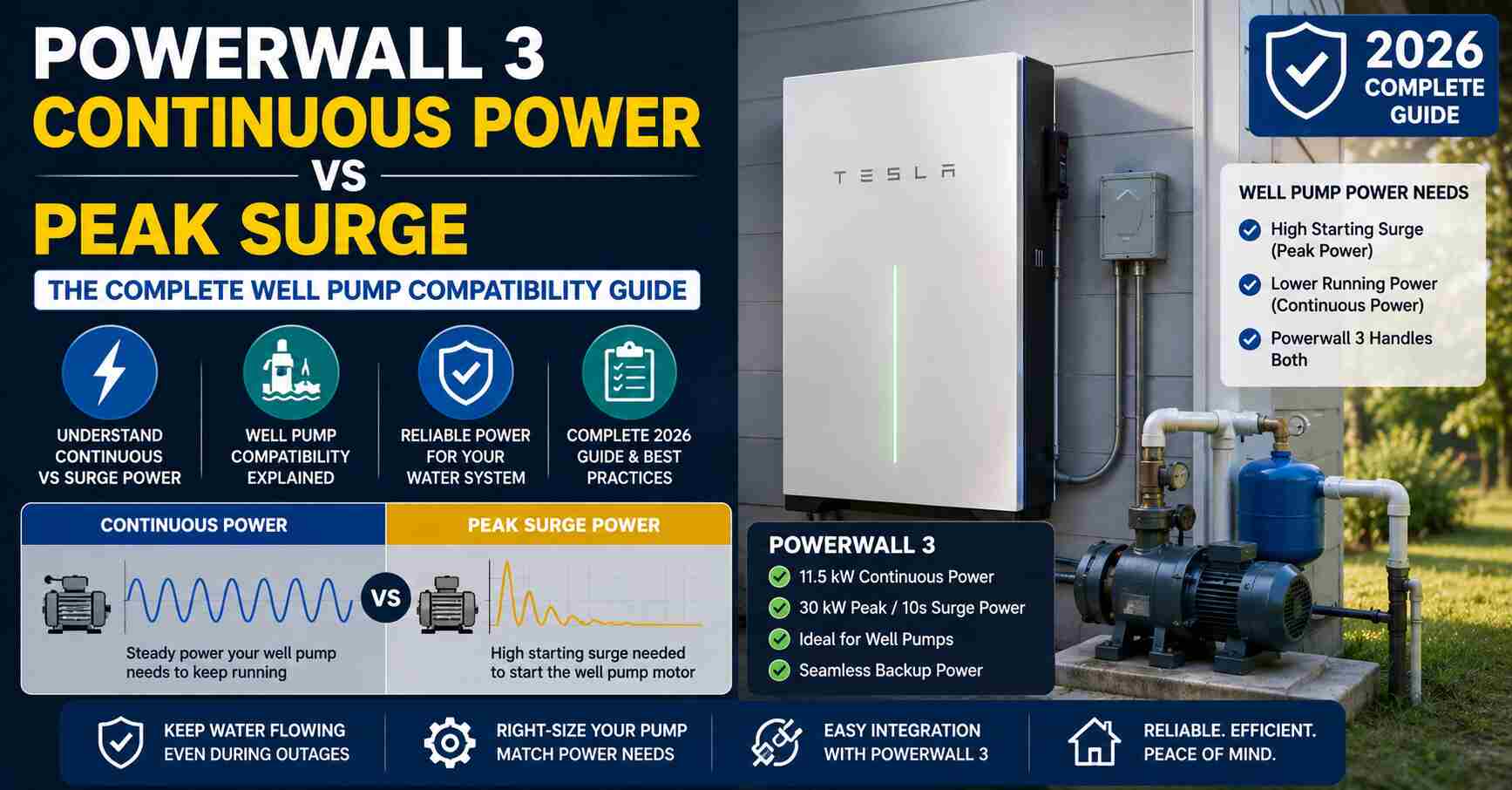
If you live on well water and you’re shopping for battery backup, one question matters more than any other spec sheet claim: when the grid goes down, will your well pump actually turn on, and will it keep running long enough to fill a shower or water the garden?
That question has two different answers, because a battery like the Tesla Powerwall 3 has two different power ratings that behave nothing alike. One number describes what the battery can sustain all day. The other describes what it can survive for a fraction of a second. Confusing the two is the single most common mistake homeowners make when sizing backup power for a well.
This guide breaks down exactly how Powerwall 3 continuous power and peak surge capacity apply to real well pump loads, horsepower by horsepower, and shows you the specific engineering fixes (soft starters, VFDs, pressure tank upsizing, and unit stacking) that turn a marginal setup into a bulletproof one.
Continuous Power vs Peak Surge: Why the Distinction Matters
Every AC-coupled home battery publishes two headline numbers, and well pump owners need to understand both before trusting either.
Continuous power is the amount of energy the inverter can deliver indefinitely, hour after hour, without overheating or derating. For the Powerwall 3, that figure is 11.5 kW AC, whether the unit is grid-tied or fully islanded in backup mode. This is the number that matters once your pump is already spinning and pulling its normal running load.
Peak surge capacity, measured in Locked Rotor Amps (LRA), is a completely different animal. It’s the momentary current an inverter can supply for a fraction of a second while a motor breaks free from a dead stop. The Powerwall 3 is rated for 185 A LRA, which is genuinely industry-leading among residential batteries and is the main reason it has become a popular choice for well pump backup specifically.
Why does the gap between these two numbers exist? Induction motors, the kind used in almost every single-phase well pump, don’t ramp up gently. To overcome the mechanical inertia of a stationary rotor and the initial resistance of moving water through the system, the motor briefly draws five to six times its normal running current. That spike lasts well under a second, but if the battery’s inverter can’t supply it, the pump simply won’t start, even though the battery has more than enough continuous capacity to run it once spinning.
This is exactly why a pump can look “safe” on paper based on its running wattage alone, and still trip a battery system that wasn’t sized with surge current in mind.
Powerwall 3 Well Pump Compatibility Matrix (Single Phase, 240V)
Here is how a single Powerwall 3 handles the full range of residential well pump sizes, based on typical single-phase 240V induction motor specifications.
| Well Pump Size (HP) | Avg. Running Load | Startup Surge (LRA) | Single Powerwall 3 Status | Recommended Action |
|---|---|---|---|---|
| 1/2 HP | 0.8 – 1.0 kW | 30 – 35 A | Fully Compatible | No special configuration needed |
| 3/4 HP | 1.2 – 1.5 kW | 40 – 50 A | Fully Compatible | Runs cleanly alongside normal household loads |
| 1 HP | 1.6 – 2.0 kW | 55 – 70 A | Safe, Standard Operation | Stable; avoid pairing with a simultaneous HVAC start |
| 1.5 HP | 2.1 – 2.5 kW | 75 – 90 A | Supported Safely | Watch for overlap with other heavy appliance starts |
| 2 HP | 2.8 – 3.5 kW | 105 – 130 A | Borderline / Conditional | Works alone, but a simultaneous HVAC or dryer start can trip the system |
| 3 HP+ | 4.0 kW+ | 150 – 200+ A | Not Recommended on a Single Unit | Requires a soft starter, VFD, or a second Powerwall 3 |
The takeaway: almost every residential well pump up to 1.5 HP will start and run comfortably on a single Powerwall 3 with zero modification. It’s the 2 HP and larger pumps, and any scenario where the pump might kick on at the same moment as a central air compressor or a well pump plus a sump pump, where surge stacking becomes the real risk.
How a Well Pump Fits Into Your Whole-Home Load Budget
A well pump rarely runs in isolation during an outage. The real question is how it interacts with everything else pulling from the same 11.5 kW continuous ceiling and 185 A surge floor.
Household loads generally fall into three tiers:
- Low-impact continuous loads (0.1 – 1.5 kW): LED lighting, WiFi routers, device chargers, laptops, refrigerators, freezers, CPAP machines, security cameras. These barely register against the Powerwall 3’s budget.
- Moderate mechanical loads (1.5 – 4.5 kW): 1/2 HP to 1.5 HP well or sump pumps, microwaves, coffee makers, toasters, dishwashers.
- High-demand inductive loads (4.5 – 11.5+ kW): Central air conditioners (3-ton to 5-ton compressors), Level 2 EV chargers, electric water heaters, clothes dryers.
The danger zone isn’t any single appliance. It’s the overlap. A 5-ton central AC unit alone draws a 130 to 160 A surge when it kicks on, already close to the Powerwall 3’s 185 A ceiling. If a well pump’s pressure switch happens to trip at that exact moment, the combined surge can exceed the inverter’s short-duration limit and cause a protective shutdown, even though either load on its own would have started fine.
This is the “simultaneous start” problem, and it’s the single most common real-world failure mode reported by battery backup owners on rural properties, not an outright inability to run the pump at all.
Three Engineering Fixes That Eliminate Surge Risk
If your pump sits in the borderline or high-risk category, or if you simply want zero risk of a nuisance trip, three proven strategies solve the problem without requiring you to buy a bigger battery.
1. Install a Digital Soft Starter
Standard single-phase induction pumps pull five to six times their running current just to break mechanical inertia at startup. A digital microprocessor soft starter (units like a Micro-Air EasyStart are common in the field) steps up voltage gradually across milliseconds instead of slamming the motor with full line voltage instantly.
The result: startup LRA surge drops by roughly 60 to 70 percent. A pump that would normally strike the system with 130 A can be tamed down to a gentle 40 to 45 A ramp. This single, relatively inexpensive component is often the difference between a 2 HP pump being “borderline” and being completely invisible to the rest of your backup load.
2. Upsize Your Pressure Tank
Most residential well systems ship with a 20 or 30-gallon pressure tank. Every time the tank empties, the pump has to fire back up, and every firing event is another surge event stacked against your battery’s power budget and another draw against its limited 13.5 kWh of stored energy.
Upgrading to an 80-gallon or 119-gallon pressure tank creates a much larger buffer of pressurized water between pump cycles. The pump turns on less frequently, which means fewer surge events per day and slower depletion of your battery’s total energy reserve during a multi-hour or multi-day outage. This is a mechanical fix with no electronics required, and it pays off even outside of outage scenarios by reducing wear on the pump motor itself.
3. Switch to a Variable Frequency Drive (VFD)
A VFD replaces the traditional pressure-switch-controlled, single-speed pump motor with a system that ramps speed up and down dynamically based on real-time water demand. Instead of an abrupt on/off cycle, the motor spins up gradually from zero.
This effectively flattens the LRA startup spike to close to 0 A above the pump’s normal running load, making even a 2 or 3 HP pump behave, from the battery’s perspective, almost identically to a purely resistive appliance. It’s the most complete solution of the three, though also the most expensive to retrofit onto an existing well system.
When One Powerwall 3 Isn’t Enough: Stacking Explained
For pumps at 3 HP or above, or for households that need to run a well pump, a central AC, and an EV charger simultaneously, stacking additional Powerwall 3 units scales both continuous power and surge capacity linearly.
| Units Stacked | Total Usable Energy | Continuous Power | Max Peak Surge (LRA) |
|---|---|---|---|
| 1 x Powerwall 3 | 13.5 kWh | 11.5 kW | 185 A |
| 2 x Powerwall 3 | 27.0 kWh | 23.0 kW | 370 A |
| 3 x Powerwall 3 | 40.5 kWh | 34.5 kW | 555 A |
| 4 x Powerwall 3 | 54.0 kWh | 46.0 kW | 740 A |
A two-unit stack alone essentially eliminates the “simultaneous start” risk for the vast majority of homes, since 370 A of headroom comfortably absorbs a well pump surge and a central AC surge occurring at the same instant. You can also add up to three DC expansion packs per primary inverter unit if what you need is more stored energy (longer runtime) rather than more instantaneous power.
Load Management: The Software Side of the Equation
Hardware isn’t the only lever. The Tesla app and Backup Gateway give you digital control over how your power budget gets allocated once the grid drops and the system enters island mode:
- Hardware interlocks: Non-essential heavy circuits (hot tubs, guest-house subpanels, secondary EV chargers) can be wired outside the critical backup loop entirely, so they simply lose power automatically during an outage and stop competing for surge headroom.
- Smart load prioritization: You can set strict battery reserve thresholds (for example, never drop below 20 percent unless an outage is actively in progress) and schedule high-draw appliances to run only during peak solar generation hours, preserving stored energy for essentials like your well pump and refrigeration.
- Load shedding rules: Some installers configure automatic shedding of secondary circuits the moment battery state of charge crosses a defined threshold, which protects your ability to keep pumping water even late into a multi-day outage.
Real-World Feedback: What Owners Actually Report
Solar and off-grid forums (Reddit’s r/TeslaPowerwall and r/solar among them) are full of firsthand reports from well pump owners running Powerwall systems. A few patterns come up consistently and are worth knowing before you buy:
- Owners running pumps at 1.5 HP or below almost universally describe the experience as “invisible,” with no noticeable dip or trip during startup.
- The most frequently reported issue isn’t the well pump alone. It’s the well pump starting at the same moment as a central AC compressor, which is precisely the simultaneous-surge scenario detailed above.
- Soft starters are the most commonly recommended fix in these communities for anyone with a 2 HP+ pump, cited repeatedly as a low-cost way to avoid nuisance trips.
Frequently Asked Questions
Will a single Powerwall 3 start my 1 HP well pump?
Yes. A 1 HP pump draws a 55 to 70 A surge, well within the Powerwall 3’s 185 A LRA ceiling, and its 1.6 to 2.0 kW running load is a small fraction of the 11.5 kW continuous budget.
How long will a Powerwall 3 run my well pump during an outage?
It depends on pump size and cycling frequency, not just running wattage. A 1.5 HP pump running continuously (for example, due to a stuck valve or heavy irrigation demand) can deplete a fully charged 13.5 kWh battery in under five hours by itself. Normal intermittent use with a properly sized pressure tank stretches that runtime considerably.
Do I need a soft starter for a 1 HP or smaller pump?
Generally no. Soft starters become valuable at 2 HP and above, or in any household where the well pump might start simultaneously with a central AC or another large motor load.
Can Powerwall 3 run a well pump and central AC at the same time?
A single unit can, but it’s conditional. If both loads happen to surge at the exact same instant, combined LRA can approach or exceed 185 A. A soft starter on the pump, or stacking a second Powerwall 3, removes this risk entirely.
The Bottom Line
The Powerwall 3’s 11.5 kW continuous rating and 185 A LRA surge capacity make it one of the strongest single-unit choices on the market for backing up a residential well pump, and for the vast majority of homes with pumps up to 1.5 HP, it works with zero modification. The risk isn’t the pump in isolation, it’s what else fires at the same moment. Know your pump’s exact horsepower, know what else shares your backup circuit, and apply a soft starter, larger pressure tank, or a second stacked unit wherever the numbers get tight.
If you’re mapping out an installation, the two details that determine your exact hardware stack are the horsepower rating stamped on your pump’s control box and whether you also need to back up a central AC or heat pump at the same time. Get a tailored load calculation from a licensed solar installer before you commit to a system size, since a $200 soft starter can sometimes save you the cost of an entire second battery.
Ready to size your system correctly? Talk to a qualified Powerwall 3 installer, share your pump’s horsepower and your home’s full backup load list, and get a written load calculation before you buy so you know exactly how many units, and which surge mitigation strategy, your property actually needs.