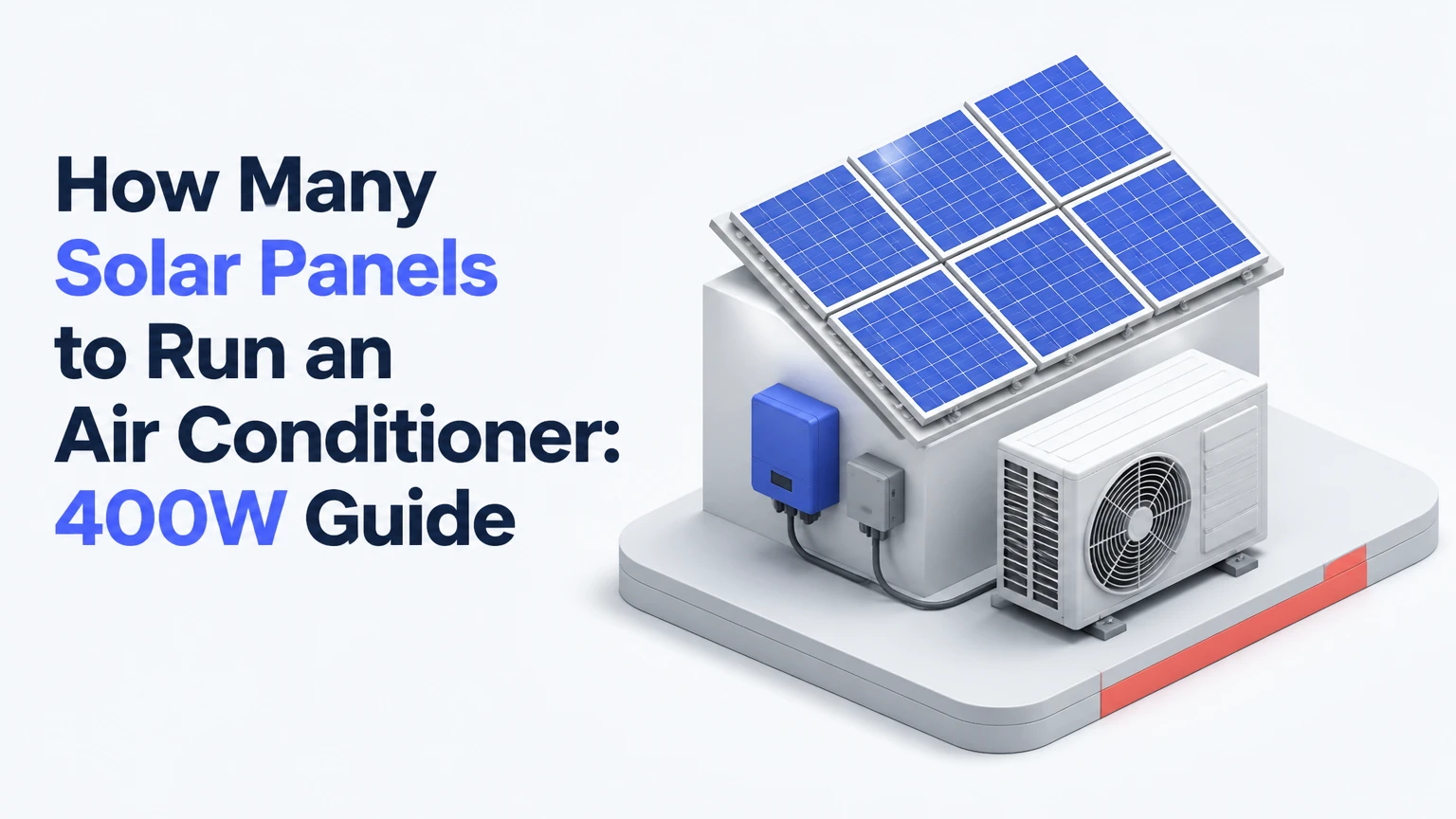
A typical 12,000 BTU inverter air conditioner requires about 4-6 400-watt solar panels for daytime operation under 5 peak sun hours, assuming roughly 1,000 running watts and normal system losses. A battery-backed system usually needs more panels because the array must replace stored energy as well as power the AC while it runs.
Key Facts at a Glance
- A 12,000 BTU air conditioner commonly consumes 700-1,200 running watts, depending on efficiency, indoor temperature, and compressor speed.
- One 400-watt solar panel typically delivers about 1.2-1.7 kWh per day after ordinary real-world losses in a location with 4-5 peak sun hours.
- A 1,000-watt AC running for eight hours uses approximately 8 kWh before inverter, wiring, cycling, and battery losses.
- A grid-tied solar array can offset air-conditioning energy without batteries, but standard grid-tied systems shut down during a utility outage.
- Solar panels must be sized for energy, while the inverter and battery must also handle the air conditioner’s starting and continuous power.
- The most reliable design uses a high-efficiency inverter mini-split, measured wattage, local peak-sun-hour data, and a battery only when nighttime or outage operation matters.
What Determines the Solar Panel Count?
Solar panel requirements depend on five linked values: the AC’s average electrical draw, daily operating hours, solar resource, panel wattage, and system efficiency. Cooling capacity identifies the approximate equipment class, but the electrical nameplate determines the actual solar load.
A 12,000 BTU label describes heat removal, not electricity consumption. Two 12,000 BTU units can draw different amounts because their EER, CEER, SEER2 rating, compressor design, refrigerant system, and operating conditions differ. A variable-speed mini-split may throttle down to a few hundred watts after reaching the set temperature, while an older fixed-speed window unit can cycle near its full rated load.
The U.S. Department of Energy’s Energy Saver guidance distinguishes cooling capacity from efficiency and recommends selecting properly sized, high-efficiency equipment. ENERGY STAR also uses certified efficiency metrics rather than BTU alone when comparing room and central air conditioners.
Which AC numbers should you use?
Use the electrical input watts printed on the rating plate whenever possible. If the label lists volts and amps, multiply them for an initial estimate:
Watts = volts × amps
That calculation can overstate or understate real consumption because motor loads may have a power factor below one, and the compressor does not necessarily run continuously. A plug-in energy meter is suitable for many 120-volt window units. A qualified electrician should measure hardwired 240-volt equipment with a clamp meter.
| Air conditioner | Typical cooling capacity | Typical running input | Typical 400W panels for daytime use |
|---|---|---|---|
| Small window unit | 5,000-6,000 BTU | 450-700 W | 2-3 |
| Efficient mini-split | 9,000-12,000 BTU | 500-1,200 W | 3-6 |
| Large mini-split or window unit | 18,000 BTU | 1,200-1,800 W | 6-9 |
| Central air conditioner | 24,000-36,000 BTU | 2,000-4,000 W | 10-20 |
The table shows planning ranges, not equipment guarantees. Central systems often have substantial duct, blower, standby, and startup loads that a small mini-split avoids.
How Do You Calculate Solar Panels for an AC?
Calculate the panel count by multiplying AC watts by daily runtime, dividing by system efficiency and peak sun hours, then dividing by panel wattage. Round up to the next whole panel and verify that the inverter can handle both continuous and startup demand.
Use this practical formula:
Panels = (AC running watts × hours per day) ÷ (peak sun hours × panel watts × system performance factor)
Use 0.75-0.85 as a typical performance factor for heat, dust, wiring, inverter conversion, panel mismatch, and other losses. A value of 0.80 is a reasonable first estimate. The National Renewable Energy Laboratory’s PVWatts tool models location, orientation, weather, and system losses for a more specific estimate.
Worked example: 12,000 BTU inverter AC
Assume:
- Average AC draw: 1,000 watts
- Runtime: 8 hours per day
- Peak sun hours: 5 per day
- Panel rating: 400 watts
- System performance factor: 0.80
First calculate energy:
1,000 W × 8 hours = 8,000 Wh, or 8 kWh
Then calculate the usable daily output of one panel:
400 W × 5 hours × 0.80 = 1,600 Wh, or 1.6 kWh
Finally:
8 kWh ÷ 1.6 kWh = 5 panels
Five 400-watt panels provide a 2 kW array. That array can replace approximately 8 kWh on a typical 5-peak-sun-hour day, but it may not deliver enough power at every moment during morning clouds, late afternoon, or extreme heat.
Why the simple calculation can fail
An AC rated at 1,000 watts may consume 8 kWh in eight hours only if the compressor operates continuously at that average. A thermostat-controlled fixed-speed unit might run 60% of the time and use less daily energy, while a poorly insulated room on a very hot day might run almost continuously.
Sizing from the maximum nameplate draw provides a safer electrical design. Sizing from measured average kWh gives a more realistic energy forecast. Use both: nameplate values for inverter and circuit capacity, and measured or manufacturer data for panel energy.
How Many Panels Does Each AC Size Need?
A 5,000 BTU window unit generally needs 2-3 400-watt panels for daytime cooling, while a 24,000 BTU system commonly needs 10-20 panels. The exact count changes with efficiency, runtime, climate, and whether the AC is a mini-split or central system.
The following table assumes five peak sun hours, a 0.80 performance factor, and daily operation during the solar production period. The running-watt figures are practical planning ranges rather than universal ratings.
| AC size | Typical average draw | Four-hour daytime runtime | Eight-hour daily runtime | Approximate 400W panels |
|---|---|---|---|---|
| 5,000 BTU | 500 W | 1.0 kWh | 2.0 kWh | 2-3 |
| 12,000 BTU | 1,000 W | 4.0 kWh | 8.0 kWh | 4-6 |
| 18,000 BTU | 1,600 W | 6.4 kWh | 12.8 kWh | 8-10 |
| 24,000 BTU | 2,200 W | 8.8 kWh | 17.6 kWh | 11-14 |
| 36,000 BTU | 3,500 W | 14.0 kWh | 28.0 kWh | 18-23 |
The four-hour column estimates energy used during a strong daytime cooling period. The eight-hour column represents total daily energy, so it requires more array capacity if cooling continues outside the strongest solar window.
Do You Need Batteries to Run an Air Conditioner on Solar?
Batteries are unnecessary for a grid-connected home that allows the AC to draw supplemental electricity from the utility. Batteries become necessary when the AC must operate after sunset, during a blackout, or when clouds reduce panel output below the compressor’s demand.
A grid-tied system sends solar power through an inverter and household electrical panel. Solar production offsets the AC and other loads in real time, while the grid supplies shortages. Utility compensation rules vary, so net metering should be checked with the local provider rather than assumed.
An off-grid system needs panels, a charge controller where applicable, batteries, an inverter, overcurrent protection, disconnects, and correctly sized conductors. The battery must be large enough for usable energy, not merely its nameplate capacity.
How large should an AC battery be?
Use this formula:
Battery nameplate capacity = AC watts × hours of battery operation ÷ (usable depth of discharge × battery efficiency × inverter efficiency)
For a 1,000-watt AC running four hours overnight, assume 80% usable depth of discharge, 90% battery efficiency, and 92% inverter efficiency:
1,000 × 4 ÷ (0.80 × 0.90 × 0.92) = 6.0 kWh
A practical design would therefore use approximately 6-7 kWh of lithium iron phosphate battery capacity, before adding lights, refrigerators, fans, pumps, or other loads.
| Nighttime AC requirement | Energy at AC load | Approximate LiFePO4 nameplate capacity | 48V battery equivalent |
|---|---|---|---|
| 500 W for 4 hours | 2.0 kWh | 3.0 kWh | 62 Ah |
| 1,000 W for 4 hours | 4.0 kWh | 6.0 kWh | 125 Ah |
| 1,600 W for 4 hours | 6.4 kWh | 9.5 kWh | 198 Ah |
| 2,200 W for 8 hours | 17.6 kWh | 26.5 kWh | 552 Ah |
The 48-volt equivalents use nominal voltage and rounded capacity. Battery management systems, temperature limits, maximum discharge current, and manufacturer warranties still govern the final choice.
Lead-acid batteries require more nameplate capacity because deep discharge shortens service life and high current reduces usable capacity. Lithium iron phosphate batteries usually provide more usable energy and tolerate higher cycling, but they cost more initially and require compatible charging controls.
Which Solar Setup Works Best?
A grid-tied array is usually the lowest-cost way to reduce daytime AC electricity bills. A hybrid battery system is better for backup and load shifting, while a direct-drive solar AC can be efficient for a dedicated daytime cooling application.
| System type | Battery required | Blackout operation | Typical inverter requirement | Best application |
|---|---|---|---|---|
| Grid-tied PV | 0 kWh | No | 3-8 kW grid-tied inverter | Suburban daytime cooling |
| Hybrid PV plus battery | 5-30 kWh for one AC | Yes, if backed-up circuits are designed | 3-8 kW hybrid inverter | Outage protection |
| Off-grid PV | 10-40 kWh for extended cooling | Yes | 3-10 kW off-grid inverter | Cabins and remote sites |
| Direct-drive DC AC | Optional | Model-dependent | Integrated DC inverter | Daytime-only cooling |
| Solar generator | 2-10 kWh portable | Yes, limited runtime | Built-in inverter | Renters and temporary use |
Grid-tied solar
Grid-tied solar does not create backup power by itself. Safety controls disconnect the inverter when grid voltage disappears, protecting utility workers from energized lines. A battery inverter with approved islanding and transfer equipment is required for outage operation.
Hybrid and off-grid solar
Hybrid systems can reserve battery capacity for outages, but running a compressor during a long blackout can exhaust storage quickly. An energy-management system may prioritize refrigeration, medical equipment, and communications before cooling.
Direct-drive solar air conditioning
Direct-drive systems accept solar DC through equipment-specific electronics and may blend panel power with grid or battery power. They can reduce conversion steps, but they are less flexible than a conventional AC connected to a whole-home solar array. Replacement parts and installer availability also deserve attention.
What Inverter Size Does an AC Need?
An inverter must exceed the AC’s continuous running watts and its startup or surge requirement. For a 1,000-watt inverter mini-split, a 2,000-3,000 watt inverter may be adequate, while an older compressor with a 2-3 times startup surge may require considerably more.
Variable-speed inverter compressors usually ramp gradually, reducing startup stress. Fixed-speed compressors can demand a short but substantial inrush current, especially at high refrigerant pressure or low line voltage.
Check four ratings:
- Continuous output watts.
- Surge output watts and surge duration.
- DC input current at the battery voltage.
- AC output voltage, frequency, and phase.
A soft-start device can reduce compressor inrush on compatible systems, but it does not reduce the AC’s energy consumption while cooling. It also must be installed according to the equipment manufacturer’s instructions by a qualified technician.
How Much Roof Space and Equipment Cost Are Required?
Six 400-watt panels typically occupy about 120-150 square feet before access clearances, roof setbacks, racking, and wiring paths. Panel price is only one part of the project because the inverter, mounting, protection equipment, labor, permitting, and batteries can exceed the module cost.
Typical U.S. planning ranges vary substantially by market and installation complexity. The figures below are broad 2025-style budgeting ranges, not quotations.
| Component or project | Typical quantity | Typical price range | Main variable |
|---|---|---|---|
| 400W solar panel | 1 module | $150-$300 | Brand, warranty, retailer |
| Six-panel array | 2.4 kW DC | $3,000-$7,000 installed | Roof, labor, permitting |
| Grid-tied inverter | 3-5 kW | $1,000-$3,000 installed | Brand and electrical work |
| 6 kWh LiFePO4 battery | 1 battery bank | $3,000-$8,000 installed | Enclosure, transfer equipment |
| Hybrid system for one AC | 3-5 kW inverter, 6-10 kWh battery | $8,000-$18,000 installed | Backup circuits and location |
| Off-grid AC system | 4-8 kW PV, 10-30 kWh battery | $15,000-$35,000 installed | Storage and site wiring |
The U.S. Department of Energy’s consumer guidance identifies equipment cost, installation, incentives, financing, and local electricity rates as separate parts of solar economics. A grid-tied system that offsets daytime cooling often has a stronger financial case than batteries purchased solely to operate an AC overnight.
What Makes Solar AC Systems Underperform?
Solar AC systems underperform when designers confuse cooling capacity with input power, use daylight hours instead of peak sun hours, ignore battery losses, or size an inverter only for running watts. Shading, high panel temperature, dirty modules, roof orientation, and inadequate ventilation can reduce output before the AC reaches its expected load.
Common failure modes
- The AC trips the inverter at startup: Compare compressor locked-rotor current with inverter surge capability, then consider a soft-start device.
- The AC works at noon but stops in late afternoon: Check shading, azimuth, panel string voltage, and whether the battery reserve setting is too high.
- The battery empties before morning: Measure actual AC kWh, reduce the thermostat demand, improve insulation, or increase usable battery capacity.
- The panels produce less than their label: Confirm irradiance, shade, module temperature, soiling, connector condition, and inverter clipping.
- The system works only with other appliances turned off: Add the refrigerator, pumps, fans, and standby loads to the simultaneous inverter calculation.
- The central AC starts but the lights flicker: Have a licensed electrician inspect voltage drop, conductor sizing, service capacity, and compressor starting current.
One counterintuitive design rule matters: adding panels does not solve an undersized inverter. More DC generation improves daily energy, but the inverter still needs sufficient AC output and surge capability at the moment the compressor starts.
Another practitioner rule is to cool the building before the hottest hours. Closing blinds, sealing duct leaks, cleaning filters, and raising the thermostat by 1-2 degrees can reduce compressor runtime more cheaply than adding panels, particularly in a poorly insulated room.
How Should You Size Solar for Different Situations?
The correct design changes with the operating schedule. Daytime-only cooling may need a modest array, while overnight cooling requires both additional daily generation and enough battery capacity to cover low-sun periods.
| Situation | Recommended AC type | Solar planning approach | Battery guidance |
|---|---|---|---|
| Apartment daytime cooling | 5,000-12,000 BTU inverter window unit | 2-6 portable or roof-mounted 400W panels | Optional |
| Efficient bedroom mini-split | 9,000 BTU variable-speed unit | 3-5 panels for daytime use | 3-6 kWh for short night use |
| Off-grid cabin | 12,000-18,000 BTU mini-split | 6-10 panels plus weather margin | 10-20 kWh typical |
| RV or van | Low-power 5,000-8,000 BTU unit | 600-1,600W portable or roof array | Usually limited by space |
| Whole-home central AC | 24,000-36,000 BTU system | 10-23 panels, subject to measured load | 15-40 kWh for extended backup |
| Cloudy coastal climate | High-efficiency inverter AC | Use conservative local PVWatts results | Add reserve for poor-sun days |
Renters should be cautious with portable solar generators. A generator labeled 2,000 watt-hours cannot run a 1,000-watt AC for two hours in practice because inverter losses, battery reserve limits, and compressor cycling reduce usable runtime.
How Can You Verify the Panel Estimate?
Verify the estimate with the AC nameplate, a power meter, local solar production modeling, and a worst-case operating scenario. A calculation is ready for installation review when the measured load, inverter ratings, battery reserve, circuit capacity, and expected solar production agree.
Follow this verification sequence:
- Record the AC model number, voltage, rated amps, cooling capacity, EER or SEER2, and startup information.
- Measure electricity use for several hot days, recording both peak watts and daily kWh.
- Enter the proposed array into NREL PVWatts using the actual location, roof direction, tilt, and system size.
- Apply a seasonal margin rather than using the annual average alone.
- Add every simultaneous household load to the inverter calculation.
- Confirm local utility interconnection, building permits, electrical rules, and equipment certifications.
- Have a qualified installer check conductor sizing, disconnects, grounding, rapid shutdown requirements where applicable, and battery clearances.
The largest uncertainty is usually not the panel’s advertised wattage. It is the AC’s average duty cycle during the hottest hours and the amount of solar production available at that same time.
FAQ
Can a 1,000-watt AC run on two 400-watt solar panels?
Two 400-watt panels produce 800 watts under laboratory conditions and less after temperature, wiring, and inverter losses. They cannot reliably supply a 1,000-watt AC continuously, although a battery or grid connection can provide the shortfall. Four to six panels are a more practical range for daily daytime operation.
How many solar panels run a 1.5-ton air conditioner?
A 1.5-ton, or approximately 18,000 BTU, air conditioner typically needs 8-10 400-watt panels for eight-hour daily cooling under five peak sun hours and a 0.80 system performance factor. A highly efficient inverter mini-split may require fewer panels than an older fixed-speed central unit.
Can solar panels run an AC without an inverter?
A conventional household air conditioner cannot connect directly to ordinary solar panels because the panels produce variable DC electricity and the AC expects stable AC voltage and frequency. A purpose-built DC solar air conditioner can accept photovoltaic input through integrated power electronics, subject to its voltage and current limits.
Is it cheaper to add solar panels or buy a battery?
Adding panels is usually cheaper when the objective is to offset daytime AC energy, while a battery is necessary for nighttime operation and backup. Battery economics depend on outage frequency, utility rates, time-of-use pricing, available incentives, replacement planning, and the value placed on cooling during outages.
What is the best air conditioner for solar power?
A properly sized variable-speed mini-split is usually the most solar-friendly option because it combines efficient part-load operation with lower startup stress. A high-efficiency inverter window unit can suit renters, while a central system may remain appropriate when whole-home ducts and simultaneous room cooling are required.
Can solar power run central air conditioning all day?
Solar can run central air conditioning all day when the array, inverter, service equipment, and utility connection are sized for the measured load. A 24,000-36,000 BTU central system commonly requires about 10-23 400-watt panels for an eight-hour schedule, with more capacity needed for batteries or weak winter sunlight.
The Bottom Line
The answer to how many solar panels to run an air conditioner is usually 2-3 panels for a small window unit, 4-6 panels for a 12,000 BTU inverter AC, 8-10 panels for an 18,000 BTU unit, and 10-23 panels for larger central systems using 400-watt modules. Calculate from measured watts, daily kWh, local peak sun hours, and a 0.75-0.85 performance factor. Add batteries only when nighttime or outage cooling is part of the requirement, and size the inverter separately for continuous and startup power.