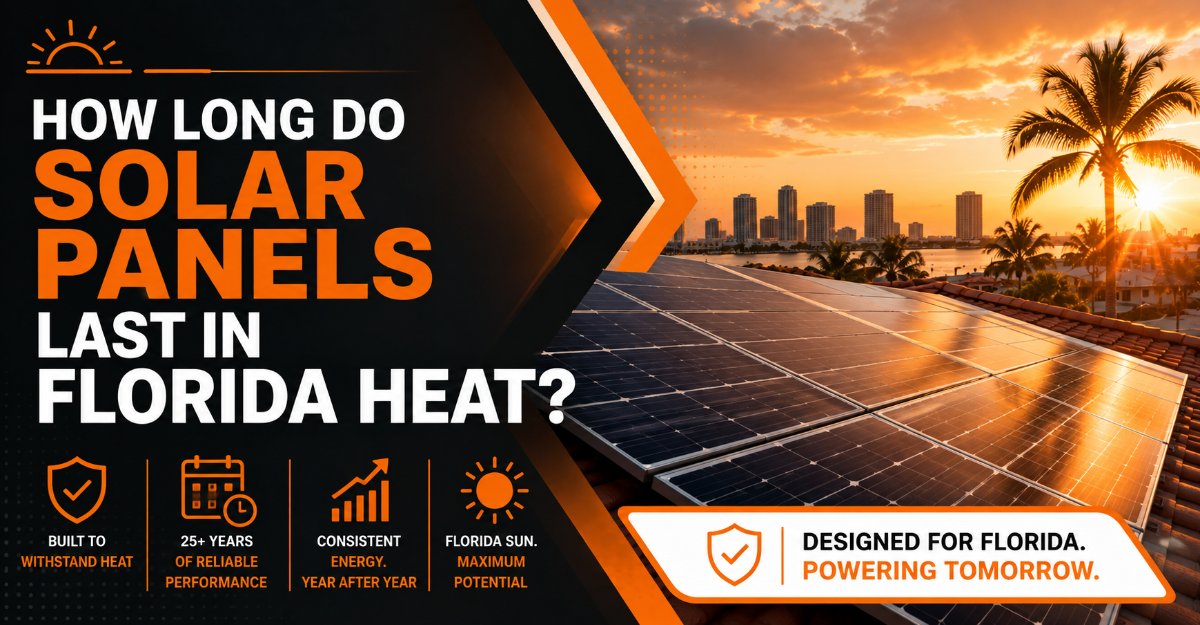
Solar panels installed in Florida heat typically last 25 to 30 years before their power generation drops below 80% of their original factory output. High-quality monocrystalline panels degrade at an average rate of 0.5% to 0.7% per year in the Sunbelt, though extreme ultraviolet exposure, constant thermal cycling, and coastal humidity require specific hardware choices to achieve this maximum lifespan.
Key Facts / At a Glance
- Average Degradation Rate: 0.5% to 0.7% annually across the state of Florida.
- Operating Temperatures: Panel surfaces routinely reach 65°C to 85°C (149°F to 185°F) during peak summer afternoons.
- Premium Lifespan: N-Type monocrystalline panels offer the highest heat tolerance, frequently maintaining viability for 35 to 40 years.
- Component Bottleneck: Standard string inverters fail in 10 to 12 years due to thermal stress, requiring at least one replacement during the solar array’s lifetime.
- Roofing Mismatch: Florida asphalt shingle roofs typically fail within 15 to 20 years, forcing costly solar removal and reinstallation before the panels actually expire.
What Causes Solar Panels to Degrade in Florida?
Photovoltaic (PV) modules are engineered for constant outdoor exposure, but intense heat actively accelerates their physical and chemical breakdown. Sustained high temperatures drive three primary decay mechanisms that dictate how long a solar array remains economically viable.
Thermal Cycling and Micro-Cracks
The intense Florida sun heats solar panels up to 85°C (185°F) during peak daylight hours, followed by rapid cooling when tropical afternoon thunderstorms roll in or the sun sets. This daily extreme expansion and contraction stresses the fragile copper pathways and silicon wafers inside the module. Over a 25-year period, this repetitive mechanical stress fractures the internal circuitry, creating microscopic structural failures known as micro-cracks that permanently reduce the panel’s ability to transmit electrical current.
UV Delamination and Encapsulant Failure
Solar cells are sandwiched between protective glass and a backsheet using a plastic adhesive layer, traditionally Ethylene Vinyl Acetate (EVA). Continuous exposure to Florida’s severe UV index and radiant heat breaks down the chemical bonds of standard EVA over time. Once this delamination occurs, the panel loses its structural rigidity and optical clarity, blocking photons from reaching the silicon cells. Modern high-end panels utilize Polyolefin Elastomer (POE) encapsulants instead of EVA, which drastically reduces delamination risks in high-heat zones.
Moisture Ingress and Saltwater Corrosion
Coastal humidity relentlessly attacks solar infrastructure. When delamination creates microscopic gaps in the panel assembly, humid air seeps inside. For homes near the Gulf or Atlantic coasts, this moisture carries salt spray. The combination of salt and water rapidly corrodes internal copper ribbon wires, soldering points, and the external aluminum junction boxes, leading to localized hot spots and premature module failure.
Which Solar Panel Technology Survives Best in the Sunbelt?
The baseline photovoltaic technology determines how a solar array handles intense heat and structural stress. Panel efficiency drops instantly as ambient temperatures rise above the standard testing condition of 25°C (77°F).
Monocrystalline (N-Type): The 30+ Year Standard
Built from single, high-purity silicon crystal structures, monocrystalline panels represent the premium option for Florida homeowners. Modern variations utilizing N-Type TOPCon or Heterojunction (HJT) architectures possess a best-in-class temperature coefficient ranging from -0.26% to -0.35% per degree Celsius. This means for every degree above 25°C, the panel loses only a fraction of its efficiency. Monocrystalline modules exhibit exceptionally low degradation rates (0.3% to 0.5% per year) and routinely provide a functional lifespan of 35 to 40 years. Their primary drawback is a higher upfront acquisition cost.
Polycrystalline: The Budget Compromise
Polycrystalline modules are formed by melting multiple raw silicon fragments together, identified by their speckled blue appearance. These panels carry a moderate temperature coefficient of -0.38% to -0.45% per degree Celsius, causing them to lose power significantly faster than monocrystalline alternatives on a hot July afternoon. Their degradation rate averages 0.7% to 1.0% annually. While they offer a cheaper upfront cost, their structural rigidity under thermal cycling is lower, frequently limiting their useful lifespan to 20 to 25 years.
Thin-Film: The High-Heat, Low-Lifespan Alternative
Thin-film modules consist of flexible layers of photovoltaic materials deposited onto glass or metal substrates. They boast an excellent temperature coefficient (-0.20% to -0.25%), meaning they experience minimal power drops during extreme heat. Furthermore, their lack of silicon wafers makes them completely immune to thermal micro-cracking. However, their rapid chemical degradation rate (1.0% to 1.5% per year) limits their functional lifespan to just 10 to 20 years. Combined with low overall efficiency that requires double the roof space, thin-film is rarely recommended for standard residential applications.
How Long Do Other Solar System Components Last?
Solar panels consistently outlast the equipment required to route and convert their energy. Understanding the failure rates of peripheral components is critical for calculating total system longevity.
String Inverters vs. Microinverters
The solar inverter converts Direct Current (DC) electricity generated by the panels into Alternating Current (AC) used by the home. Central string inverters are hardworking electronic components that bear massive thermal loads. In Florida, string inverters typically fail within 10 to 12 years and will require replacement. Conversely, microinverters (installed beneath each individual panel) feature decentralized thermal management and generally last 20 to 25 years, closely matching the lifespan of the modules.
Solar Batteries in Unconditioned Garages
Lithium-ion home backup batteries typically carry a 10 to 15-year lifespan. However, installing a battery in an unconditioned Florida garage where ambient temperatures routinely exceed 37°C (100°F) severely accelerates lithium degradation. Thermal throttling will reduce the battery’s charge capacity up to 30% faster than if it were installed in a climate-controlled space.
System Feature Comparison Matrix
| Component / Panel Type | Average Florida Lifespan | Heat Resistance (Power Loss) | Hurricane Durability |
| Monocrystalline (N-Type) | 30 to 40 Years | Excellent (Low loss) | High (Rigid frame) |
| Polycrystalline | 20 to 25 Years | Poor (High loss) | High (Rigid frame) |
| Thin-Film | 10 to 20 Years | Best (Minimal loss) | Variable (Depends on substrate) |
| Microinverters | 20 to 25 Years | High (Distributed load) | High (Protected by panel) |
| String Inverter | 10 to 12 Years | Moderate (Requires shade) | N/A (Wall mounted) |
What Are the Cost and Payback Timelines in Florida?
As of August 2026, fully installed residential solar systems in Florida average $2.18 to $2.61 per watt. Because Florida homes require substantial power to handle high central air conditioning demands, average system sizes range from 8.4 kW to 14.7 kW.
A professionally installed system requires a total initial investment of $19,500 to $32,000 before federal tax credits or local exemptions. Based on average utility rates, the payback period spans 7.5 to 11.5 years. Over a 25-year operational window, net lifetime savings average $49,000 to $54,000. Florida residents installing systems over 10 kW (Tier 2 interconnection) must also factor in the requirement to carry a $1,000,000 personal liability insurance policy, which slightly increases ongoing carrying costs.
What Are the Most Common Installation Mistakes in Florida?
Poor engineering and installation practices destroy solar panel lifespans faster than ambient heat alone. Avoiding these specific installation errors is the difference between a 30-year asset and a 10-year liability.
Zero-Clearance Flat Roof Installations
Mounting panels completely flush against a roof surface cuts off all ambient airflow underneath the array. Without ventilation to dissipate radiant heat, panel temperatures spike violently, triggering rapid efficiency drops and accelerating chemical delamination. Florida building codes and best practices dictate a minimum clearance gap of 4 to 6 inches between the roof surface and the bottom of the panel.
Ignoring Roof-to-Panel Lifespan Mismatches
A standard asphalt shingle roof in Florida lasts 15 to 20 years due to harsh weather conditions. Installing a 30-year solar array on a 12-year-old roof is a catastrophic financial mistake. When the roof inevitably fails, the homeowner must pay solar contractors thousands of dollars to detach, store, and reinstall the panels during the roof replacement.
Substandard Mounting and Wind Load Micro-Fractures
Florida building codes require solar mounts to withstand 140 to 160 mph hurricane winds. However, inferior racking systems allow the panels to flex during high-wind events. This violent flexing, even if the panel does not blow off the roof, causes massive internal micro-cracking, permanently crippling the power output of the array long after the storm has passed.
How Can Homeowners Prevent Heat and Storm Damage?
Strategic hardware selection and site planning actively mitigate the effects of the subtropical climate. Different property types require distinct engineering approaches to maximize longevity.
- For Urban/Suburban Homes: Mandate N-Type Monocrystalline modules paired with Microinverters. This architecture keeps localized temperatures lower and prevents shading on a single panel (from palm trees or chimneys) from dragging down the output of the entire system.
- For Coastal Properties: Require Glass-to-Glass (Bifacial) panels with anodized aluminum frames. Standard panels use a plastic backsheet that degrades under salt spray. Solid glass backing creates an airtight shield that completely locks out saltwater corrosion, moisture ingress, and high wind pressures.
- For Rural Acreage: Utilize a ground-mounted solar array. Ground mounts completely eliminate the roof-lifespan mismatch problem and enjoy unrestricted 360-degree ambient airflow. This superior ventilation significantly lowers internal cell temperatures, maximizing both daily yield and total asset lifespan.
Frequently Asked Questions
Do solar panels stop working when it gets too hot?
Solar panels do not shut down in extreme heat, but their efficiency continuously decreases as surface temperatures rise. Once a panel exceeds 25°C (77°F), its power output drops by its specific temperature coefficient (typically 0.3% to 0.4% per degree Celsius), reducing peak generation on summer afternoons but never stopping it entirely.
What is the difference between a product warranty and a performance warranty?
A product warranty (usually 10 to 12 years, sometimes 25 for premium brands) covers physical manufacturing defects, structural failures, and premature corrosion. A performance warranty (standard 25 years) guarantees that the panel will still produce a specific percentage of its original power rating (usually 80% to 85%) at the end of the term.
How do you fix “snail trails” and soiling on solar panels?
Florida’s high humidity mixes with airborne dust, pollen, and vehicle exhaust to create a sticky layer of grime on the glass face. This soiling blocks photons and can trigger localized hot spots that damage the cells. Cleaning requires a gentle wash with deionized water and a soft brush; never use harsh chemicals, abrasive sponges, or high-pressure washers, which will strip the anti-reflective coating off the glass.
Does shading damage solar panels over time?
Persistent shading from rapidly growing tropical trees does more than just lower power output; it causes localized thermal stress. When a cell is shaded while the rest of the panel remains in direct sunlight, the shaded cell acts as a resistor, absorbing energy and turning it into intense heat. Over years, this accelerates backsheet degradation and can burn out the panel’s bypass diodes.