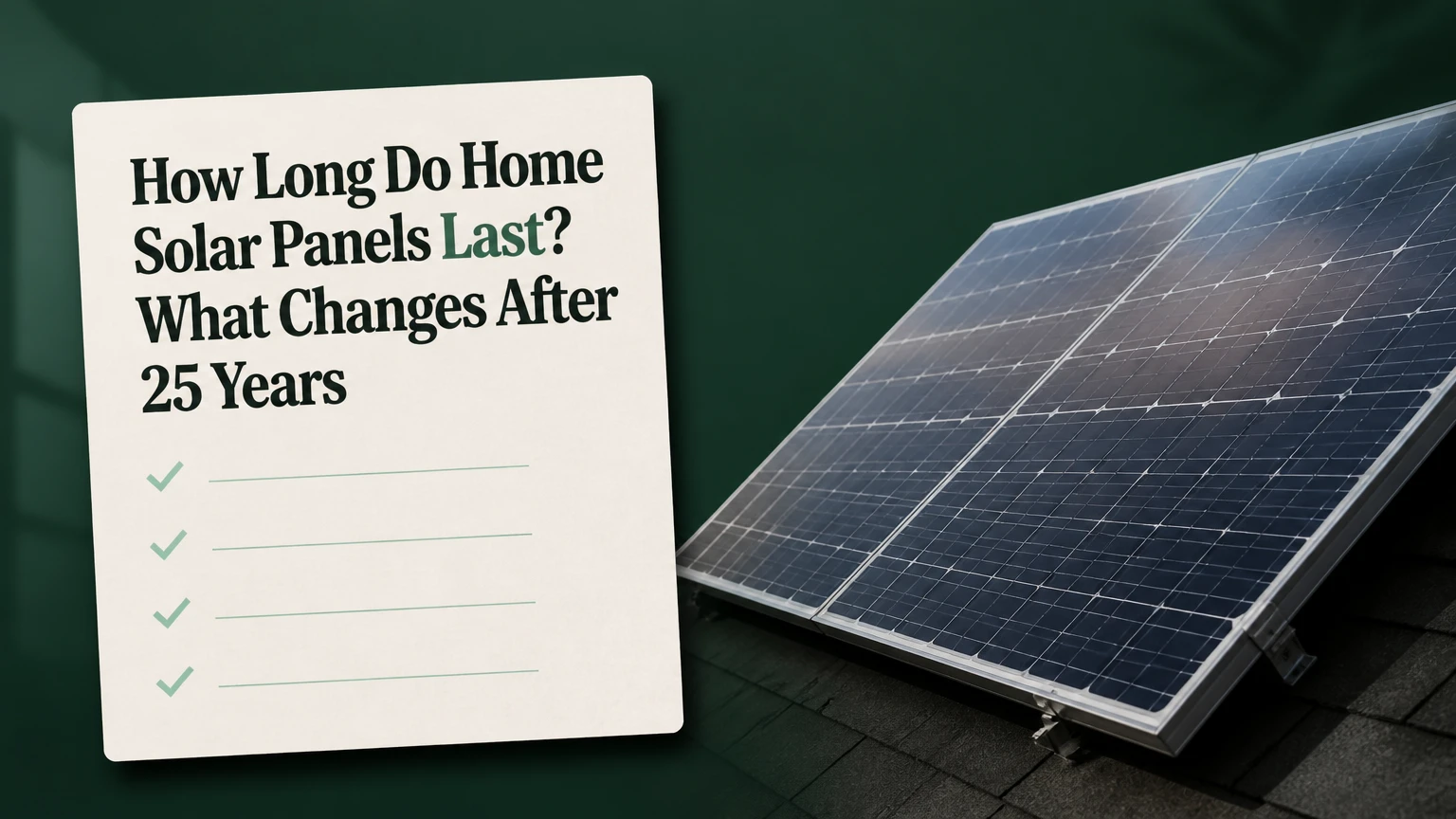
Home solar panels typically last 25-30 years within their original performance warranty, while many continue producing usable electricity for 30-40 years. Solar panels do not suddenly stop working at the end of year 25. Their output declines gradually, usually reaching about 80-90% of the initial rated power by the end of the warranty period.
Key Facts at a Glance
- A residential photovoltaic module commonly carries a 25-30 year power warranty.
- Modern panels often lose about 0.25-0.5% of rated output per year after initial light-induced degradation.
- A panel rated at 400 watts may still produce approximately 340-365 watts at year 25, depending on its warranty curve.
- String inverters commonly last 10-15 years, while microinverters often carry 20-25 year warranties.
- Solar batteries commonly last 10-15 years, measured through capacity retention and charge cycles rather than calendar age alone.
- Roof condition, heat, humidity, salt exposure, hail, installation quality, and warranty terms can matter more than the panel brand.
What Does Solar Panel Lifespan Actually Mean?
Solar panel lifespan has three separate meanings: warranted life, physical life, and economic life. The warranted life is the period during which the manufacturer guarantees a minimum power output, physical life is how long the module remains intact and electrically functional, and economic life is how long its electricity is worth maintaining.
A typical modern module has a product warranty of 12-25 years and a performance warranty of 25-30 years. The performance warranty usually guarantees at least 98% of initial power after the first year, followed by a specified annual decline until the panel reaches roughly 80-90% of its original rating. Exact thresholds vary by manufacturer and model.
The U.S. Department of Energy describes solar panels as equipment designed to operate for decades, but “decades” does not mean unchanged production. A 400-watt module producing 384 watts under the same test conditions remains functional, although it has lost 4% of its nameplate capacity.
Warranted Life Versus Useful Life
A warranty endpoint is not a failure date. If a panel reaches 80% of its original rating in year 30, the panel still generates electricity, but the manufacturer may no longer owe compensation for further degradation.
| Lifespan term | Typical timeframe | What it measures | Homeowner consequence |
|---|---|---|---|
| Product warranty | 12-25 years | Materials and workmanship | Covers defects such as delamination or junction-box failure |
| Power warranty | 25-30 years | Minimum retained output | Defines guaranteed performance, not shutdown |
| Physical service life | 30-40 years | Continued electrical operation | Panel may keep producing after warranty expiration |
| Economic service life | 20-35 years | Value after maintenance and replacement | Depends on electricity prices, repairs, and system output |
The most useful planning assumption is therefore 25-30 years of guaranteed performance, with possible operation beyond 30 years if the module remains safe, structurally sound, and economically productive.
How Do Solar Panels Generate Electricity?
Solar panels generate direct-current electricity when photovoltaic cells absorb photons and release electrons, while an inverter converts that DC electricity into alternating current for household circuits. The panel creates energy, but the inverter, wiring, protection equipment, meter, and grid connection determine whether the home can use it safely.
The process follows four physical stages:
- Light absorption: Silicon semiconductor cells absorb photons from sunlight.
- Charge separation: Photon energy frees electrons, and the cell’s electric field directs their movement.
- DC collection: Conductive fingers and busbars collect the electron flow as direct current.
- AC conversion: A string inverter or microinverter converts DC into grid-compatible alternating current.
Solar cells do not need high outdoor temperatures to work. They need light. In fact, crystalline silicon modules generally lose power as cell temperature rises, which is why a cool, sunny day can produce more power than a hotter day with identical sunlight.
How Fast Do Solar Panels Degrade?
Modern crystalline silicon panels commonly degrade by about 0.25-0.5% annually after an initial first-year reduction, although premium panels can specify lower rates and older or poorly manufactured modules can perform worse. NREL’s degradation research found that degradation varies by technology, climate, age, and failure mechanism, so one universal annual percentage is misleading.
The first-year change may include light-induced degradation, or LID, when sunlight alters the silicon material and causes an early output reduction. Some technologies can also experience light and elevated-temperature-induced degradation, known as LeTID. These mechanisms are separate from ordinary long-term aging.
| Panel age | Example retained output at 0.3% annual degradation | Example retained output at 0.5% annual degradation | 400-watt panel range |
|---|---|---|---|
| New, before degradation | 100% | 100% | 400 watts |
| End of year 1 | 98% | 97% | 388-392 watts |
| Year 10 | 95.3% | 92.5% | 370-381 watts |
| Year 25 | 91.6% | 85.0% | 340-366 watts |
| Year 30 | 90.2% | 82.5% | 330-361 watts |
The table uses simplified compound estimates, not a warranty interpretation. A manufacturer may guarantee a stepped curve, such as 98% in year one and 0.35% annual degradation afterward, rather than a single straight-line rate.
What Causes Solar Panel Degradation?
Solar panel degradation results from several interacting stresses:
- Ultraviolet exposure: UV radiation gradually affects encapsulants, backsheets, and cell materials.
- Thermal cycling: Daily heating and cooling expand and contract glass, solder joints, ribbons, and frames.
- Moisture ingress: Water entering through damaged seals can corrode contacts and cause electrical leakage.
- Potential-induced degradation: High voltage relative to the frame can reduce cell performance under certain humidity and system conditions.
- Mechanical loads: Wind, snow, hail, and repeated vibration can create cracks or frame stress.
- Soiling: Dust, pollen, bird droppings, and leaves reduce light reaching the cells; soiling is usually a production loss, not permanent degradation.
A practitioner rule is to treat a sudden 15% production loss differently from a gradual 15% loss. Gradual decline may be normal aging. Sudden decline usually indicates shading, inverter trouble, a tripped breaker, wiring damage, soiling, or a failed module.
Which Solar Panel Type Lasts the Longest?
Monocrystalline silicon panels generally offer the longest mainstream residential service life and the lowest published degradation rates, while polycrystalline modules remain durable but are now less common in new home installations. Thin-film products vary widely, so flexible RV modules should not be compared directly with glass-and-frame utility modules.
| Technology | Typical residential efficiency | Typical power degradation | Typical service expectation | Best-fit use |
|---|---|---|---|---|
| Monocrystalline silicon | 19-24% | 0.25-0.5% per year | 25-40 years | Roofs with limited area |
| Polycrystalline silicon | 16-20% | 0.4-0.7% per year | 20-30 years | Large roofs or ground arrays |
| Glass thin-film | 10-18% | 0.4-0.8% per year | 20-30 years | Large commercial surfaces |
| Flexible thin-film | 8-15% | 0.8-1.5% per year | 5-15 years | RVs, boats, temporary systems |
The older claim that all thin-film panels last only 10-15 years is too broad. Glass thin-film modules can have long warranties, while lightweight flexible products often sacrifice durability for low mass and curved-surface installation.
For most homes, the meaningful choice is not simply mono versus poly. Compare the manufacturer’s degradation curve, product warranty, hail rating, temperature coefficient, certifications, installer quality, and replacement availability.
Which System Components Need Replacement First?
The inverter usually reaches the end of its service life before the solar panels. A string inverter commonly lasts 10-15 years, whereas a microinverter may operate for 20-25 years; batteries often need replacement after 10-15 years, depending on chemistry, temperature, usable capacity, and cycling frequency.
| Component | Typical life | Common warranty period | Typical U.S. replacement range | Early warning |
|---|---|---|---|---|
| Solar module | 25-40 years | 12-30 years | $250-$600 per module installed | Cracks, hot spots, delamination |
| String inverter | 10-15 years | 5-12 years, extensions available | $1,500-$3,500 | Red fault light, no AC output |
| Microinverter | 15-25 years | 20-25 years | $250-$600 per unit installed | One-panel monitoring failure |
| DC optimizers | 10-25 years | 10-25 years | $100-$300 per unit | Repeated module-level faults |
| Lithium battery | 10-15 years | 10 years is common | $7,000-$18,000 | Reduced usable capacity |
| Racking and rails | 25-40 years | 10-25 years | $500-$2,500 for repairs | Corrosion, loose hardware |
Prices are typical planning ranges for U.S. residential work and vary substantially by access, permitting, equipment compatibility, labor, and region. A battery replacement can cost more than the original panels, especially when electrical upgrades or a new hybrid inverter are required.
Do Microinverters Make Panels Last Longer?
Microinverters do not extend the physical life of solar cells, but they can reduce system-wide production loss when one panel is shaded or fails. A string inverter may lose the output of an entire series-connected string when a fault affects the circuit, while module-level electronics isolate the fault more effectively.
Microinverters also introduce more rooftop electronics, which can complicate service access. The correct decision depends on roof geometry, shade, labor rates, warranty terms, and whether module-level monitoring has practical value.
Which Conditions Shorten Solar Panel Life?
Heat, moisture, salt air, severe hail, poor mounting, and roof movement can shorten solar panel life, although certified modules are tested against defined environmental stresses. Climate affects both degradation and access to repair, so a desert rooftop and a humid coastal rooftop may develop different failure patterns.
| Condition | Main risk | Typical symptom | Preventive decision |
|---|---|---|---|
| High heat | Faster electronic and cell aging | Lower summer output | Choose a low temperature coefficient |
| Coastal salt air | Corrosion of frames and connectors | Discolored contacts | Use corrosion-resistant hardware |
| Heavy snow | Mechanical loading | Bent frames or cracked glass | Verify local snow-load rating |
| Hail | Glass and cell fractures | Spreading cracks or hot spots | Check IEC hail rating and insurance |
| Humidity | Moisture ingress and PID | Leakage faults or low insulation | Use suitable backsheets and sealing |
| Wind | Uplift and vibration | Loose rails or rattling modules | Require engineered attachment points |
| Trees | Shading and falling branches | Repeating midday output loss | Model future tree growth |
The roof itself is often the limiting asset. Installing a solar array over shingles with only five years of remaining life can force expensive panel removal and reinstallation before the modules reach their expected service life.
Does Extreme Weather Destroy Solar Panels?
Extreme weather can damage solar panels, but ordinary rain, snow, and sunlight are expected operating conditions. Hail is the most direct physical threat, while wind-related damage often results from inadequate attachment, roof failure, or flying debris rather than panel weakness alone.
Inspect modules after a severe hailstorm, falling-tree event, or unusually high wind if insurance coverage matters. Do not walk on the array or touch damaged wiring. A cracked module can remain energized in daylight even when the inverter is switched off.
How Can You Make Solar Panels Last Longer?
Professional installation, sound roof preparation, appropriate equipment selection, and periodic monitoring provide the greatest gains in solar system longevity. Cleaning helps when soiling is material, but aggressive cleaning can cause more damage than dirt.
Use this maintenance schedule:
- Monitor monthly: Compare current production with the same season in previous years.
- Inspect from the ground quarterly: Look for broken glass, discoloration, nests, loose conduit, and heavy debris.
- Trim shading vegetation annually: Remove branches that create new midday shade or threaten the array.
- Review inverter data promptly: Record fault codes and contact the installer if errors persist.
- Clean only when justified: Use manufacturer-approved methods, soft water, and nonabrasive tools.
- Arrange professional inspection every 3-5 years: Check torque, connectors, roof penetrations, insulation, and thermal anomalies.
Never pressure-wash modules, apply abrasive chemicals, disconnect live DC connectors, or repair rooftop wiring without qualified electrical expertise. The National Renewable Energy Laboratory and the Solar Energy Industries Association both emphasize system monitoring and proper maintenance as parts of reliable photovoltaic operation.
What Should You Do if Solar Production Drops Suddenly?
Check monitoring data, the inverter status, the solar breaker, visible debris, and recent weather before scheduling a service visit. A failure affecting every panel points toward the inverter, grid connection, or breaker, while a failure affecting one module points toward shading, a connector, a microinverter, or that module.
Follow this safe diagnostic sequence:
- Check the monitoring portal: Compare the affected date with weather and historical output.
- Look at inverter indicators: Record the displayed code rather than repeatedly resetting the equipment.
- Check the dedicated breaker visually: Do not remove covers or touch wiring.
- Inspect from ground level: Look for snow, leaves, bird droppings, cracks, or storm damage.
- Check utility status: Grid outages can stop grid-tied systems even when panels are healthy.
- Contact a qualified technician: Arrange testing when the fault persists or physical damage appears.
| Production pattern | Likely cause | Appropriate next action | DIY boundary |
|---|---|---|---|
| Entire system at zero | Grid outage, breaker, inverter | Check utility and monitoring alerts | Do not open inverter |
| One string underperforming | Wiring, shade, string fault | Request electrical testing | No connector unplugging |
| One module at zero | Microinverter, connector, module | Compare module-level data | Ground inspection only |
| Gradual annual decline | Normal degradation or soiling | Review cleaning and warranty curve | No immediate replacement |
| Intermittent shutdowns | Heat, grid voltage, inverter fault | Save time-stamped fault logs | Use a licensed technician |
| Post-storm decline | Hail, water, wiring, roof damage | Photograph from ground, contact insurer | Do not walk on panels |
When Should You Replace Solar Panels?
Replace a solar panel when testing confirms a safety defect, structural failure, severe localized damage, or a repair cost that exceeds the value of its remaining production. Replace the entire array only when widespread degradation, obsolete equipment, roof work, or a repowering plan makes module-by-module repair uneconomic.
A 25-year-old array producing 82% of original output may remain financially sensible if the roof is sound and the inverter has recently been replaced. Conversely, a 12-year-old system may justify major work if its inverter is obsolete, replacement modules are unavailable, and several panels have delaminated.
Repair, Partial Replacement, or Repowering?
| Situation | Recommended path | Typical planning cost | Why |
|---|---|---|---|
| One failed module under warranty | Warranty replacement | $300-$900 labor and service | Preserves the existing array |
| Failed string inverter | Inverter replacement | $1,500-$3,500 | Usually cheaper than new modules |
| Five or more damaged modules | Partial replacement study | $2,000-$8,000 | Compatibility may limit choices |
| Roof replacement needed | Remove and reinstall array | $4,000-$12,000 | Roof work comes before solar |
| Widespread aging after year 25 | Repowering analysis | $10,000-$30,000 | New modules can restore capacity |
| Battery at end of life | Battery replacement | $7,000-$18,000 | Confirm inverter compatibility |
Do not replace functioning modules solely because their warranty expired. The warranty expiration date is an administrative boundary, not proof that the module has become unsafe or unproductive.
How Long Do Solar Panels Last in Different Home Situations?
Solar panels usually last longest in well-ventilated, unshaded installations with moderate temperatures and low salt exposure, while off-grid systems often experience more stress because batteries cycle daily and backup electronics operate frequently. The panel lifespan may be similar across homes, but total system maintenance differs.
- Suburban roof: Prioritize high-efficiency modules, shade analysis, and a roof with at least 25 years of expected life.
- Rural ground mount: Space can make lower-cost modules viable, but animals, weeds, snow, and mowing increase maintenance.
- Coastal property: Specify corrosion-resistant fasteners, suitable connectors, and frequent visual inspections.
- Hot desert: Compare temperature coefficients and inverter ventilation; nameplate efficiency alone is insufficient.
- Snow country: Verify snow-load engineering, snow shedding risk, and safe access for post-storm inspection.
- Off-grid cabin: Size batteries and inverters conservatively because cycling and thermal conditions may dominate replacement timing.
- RV or boat: Flexible modules can reduce weight, but their service life may be shorter than framed glass modules.
Frequently Asked Questions
Do solar panels lose efficiency every year?
Solar panels usually lose a small amount of power each year, but the rate depends on technology and manufacturer. Modern crystalline silicon modules commonly specify approximately 0.25-0.5% annual degradation after the first year. Dirt, shade, inverter faults, and weather can reduce measured production more sharply without representing permanent cell degradation.
Can solar panels last 50 years?
Some solar panels may still produce electricity after 40 years, but 50 years should not be used as a standard planning assumption for a home system. Encapsulants, backsheets, seals, connectors, racking, and inverters can fail before the silicon cells stop generating power. Use 25-30 years for guaranteed performance and treat later operation as a bonus.
Are older solar panels worth keeping?
Older solar panels can be worth keeping when they remain safe, produce close to their expected output, and use serviceable balance-of-system equipment. Keep an older array when repair costs are modest and electricity value remains high. Consider replacement when multiple modules fail, the inverter is unsupported, or roof work already requires removal.
Does cleaning solar panels increase their lifespan?
Cleaning usually improves energy production rather than directly extending panel lifespan. Removing bird droppings, dust, and pollen can prevent persistent hot spots in severe cases, but abrasive tools, harsh chemicals, and pressure washers can damage coatings and seals. Clean when soiling materially reduces output or when the manufacturer specifies a method.
What happens to solar panels after the warranty ends?
Solar panels continue operating after the warranty ends if they remain structurally intact and electrically safe. The owner assumes the risk of further degradation and repair costs, while the panel may still produce valuable energy for years. Test output, inspect physical condition, and compare repair costs with the value of expected future generation before replacing it.
The Bottom Line
Home solar panels generally last 25-30 years under their performance warranty and may continue generating electricity for 30-40 years. The panels usually outlive the inverter and battery, so long-term ownership requires a replacement plan for those components. For the query “how long do home solar panels last,” the most accurate answer is 25-30 years of warranted output, not 25-30 years until shutdown.
Choose equipment by degradation rate, warranty language, climate rating, installer quality, roof condition, and replacement compatibility. Monitor production, address faults early, and judge an aging array by measured output and future economics rather than its calendar age.