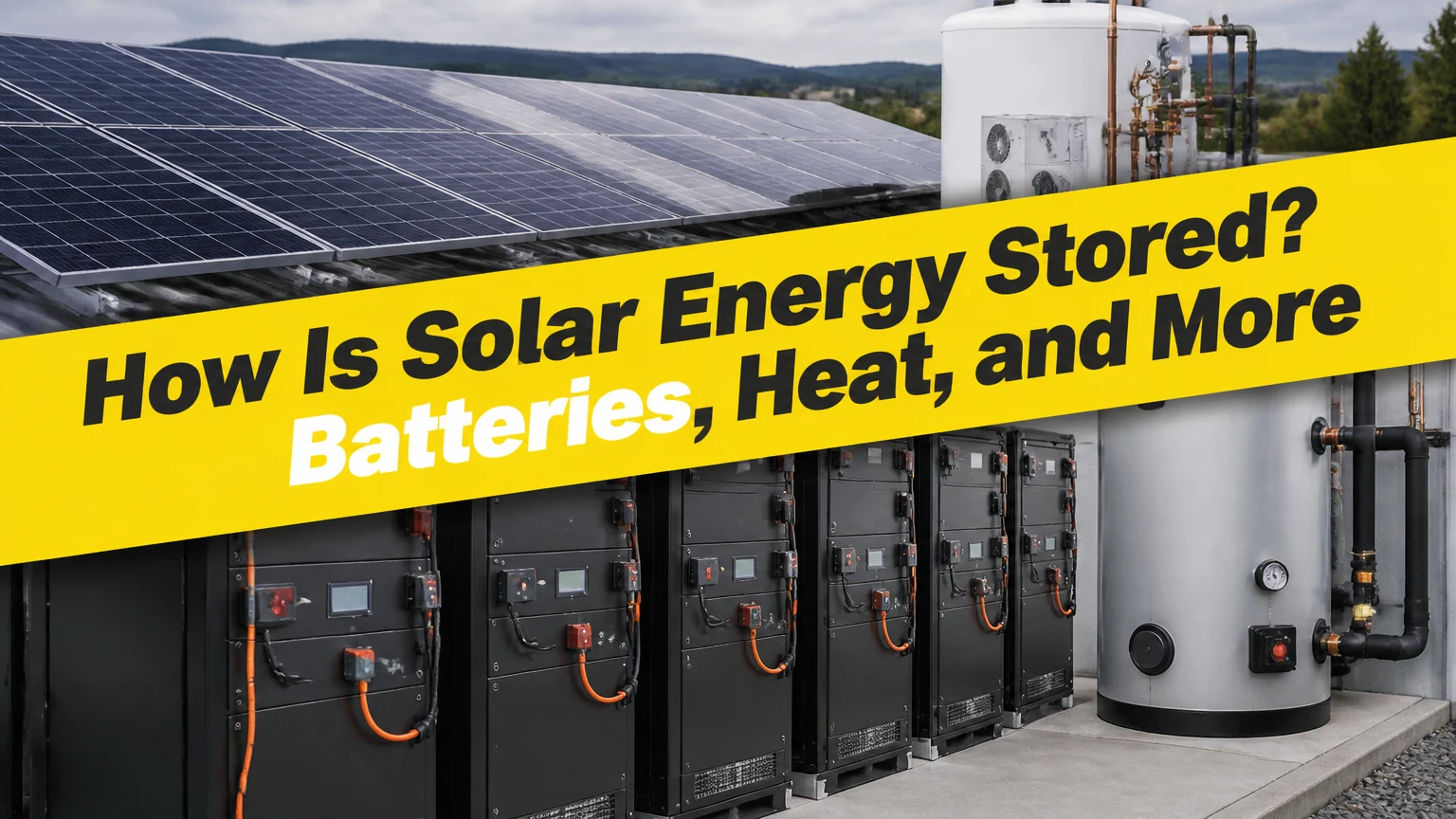
Solar energy is stored by converting sunlight into electricity or heat and holding that energy in batteries, hot materials, pumped water, compressed air, or other storage media. Photovoltaic panels usually generate DC electricity, which a battery stores electrochemically; an inverter later converts it to AC power for appliances or the grid.
Key Facts at a Glance
- Lithium-ion batteries commonly provide 90-95% round-trip efficiency and respond in milliseconds.
- A battery’s usable capacity is smaller than its nameplate capacity because the system reserves energy to protect battery life.
- Solar thermal systems store heat directly in water, molten salt, rocks, or phase-change materials instead of first making electricity.
- Pumped-storage hydropower stores electricity as gravitational potential energy by moving water to an elevated reservoir.
- Solar storage does not create energy. Round-trip conversion losses commonly leave 70-95% of the input electricity available.
- Home storage sizing depends on usable kWh, continuous kW, surge watts, outage duration, and the household’s critical loads.
What Does Solar Energy Storage Mean?
Solar energy storage means retaining energy produced during sunny periods so the energy can be used later. The stored form may be chemical electricity in a battery, thermal energy in heated water or molten salt, or mechanical potential energy in elevated water or compressed air.
The U.S. Department of Energy defines energy storage as “a technology that holds energy at one time so it can be used at another time”. Solar storage therefore describes a timing function, not a single device. A rooftop photovoltaic system can export surplus electricity to the grid, charge a battery, heat water, or combine these methods.
Storage solves a timing mismatch. Solar production usually peaks around midday, while household demand often rises in the morning and evening. A storage system shifts some midday energy into those higher-demand hours, reduces grid purchases, and can provide backup when the grid fails.
What Is Actually Stored?
A solar panel does not store sunlight inside its cells. A photovoltaic cell converts photons into direct-current electricity, and a separate storage device changes that electricity into a storable form.
| Storage pathway | Stored form | Conversion equipment | Typical duration |
|---|---|---|---|
| Lithium-ion battery | Chemical potential | Charge controller, battery management system, inverter | 2-8 hours |
| Solar water heating | Hot water | Solar thermal collector, insulated tank | 6-48 hours |
| Molten-salt CSP | Sensible heat | Heat exchangers, steam turbine | 6-15 hours |
| Pumped hydro | Gravitational potential | Pumps, reservoir, turbine-generator | 8-24 hours |
| Compressed air | Pressurized air | Compressor, cavern, expander-generator | 8-100 hours |
How Does Solar Energy Storage Work?
Solar energy storage works through five linked stages: generation, regulation, storage, conversion, and consumption. Solar panels generate DC electricity, a controller or inverter regulates it, the storage medium retains it, and an inverter supplies usable AC power when demand occurs.
- Generation: Photovoltaic modules produce DC electricity when sunlight reaches semiconductor cells.
- Regulation: A charge controller or hybrid inverter controls voltage and current entering the storage device.
- Storage: Battery cells use reversible electrochemical reactions, while thermal and mechanical systems retain heat, pressure, or elevation.
- Conversion: An inverter changes DC battery output into AC electricity for normal building circuits.
- Consumption or export: Loads use the electricity, or the system sends surplus power to the utility grid.
A battery energy storage system also contains a battery management system, contactors, thermal controls, sensors, and safety disconnects. The battery management system monitors cell voltage and temperature, balances cells, and limits charging or discharging when operating conditions become unsafe.
Where Does Energy Get Lost?
Energy is lost through electrical resistance, battery chemistry, inverter conversion, cooling, pumps, and standby electronics. Round-trip efficiency measures the energy delivered from storage compared with the energy required to charge it.
| System configuration | Typical round-trip efficiency | Main loss location | Practical consequence |
|---|---|---|---|
| Lithium iron phosphate battery | 88-95% | Inverter and cell resistance | 8-12 kWh delivered from 10 kWh charged |
| Lead-acid battery | 70-85% | Charge acceptance and heat | More solar generation is needed for the same load |
| Flow battery | 65-85% | Pumps and power conversion | Better suited to long, frequent cycles |
| Molten-salt storage | 80-90% | Heat exchangers and turbine | Heat can remain available after sunset |
| Pumped hydro | 70-85% | Pump and turbine losses | Large sites need suitable elevation and water |
A system advertised as 10 kWh does not necessarily deliver 10 kWh to appliances. If the battery permits 90% depth of discharge and the inverter system operates at 92% efficiency, the approximate AC energy available is 8.28 kWh before additional standby losses.
Which Technologies Store Solar Energy?
Solar energy storage technologies fall into electrochemical, thermal, and mechanical categories. Batteries dominate homes because they combine compact size, rapid response, and modular installation, while thermal and mechanical systems become more useful as heat or grid-scale duration increases.
Electrochemical Batteries
Lithium-ion batteries store electricity through reversible movement of lithium ions between electrodes. Lithium iron phosphate, or LiFePO4, generally trades some energy density for strong thermal stability and long cycle life, making it common in stationary storage.
| Battery type | Typical efficiency | Typical service life | Best-fit application |
|---|---|---|---|
| Lithium nickel manganese cobalt oxide | 90-95% | 10-15 years | Compact residential systems |
| Lithium iron phosphate | 88-95% | 10-20 years | Home backup and daily cycling |
| Lead-acid | 70-85% | 3-7 years | Low-cost, lightly used off-grid backup |
| Vanadium flow battery | 65-85% | 15-25 years | Commercial systems with long daily cycles |
| Sodium-ion | 85-92% | 10-15 years | Emerging stationary storage in colder markets |
Lead-acid batteries cost less initially but usually require more space, ventilation, and conservative discharge limits. Flow batteries separate energy capacity, stored in electrolyte tanks, from power capacity, determined by the cell stack. That design can make long-duration expansion practical, although pumps and larger footprints reduce residential appeal.
Thermal Storage
Thermal energy storage captures heat directly or converts electricity into heat. A solar water-heating collector can transfer solar radiation into a tank, while a concentrating solar power plant can heat molten salt and use that heat later to produce steam.
Sensible heat storage raises the temperature of a material without changing its phase. Water is effective for low-temperature domestic heating because it is inexpensive and has high heat capacity. Molten nitrate salts operate at much higher temperatures and can retain heat for several hours in utility-scale CSP plants.
Phase-change materials store energy while melting or solidifying. Their nearly constant operating temperature can benefit building heating and cooling, but material cost, containment, and long-term cycling remain design constraints.
Mechanical Storage
Mechanical storage retains energy through motion, pressure, or elevation. Pumped-storage hydropower uses surplus electricity to move water uphill, then sends the water through turbines when electricity demand rises.
Compressed-air energy storage forces air into underground caverns or engineered vessels. During discharge, the compressed air expands through machinery that drives a generator. Conventional systems may require heat management or fuel, while advanced adiabatic designs attempt to reuse compression heat.
Flywheels accelerate a rotor in a low-friction enclosure. They respond quickly and can stabilize frequency, but self-discharge makes them unsuitable for storing a household’s evening solar output. Gravity systems raise heavy masses and lower them through generators, although most remain at demonstration or early commercial stages.
How Is Solar Energy Used After Sunset?
Solar energy is used after sunset when a battery discharges through an inverter, a thermal tank releases stored heat, or a grid-scale storage plant generates electricity from stored mechanical or thermal energy. A grid-tied home without a battery normally cannot use its solar panels during an outage.
A battery system detects that household demand exceeds current solar production. The inverter then draws DC power from the battery and supplies AC power to selected circuits or the entire backed-up panel, depending on system design.
Solar storage can support several operating goals:
- Self-consumption: Store midday surplus and use it during evening demand.
- Backup: Maintain refrigerators, lighting, internet equipment, medical devices, or pumps during an outage.
- Time shifting: Charge when solar power is available and discharge during expensive utility periods.
- Peak shaving: Reduce a commercial facility’s highest demand interval and associated demand charges.
- Grid services: Respond to frequency or voltage needs under utility control.
Backup capability depends on more than battery capacity. A 10 kWh battery with a 5 kW inverter may run a 500-watt refrigerator and lights for many hours, but a 4-ton air conditioner can exceed the inverter’s continuous or starting-power limit.
How Much Solar Storage Does a Home Need?
A home usually needs 5-15 kWh of usable battery capacity for essential loads and 10-30 kWh for broader evening use, but the correct size depends on load energy, peak power, desired backup hours, solar production, and local weather.
Use this basic estimate:
Required usable capacity = critical-load energy per day × backup days ÷ allowed reserve-adjusted efficiency
For example, a household using 7 kWh per day on essential circuits, seeking one day of backup, and allowing 90% usable battery capacity with 92% conversion efficiency needs approximately 8.45 kWh of nameplate storage. Installers then check surge power, winter solar yield, battery temperature, and generator or grid-recharge options.
| Household objective | Usable battery capacity | Inverter power | Typical backed-up loads |
|---|---|---|---|
| Refrigerator and communications | 5-8 kWh | 3-5 kW | Refrigerator, modem, lights |
| Critical-load backup | 8-15 kWh | 5-8 kW | Above plus freezer, sump pump |
| Evening self-consumption | 10-20 kWh | 5-10 kW | Lighting, kitchen, electronics |
| Whole-home backup | 20-40 kWh | 8-15 kW | Heating, cooling, appliances |
| Off-grid daily operation | 20-60+ kWh | 8-20 kW | Household loads plus water systems |
Nameplate capacity and usable capacity are different specifications. Depth of discharge indicates the portion of a battery that the manufacturer permits regular use, while power rating indicates how quickly that energy can be delivered.
What Does Solar Energy Storage Cost?
Residential solar battery storage commonly costs about $8,000-$20,000 installed for a 10-15 kWh system before incentives, although labor, electrical upgrades, enclosure requirements, and local market conditions can move the price substantially.
| Cost component | Typical residential range | Main price driver |
|---|---|---|
| 10-15 kWh battery pack | $5,000-$12,000 | Chemistry and manufacturer |
| Hybrid or battery inverter | $2,000-$5,000 | Power rating and backup features |
| Installation and commissioning | $1,500-$5,000 | Wiring, permits, labor |
| Main-panel upgrade | $2,000-$6,000 | Service capacity and code requirements |
| Outdoor enclosure or fire separation | $500-$4,000 | Location and local rules |
Levelized cost of storage, or LCOS, is more useful for grid projects than a simple equipment price. LCOS includes capital, financing, operation, maintenance, charging energy, replacement, and the amount of electricity delivered over the system’s life. The U.S. Department of Energy’s Energy Storage Grand Challenge identifies cost, performance, safety, and sustainability as connected storage-development priorities.
A battery may be financially weak where net metering provides full retail credit for exported solar. Storage becomes more valuable when export compensation is low, evening electricity prices are high, outages are frequent, or demand charges penalize short periods of high consumption.
How Long Can Stored Solar Energy Last?
Home batteries commonly provide two to eight hours of power at their rated output, while pumped hydro, compressed air, and thermal systems can provide eight hours to several days. Storage duration equals usable energy divided by the discharge power selected by the operator.
| Storage application | Typical discharge duration | Response time | Main limitation |
|---|---|---|---|
| Home lithium battery | 2-12 hours | Milliseconds | Capacity and inverter size |
| Utility lithium battery | 2-8 hours | Milliseconds | Cost of adding more hours |
| Flow battery | 4-12 hours | Seconds | Pumping and footprint |
| Pumped hydro | 8-24+ hours | Seconds to minutes | Geography and permitting |
| Compressed air | 8-100 hours | Minutes | Cavern and thermal design |
| Seasonal hydrogen storage | Days to months | Minutes to hours | Low conversion efficiency |
Battery lifespan is measured through calendar age, cycle count, and retained capacity. High temperatures, full-time operation at maximum charge, deep discharge, and high current accelerate degradation. The National Renewable Energy Laboratory models battery degradation as a function of operating conditions rather than treating lifespan as a fixed number.
Can Solar Energy Be Stored Without Batteries?
Solar energy can be stored without batteries by heating water or molten salt, pumping water uphill, compressing air, raising a mass, or exporting electricity to the utility grid. These approaches are often more practical for heat demand or grid-scale storage than for a typical home.
Solar water heating is the most direct residential alternative. A collector transfers heat into an insulated tank, reducing the electricity or gas needed for showers and space heating. The system does not provide ordinary AC electricity for outlets.
At grid scale, pumped hydro remains one of the largest forms of installed electricity storage worldwide. The International Energy Agency identifies pumped storage as a major source of flexibility because reservoirs can absorb surplus generation and dispatch electricity during demand peaks.
Hydrogen can store renewable electricity for long periods. An electrolyzer uses electricity to split water, hydrogen is stored, and a fuel cell or turbine later produces electricity. The multiple conversion stages cause greater energy loss than a battery, so hydrogen is better suited to difficult long-duration applications than routine overnight home shifting.
Is Solar Battery Storage Safe?
Solar battery storage is generally safe when the battery chemistry, enclosure, controls, installation, and emergency procedures match applicable standards. Safety risks increase when damaged cells, unauthorized repairs, poor ventilation, extreme temperatures, or incompatible components are present.
Lithium-ion batteries can experience thermal runaway if a cell overheats and triggers a self-reinforcing failure. LiFePO4 chemistry generally has stronger thermal stability than nickel-rich lithium chemistries, but no lithium battery is risk-free.
A qualified installation should address:
- Manufacturer clearance and temperature limits.
- Listed equipment and required electrical disconnects.
- Battery management and fault monitoring.
- Flood, impact, and fire exposure.
- Local building and fire-code requirements.
- Emergency access and first-responder labeling.
The U.S. Environmental Protection Agency recommends using established battery-recycling channels because lithium-ion batteries can create fire hazards when placed in ordinary trash or recycling containers. Never open a battery enclosure or bypass a battery management system.
What Happens When Solar Production Falls?
When clouds reduce solar output, the battery supplies the shortfall if its state of charge and inverter rating are sufficient. When solar production remains low for several days, the system may draw from the grid, start a generator, shed nonessential loads, or shut down after reaching its reserve limit.
A battery cannot solve a prolonged winter energy deficit by itself unless the array, storage capacity, and backup source are sized for that event. Snow cover, shading, short daylight hours, and heating loads can reduce the energy available for charging.
Practitioner rule: size backup around the worst important load, not the average daily load. A system that comfortably covers average consumption may still fail when a pump, compressor, or air-conditioner motor starts.
Why Does a Solar Battery Stop Charging?
A solar battery may stop charging because the battery is full, solar input is too low, temperature limits are active, a charge schedule blocks charging, or the inverter and battery communication link has failed.
Check the system in this order:
- Confirm the solar array has no new shading, snow, debris, or disconnected strings.
- Read battery state of charge and fault codes on the manufacturer’s monitoring portal.
- Check whether time-of-use settings reserve capacity for a predicted outage.
- Verify ambient temperature against the battery’s charging range.
- Inspect only external disconnects and indicators, never internal battery wiring.
- Contact the installer for persistent BMS, insulation, ground-fault, or communication faults.
A battery that reaches 100% quickly and empties quickly may have lost usable capacity, while a battery that never reaches full charge may have insufficient solar input or an incorrect control setting.
Solar Storage Compared With Grid Export
Grid export is simpler and often cheaper than a battery when the utility provides strong net-metering credit, while a battery is more valuable when the home needs outage protection or faces low export compensation and high evening rates.
| Decision factor | Grid export without battery | Solar battery | Solar thermal tank | Generator backup |
|---|---|---|---|---|
| Nighttime electricity | Purchased from grid | Supplied from stored DC | Not applicable to appliances | Supplied by fuel |
| Outage operation | Usually unavailable | Available with backup gateway | Hot water only | Available while fuel lasts |
| Typical response | Utility-controlled | Milliseconds | Minutes to hours | Seconds to minutes |
| Routine fuel cost | Utility tariff | Charging losses | Pump electricity | Diesel, propane, or gasoline |
| Maintenance | Low homeowner burden | Monitoring and service | Collector and tank service | Engine maintenance |
| Best use | Low-cost bill reduction | Backup and time shifting | Hot water and heating | Long outage backup |
A battery does not automatically maximize financial return. Calculate avoided import cost, export credit, demand-charge savings, incentives, degradation, warranty limits, and replacement assumptions before purchasing.
The Bottom Line
How is solar energy stored? Solar electricity is most commonly stored in a battery, where electrical energy becomes chemical potential energy and later returns through an inverter as AC electricity. Solar heat can be held in water or molten salt, while grid-scale systems can store energy in elevated water, compressed air, rotating masses, or hydrogen.
For most homes, LiFePO4 battery storage offers a practical balance of usable capacity, response speed, cycle life, and safety when professionally installed. The correct system is determined by critical loads, usable kWh, inverter power, outage duration, utility tariffs, climate, and local code, not by panel wattage alone.
Frequently Asked Questions
Do solar panels store energy during the day?
Solar panels generate electricity but do not store it. During daylight, the electricity either powers active loads, charges a battery, heats water, or flows to the grid. A grid-tied system without storage generally exports surplus production and imports electricity after sunset.
Can solar batteries work during a power outage?
Solar batteries can work during an outage only when the system includes islanding controls, a backup gateway, and circuits designed for backup operation. Standard grid-tied inverters shut down during outages to prevent energizing utility lines and endangering repair crews.
Is AC-coupled or DC-coupled storage more efficient?
DC-coupled storage can be more efficient when new solar panels charge a battery directly because it avoids one inverter conversion. AC-coupled storage is often easier to add to an existing solar system, although repeated DC-to-AC-to-DC conversion can increase losses.
How many solar batteries are needed for a whole house?
A whole-home system may require 20-40 kWh of usable storage and 8-15 kW of inverter power, but the number varies with heating, cooling, water heating, and motor loads. An installer should calculate hourly demand, starting surges, winter production, and the desired outage duration.
Can a solar battery be charged from the grid?
Many modern battery systems can charge from the utility grid when the manufacturer, tariff, and interconnection rules allow it. Grid charging can prepare for storms or exploit lower overnight rates, but it may not qualify for every solar incentive or backup operating mode.
Are solar batteries recyclable?
Solar batteries contain recoverable materials, but recycling pathways differ by chemistry and location. The EPA advises consumers to use manufacturer programs, retailer take-back services, or qualified hazardous-waste channels instead of placing lithium-ion batteries in household trash or curbside recycling.