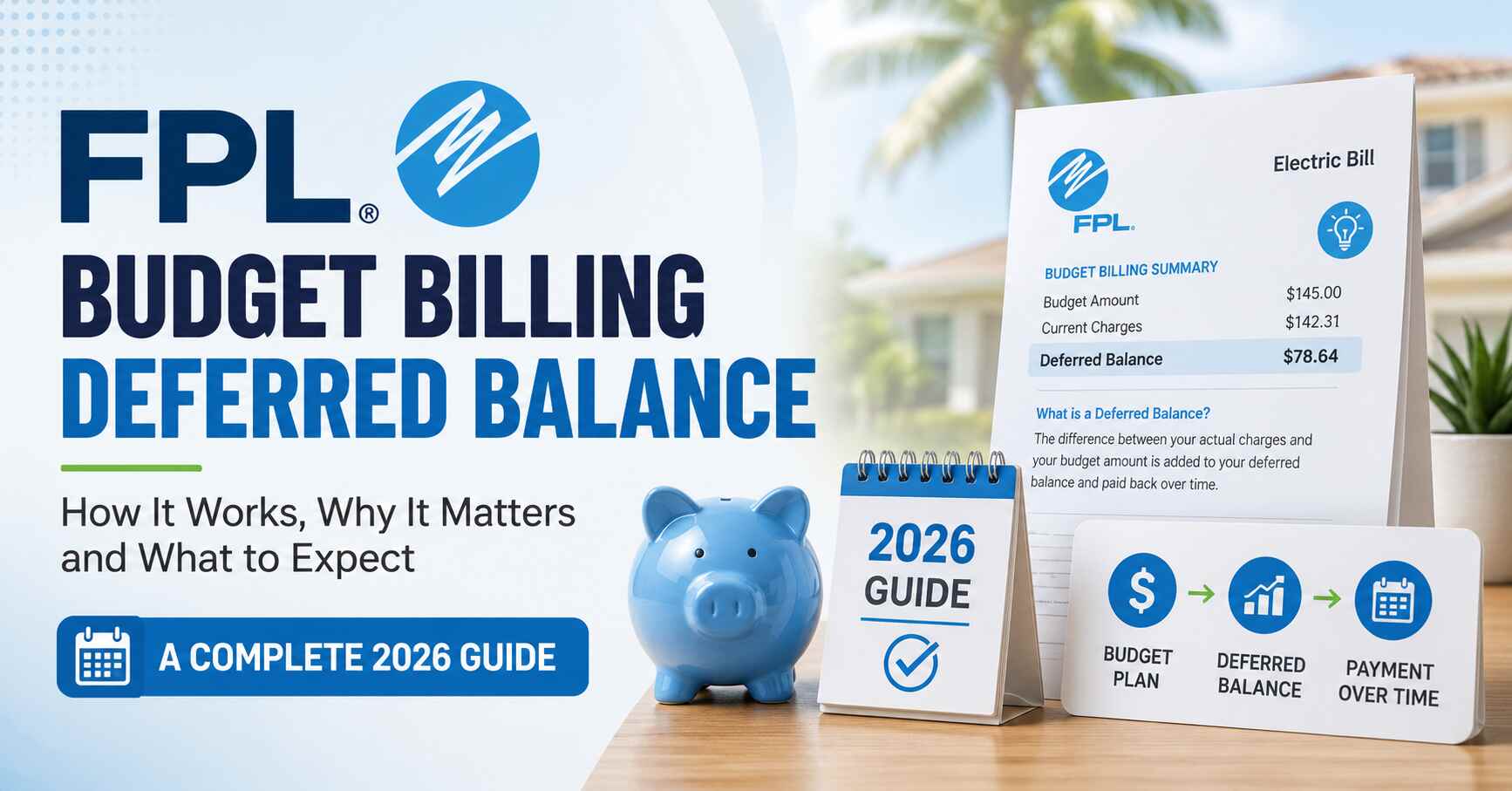
If you have ever opened your Florida Power & Light statement, seen a line labeled “deferred balance,” and immediately wondered whether you suddenly owe the power company hundreds of dollars, you are not alone. It is the single most misunderstood number on an FPL bill.
Here is the short version: your deferred balance is not a late fee, not a penalty, and not a hidden charge. It is a running scorecard. It tracks the gap between the electricity you actually used and the flat amount you actually paid. This guide breaks down exactly how that number is calculated, how it quietly reshapes your bill every single month, what happens to it if you cancel or move, and how to bring it down without leaving the program.
What Is a Deferred Balance on an FPL Bill?
FPL Budget Billing (sometimes called levelized or averaged billing) lets you pay a smooth, predictable amount every month instead of riding the brutal seasonal swings of a Florida electric bill. August in Fort Lauderdale and February in Fort Lauderdale are not the same bill. Budget Billing flattens that curve.
But flattening the curve does not erase the difference. The electricity you consume is still metered and still charged at your actual rate. The deferred balance is where that difference is parked.
Every month, FPL runs a simple comparison:
- Actual electric charges: what you would have owed on standard billing for the kilowatt hours you used.
- Budget billing amount: the flat, smoothed figure you were asked to pay.
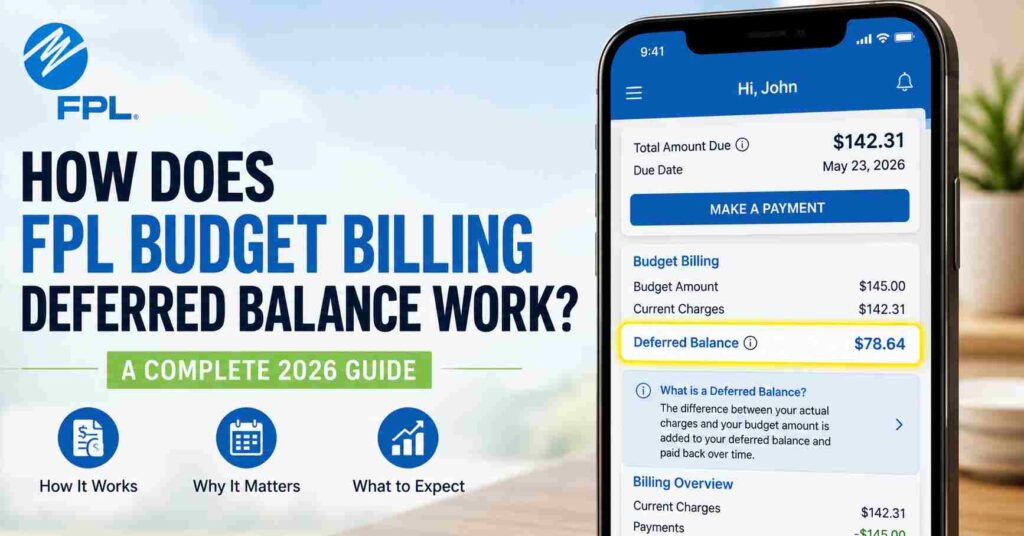
- Deferred balance: the accumulated running difference between those two numbers over time.
If your actual charges are higher than your budget payment, the shortfall is added to your deferred balance. If your actual charges come in lower, the surplus is subtracted. That is the whole mechanism. Nothing is hidden and nothing is forgiven.
Positive vs Negative: Reading the Sign Correctly
This trips people up constantly, and the styling on the app and the PDF statement does not always make it obvious.
- Positive deferred balance (no minus sign): you owe FPL. Your consumption has outrun your payments. This is normal heading out of a Florida summer, when air conditioning dominates your usage.
- Negative deferred balance (shown with a minus sign, sometimes in green): FPL owes you. You have overpaid relative to what you consumed. This is normal in mild winter and spring months.
A positive balance in September is not a red flag. A positive balance that keeps climbing through the cool months is.
| Balance Type | Display Format | Meaning | Typical Season |
|---|---|---|---|
| Positive Balance | No Minus Sign / Black Text | You owe FPL (actual usage exceeded your budget payment). | Summer (High AC usage) |
| Negative Balance | Minus Sign “-” / Green Text | FPL owes you (budget payment exceeded your actual usage). | Winter / Spring (Low AC usage) |
How FPL Calculates Your Budget Billing Amount
Your monthly budget figure is built on a rolling 12-month average of energy usage at your service address. Two things follow from that word “rolling.”
First, the average is recalculated continuously rather than being locked in once a year. As each new month of usage data lands, the oldest month drops off. Your baseline drifts naturally with your consumption habits, your household size, and the weather.
Second, if you have lived at the address for less than a year, FPL builds the baseline from the property’s own consumption history, which may reflect the previous occupant. That is why new movers sometimes see a budget amount that feels disconnected from how they personally use power. Give it a few months and the average will migrate toward your real footprint.
The 1/12 Adjustment: The Formula That Actually Matters
This is the part most explanations skip, and it is the key to understanding why your “fixed” bill is not really fixed.
FPL does not wait for a giant annual reckoning. Instead, it applies a continuous correction every billing cycle:
(Current 12-month base average) + or – (Total deferred balance ÷ 12) = Your next budget bill
Every month, FPL takes one twelfth of your outstanding deferred balance and folds it into your next payment. A large positive balance nudges your monthly amount upward, slowly absorbing what you owe. A large negative balance nudges it downward, gradually returning your credit.
The practical effect is that a deferred balance never sits still. It is always being repaid or refunded in small, digestible slices. This is the strongest argument in favor of FPL’s version of budget billing compared with utilities that impose a hard annual true-up bill.
A Month-by-Month Example You Can Follow
Numbers make this concrete. Assume a household with a rolling 12-month average of $150.
Month 1, peak summer. Your budget bill is $150. Heavy AC use pushes your actual charges to $210. You pay $150. The $60 shortfall is added to your deferred balance. Deferred balance: +$60.
Month 2, the recalculation. FPL divides the $60 balance by 12, producing a $5 adjustment. Assuming the base average holds at $150, your new budget bill becomes $155. You are not being punished. You are repaying $5 of energy you already consumed.
Month 3, mild weather. Your budget bill is $155. Cooler temperatures drop your actual charges to $95. You paid $60 more than you used, so that $60 is subtracted from the deferred balance, bringing it back toward zero.
That oscillation is the program working exactly as designed. The balance swells in summer, drains in winter, and the 1/12 adjustment keeps the monthly payment from ever lurching.
| Scenario | Base Budget Bill | Actual Electric Charge | What Happens to Deferred Balance |
|---|---|---|---|
| Month 1 (Summer) | $150 | $210 | You underpaid by $60. The remaining $60 is added to your deferred balance. |
| Month 2 (Recalculation) | $155 | N/A | Your $60 balance is divided by 12 ($5). This $5 is added to your new bill ($150 + $5 = $155). |
| Month 3 (Winter) | $155 | $95 | You overpaid by $60. This $60 credit is subtracted from your deferred balance. |
What Happens If You Cancel FPL Budget Billing?
This is where the program stops being gentle, and it is the single most important thing to understand before enrolling.
Immediate settlement. You can leave Budget Billing at any time from your FPL account dashboard, but the entire deferred balance becomes due (or is credited) on your very next billing cycle. There is no payment plan for it by default. If you opt out in September carrying a $400 positive balance, your next bill absorbs all of it at once.
Timing is everything. The cheapest month to leave the program is when your deferred balance is near zero or negative, which for most Florida households means late spring. The most expensive month to leave is the tail end of summer.
The 12-month lockout. Once you voluntarily un-enroll, FPL policy generally bars you from rejoining Budget Billing for 12 consecutive months. This is not a decision to make impulsively after one uncomfortable statement.
Involuntary removal. Falling significantly past due can also get you dropped from the program, which triggers the same immediate settlement while you are already under financial strain. That is the worst possible sequence, and it is worth watching for if money is tight.
Moving Homes or Transferring Service
Your deferred balance does not conveniently evaporate when you move.
- Transferring within FPL territory: the accumulated balance travels with you to the new account. Your budget amount then re-forms around the new property’s 12-month consumption history.
- Closing your FPL account entirely: the program ends immediately. A positive balance is added to your final bill. A negative balance is refunded as a credit or a check.
How the 2026 Rate Increase Affects Your Deferred Balance
A base rate adjustment approved by the Florida Public Service Commission took effect at the start of 2026, and it interacts with budget billing in a way that catches people off guard.
The mechanism is a timing mismatch. Your actual charges reflect the new rates immediately. Your budget billing amount is anchored to a rolling average that still contains months priced at the old rates. The gap between the two widens, and your deferred balance grows faster than usual through the transition.
Nothing is broken when this happens. The 1/12 adjustment will catch up over roughly a year as older, cheaper months roll off the average. But if you enrolled in late 2025 and watched your deferred balance climb through spring 2026 despite normal usage, this is very likely why.
Rate structures and any assistance programs tied to the settlement change over time, so confirm current figures directly on fpl.com or in your account before making decisions based on them.
What Real Customers Say About It
Scan the Florida homeowner forums and community threads on Reddit and Facebook and the same handful of verdicts surface again and again.
The people who love it are almost always on tight monthly budgets. Predictability, they say, is worth more than optimization. Knowing the number in advance beats being ambushed by a $380 August bill.
The recurring complaint is not about fairness, it is about visibility. Customers report checking their balance rarely, then discovering a several-hundred-dollar deferred balance and feeling blindsided, even though every dollar of it was electricity they genuinely used.
The sharpest warning that circulates is about cancelling at the wrong time. Story after story follows the same arc: opted out in late summer, got hit with the full balance on the next bill, then could not rejoin for a year.
The most useful piece of community advice: check your deferred balance monthly, not annually. It takes fifteen seconds in the app and it removes essentially all of the unpleasant surprises.
Two Drawbacks FPL Does Not Advertise
Budget billing and rooftop solar do not mix well. Net metering credits are generated and applied monthly, while budget billing smooths on a 12-month average. The two systems fight each other, and solar owners frequently report distorted balances and credits that are difficult to track. If you have panels, standard billing is usually the cleaner choice.
A flat bill masks equipment failures. This is the underrated risk. A failing AC compressor, a stuck pool pump, or a leaking hot water heater normally announces itself as a shocking bill. On budget billing, that spike does not show up in what you pay. It quietly inflates your deferred balance instead, and you may not notice for months. The fix is simple: monitor daily kilowatt hour usage in the FPL app rather than relying on your payment amount as an alarm bell.
How to Lower a High FPL Deferred Balance Without Cancelling
You do not have to leave the program to fix a balance that has gotten uncomfortable.
- Cut usage deliberately for a few months. Because your budget payment is pinned to a rolling average, reducing consumption now widens the gap in your favor. The surplus from each flat payment chips directly at the deferred balance.
- Pay above the minimum. You can pay more than your budget amount through your account, and can contact FPL customer service to confirm the excess is applied against the deferred balance rather than just sitting as a credit.
- Time a strategic exit. If you have decided the program is not for you, wait for a low-balance month in spring rather than bailing out in September.
- Audit the cause. A balance that climbs through mild months is a usage problem, not a billing problem. Check your daily usage graph for a step change, which usually points at HVAC, pool equipment, or a water heater.
- Ask about assistance. If a balance has become genuinely unmanageable, contact FPL before you fall behind. Payment arrangements and assistance programs exist, and they are far easier to access before an account goes delinquent.
The Bottom Line
The FPL deferred balance is a ledger, not a bill. It records the running difference between the power you used and the flat amount you paid, and FPL settles it gradually by folding one twelfth of it into each month’s payment rather than dropping a lump-sum true-up on you once a year.
Budget Billing is an excellent fit if you value predictability, plan around a fixed monthly figure, and are willing to glance at your balance once a month. It is a poor fit if you have rooftop solar, if you expect to close your account soon, or if you would rather see real usage signals in real time.
Your next step: log in to your FPL account or open the FPL app right now and find your current deferred balance and your actual charges for the last three months. Two minutes with those numbers will tell you more about whether this program is working for you than any article can. If the balance is climbing during cool weather, treat that as your cue to investigate your usage before it compounds.