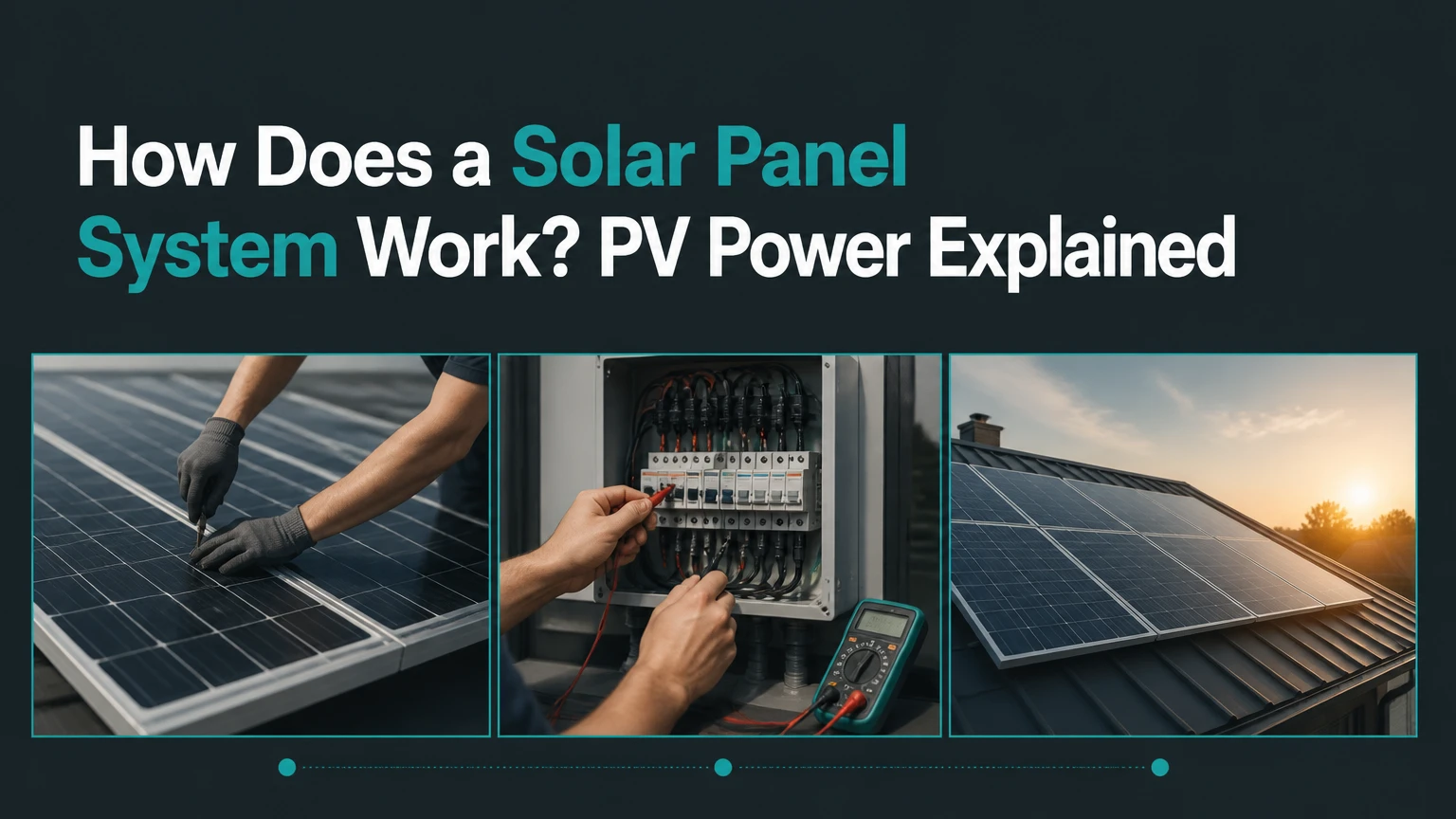
A solar panel system converts sunlight into electricity through the photovoltaic effect. Photons transfer energy to semiconductor electrons inside photovoltaic cells, producing direct-current electricity; an inverter then converts that DC electricity into alternating current for household loads, batteries, or the utility grid.
Key Facts at a Glance
- A photovoltaic panel produces DC electricity, while most household appliances use AC electricity.
- A grid-tied inverter synchronizes AC output with the utility’s voltage and frequency.
- Solar panels usually stop supplying ordinary grid-connected homes during outages unless an approved battery backup system creates an isolated circuit.
- Solar production depends on irradiance, temperature, shading, orientation, system losses, and inverter limits, not panel wattage alone.
- A battery stores surplus electricity chemically and later returns part of that energy with round-trip losses.
- A typical residential system is often sized from annual electricity consumption, local solar resource, roof area, and utility export rules.
How does a solar panel system work?
A solar panel system follows this energy path: sunlight, photovoltaic cells, DC electricity, inverter, AC electricity, electrical panel, appliances, battery, or grid. The photovoltaic effect begins when light with sufficient energy excites electrons in a semiconductor, creating charge carriers that an internal electric field directs through an external circuit.
The United States Department of Energy defines solar energy as “radiation from the sun that is capable of producing heat, causing chemical reactions, or generating electricity.” A solar photovoltaic system uses the electricity-producing part of that definition.
A panel contains multiple interconnected solar cells. Each cell produces a small voltage, commonly around 0.5-0.7 volts under operating conditions. Cells connect in series to raise voltage, and panels connect in series or parallel to achieve the array’s required electrical characteristics. The array’s nameplate rating is measured in kilowatts DC, while the inverter’s output rating is measured in kilowatts AC.
What happens inside a photovoltaic cell?
A photovoltaic cell normally uses silicon treated with carefully selected impurities to create n-type and p-type semiconductor regions. The boundary between those regions forms a depletion region with an electric field. When sunlight supplies enough energy, electrons move into a higher-energy state, leaving mobile charge carriers behind.
Conductive metal contacts collect the electrons and move them through an external circuit. The electron flow is direct current because the electrical polarity remains oriented in one direction. More sunlight generally increases current, while cell temperature, electrical resistance, and operating voltage affect total power.
The simplified phrase “photons knock electrons free” is useful for beginners but incomplete. The cell must also separate and collect those charge carriers before recombination, where an electron loses its usable energy. Cell design, passivation, metallization, and operating temperature influence how much of the incoming light becomes electrical output.
What components are in a complete system?
A complete residential solar installation includes generation equipment, power-conversion equipment, structural hardware, electrical protection, monitoring, and an interconnection point. The photovoltaic modules are only one part of the balance of system, which determines how safely and efficiently energy reaches the building.
| Component | Electrical or physical role | Typical location | Main design variable |
|---|---|---|---|
| PV modules | Convert light to DC power | Roof, rack, or ground mount | 350-550 W per module |
| Inverter | Converts DC to grid-compatible AC | Wall, garage, roof, or module level | 3-15 kW AC residential range |
| Racking | Secures modules and manages roof loads | Roof or ground structure | Roof type, wind, snow load |
| DC and AC wiring | Carries array and inverter current | Roof, conduit, walls, panels | Conductor size and voltage |
| Disconnects and breakers | Isolate equipment for service and faults | Array, inverter, main panel | Local code and equipment rating |
| Rapid shutdown equipment | Reduces rooftop conductor voltage during emergencies | Module or array level | Code-required system design |
| Utility meter | Records imported and exported energy | Service entrance | Utility interconnection rules |
| Battery system | Stores energy for later use | Garage, utility room, exterior wall | 5-30 kWh usable capacity |
The inverter also performs maximum power point tracking, or MPPT. MPPT continuously adjusts electrical operating conditions so the array produces close to its available maximum under changing irradiance and temperature.
A system may include a production meter, consumption meter, communications gateway, surge protection, grounding equipment, and an automatic transfer function for backup circuits. Electrical installation must follow the applicable authority having jurisdiction, utility requirements, and adopted standards. Homeowners should not open energized equipment.
What happens to solar electricity during the day?
Solar electricity normally serves available household loads before the system exports surplus power. If the array produces less than the home consumes, the utility or battery supplies the deficit; if the array produces more, the surplus may charge a battery, export through the meter, or be curtailed.
Consider a home using 2 kW at noon. If the array produces 6 kW AC, approximately 2 kW can serve current loads and the remaining 4 kW can charge a battery or flow to the grid, subject to equipment and utility limits. If the home uses 8 kW, the array supplies 6 kW and the grid supplies the remaining 2 kW.
The physical electricity does not carry a label identifying its source. The meter measures net energy flow, while the home’s electrical system balances supply and demand continuously.
What happens when production exceeds inverter capacity?
Inverter clipping occurs when the array can produce more DC power than the inverter can convert to AC. Designers often install a DC array larger than the inverter’s AC rating because panels rarely reach their nameplate output for long periods, and the larger array improves morning, afternoon, and cloudy-weather production.
| Operating condition | Array output | Home demand | Likely energy destination |
|---|---|---|---|
| Clear summer noon | 8.5 kW DC, 7.5 kW AC | 2.0 kW | 2.0 kW home, 5.5 kW export or battery |
| Cloudy afternoon | 2.2 kW DC, 2.0 kW AC | 3.5 kW | 2.0 kW home, 1.5 kW grid import |
| Battery full, export enabled | 6.0 kW AC | 1.5 kW | 1.5 kW home, 4.5 kW grid export |
| Battery full, export limited | 6.0 kW available | 1.5 kW | 1.5 kW home, surplus curtailed |
| Inverter-limited peak | 10.0 kW DC | 2.0 kW | Inverter supplies its AC limit, excess DC clipped |
Do solar panels work at night or in cloudy weather?
Solar panels produce no meaningful electricity in darkness because there is no incoming sunlight, so a home must use grid power, stored battery energy, or a generator at night. Cloudy weather reduces output rather than stopping it, and diffuse skylight can still generate electricity.
Production varies with cloud thickness, sun angle, atmospheric conditions, and panel orientation. A bright overcast day may produce a substantial fraction of clear-sky output, while heavy storm clouds can reduce generation sharply. Moonlight is far too weak for useful residential photovoltaic production.
Winter output requires separate analysis. Shorter days, lower sun angles, snow cover, and persistent clouds can reduce energy, although cooler module temperatures improve electrical efficiency when sunlight is available.
Which factors reduce production?
| Factor | Typical effect or threshold | Practical response |
|---|---|---|
| Partial shade | Can reduce affected module or string output by 5-100% | Model hourly shade, prune selectively, use module-level electronics |
| High cell temperature | Silicon power commonly falls about 0.3-0.5% per °C above 25°C | Allow rear ventilation and use accurate temperature coefficients |
| Soiling | Often 1-5% in ordinary conditions, higher in dusty areas | Inspect seasonally and clean only when necessary |
| Snow cover | Near-total temporary reduction while covered | Use roof-safe removal methods, never scrape modules aggressively |
| Wrong orientation | Annual loss depends on latitude and roof geometry | Compare modeled annual yield, not compass direction alone |
| Inverter clipping | Caps brief high-output periods | Check whether annual energy gains justify a larger inverter |
| Module degradation | Often about 0.25-0.5% per year for modern modules | Review the product warranty and modeled year-25 output |
NREL’s PVWatts tool models production using location, system size, orientation, tilt, losses, and inverter assumptions rather than treating panel wattage as annual energy. That distinction prevents a common sizing error.
Which system configuration fits a home?
A grid-tied system usually offers the lowest complexity and lowest upfront cost, while an off-grid system requires enough battery capacity and backup generation to survive prolonged low-sun periods. A hybrid system combines utility connection with batteries and backup circuits.
| Configuration | Utility connection | Battery requirement | Outage operation | Best-fit situation |
|---|---|---|---|---|
| Grid-tied | Yes | Optional | Usually shuts down | Bill reduction with reliable grid service |
| Off-grid | No | Required | Continues through battery system | Remote cabin or unavailable utility service |
| Hybrid | Yes | Usually included | Powers selected or whole-home loads | Outage resilience and time-of-use control |
| Grid-tied with generator | Yes | Optional | Generator supplies backup loads | Large loads with infrequent outages |
Why does a grid-tied system shut down in an outage?
A standard grid-tied inverter shuts down when utility voltage disappears because of anti-islanding protection. Continuing to energize utility lines could endanger line workers and damage equipment during restoration.
A battery inverter can disconnect the home from the utility and create a stable local microgrid. Solar modules can then recharge the battery and supply designated loads, provided the battery inverter, transfer equipment, array controls, and load panel are designed for that operating mode.
A battery does not automatically provide whole-home backup. A 10 kWh battery powering a steady 2 kW load lasts about five hours before conversion and reserve losses, while a 500 W refrigerator, lights, internet equipment, and controls can last considerably longer. Electric resistance heating, central air conditioning, water heaters, and EV charging can exhaust storage rapidly.
How do inverter choices change performance?
String inverters connect modules into series strings and convert their combined DC output centrally. Microinverters convert each module’s output to AC at the module, while power optimizers condition each module’s DC output before a central inverter performs the AC conversion.
| Inverter architecture | Module-level conversion | Typical cost position | Shade behavior | Service consideration |
|---|---|---|---|---|
| String inverter | No | Lowest | String design determines losses | Central unit is accessible |
| String plus optimizers | DC optimization | Medium | Better mismatch management | More roof electronics |
| Microinverters | Yes | Highest | Independent module tracking | Roof-level electronics |
| Hybrid inverter | Battery and PV conversion | Medium-high | Depends on MPPT inputs | Backup integration is central |
The claim that one shaded panel always reduces every panel in a string to that panel’s output is too broad. Bypass diodes, separate MPPT inputs, string layout, and shade geometry change the result. A shaded module can still reduce a string’s output, but the loss is not automatically identical to the shaded panel’s percentage loss.
String inverters suit simple, unshaded roofs with accessible equipment. Microinverters or optimizers become more attractive when roof planes face different directions, module-level monitoring matters, or recurring shade is difficult to avoid.
What panel technology should you choose?
Monocrystalline silicon modules dominate residential installations because they combine high efficiency with mature manufacturing and long performance warranties. Polycrystalline modules remain technically functional but are less common, while thin-film modules fit lightweight, flexible, or specialized surfaces better than most residential roofs.
| Panel technology | Typical module efficiency | Typical power range | Main advantage | Main limitation |
|---|---|---|---|---|
| Monocrystalline silicon | 19-24% | 350-550 W | High output per roof area | Higher material and product cost |
| Polycrystalline silicon | 15-20% | 250-450 W | Mature, lower-cost design | More roof area for equal output |
| CdTe thin film | 16-19% | Project-dependent | Good large-area performance | Less common for roofs |
| CIGS thin film | 12-18% | Project-dependent | Flexible form factors | Availability and installation complexity |
| Amorphous silicon | 6-12% | Low per area | Lightweight specialty use | Low power density |
Efficiency matters most when roof area is limited. A lower-efficiency module can still produce more annual energy if it has a larger physical area, better shade exposure, or a favorable orientation. Compare modeled annual kilowatt-hours, not efficiency percentage alone.
How much electricity can solar produce?
A transparent first estimate uses this equation: annual energy equals system size in kilowatts multiplied by equivalent peak-sun hours per day, 365 days, and a performance ratio. A 10 kW system with 4.5 peak-sun hours and an 80% performance ratio produces about 13,140 kWh per year before local modeling refinements.
The 80% performance ratio represents aggregate losses from temperature, wiring, mismatch, inverter conversion, soiling, availability, and other conditions. It is a planning assumption, not a guarantee. NREL PVWatts provides a more location-specific estimate.
| DC system size | Peak-sun assumption | Performance ratio | Estimated annual energy |
|---|---|---|---|
| 4 kW | 4.0 hours/day | 80% | 4,672 kWh |
| 6 kW | 4.5 hours/day | 80% | 7,884 kWh |
| 8 kW | 4.5 hours/day | 80% | 10,512 kWh |
| 10 kW | 4.5 hours/day | 80% | 13,140 kWh |
| 12 kW | 5.0 hours/day | 80% | 17,520 kWh |
For a household using 9,000 kWh annually, a preliminary system size at 4.5 peak-sun hours and 80% performance is:
9,000 ÷ (4.5 × 365 × 0.8) = approximately 6.85 kW DC.
That estimate must be adjusted for roof shading, future EV or heat-pump loads, seasonal utility rates, export limits, and the difference between annual energy offset and monthly bill offset.
How much does a solar system cost?
A typical United States residential installation may cost roughly $2.00-$3.50 per watt before incentives, making a 6 kW system approximately $12,000-$21,000 before batteries and local incentives. Batteries commonly add about $8,000-$15,000 installed, but equipment size, labor, electrical upgrades, and permitting can move the total substantially.
| System example | Approximate gross cost | Battery status | Main cost driver |
|---|---|---|---|
| 4 kW grid-tied | $8,000-$14,000 | None | Roof complexity and labor |
| 6 kW grid-tied | $12,000-$21,000 | None | Equipment and local installation rates |
| 10 kW grid-tied | $20,000-$35,000 | None | Array size and service-panel work |
| 6 kW hybrid | $22,000-$36,000 | 10-13.5 kWh | Battery and backup wiring |
| 10 kW hybrid | $30,000-$50,000 | 10-27 kWh | Multiple batteries and load control |
The federal Residential Clean Energy Credit rules have changed over time and depend on taxpayer eligibility, project timing, and current law. The IRS describes the credit and qualifying property requirements; homeowners should verify the applicable tax year rather than assume a universal 30% deduction.
Payback equals net project cost divided by annual bill savings, but annual savings depend on retail rates, export compensation, fixed charges, degradation, maintenance, financing interest, and battery cycling. A $20,000 system saving $2,000 per year has a simple ten-year payback, before financing and replacement costs.
How long does installation take?
Physical solar installation commonly takes one to three days for an uncomplicated home, while the complete project often takes two to six months because design, permitting, inspection, and utility approval take longer than roof work.
| Project stage | Typical duration | What can delay it |
|---|---|---|
| Site survey and design | 1-3 weeks | Structural questions, shade analysis |
| Permit review | 1-8 weeks | Local workload and design revisions |
| Equipment procurement | 1-8 weeks | Module or inverter availability |
| Physical installation | 1-3 days | Roof complexity and weather |
| Inspection | 1-3 weeks | Scheduling and corrections |
| Utility permission to operate | 1-6 weeks | Interconnection queue and meter work |
A system should not be operated in parallel with the utility before permission to operate. The installer must complete required inspections, labeling, commissioning, and utility procedures.
What problems can occur in a solar system?
The fastest diagnostic method is to compare current production with historical production, weather conditions, inverter status, and individual module data. Sudden zero output usually indicates a shutdown, tripped protection device, communications issue, or inverter fault; gradual decline more often points to shade, soiling, degradation, or equipment performance.
| Symptom | Likely cause | Safe next action |
|---|---|---|
| Zero production at noon | Inverter fault, shutdown, breaker trip | Check monitoring and visible status indicators |
| Low output on sunny days | Shade, soiling, snow, wiring fault | Compare weather-adjusted production history |
| One module underperforms | Shade, connector, diode, or module fault | Request installer-level diagnostics |
| Repeated inverter restarts | Grid voltage, temperature, or hardware issue | Record fault codes and contact installer |
| Battery will not charge | Reserve setting, full battery, outage mode, or fault | Review operating mode and alert history |
| Production data is missing | Internet or gateway failure | Distinguish communications loss from energy loss |
Do not remove covers, disconnect rooftop wiring, or reset unfamiliar equipment repeatedly. Solar arrays can produce hazardous DC voltage whenever light reaches them, even when the utility is disconnected.
Which mistakes reduce long-term value?
- Installing over a roof that needs replacement within five years can create avoidable detach-and-reinstall costs.
- Sizing only for current electricity use can leave insufficient capacity for an EV, heat pump, induction cooking, or electric water heating.
- Choosing a battery for whole-home backup without calculating starting currents and continuous loads produces disappointing outage performance.
- Ignoring growing trees creates a shade problem that did not exist on installation day.
- Comparing lease payments with purchase prices without including escalation rates, transfer terms, and roof obligations can distort the financial decision.
One practitioner rule matters more than many equipment comparisons: model the roof hour by hour before selecting panel electronics. A premium inverter cannot recover sunlight blocked by a neighboring building or a mature tree.
Can solar power replace the utility grid?
Solar power can reduce grid purchases substantially, but replacing the utility requires a larger array, substantial battery storage, load management, and usually a generator for extended cloudy periods. Annual energy independence is easier than hour-by-hour independence because seasonal production and household demand rarely align.
Off-grid systems need storage for overnight use and reserve capacity for several low-production days. Designers also account for battery depth of discharge, cold-weather capacity, inverter surge power, generator integration, and the largest motor or compressor load.
Grid independence is often a poor financial objective for a home with reliable utility service. A grid-tied system can achieve lower cost per kilowatt-hour, while a hybrid system adds value when outages, medical equipment, time-of-use rates, or weak grid service justify the expense.
Frequently Asked Questions
Do solar panels increase a home’s value?
Solar panels can influence resale value, but the outcome depends on ownership, system age, local buyer demand, utility rates, and whether the system is owned, financed, leased, or subject to a power-purchase agreement. Owned systems are generally easier to explain during a sale than contracts requiring assumption or transfer.
How long do solar panels last?
Modern photovoltaic modules commonly carry 25-30-year performance warranties, with modeled degradation often around 0.25-0.5% annually. Inverter service life is usually shorter than module service life, so a homeowner may replace a string or hybrid inverter before replacing the panels.
Is a battery necessary for solar panels?
A battery is not necessary for a conventional grid-tied system. Battery storage becomes useful when a homeowner wants outage backup, higher self-consumption, time-of-use arbitrage, or reduced exposure to low export compensation, but storage adds cost, conversion losses, controls, and eventual replacement considerations.
Can hail or storms damage solar panels?
Certified modules are tested for impact and environmental exposure, but severe hail, falling branches, windborne debris, and improper installation can cause damage. Review the module warranty, homeowner insurance, mounting design, local wind and snow loads, and post-storm inspection procedure before installation.
What happens to solar panels at the end of their life?
End-of-life modules can enter reuse, refurbishment, or recycling streams, although collection infrastructure varies by region. The International Energy Agency Photovoltaic Power Systems Programme identifies recycling and material recovery as important parts of photovoltaic lifecycle management. Ask the installer how damaged modules and electronic equipment will be handled.
The Bottom Line
A solar panel system uses the photovoltaic effect to turn sunlight into DC electricity, then uses an inverter to supply AC power to a home, battery, or utility grid. The best configuration depends on annual consumption, roof conditions, local solar resource, outage requirements, export rules, and future electrical loads. Understanding that energy path explains how does a solar panel system work and prevents common errors in sizing, backup expectations, and payback calculations.