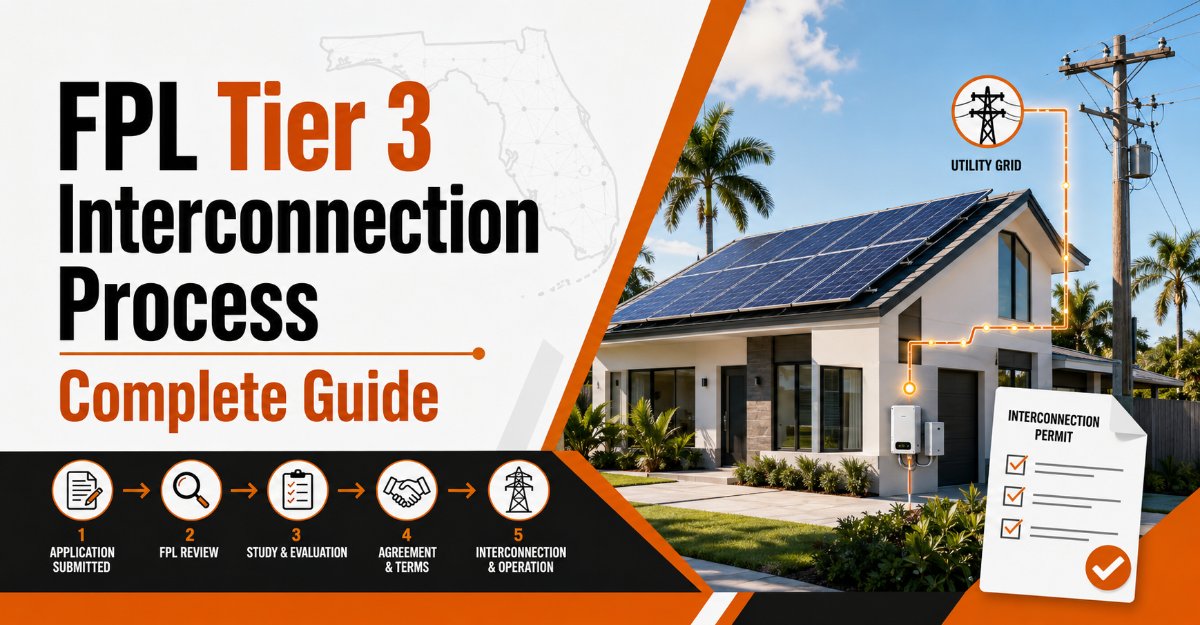
The Florida Power & Light (FPL) Tier 3 Interconnection Process is a formalized, highly regulated electrical grid-connection framework governing customer-owned renewable energy systems sized above 100 kW AC up to 2,000 kW AC (2 MW AC). This process ensures that large commercial, industrial, and agricultural distributed generation facilities synchronize safely with the local distribution network under strict IEEE 1547 standards.
Key Facts / Quick Answer
- Capacity Range: 100 kW AC to 2,000 kW AC (2 MW AC).
- Application Fee: $1,000.00 non-refundable.
- Fast Track Timeline: 10 business days for initial screening.
- Insurance Minimum: $2,000,000 commercial general liability.
- Mandatory Hardware: External, visible-load break manual disconnect switch adjacent to the FPL meter.
What is the FPL Tier 3 Interconnection Framework?
The FPL Tier 3 Interconnection framework regulates large-scale commercial solar, wind, and biomass installations seeking parallel operation with Florida Power & Light distribution circuits. Systems under Tier 3 must adhere to strict capacity constraints: the gross power rating cannot exceed 90% of the customer’s utility distribution service rating. Furthermore, any installation with a capacity of 50 kW AC and above is strictly required to configure on a three-phase WYE service. Governed legally by FPL Sheet No. 9.075 (Attachment 3), this process mitigates utility backfeed hazards, transformer thermal overloads, and voltage flicker on shared medium-voltage distribution lines.
What Does the Cost Breakdown Entail?
Financial planning for a commercial renewable energy project under Tier 3 requires accounting for distinct utility administrative fees, engineering deposits, and compliance mandates.
- Application Fee: A non-refundable baseline fee of $1,000.00 is required at submittal.
- System Impact Study Deposit: If the project fails the initial Fast Track screen, a $2,000.00 deposit is billed to fund deep thermal and fault-current modeling.
- Facilities Study Deposit: Ranging from $2,000.00 to $5,000.00, this deposit covers custom substation or transformer engineering if local grid upgrades are necessary.
- Insurance Requirements: Commercial general liability insurance of at least $2,000,000 is mandatory to protect utility personnel and infrastructure.
- Grid Upgrades: Costs range from $0 for systems passing Fast Track to upwards of $50,000.00+ for remote or capacity-constrained industrial feeders.
How Does the 8-Step Interconnection Workflow Operate?
Navigating the FPL Tier 3 Interconnection Process requires strict adherence to a sequential, gate-checked workflow. Skipping a step or executing hardware changes prematurely results in automatic rejection or regulatory penalties.
- Pre-Application Inquiry: Project developers review local grid constraints, substation capacities, and circuit loading parameters prior to finalizing facility designs.
- Online Application Submittal: The complete portfolio including account details, matching Taxpayer Identification Number (EIN/SSN), engineered Single-Line Diagrams (SLD), and inverter data sheets is submitted via the FPL Net Metering Portal.
- Fast Track Screening: FPL evaluates system size against local circuit peak load and existing grid capacity within 10 business days.
- Engineering Review Paths: Projects either secure conditional pre-approval (Fast Track pass) or drop into the Supplemental Engineering Study queue (Fast Track fail) requiring impact and facilities studies.
- Physical System Construction: Contractors construct the physical generation plant only after securing written conditional pre-approval from FPL, ensuring an external manual disconnect switch is installed.
- Local AHJ Inspection Approval: The local city or county Authority Having Jurisdiction (AHJ) issues formal electrical and structural sign-offs.
- FPL Field Verification: Passed AHJ documents are submitted to FPL, which schedules field technicians to verify wiring and install a bidirectional net meter.
- Permission to Operate (PTO): FPL issues a formal PTO letter, granting legal authorization to energize the system and synchronize with the grid.
Fast Track vs. Full Engineering Study Route
Choosing the right engineering pathway dictates project velocity, upfront capital exposure, and final deployment timelines.
| Evaluation Element | Fast Track Route | Full Engineering Study Route |
| Fixed Cost | $1,000 Application Fee | $1,000 Fee + $2,000 to $7,000+ Study Deposits |
| Grid Upgrade Fee | $0 | Custom-priced costs ($10,000 to $100,000+) |
| Timeline | 2 to 4 Months | 6 to 12+ Months |
| Pros | Quick deployment; minimal engineering overhead; low capital risk. | Unlocks grid access in heavily constrained industrial zones. |
| Cons | System must strictly align with existing utility capacity limits. | High capital expenditure; significant risk of schedule delays. |
What Are the Architectural Integration Paths?
Commercial properties select from three primary structural integration pathways depending on their generation assets and operational resilience goals.
- Standard Inverter-Interactive Interconnection: Systems map directly to utility-interactive inverters that drop offline immediately during grid outages, complying fully with IEEE 1547 anti-islanding protocols. This configuration suits standard commercial rooftops.
- Microgrid / Islandable Interconnection: This approach pairs the primary commercial array with an Energy Storage System (ESS) and an automatic transfer microgrid switch. It provides continuous energy resiliency for critical industrial operations during utility blackouts.
- Non-Inverter Generation Interconnection: Utilizing synchronous or induction generators such as agricultural bio-digesters or waste-to-energy turbines this path requires heavily audited electrical blueprints highlighting precise manual disconnect locations.
Common Operational Pitfalls & Risk Mitigation
Commercial developers frequently encounter avoidable delays due to administrative oversights or misunderstandings of utility protocols.
- Premature Activation (Gun Jumping): Energizing the commercial array after passing local city building inspections but before receiving FPL’s official PTO letter triggers severe utility safety violations and can damage unconfigured grid hardware.
- Mismatched Account Entities: Submitting the application under a corporate parent name or LLC that does not match the exact commercial name on the primary FPL utility bill causes an automatic administrative rejection.
- Sub-par Disconnect Accessibility: Installing the physical manual disconnect switch inside a fenced courtyard, behind security gates, or separated from the main meter housing violates utility accessibility rules. It must be placed in a completely unobstructed area accessible to FPL workers 24/7 without a security escort.
- Improper Placard Signage: Forgetting to mount permanent, weather-resistant placard signage at the main billing meter noting the exact path and location of the Tier 3 system disconnect will result in a failed FPL field inspection.
Frequently Asked Questions About fpl tier 3 interconnection process
What happens if my system fails the FPL Fast Track screening?
If your system fails the initial Fast Track screening, it is not rejected outright; instead, it transitions into the Supplemental Engineering Study queue. FPL will issue invoices for a $2,000 System Impact Study deposit and potentially a Facilities Study deposit to analyze local transformer and substation capacity.
Can I install battery storage under the Tier 3 interconnection process?
Yes, commercial Energy Storage Systems (ESS) can be integrated under Tier 3. When paired with solar arrays, they can operate in grid-tied mode or configure as an islandable microgrid using certified automatic transfer switches to maintain site power during outages.
How long does the entire FPL Tier 3 process take?
For systems passing the Fast Track route, the entire timeline from application submittal to final Permission to Operate (PTO) typically spans 2 to 4 months. If a project requires full engineering studies and grid upgrades, the timeline extends to 6 to 12 months or longer.
Is the $1,000 FPL application fee refundable if my project is canceled?
No, the $1,000.00 initial application fee is strictly non-refundable. It covers the administrative and preliminary engineering overhead incurred by FPL during the initial document intake and validation phase.
What are the exact requirements for the external manual disconnect switch?
The manual disconnect switch must be an external, visible-load break device located directly adjacent to the FPL billing meter. It must be weather-proof, clearly labeled with weather-resistant placards, and capable of being locked in the open position with a standard FPL utility padlock.