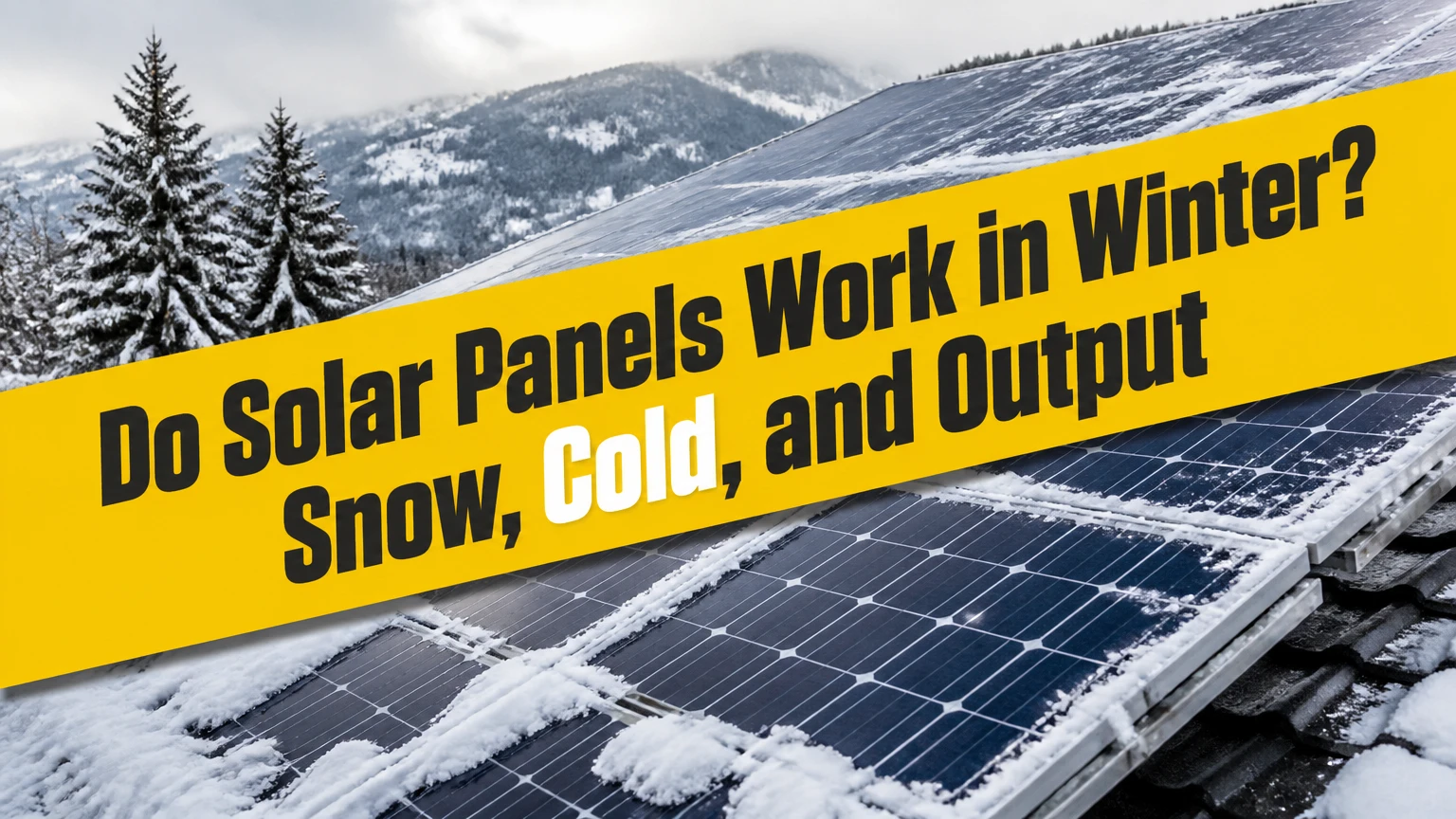
Solar panels do work in winter because photovoltaic cells use sunlight, not warmth, to produce electricity. Cold temperatures can improve a panel’s voltage and rated power, but shorter days, lower sun angles, cloud cover, snow, and ice often reduce total winter energy compared with summer.
Key facts at a glance
Solar panels generate electricity below freezing whenever sunlight reaches the photovoltaic cells.
A typical crystalline-silicon panel loses about 0.3%-0.5% of maximum power for every 1°C increase above its rated cell temperature.
Snow covering the active surface can reduce output to nearly zero until light reaches the cells.
Winter energy yield varies by location, roof orientation, shading, snow persistence, and electricity demand.
A panel’s snow-load rating is measured in pascals and cannot be converted into a universal “feet of snow” limit.
Solar panels do not automatically provide electricity during a grid outage unless the system includes approved backup equipment and batteries.
How photovoltaic panels make electricity in winter
Photovoltaic panels convert photons into direct-current electricity through semiconductor cells, then an inverter converts that electricity into alternating current for household circuits. The photovoltaic effect does not require ambient heat, so a clear, cold day can produce strong instantaneous power even when the air temperature is below 0°C.
The U.S. Department of Energy’s Solar Energy Technologies Office describes the technology this way: “Solar photovoltaic (PV) devices generate electricity directly from sunlight.” Silicon cells absorb photons, release charge carriers, and use an internal electric field to move those charges through an electrical circuit.
Cold affects the electrical characteristics rather than the basic reaction. Lower cell temperature generally raises voltage, while sunlight intensity determines how much current the cell can produce. The inverter then limits or adjusts the operating point so the array produces usable AC electricity.
Why cold can improve panel performance
Cold crystalline-silicon cells usually deliver higher voltage and slightly higher maximum power than hot cells under the same sunlight conditions. Manufacturers commonly specify a temperature coefficient between approximately -0.3% and -0.5% of maximum power per °C above 25°C, although the exact value depends on the module.
The often-repeated “0.4% efficiency gain per degree” needs precision. A coefficient of -0.4% per °C generally describes the change in maximum power, not a universal increase in conversion efficiency, and real winter output still depends on irradiance, shading, snow, and daylight duration.
| Condition at the cell | Typical electrical effect | Practical result |
|---|---|---|
| 25°C rated test condition | 100% of nameplate reference | Standard comparison point |
| 45°C cell temperature | About 6%-8% lower maximum power | Hot summer roof output falls |
| 5°C cell temperature | About 6%-8% higher maximum power | Cold clear-day output can improve |
| -10°C cell temperature | About 10%-14% higher maximum power | Voltage rises, subject to equipment limits |
The cell temperature is not the same as outdoor air temperature. Dark modules absorb sunlight, wind cools them, and a roof can be warmer than the surrounding air. Installers must therefore use the module’s voltage coefficient and the site’s minimum design temperature when checking string-inverter voltage.
Does cold weather reduce solar panel efficiency?
Cold weather usually does not reduce photovoltaic panel efficiency; heat is the more direct thermal penalty. Winter can still produce less total electricity because the sun remains above the horizon for fewer hours, reaches a lower elevation, and may be obscured by clouds or snow.
The distinction between instantaneous efficiency and daily energy matters. A panel producing more power at noon on a cold, clear day may still generate less energy across the whole day than it would during a long summer day.
The National Renewable Energy Laboratory’s PVWatts model accounts for solar resource, temperature, system losses, tilt, azimuth, and location rather than applying one winter percentage to every array. That approach is more useful than a universal claim that winter production falls by 40% or 60%.
How much electricity do solar panels produce in winter?
A typical winter monthly yield may be 20%-70% of summer yield, but the range is location-specific rather than a panel specification. Southern sites with little snow can have modest seasonal variation, while northern sites with short daylight and persistent snow can experience much larger reductions.
| Site pattern | Typical winter effect | Main limiting factor | Planning implication |
|---|---|---|---|
| Phoenix, Arizona | 70%-95% of summer monthly yield | Shorter days and occasional clouds | Winter solar can remain strong |
| Seattle, Washington | 35%-70% of summer yield | Cloud cover and low sun angle | Use local hourly production data |
| Minneapolis, Minnesota | 25%-65% of summer yield | Short days, cold, snow events | Size for snow-free winter intervals |
| Buffalo, New York | 20%-60% of summer yield | Snow cover and cloud persistence | Include grid or generator support |
| Fairbanks, Alaska | Highly variable, often near zero in deep winter | Very short daylight and snow | Solar alone cannot cover winter loads |
These figures are planning ranges, not performance guarantees. A roof shaded by leafless trees, chimneys, or nearby buildings can underperform a less snowy array with better winter sun exposure.
What happens when snow covers solar panels?
Snow blocks photovoltaic production in proportion to the amount of active glass it covers. A thin, translucent layer may permit some light through, but dense or wet snow can reduce output to nearly zero until wind, sunlight, or gravity clears the module.
Solar panels often shed snow faster than roofs because their glass surface is smooth and their tilt encourages sliding. The lower edge can remain blocked when snow piles against a snow guard, roof obstruction, ice ridge, or neighboring panel.
The snow’s water content matters. Two feet of dry powder and two feet of wet snow impose very different structural loads, which is why panel ratings use pressure units rather than a simple depth rule.
Does snow melt naturally?
Snow can melt naturally when sunlight warms the module and ambient conditions rise above freezing. The dark surface may melt a narrow layer at the interface, allowing the upper mass to slide, but snow will not reliably clear when the array is flat, shaded, heavily packed, or covered by freezing rain.
The U.S. Department of Energy notes that snow can reflect sunlight toward a PV array, but the benefit occurs only when the active surface remains sufficiently clear and the additional reflected light reaches the cells. Albedo is an optical advantage, not a substitute for removing opaque snow cover.
Is a panel’s snow-load rating enough?
A module rated at 2,400 Pa or 5,400 Pa has passed a pressure requirement under defined test and mounting conditions. The rating does not mean the module safely supports a fixed depth of every snow type, and it does not replace the roof structure, racking design, clamp placement, or local building-code review.
| Snow or ice condition | Approximate density | Why depth alone misleads |
|---|---|---|
| Fresh dry snow | 50-150 kg/m³ | Large depth can weigh relatively little |
| Settled snow | 200-300 kg/m³ | Wind and compaction increase pressure |
| Wet snow | 300-600 kg/m³ | A shallow layer can become heavy |
| Solid ice | About 900 kg/m³ | Thin ice can create major concentrated load |
A structural engineer or qualified installer should assess unusual accumulation, roof age, drift formation, and snow guards. Never climb onto a roof to clear a residential array without appropriate fall protection.
Which solar panels perform best in winter?
Monocrystalline and polycrystalline panels both function in winter, while bifacial modules can gain extra energy from snow-reflected light when their rear surface has adequate clearance. Panel technology matters less than winter irradiance, shade management, orientation, tilt, and whether snow remains on the cells.
Modern monocrystalline modules usually offer higher nameplate efficiency because manufacturers can fit more output into limited roof area. Polycrystalline modules can still be sound choices where roof space is plentiful, but their lower typical efficiency may require more area for the same system size.
Bifacial modules are not automatically 23%-27% efficient in the sense suggested by some comparison tables. Their front-side nameplate rating is specified like other modules; the rear-side gain depends on ground reflectivity, row spacing, mounting height, and rear shading.
| Module type | Typical front efficiency | Winter advantage | Main limitation |
|---|---|---|---|
| Monocrystalline silicon | 20%-24% | High output per square metre | Usually higher module price |
| Polycrystalline silicon | 15%-19% | Established, lower area cost | More roof area for equal watts |
| Bifacial monocrystalline | 20%-24% front side | Rear gain over bright snow or roof membrane | Needs rear-light access |
| Thin-film PV | 10%-на? | Some products tolerate diffuse light well | Larger area and different mounting |
The thin-film row should not contain a nonnumeric typo. Typical commercial thin-film module efficiency is approximately 10%-18%, depending on chemistry and product. Thin film may perform well in some diffuse-light conditions, but it rarely solves a roof-area constraint.
Which system design choices help in snowy climates?
Snowy-climate design should prioritize winter shade analysis, safe snow shedding, correct cold-voltage calculations, and service access. A higher tilt can reduce snow persistence, while module-level power electronics can limit mismatch from partial shading, although no inverter can make a fully covered module produce energy.
Roof-mounted systems should follow local structural requirements and preserve access around vents, valleys, snow guards, and roof edges. Ground-mounted arrays provide easier maintenance and adjustable tilt, but they require space, foundations, fencing, and a plan for drifting snow.
| Design choice | Typical specification | Winter benefit | Trade-off |
|---|---|---|---|
| Roof tilt | Existing roof, often 20°-45° | Passive shedding at steeper angles | Roof angle cannot always be changed |
| Adjustable ground mount | Seasonal setting up to 45°-60° | Better low-sun alignment | Higher land and installation cost |
| String inverter | One or more MPPT inputs | Lower equipment cost | Shade can affect a string |
| Microinverters | One unit per module | Better module-level monitoring | More rooftop electronics |
| DC optimizers | One optimizer per module | Reduces mismatch in shade | Adds component and service complexity |
Microinverters and optimizers help when one module is shaded or snow-covered, but they do not remove the energy loss from blocked sunlight. A completely buried module remains unproductive.
How much does a winter-capable solar system cost?
A typical 10 kW residential system often costs about $18,000-$25,000 before incentives in the United States, although labor rates, roof complexity, equipment choice, permitting, and regional prices can move the range substantially. Batteries add a separate cost that commonly reaches $10,000-$20,000 installed for residential-scale storage.
The Federal Energy Management Program recommends evaluating solar with site-specific production and lifecycle economics rather than relying on nameplate capacity alone. Net-metering rules, time-of-use rates, export limits, and winter utility prices can change the financial result more than a small module-efficiency difference.
| Project component | Typical residential range | Typical timeframe | Main cost driver |
|---|---|---|---|
| 10 kW PV system | $18,000-$25,000 before incentives | 1-3 installation days | Roof and labor complexity |
| Permitting and design | Included or $500-$2,000 | 4-8 weeks in slower jurisdictions | Utility and authority review |
| 10-15 kWh battery | $10,000-$20,000 installed | 1-2 additional days | Battery, inverter, electrical work |
| Ground-mount structure | $3,000-$10,000 added | 1-4 days | Excavation and foundation type |
| Snow-related service visit | $150-$500 typical | Same day to several days | Access, weather, and roof height |
Winter installation is possible when roofing, excavation, and electrical work can proceed safely. Frozen ground, ice, high winds, and permitting delays may extend the schedule.
Do solar panels work on cloudy winter days?
Solar panels produce electricity on cloudy winter days because diffuse sunlight still reaches the cells, but output can fall sharply compared with direct sun. Thick overcast skies may reduce production to roughly 10%-40% of clear-sky output, while bright thin cloud can produce substantially more.
Cloud performance varies by module, irradiance spectrum, inverter behavior, and the thickness of the cloud layer. Portable panels and small off-grid systems are particularly sensitive because their limited area leaves little production margin.
The National Renewable Energy Laboratory’s PVWatts calculator uses hourly weather data and irradiance modeling to estimate these variations for a specific location. A local production model is therefore more reliable than a claim that every cloudy day produces a fixed percentage.
How should snow and ice be handled?
Leave light snow alone when the array can clear naturally and no safety hazard exists. If removal is necessary, use a manufacturer-approved soft tool from ground level or hire a qualified service, and never scrape glass with metal, pour hot water on modules, or walk on the array.
Snow removal can damage anti-reflective coatings, seals, wiring, and mounting hardware. A warm-water shock can crack cold glass, while aggressive raking can dislodge snow onto people, cars, gutters, or lower roof sections.
| Symptom | Likely cause | Safe first action | Escalate when |
|---|---|---|---|
| Zero output during snowfall | Opaque snow cover | Wait for safe natural clearing | Snow persists after clear weather |
| Low output after partial clearing | Patchy shade or ice | Check monitoring by module | One module reports repeated faults |
| Inverter shutdown | Moisture, cold, grid fault, or blocked vents | Read the exact error code | Fault returns after reset |
| Snow pile at lower edge | Low tilt or roof obstruction | Keep people clear below | Ice dam threatens roof drainage |
| Battery stops charging | Battery temperature protection | Move system into approved temperature range | Alarm remains after warming |
Heating cables are not a default solution. They consume energy, add roof penetrations or wiring complexity, and can create localized ice and water problems if poorly installed.
Can solar panels run a home’s heating in winter?
Solar panels can offset winter heating energy, but a typical residential array cannot be assumed to cover all electric heating demand. Heat pumps use less electricity than resistance heaters for the same delivered heat, yet their winter load can still peak when solar production is lowest.
For example, a 10 kW array may produce only a fraction of its summer daily energy during a short, cloudy winter day, while a heat pump, water heater, cooking equipment, and vehicle charger increase demand. Batteries shift daytime solar into evening hours, but they do not create energy during multi-day low-sun events.
Heating design should compare hourly generation with hourly load. Homes relying on electric resistance heating, electric boilers, or large heat pumps may need grid service, a generator, larger storage, demand management, or backup fuel.
Do batteries work in freezing temperatures?
Lithium batteries can operate in cold weather, but charging below 0°C may be restricted because lithium plating can damage cells. Many battery-management systems reduce charging current or stop charging until the battery warms, while discharge capacity and usable power also decline at low temperatures.
A battery installed in a conditioned basement or approved insulated enclosure usually has fewer cold-weather limitations than one placed in an unheated exterior shed. LiFePO4 batteries often include low-temperature charging protection, but built-in protection is not the same as unlimited cold operation.
| Battery condition | Typical effect | Design response |
|---|---|---|
| 10°C to 30°C | Normal charging range for many systems | Standard operation |
| 0°C to 10°C | Reduced charging performance | Monitor temperature |
| Below 0°C | Charging may be disabled | Use approved heating or indoor installation |
| Multi-day cloudy spell | State of charge declines | Retain grid or generator backup |
Manufacturer instructions control. Battery chemistry, enclosure, heating system, and warranty conditions differ by product.
Will solar panels work during a winter power outage?
A standard grid-tied solar system usually shuts off during an outage to protect utility workers from energized lines. Solar panels provide outage power only when the system includes an approved islanding-capable inverter, battery or other backup source, and a properly configured transfer mechanism.
A battery backup system can power selected circuits during daylight and after sunset, subject to battery capacity and inverter output. Some systems can recharge from solar during an outage, but heavy snow or a prolonged storm may prevent meaningful recharging.
The National Electrical Code requires anti-islanding behavior for utility-interactive inverters, and local utilities approve interconnection equipment under their own procedures. Ask the installer whether backup circuits include heating equipment, refrigeration, medical devices, or well pumps before assuming the whole home remains powered.
What are the most common winter solar problems?
The most common winter problems are snow shading, persistent low irradiance, inverter faults, cold battery protection, roof drainage issues, and unrealistic expectations about seasonal production. Most problems require diagnosis from monitoring data rather than guesswork.
Use the inverter application to compare today’s output with clear-day output, inspect the array visually from the ground, and record fault codes before contacting service. Do not open energized equipment or disconnect rooftop wiring.
Expert rules that prevent expensive mistakes
- Calculate voltage at the coldest design temperature. Cold raises open-circuit voltage, so a string that appears acceptable at 25°C can exceed an inverter’s maximum voltage in a severe climate. The installer should use the module’s voltage coefficient, string length, and local design temperature.
- Model snow loss separately from temperature gain. A 6% cold-weather power improvement cannot compensate for a module covered by opaque snow. Production software should include snow-loss assumptions or a locally appropriate weather file.
- Do not buy bifacial modules for a conventional shaded roof. Bifacial gain requires rear irradiance. A flush roof, dark roof surface, narrow row spacing, or rear obstruction can produce little additional energy despite snowy conditions.
- Treat winter access as part of system design. Arrays above fragile skylights, narrow roof valleys, or difficult snow-drop zones may cost more to service than a slightly cheaper layout saves.
Which winter strategy fits each user?
A heavy-snow homeowner generally benefits from a structurally reviewed roof layout, steepest practical tilt, clear lower-edge drainage, and module-level monitoring. The best inverter choice depends on shade and service preferences, not snow alone.
An off-grid cabin needs more than high-efficiency modules. It needs winter solar-resource modeling, oversized array capacity, temperature-managed batteries, a generator or other backup, and load controls for heating and water pumping.
A net-metered suburban home may gain more from a larger array and utility credits than from an expensive battery, provided the local tariff preserves credits across seasons. Export rules and annual true-up dates must be checked before making that decision.
| User situation | Recommended priority | Usually poor assumption | Backup approach |
|---|---|---|---|
| Heavy-snow roof | Structure, tilt, snow access | Snow always slides immediately | Grid connection |
| Off-grid cabin | Array oversizing and battery temperature | A 10 kW array covers winter heating | Generator and load shedding |
| Net-metered suburb | Annual production and tariff rules | Summer credits always roll over | Utility-approved storage |
| Winter outage concern | Backup inverter and critical-load panel | Grid-tied PV works during outage | Battery-backed circuits |
| Small portable system | Clear placement and frequent repositioning | Cloudy winter charging is predictable | Larger power station or AC charging |
The bottom line
Do solar panels work in winter? Yes, photovoltaic panels produce electricity in cold weather whenever sunlight reaches their cells. Winter performance depends less on temperature than on available daylight, cloud cover, snow persistence, roof shade, orientation, and the household’s energy demand.
Cold can improve instantaneous panel power, but shorter days and snow can reduce total monthly yield. The sound decision is to model the property’s winter irradiance, verify structural and electrical limits, plan snow access, protect batteries from freezing-charge conditions, and retain grid or generator support when winter loads exceed solar supply.
FAQ
Do solar panels work at night in winter?
Solar panels do not produce useful electricity at night because photovoltaic cells require incoming photons. A battery can supply nighttime loads from energy collected during the day, while a grid-connected home can draw electricity from the utility when solar production reaches zero.
Does freezing rain damage solar panels?
Freezing rain usually does not damage certified modules by itself, but ice accumulation can add weight, reduce output, and obstruct drainage. Hail, windborne debris, poor mounting, and repeated thermal stress create greater risks. Do not chip ice from the glass because impact can crack the module or damage its coating.
Should winter solar systems be oversized?
Many winter-focused systems benefit from additional array capacity because snow, clouds, and short days reduce the energy available for charging. Oversizing must remain within inverter, utility, roof, and electrical limits. Off-grid systems generally need more winter margin than net-metered systems with seasonal crediting.
Are solar panels worth installing in a cold climate?
Solar panels can be worthwhile in cold climates when the site has usable winter sun, acceptable roof orientation, reliable utility credits or high electricity prices, and manageable snow losses. A cold climate is not disqualifying, but persistent cloud, shade, and electric heating demand can lengthen the financial payback.
Can snow reflect more sunlight onto solar panels?
Snow can reflect additional sunlight toward panels, especially for elevated bifacial modules with an unobstructed rear surface. The gain is lost when snow covers the front glass, when the rear side is shaded, or when the snow is dirty and absorbs more light than it reflects.