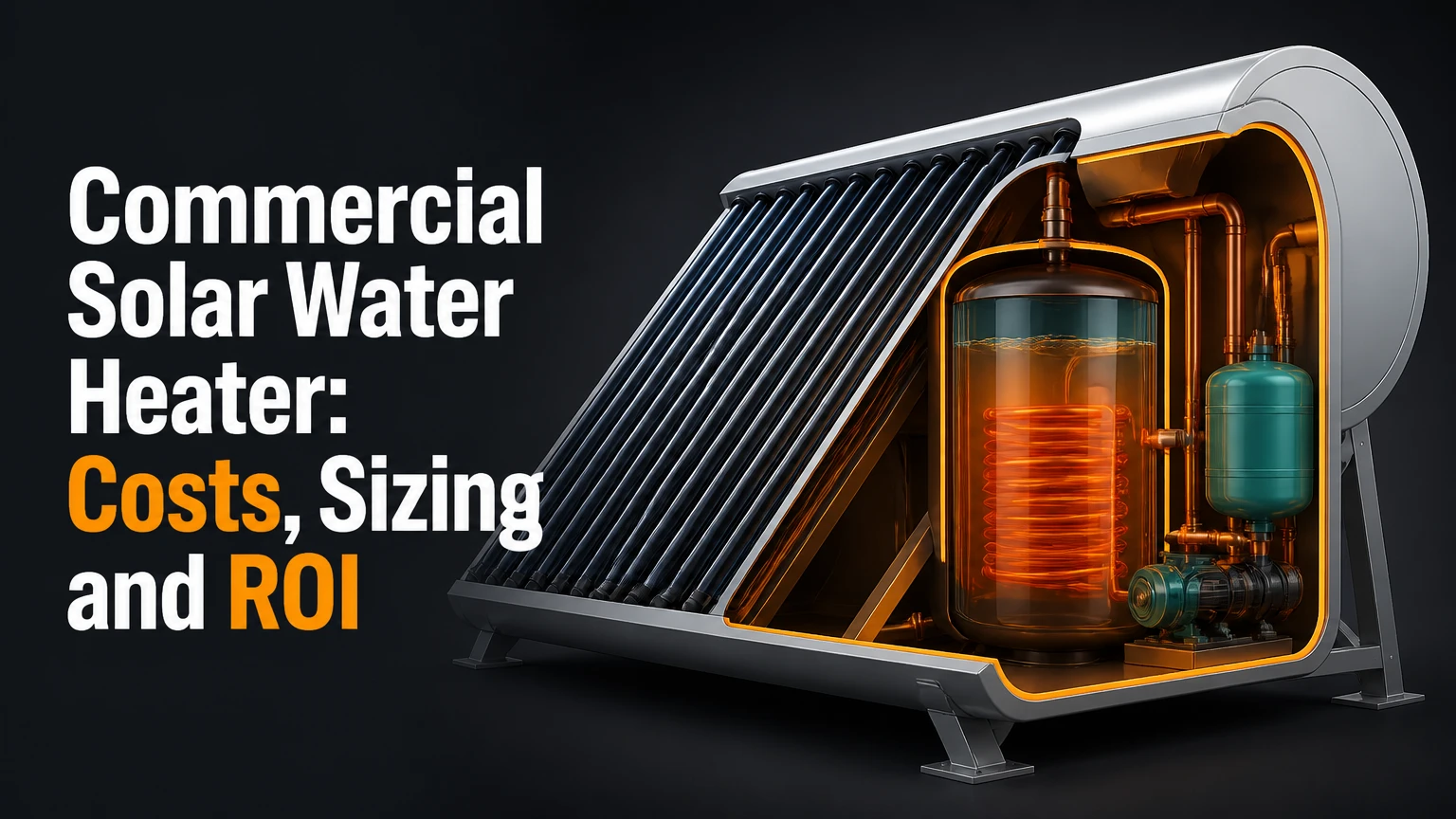
A commercial solar water heater is a solar thermal system that captures sunlight in roof-mounted collectors, transfers the heat to a building’s domestic hot-water supply, and uses insulated storage plus auxiliary equipment to meet demand. Hotels, hospitals, laundries, gyms, restaurants, and multifamily properties use these systems to reduce gas or electricity consumption without depending on solar photovoltaic panels.
Commercial Solar Water Heater Key Facts
- Commercial solar thermal systems typically supplement, rather than replace, a boiler or electric water heater.
- A preliminary design commonly targets a 50-70% annual solar fraction, not 100% solar coverage.
- Flat plate collectors generally suit high-flow, moderate-temperature loads and durable long-term operation.
- Evacuated tube collectors reduce heat loss in cold conditions but introduce glass, snow, and stagnation concerns.
- A commercial installation commonly costs about $30,000-$200,000 or more before incentives, depending on capacity and site complexity.
- Collector service life commonly reaches 20-25 years, while pumps, sensors, and controllers usually need earlier replacement.
What Is a Commercial Solar Water Heater?
A commercial solar water heater is a centralized solar thermal plant sized for a business’s hot-water load, storage volume, operating temperature, and peak demand. Unlike a residential unit serving a predictable household, a commercial installation may supply hundreds or thousands of gallons per day across multiple fixtures, showers, kitchens, guest rooms, or production processes.
Solar thermal equipment produces heat directly. Solar photovoltaic panels produce electricity, which can then power a heat pump or resistance heater. That distinction matters because a solar thermal collector can deliver useful heat without first converting sunlight into electricity.
The U.S. Department of Energy identifies solar water heating as a technology that can reduce conventional water-heating energy use, but the financial result depends on local solar resource, fuel prices, collector placement, demand timing, and backup-system efficiency. A property with continuous daytime demand usually captures more value than a property with a short weekend load.
Which businesses use solar thermal hot water?
Hotels, hospitals, student housing, correctional facilities, athletic clubs, laundromats, restaurants, and food-processing sites are strong candidates because they consume large volumes of hot water throughout the year. Solar thermal becomes less attractive when a building has low demand, severe shading, limited roof area, or highly irregular occupancy.
| Facility type | Typical hot-water pattern | Design priority | Suitable configuration |
|---|---|---|---|
| Hotel | 25-100+ gallons per occupied room daily, with morning and evening peaks | Storage and recirculation control | Flat plate, indirect or drainback |
| Hospital | Continuous demand, high hygiene temperature, limited service interruption | Redundancy and thermal disinfection | Flat plate or evacuated tube with boiler backup |
| Laundromat | Large daytime draw, repeated high-temperature cycles | High flow and heat exchanger capacity | Flat plate, direct or indirect |
| Gym or sports club | Strong morning and evening shower peaks | Peak storage and recovery rate | Flat plate with auxiliary heat |
| Restaurant | Kitchen demand concentrated around meal periods | Scale control and compact mechanical layout | Flat plate or heat-pump hybrid |
| Multifamily building | Distributed demand with long recirculation loops | Metering, recirculation, and tenant reliability | Central indirect system |
How Does Commercial Solar Hot Water Work?
A commercial solar water heater moves thermal energy through a controlled collector loop, transfers that energy through a heat exchanger, stores hot domestic water, and activates a boiler or electric heater when solar heat cannot satisfy the setpoint. Differential controls usually start the collector pump only when the collector is warmer than the storage tank.
- Collectors absorb sunlight. An absorber coating transfers solar radiation to water, glycol, or a heat pipe.
- The collector loop circulates. A pump moves heat-transfer fluid through roof piping when the control differential is favorable.
- The heat exchanger transfers energy. A plate-and-frame or coil heat exchanger separates potable water from glycol or contaminated collector fluid.
- Storage buffers demand. Insulated tanks hold solar-heated water for later showers, laundry cycles, or kitchen use.
- The backup heater finishes the cycle. A gas boiler, electric heater, heat pump, or steam system raises water to the required operating temperature.
- The recirculation loop maintains service. A controlled return loop prevents long waits at distant fixtures, although poorly designed recirculation can waste substantial heat.
The control system needs sensors at the collector outlet, storage tank, return line, and sometimes the backup heater. ASHRAE Standard 90.1 addresses energy-efficiency requirements for commercial buildings, including controls, insulation, and service-water-heating design considerations. Local plumbing, mechanical, fire, structural, and health codes still govern the final installation.
What equipment does a commercial system require?
A complete installation normally includes collectors, mounting hardware, supply and return piping, pumps, expansion equipment, isolation valves, check valves, air separators, pressure relief devices, heat exchangers, storage tanks, sensors, controls, backup heating, insulation, and monitoring.
The heat exchanger must be selected for flow rate, temperature difference, pressure drop, water chemistry, and allowable approach temperature. An undersized exchanger can leave collectors hot while the storage tank remains cold, causing poor energy capture and unnecessary stagnation.
Which Collector Type Is Best?
Flat plate collectors are usually the practical choice for high-volume, moderate-temperature commercial loads, while evacuated tube collectors become more attractive when winter heat loss, limited roof area, or higher delivery temperatures dominate the design. Neither collector type is universally superior.
| Criterion | Flat plate collector | Evacuated tube collector | Design consequence |
|---|---|---|---|
| Typical useful output range | About 40-70°C | About 50-95°C | Higher temperature increases losses and lowers output |
| Cold-weather heat retention | Moderate | High | Tubes perform better where ambient temperatures are low |
| Roof loading | Commonly 25-45 kg/m² installed, site-dependent | Commonly 15-35 kg/m² installed, site-dependent | Structural review remains mandatory |
| Durability exposure | Metal box and glass cover | Multiple glass tubes | Tube breakage creates individual replacement work |
| Snow behavior | Broad surface sheds snow variably | Tubes can retain snow between rows | Racking angle and access affect winter production |
| Typical maintenance | Low, with pump and fluid checks | Medium, including tube inspection | Spare tubes and seals may be needed |
| Best load | High flow at moderate temperature | Higher temperature or cold climate | Load temperature should drive selection |
Flat plate collectors
Flat plate collectors use a dark absorber plate, fluid channels, insulation, and a glass cover inside a rigid casing. The design has fewer fragile components than evacuated tube equipment and generally handles high flow rates well.
Flat plates fit hotels, apartments, laundries, and gyms where the system preheats large quantities of water rather than producing extreme temperatures. Their limitations appear in cold, windy locations, on heavily shaded roofs, and where the system must maintain a high delivery temperature with little auxiliary heat.
Evacuated tube collectors
Evacuated tube collectors place an absorber inside a vacuum-insulated glass tube. Heat-pipe models transfer energy to a manifold, while direct-flow models circulate fluid through the tube assembly.
The vacuum limits conductive and convective heat loss, which can improve winter performance and allow higher operating temperatures. The trade-offs include higher hardware cost, glass breakage, snow accumulation, replacement access, and greater risk of excessive summer temperature when demand falls.
Should a System Use Direct, Indirect, or Drainback Circulation?
An indirect closed loop is the safest default where freezing is possible because non-toxic propylene glycol protects roof piping while a heat exchanger keeps glycol away from potable water. Direct systems can be efficient in warm climates, while drainback systems provide freeze and stagnation protection when gravity drainage and piping slopes are feasible.
| Configuration | Roof-loop fluid | Freeze protection | Main benefit | Main limitation |
|---|---|---|---|---|
| Direct open loop | Potable water | None unless climate permits | High heat-transfer efficiency | Freezing, scale, and corrosion reach collectors |
| Indirect closed loop | Propylene glycol mixture | Glycol concentration | Broad climate suitability | Glycol degrades and needs testing |
| Drainback | Water, usually | System drains when pump stops | No glycol boiling or freeze damage | Requires sloped piping and indoor reservoir |
| Pressurized glycol | Propylene glycol | Glycol and expansion vessel | Flexible routing and familiar controls | Stagnation can damage fluid and seals |
Water chemistry should influence the decision. Hard water can scale collector passages, heat exchangers, mixing valves, and storage tanks. A water-treatment specialist should review hardness, chlorides, pH, and dissolved solids before specifying a direct system.
How Large Should a Commercial Solar Water Heater Be?
Commercial solar water heater sizing begins with measured daily demand and hourly drawdown, not roof area. A preliminary design may target 50-70% annual solar fraction, but the final collector and tank sizes require climate data, load simulation, operating temperature, storage strategy, shading analysis, and backup capacity.
A useful first calculation is:
Daily heating load = gallons per day × 8.34 × temperature rise in °F
For metric designs:
Daily heating load = liters per day × 4.186 × temperature rise in °C
For example, heating 1,000 gallons per day from 55°F to 120°F requires approximately 542,000 Btu before distribution and storage losses. Solar collectors may cover part of that load, while the backup system supplies the remainder and protects service continuity.
| Preliminary design variable | Typical planning range | Why it matters |
|---|---|---|
| Annual solar fraction | 50-70% | Limits winter underperformance and summer overheating |
| Storage volume | 1.3-2.0 gallons per daily gallon heated, site-dependent | Buffers solar collection and demand timing |
| Collector area | About 0.5-1.5 ft² per daily gallon, highly climate-dependent | Depends on collector efficiency and solar resource |
| Storage per collector area | About 50-75 liters per m² | Preliminary rule only, not a final design value |
| Pipe insulation | At least code-required thickness, often greater on long runs | Reduces distribution loss |
| Backup capacity | Sized for peak demand without solar input | Maintains service during cloudy periods |
The 50-75 liters per square meter ratio is a preliminary rule of thumb, not a universal engineering requirement. A laundromat with immediate daytime demand may need less storage than a hotel with morning peaks. An oversized tank can also increase standby loss and capital cost.
What roof and site conditions matter?
A structural engineer should verify dead load, wind uplift, seismic forces, ballast, roof membrane condition, access paths, and remaining roof life. Collectors, full piping, glycol, storage tanks, pumps, and maintenance loads all affect the structural calculation.
The mechanical room must have space for tanks, heat exchangers, valves, expansion vessels, and safe service access. Long roof-to-mechanical-room piping increases heat loss, pump head, installation labor, and the number of penetrations that require waterproofing.
Collectors should face the equator-facing direction where practical, with shading assessed across the operating day and year. Orientation and tilt can be optimized, but eliminating shade usually produces more value than chasing a perfect angle.
What Does a Commercial Solar Water Heater Cost?
A commercial solar water heater commonly costs $30,000-$200,000 or more installed, with the largest variables being daily demand, collector area, storage capacity, structural reinforcement, trenching or pipe length, water treatment, controls, and site access. A price based only on collector area is incomplete.
| Project scale | Approximate installed cost | Typical scope | Typical design and installation time |
|---|---|---|---|
| Small commercial retrofit | $30,000-$70,000 | 100-300 gallons per day, limited storage | 6-12 weeks design, 3-7 days site work |
| Medium facility | $70,000-$150,000 | 300-1,500 gallons per day, multiple tanks | 8-16 weeks design, 1-2 weeks site work |
| Large institutional system | $150,000-$350,000+ | 1,500+ gallons per day, engineered plant | 12-24 weeks design, 2-5 weeks site work |
| Industrial process-water system | $200,000+ | High temperature, custom heat exchange | 16-30 weeks design, project-specific construction |
These figures are typical planning ranges, not bids. A project with a sound roof and nearby mechanical room can cost far less than one requiring structural reinforcement, hazardous-area equipment, long pipe runs, or major boiler modifications.
Simple payback equals net installed cost divided by annual avoided fuel cost. A project may achieve a 4-8 year simple payback in a high-demand facility with expensive fuel and incentives, while a low-use building may produce a much longer result.
The U.S. Internal Revenue Service describes qualifying solar energy property under the federal business energy investment credit rules. Eligibility, credit percentage, prevailing-wage and apprenticeship conditions, domestic-content rules, direct-pay treatment, depreciation, and project ownership should be confirmed with a tax professional before financial modeling. Incentives change.
How Does Solar Thermal Compare With Alternatives?
Solar thermal is strongest when hot-water demand is high, predictable, and available during the system’s operating life. Heat-pump water heaters often provide a simpler alternative when roof space is limited, electricity is reasonably priced, and the owner values easier modular replacement.
| Technology | Typical efficiency metric | Best operating condition | Main limitation | Typical service issue |
|---|---|---|---|---|
| Solar thermal | Seasonal solar fraction, often 50-70% target | High daytime or daily hot-water demand | Weather and roof dependence | Glycol, pumps, sensors |
| Gas condensing boiler | About 90-98% combustion efficiency, load-dependent | High-temperature backup and peak demand | Gas connection and emissions | Burner and heat exchanger service |
| Electric resistance | Nearly 100% at point of use | Small systems or low capital budget | High operating cost in many markets | Element and contactor failure |
| Heat-pump water heater | Often 2-4 COP under suitable conditions | Moderate-temperature water and available electricity | Space, acoustics, cold ambient air | Compressor and refrigerant service |
| PV plus heat pump | Depends on PV yield and heat-pump COP | Sites with electrical demand and roof area | More electrical equipment | Inverter and compressor replacement |
Solar thermal should not be selected solely because its collectors appear more efficient than photovoltaic modules. Collector efficiency describes captured heat under test conditions. Project economics depend on delivered hot-water energy, backup displacement, storage loss, maintenance, roof use, and the value of electricity or fuel avoided.
Which Applications Need Special Design?
Hospitals and care facilities need redundancy, monitored temperatures, anti-scald mixing, and a validated water-management plan because solar preheating does not remove the need to control Legionella risk. ASHRAE Standard 188 addresses building water-system management practices, while local health requirements determine implementation.
Hotels benefit from storage and robust recirculation control because demand arrives in concentrated morning and evening peaks. A drainback arrangement can reduce summer stagnation risk when occupancy drops, but the design must provide correct pipe slopes and a reliable drainback reservoir.
Laundries and industrial users often favor flat plates because daytime demand can consume heat as collectors produce it. High-temperature wash processes may still require a boiler or heat pump, and the heat exchanger must handle rapid flow changes without excessive pressure loss.
Restaurants have smaller footprints but severe scale and grease-related maintenance environments. A compact preheat tank and accessible heat exchanger may outperform a larger roof array that cannot be serviced without disrupting kitchen operations.
How Can a System Avoid Overheating and Freezing?
A commercial solar thermal system avoids damage through correct collector sizing, stagnation-resistant components, heat dumping or drainback, expansion control, insulation, freeze protection, and commissioning. Overheating usually results from excess collector area, failed circulation, low occupancy, or controls that do not recognize a full storage tank.
Freeze protection requires more than adding glycol. The installer must verify concentration, freeze point, pH, pressure, expansion volume, relief-valve settings, and compatibility with pumps and seals. Glycol can degrade under repeated high-temperature stagnation and become acidic, which accelerates corrosion.
High-temperature systems also need mixing valves to prevent scalding at fixtures. Storage may operate above distribution temperature, but occupants should receive water at a code-compliant mixed temperature.
Practitioner rule: Design for the building’s lowest realistic summer demand, not its annual average. A hotel that closes one wing or a school that empties in July can create more stagnation risk than a cold winter week.
What Maintenance Does the System Require?
Commercial solar water heating usually needs monthly operator checks, seasonal inspection, and annual professional service. The maintenance plan should record collector temperatures, tank temperatures, pump status, loop pressure, glycol condition, relief-valve discharge, water quality, and backup-heater runtime.
| Component | Inspection interval | Typical fault | Corrective action |
|---|---|---|---|
| Collector glazing | Monthly or quarterly | Dust, bird fouling, cracked glass | Clean or replace after safe isolation |
| Pumps and valves | Monthly | Noise, vibration, seized actuator | Verify power, flow, and valve position |
| Glycol loop | Annually | Low pH, weak freeze protection | Test, flush, and recharge as specified |
| Temperature sensors | Quarterly | Drift or loose mounting | Compare readings and replace sensor |
| Storage tanks | Annually | Corrosion, scale, insulation damage | Inspect anodes, drains, insulation, and valves |
| Heat exchanger | Annually | Scaling and reduced temperature transfer | Measure approach temperature and descale |
| Backup heater | Per manufacturer schedule | Constant operation or low recovery | Check controls, burner, elements, and flow |
A common commissioning mistake is accepting a running pump as proof of performance. The correct test verifies collector-to-tank temperature differential, flow rate, heat exchanger approach temperature, tank stratification, backup lockout logic, mixing-valve operation, and high-limit response.
Practitioner rule: Trend backup-heater runtime before and after commissioning. A solar array can appear healthy while a miswired sensor leaves the boiler enabled all day.
What Problems Should Operators Troubleshoot First?
When a pump runs constantly but water remains cold, check collector-loop flow, trapped air, closed valves, failed impellers, incorrect sensor positions, and a scaled heat exchanger. A pump signal alone does not confirm heat transfer.
When a relief valve leaks on sunny days, inspect the expansion vessel, system pressure, fluid volume, stagnation temperature, and valve condition. Replacing the valve without correcting thermal expansion often produces another leak.
When system pressure falls rapidly, inspect roof penetrations, unions, relief outlets, pump seals, heat-exchanger plates, and buried or concealed piping. A pressure loss in a long commercial loop should be isolated by circuit rather than guessed from the mechanical room.
When the backup boiler runs constantly, verify collector temperature, tank temperature, controller differential, pump power, flow, and backup setpoints. Dirty collectors or snow can reduce output, but incorrect controls are often faster to diagnose and cheaper to fix.
What Are the Most Common Design Mistakes?
- Oversizing the collector field: Excess summer heat raises stagnation temperatures, degrades glycol, and increases valve failures without improving annual fuel savings.
- Ignoring recirculation loss: A hot-water return loop can operate continuously and erase much of the solar benefit, especially in hotels and multifamily buildings.
- Skipping water-quality analysis: Hardness and chlorides can shorten heat-exchanger life even when collectors perform correctly.
- Treating the roof as unused space: Structural reinforcement, ballast, membrane repairs, access lanes, and wind engineering can materially change project cost.
- Sizing from daily gallons only: Peak-hour drawdown determines storage and backup capacity; daily totals alone cannot protect service quality.
- Failing to plan replacement access: A system may last 20 years, but pumps, sensors, valves, tubes, and controls will need service during that period.
The most counterintuitive point is that maximum collector efficiency is not the same as maximum project value. Lower-temperature preheating can deliver more annual savings than a high-temperature design that loses heat, stagnates, and relies on expensive maintenance.
Is a Commercial Solar Water Heater Worth It?
A commercial solar water heater is usually worth evaluating when the facility has substantial year-round hot-water demand, usable unshaded roof area, a serviceable mechanical room, and costly gas or electricity. The investment becomes difficult to justify when demand is seasonal, roof replacement is imminent, or the system cannot be maintained by qualified personnel.
Use a lifecycle model that includes installed cost, incentives, avoided fuel, backup efficiency, pump electricity, glycol replacement, heat-exchanger cleaning, roof access, financing, and component replacement. Compare the solar project against a heat-pump water heater and a high-efficiency boiler, not against fuel cost alone.
The best design is often hybrid. Solar thermal can preheat water, a heat pump can provide efficient intermediate heating, and a boiler can cover high-temperature peaks or emergency operation.
Frequently Asked Questions
Can a commercial solar water heater work in a cold climate?
Yes, a commercial solar water heater can operate in cold climates with evacuated tubes or well-designed flat plates, indirect glycol loops, drainback protection, insulation, and reliable controls. Winter output will be lower because solar availability and ambient temperature reduce useful heat, so backup heating remains necessary.
How many gallons can a commercial solar water heater supply?
A commercial solar water heater can supply from several hundred to many thousands of gallons per day, depending on collector area, solar resource, storage, inlet temperature, delivery temperature, and backup capacity. Designers should calculate hourly demand rather than select a system from a daily gallon label alone.
Does commercial solar hot water need electricity?
Most active commercial solar hot-water systems need electricity for pumps, sensors, controllers, valves, and monitoring. A power outage can stop circulation, although drainback designs can reduce freeze and stagnation risks when the system is correctly configured.
What temperature should commercial solar hot water reach?
The required temperature depends on the facility, local code, fixture controls, and water-management plan. Storage may operate at 140°F or higher in some designs, while thermostatic mixing valves reduce distribution temperature to prevent scalding. Hospitals and care facilities require especially careful temperature and hygiene coordination.
How long does commercial solar thermal equipment last?
Collectors commonly last 20-25 years or longer when properly installed and maintained. Pumps, sensors, controllers, valves, expansion vessels, and glycol generally have shorter service lives, often requiring replacement or recharge during the collector’s operating period.
Is solar thermal better than photovoltaic panels for hot water?
Solar thermal can produce heat directly and may use roof area efficiently for large hot-water loads, while photovoltaic panels paired with a heat pump offer simpler integration and broader electrical flexibility. The better choice depends on roof area, electricity and fuel prices, maintenance capability, temperature requirements, and building load timing.
The Bottom Line
A commercial solar water heater reduces conventional water-heating demand by collecting solar heat, storing it, and integrating it with a dependable backup system. Flat plates usually suit high-volume moderate-temperature loads, evacuated tubes help in colder or higher-temperature applications, and drainback or glycol loops manage freeze and overheating risks.
A sound project starts with measured hourly demand, water-quality testing, structural review, roof shading analysis, code compliance, and a lifecycle comparison with heat-pump and boiler alternatives. Size for a realistic 50-70% annual solar fraction, control recirculation losses, and commission every sensor, pump, heat exchanger, and backup interlock before judging performance.