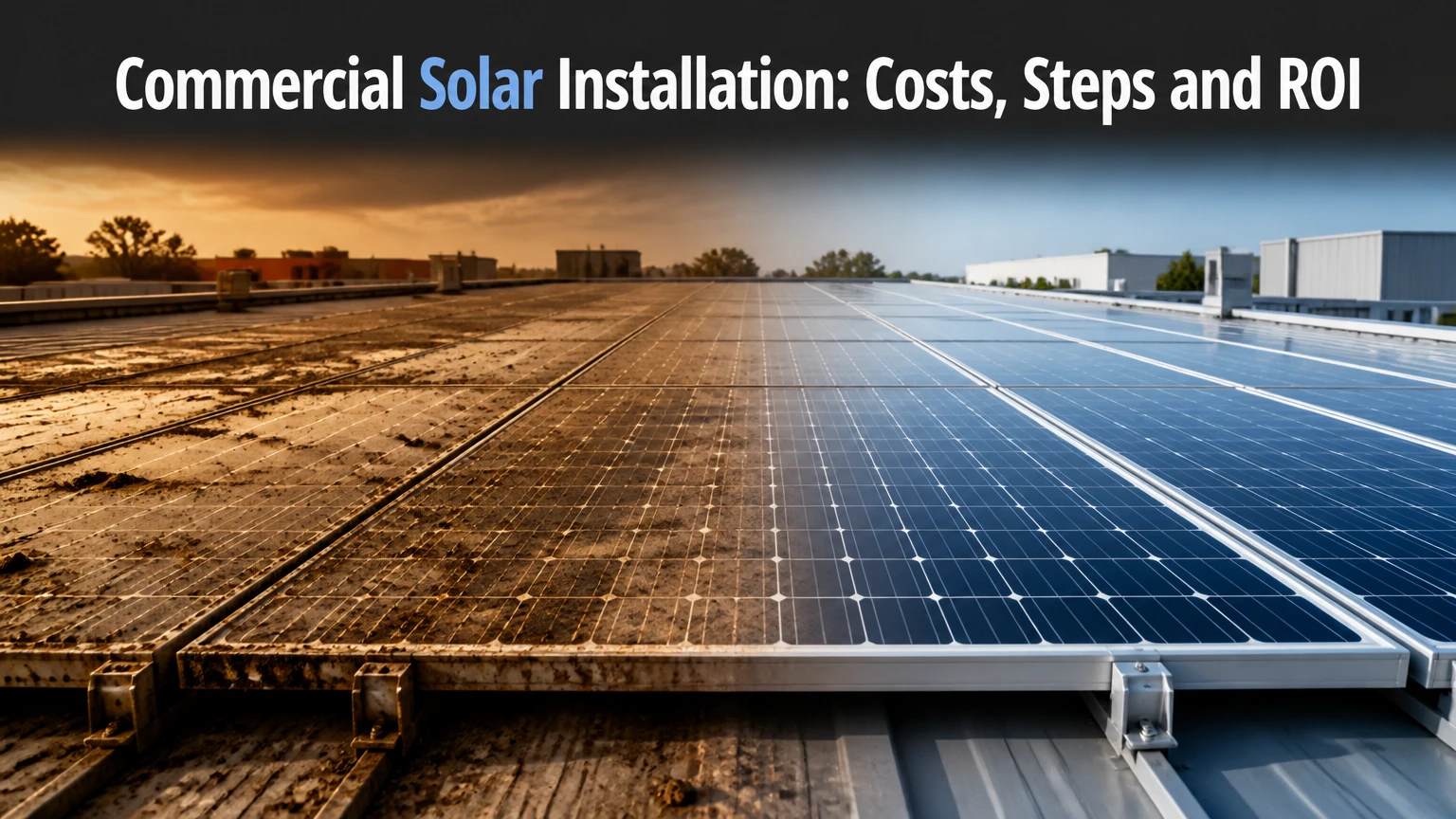
Commercial solar installation is the engineering, procurement, construction, and commissioning of a photovoltaic power system for a business, industrial site, farm, nonprofit, or public facility. A properly designed system supplies onsite electricity first, manages utility exports second, and may use batteries to reduce demand charges, outage exposure, or time-of-use costs.
Key Facts at a Glance
- Commercial solar systems commonly use three-phase inverters connected to a facility’s main distribution equipment.
- Typical US planning costs range from about $1.45 to $3.25 per watt before incentives, storage, unusual civil work, and interconnection upgrades.
- A commercial project usually takes 3-12 months because utility studies, permits, procurement, and commissioning control the schedule.
- Roof age, structural capacity, electricity tariff, and daytime load shape influence financial results more than panel efficiency alone.
- Net metering is not universal; export compensation and interconnection limits depend on the local utility and jurisdiction.
- A battery can reduce selected demand peaks, but storage does not automatically improve every project’s payback.
What Is Commercial Solar Installation?
Commercial solar installation is the deployment of a grid-connected photovoltaic system sized for a nonresidential electricity load. The project can include roof-mounted modules, a ground array, a parking canopy, battery energy storage, electric vehicle charging, energy management software, and utility interconnection equipment.
Commercial systems differ from residential systems through scale, electrical complexity, ownership structure, and approval requirements. A warehouse may install a 250-kilowatt roof array, while a manufacturing campus may need several megawatts, medium-voltage equipment, protective relays, and a utility export study.
The design objective is usually annual bill reduction, but the operating objective depends on the tariff. A facility with high daytime consumption can obtain strong value from direct solar use, whereas a site with brief but severe afternoon peaks may need battery dispatch or load controls.
Which Businesses Use Commercial Solar?
| Facility type | Typical system size | Main value driver | Common design constraint |
|---|---|---|---|
| Small office or retail site | 20-100 kW | Daytime energy offset | Limited roof area |
| Warehouse or distribution center | 100 kW-2 MW | Large roof and daytime refrigeration loads | Roof structure and fire access |
| Manufacturing plant | 250 kW-10 MW | Energy and demand-charge reduction | Motor loads and interconnection |
| Farm or agricultural processor | 50 kW-2 MW | Seasonal operating load | Dust, land use, and feeder capacity |
| School, hospital, or public facility | 100 kW-5 MW | Budget stability and resilience | Procurement and public approval rules |
How Does a Commercial Solar System Work?
A commercial photovoltaic system converts sunlight into direct-current electricity, changes that electricity into grid-compatible alternating current, and routes it through facility distribution equipment. The facility consumes solar power behind the utility meter first; a controller then manages battery charging, export, or curtailment according to system settings and tariff rules.
Solar modules generate DC power when photons release charge carriers in semiconductor cells. Modules connect into strings, and string inverters or centralized inverters convert the DC output into three-phase AC power. A transformer may raise voltage before the power enters medium-voltage equipment or the utility point of interconnection.
Energy management software measures production, facility demand, battery state of charge, and utility conditions. The controller can charge a battery during solar surplus and discharge it during a programmed demand window, but the control strategy must match the utility’s billing interval and demand calculation.
The National Renewable Energy Laboratory describes PVWatts as a tool that “estimates the energy production and cost of grid-connected PV energy systems.” NREL’s model is useful for early yield estimates, but a bankable design still needs site-specific shading, equipment, tariff, and interconnection analysis.
What Equipment Does a Commercial Array Need?
| Component | Commercial function | Typical specification or range | Main design issue |
|---|---|---|---|
| PV modules | Produce DC electricity | 400-700 W per module | Degradation, warranty, and roof layout |
| String inverter | Convert distributed DC to AC | 25-350 kW per unit | String voltage and serviceability |
| Central inverter | Convert large DC blocks to AC | 500 kW-3 MW | Single-point failure exposure |
| AC switchgear | Isolate and protect circuits | 480 V or medium voltage | Fault current and arc-flash rating |
| Transformer | Change voltage level | 500 kVA-5 MVA typical | Utility protection and losses |
| Monitoring platform | Track production and faults | 1-minute to 15-minute data | Data access and alarm quality |
| Battery system | Shift energy or reduce peaks | 1-4 hours of rated duration | Fire code, controls, and degradation |
Which Mounting Option Fits the Site?
Roof-mounted solar usually has the lowest construction cost where the roof is structurally suitable and has at least 15 years of useful life remaining. Ground-mounted arrays provide easier maintenance and orientation control, while carports use parking space but cost more because they require steel structures, drainage, lighting, and underground electrical work.
Roof-Mounted Arrays
Ballasted systems use engineered weights on low-slope roofs, reducing membrane penetrations but increasing dead load and wind-uplift requirements. Penetrating systems attach to structural members and are common on pitched metal roofs, standing-seam roofs, and buildings where ballast would be impractical.
A roof survey must examine membrane condition, purlins, rafters, drainage paths, parapets, rooftop equipment, fire lanes, and access routes. A generic load figure such as 10-25 kilograms per square meter cannot replace structural engineering because local snow, wind, seismic, ballast, and maintenance loads vary.
Ground-Mounted Arrays
Ground systems work well when a facility has usable land, poor roof geometry, or a roof reserved for future operations. Fixed-tilt structures reduce mechanical complexity, while single-axis trackers can increase annual production but add motors, controls, maintenance, and grading requirements.
Ground projects need geotechnical testing, pile or foundation design, trenching, access roads, fencing, stormwater planning, vegetation control, and land-use approval. A low module price can therefore conceal significant balance-of-system costs.
Solar Carports and Canopies
Solar carports place modules over parking spaces and can support lighting, fleet charging, or public charging. Their dual land use is attractive when roof space is unavailable, but steel, foundations, drainage, vehicle-clearance requirements, and trenching commonly produce a higher installed cost.
Carports are a poor fit where parking must be reconfigured frequently, heavy vehicles create collision exposure, or the owner cannot fund substantial structural work. They are stronger candidates when shade, EV charging, and visible sustainability infrastructure have measurable value.
How Much Does Commercial Solar Cost?
Typical US commercial solar planning costs range from $1.45 to $3.25 per watt before incentives, with smaller systems generally costing more per watt. Actual pricing changes with roof repairs, switchgear, transformer work, labor market, site access, utility studies, storage, prevailing-wage rules, and procurement timing.
The following ranges are planning estimates, not bids. The gross project cost should separate modules from engineering, permitting, interconnection, structural work, construction labor, controls, and contingency.
| System scale | Typical capacity | Planning cost per watt | Gross cost range |
|---|---|---|---|
| Micro-commercial | Under 50 kW | $2.45-$3.25 | $60,000-$150,000 |
| Small to medium | 50-250 kW | $1.85-$2.60 | $150,000-$500,000 |
| Large commercial | 250 kW-1 MW | $1.60-$2.15 | $500,000-$1.8 million |
| Industrial | Above 1 MW | $1.45-$1.80 | $1.8 million and higher |
Battery storage is priced separately in many proposals. A commercial battery may add roughly $500-$1,200 per usable kilowatt-hour for the complete installed system, depending on duration, fire protection, switchgear, controls, site work, and market conditions. Storage pricing requires a project-specific design rather than a module-only comparison.
What Determines the Financial Return?
Commercial solar return depends on avoided energy charges, demand charges, export compensation, degradation, maintenance, financing cost, incentives, and the percentage of production consumed onsite. A system with a lower annual yield can outperform a larger system if it avoids expensive afternoon electricity instead of exporting low-value surplus.
Use at least 12 months of interval utility data, preferably 15-minute data, before approving a financial model. The model should include a production estimate, annual degradation, inverter replacement reserve, roof work, insurance, property tax treatment, and a sensitivity case for lower export compensation.
A simple screening calculation is:
Simple payback = net project cost ÷ first-year annual bill savings
Simple payback is not a complete investment return measure. Net present value, internal rate of return, debt service, tax treatment, residual value, and avoided carbon costs may change the investment decision.
What Are the Commercial Solar Installation Steps?
A typical commercial solar project follows eight stages and takes approximately 3-12 months from feasibility to permission to operate. Utility interconnection, building permits, equipment lead times, and roof remediation usually control the schedule more than the physical panel installation.
Step 1: Audit Load and Tariffs
Collect 12-24 months of bills and interval data, then identify energy use, peak demand, time-of-use periods, export rules, and contract demand conditions. Confirm the facility’s operating schedule, planned expansions, generators, and critical loads.
Success checkpoint: The engineer can identify when the facility consumes power and how the utility calculates each charge.
Common mistake: Sizing from monthly kilowatt-hours while ignoring the 15-minute demand peak.
Step 2: Survey the Site and Roof
Map roof planes, shading, equipment, drainage, access, structural members, electrical rooms, and the point of interconnection. Inspect roof membranes and determine whether repairs or replacement should precede solar construction.
Success checkpoint: The preliminary layout includes setbacks, walkways, fire access, service clearances, and cable routes.
Common mistake: Treating satellite imagery as a structural or roof-condition assessment.
Step 3: Develop the Electrical and Structural Design
Prepare module layouts, string calculations, inverter selection, single-line diagrams, grounding and bonding details, protection settings, structural attachments, and equipment locations. The design must account for voltage range, conductor ampacity, fault current, arc-flash exposure, and local code.
Success checkpoint: The design package identifies every major equipment rating and the exact point where solar connects to the facility.
Common mistake: Selecting an inverter before confirming service voltage, transformer capacity, and utility protection requirements.
Step 4: Apply for Interconnection and Permits
Submit the utility application, single-line diagram, protection study, site plan, structural documents, and required fees. Obtain building, electrical, fire, environmental, grading, or zoning approvals that apply to the site.
Success checkpoint: The project has written interconnection conditions, not merely an informal utility estimate.
Common mistake: Ordering long-lead equipment before the utility confirms export limits or required upgrades.
Step 5: Procure Equipment and Prepare the Site
Order modules, inverters, racking, switchgear, transformers, monitoring hardware, and batteries when the design is sufficiently stable. Complete roof repairs, structural reinforcement, civil work, equipment pads, trenching, and conduit routes.
Success checkpoint: Materials match the approved design and the site can receive equipment without interrupting operations.
Common mistake: Allowing substitutions without checking voltage, certification, warranty, and utility approval impacts.
Step 6: Install the Mounting and Electrical Systems
Install roof attachments or ballast, ground foundations, modules, DC wiring, inverters, AC feeders, switchgear, transformers, communications, and safety labels. Coordinate construction around production shifts, roof loading limits, cranes, forklifts, and weather.
Success checkpoint: Every circuit is labeled, torqued, tested, and documented before energization.
Common mistake: Leaving cable connectors exposed to standing water, ultraviolet damage, or unsupported mechanical strain.
Step 7: Inspect, Test, and Interconnect
Complete electrical testing, insulation resistance checks, polarity verification, grounding tests, relay settings, communications checks, and required inspections. The utility may require witness testing, meter installation, protection verification, and anti-islanding confirmation.
Success checkpoint: The authority having jurisdiction and utility issue approval for operation.
Common mistake: Treating a passed building inspection as permission to export electricity.
Step 8: Commission and Handover
Verify production, inverter alarms, revenue-grade meter data, battery dispatch, emergency shutdown, thermal conditions, and monitoring access. Deliver as-built drawings, warranties, equipment manuals, test records, training, and an operations plan.
Success checkpoint: The owner can confirm system output and respond to a fault without relying on the installer’s personal device.
Common mistake: Accepting a monitoring portal without alarm thresholds, ownership of data, or service response terms.
Which System Type Has the Lowest Total Cost?
Roof-mounted solar usually has the lowest total installed cost when the roof is sound, structurally adequate, and close to the electrical service. Ground arrays can offer better access and production, but land preparation and trenching alter the comparison. Carports cost more upfront but may deliver parking shade, EV charging, and property-use benefits.
| Decision factor | Roof-mounted | Ground-mounted | Solar carport |
|---|---|---|---|
| Typical construction cost | $1.45-$2.60/W | $1.60-$3.00/W | $2.25-$4.00/W |
| Land requirement | 0.5-1.0 acre per MW of roof area equivalent | 4-8 acres per MW | 250-400 square feet per parking space |
| Main civil work | Roof attachments or ballast | Piles, roads, drainage, trenching | Foundations, steel, drainage, trenching |
| Maintenance access | Moderate, restricted roof access | High, ground-level access | Moderate, vehicle-area safety controls |
| Best facility profile | Warehouse or retail roof | Industrial campus with land | Parking-heavy office or fleet site |
| Primary risk | Roof replacement and loading | Zoning, land, and civil cost | Steel cost and vehicle impact |
The lowest total cost is therefore a site-specific result, not a universal mounting-type ranking. A roof that needs replacement in five years can be more expensive over the project life than a ground array with higher initial construction cost.
Should a Business Add Battery Storage?
A business should add battery storage when measured demand peaks, time-of-use spreads, outage requirements, or export restrictions create enough value to justify the battery’s installed cost and degradation. Solar alone is usually simpler when the facility consumes most production during daylight and has modest demand charges.
Battery sizing begins with the target peak, not the solar array nameplate. For example, a facility seeking to reduce a 500-kilowatt peak may need a 250-kilowatt battery that discharges for two hours, although the correct size depends on peak duration, controls, state-of-charge reserve, and utility measurement intervals.
Storage can also support backup power, but grid-tied peak shaving does not automatically provide outage protection. Backup operation requires compatible inverters, isolation equipment, critical-load panels, fuel or charging strategy, black-start capability, and code-compliant fire protection.
When Is Solar Without Storage Better?
Solar without storage is often preferable when the site has steady daytime loads, low demand charges, limited export opportunities that can be controlled through system sizing, or a short investment horizon. Batteries add HVAC requirements, fire-system coordination, replacement planning, software dependence, and round-trip energy losses.
Storage is a poor economic choice when the battery rarely dispatches, the tariff does not reward peak reduction, or the facility’s largest peaks occur after the battery has already discharged. A tariff simulation using interval data is more reliable than a generic battery payback claim.
What Incentives Can Reduce the Cost?
US incentives may include federal tax credits, accelerated depreciation, transferable tax credits, state programs, utility rebates, renewable-energy certificates, and grants. The commonly cited 30% federal Investment Tax Credit has eligibility, placed-in-service, labor, domestic-content, energy-community, and ownership conditions that should be verified for the project year with a tax professional and current IRS guidance.
MACRS depreciation can improve after-tax economics for eligible commercial owners, but a tax credit and depreciation benefit are not the same as an immediate cash rebate. A nonprofit, school, or public agency without sufficient tax liability may examine direct-pay eligibility or a third-party ownership structure.
A proposal should identify the incentive owner, application deadline, prevailing-wage condition, recapture risk, transfer mechanism, and treatment of storage. Local utility programs can also impose capacity caps, application windows, or performance requirements.
How Are Safety and Grid Requirements Managed?
Commercial solar safety depends on the adopted electrical code, equipment listings, utility protection rules, fire requirements, and engineered grounding and bonding. No single earthing resistance value, including a universal one-ohm rule, applies to every commercial project because soil, electrode systems, fault-current design, and local standards differ.
The design should address DC arc-fault protection where required, overcurrent protection, surge protective devices, equipment grounding, lightning exposure, clearances, labeling, emergency shutdown, arc-flash analysis, and safe access. National Fire Protection Association standards, the National Electrical Code, local amendments, and utility manuals determine the enforceable requirements in the United States.
A qualified engineer should specify test methods and acceptance values. Installers should not promise compliance by quoting one resistance threshold without identifying the governing standard and system voltage.
What Can Make a Commercial Solar Project Fail?
Commercial solar projects most often underperform because the financial model, roof lifecycle, interconnection assumptions, or operating controls were incomplete. Equipment failure matters, but poor project assumptions usually create larger losses than a modest difference in module efficiency.
Roof Replacement Conflict
A 25-year PV system installed over a roof with five years of remaining life may require costly removal and reinstallation. A roof assessment should compare replacement timing, warranty requirements, attachment details, and the cost of temporary production loss.
Export and Net-Metering Assumptions
Net metering is a policy mechanism, not a universal commercial entitlement. Some utilities use avoided-cost rates, export caps, time-varying credits, non-bypassable charges, or no compensation for certain exports. The interconnection agreement and tariff should control the financial model.
Demand-Charge Misreading
Solar production can reduce energy consumption while leaving a short evening or cloudy-day demand peak unchanged. Battery controls must respond to the utility’s actual demand interval, and the model should test cloudy-day peaks, operational changes, and battery reserve requirements.
Poor Monitoring and Maintenance
A system can lose production for weeks when alarms are not configured or data ownership is unclear. The operations contract should define response times, inspection frequency, vegetation control, module cleaning conditions, inverter replacement responsibility, and guaranteed performance measurements.
Which Design Fits Each Facility?
Warehouses generally favor roof arrays when roof condition, structure, and daytime refrigeration or handling loads align. Manufacturing plants need a more detailed load study because motors, furnaces, compressors, harmonics, and shift changes can affect inverter and switchgear selection.
Offices may benefit from carports where parking is large and daytime occupancy is predictable. Farms need equipment suited to dust, washdown, seasonal load, and remote monitoring. Leased properties require a written agreement covering roof access, insurance, removal obligations, tax benefits, utility accounts, and ownership at lease termination.
Commercial solar is not a universal answer for every facility. A shaded, short-term leased building with low daytime consumption and expensive interconnection upgrades may be better served by a renewable-energy contract, community solar subscription, efficiency project, or offsite power purchase agreement.
How Should a Business Choose an Installer?
Choose an installer through technical scope, financial transparency, safety record, and service obligations rather than panel brand alone. Request a complete proposal that includes production assumptions, structural findings, single-line diagrams, utility responsibility, equipment warranties, workmanship coverage, exclusions, schedule dependencies, and post-commissioning support.
Check the installer’s experience with the facility’s service voltage and system scale. Ask for references from projects that have operated for at least 12 months, then compare measured production with the original estimate and review how faults were handled.
The contract should define substantial completion, permission to operate, liquidated damages where appropriate, change-order rules, equipment substitutions, roof warranty coordination, monitoring data ownership, and end-of-life removal. A low price without these terms is difficult to compare fairly.
Frequently Asked Questions
How large should a commercial solar system be?
A commercial solar system should be sized from interval load data, usable site area, tariff value, export rules, and interconnection capacity. Many projects target high onsite consumption rather than maximum annual generation. A 500-kilowatt array may fit a warehouse, while a manufacturing campus may justify several megawatts after utility and structural studies.
How long do commercial solar panels last?
Commercial PV modules commonly carry 25-30-year performance warranties, while inverters often have shorter standard warranties and may require replacement during the array’s life. Actual output declines gradually, and heat, soiling, shading, mechanical stress, and maintenance affect production more than the warranty headline alone.
Can solar be installed on a leased commercial building?
Solar can be installed on a leased commercial building if the lease, roof rights, utility account, insurance, tax benefits, and removal duties are documented. The building owner may own the system, the tenant may finance it, or a third party may sell electricity under a power purchase agreement.
Does commercial solar work during a power outage?
A standard grid-tied commercial solar system shuts down during a utility outage to prevent dangerous backfeed. Solar can operate during an outage only with islanding controls, compatible inverters, energy storage or another grid-forming source, protected critical-load circuits, and utility-approved isolation equipment.
How often does a commercial solar system need maintenance?
A commercial solar system typically needs continuous remote monitoring, scheduled electrical and visual inspections, vegetation control for ground arrays, and cleaning when soiling materially reduces production. Maintenance frequency depends on dust, pollen, bird activity, weather, roof access, module tilt, and the manufacturer’s service requirements.
Conclusion
Commercial solar installation is a long-term electrical and property project, not simply a panel purchase. The strongest design matches PV production to the facility’s load profile, roof or land lifecycle, utility tariff, export rules, safety requirements, and financing structure. Compare total lifecycle cost, test storage against interval data, and obtain written interconnection conditions before construction. A carefully engineered commercial solar installation can reduce operating costs for decades, but the financial result depends on project assumptions established before the first module arrives.