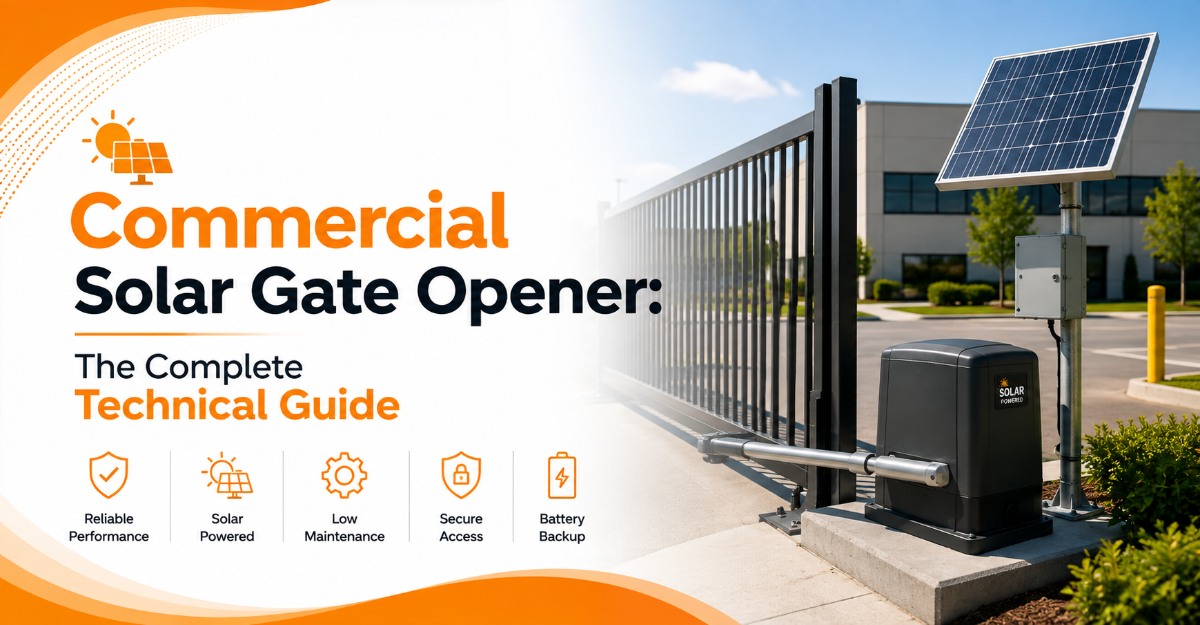
A commercial solar gate opener is a continuous-duty, off-grid access-control operator that runs a slide, swing, or barrier gate on stored photovoltaic power, meeting UL 325 safety standards at high-traffic or remote perimeters where AC utility power is impractical or costly to trench. It stores solar energy in a battery bank and actuates on credentialed demand.
Key Facts: Commercial Solar Gate Opener
- ● Runs on a 12V or 24V deep-cycle battery, not directly off the panel.
- ● 24V DC dominates commercial builds for speed and long wire runs.
- ● Typical arrays run 20W to 100W-plus; oversize 50 to 100% for winter.
- ● Handles roughly 100 to 500-plus cycles per day depending on duty class.
- ● Turnkey commercial cost runs about $6,000 to $15,500-plus.
- ● Governed by UL 325 (safety) and ASTM F2200 (gate construction).
What is a commercial solar gate opener?
A commercial solar gate opener is a heavy-duty operator engineered for public or industrial sites that cycle far more often than a home gate and carry legal safety obligations a residential unit does not. The defining difference is duty rating. A residential operator may be built for 20 to 50 cycles a day, while a commercial unit is specified for hundreds and rated under a UL 325 usage class that matches how the public interacts with it.
Two structural traits separate these systems from consumer kits. First, reinforced housings and continuous-duty DC motors tolerate frequent starts without overheating. Second, the power architecture is fully off-grid: monocrystalline panels feed a charge controller, which feeds a battery bank, which drives the motor. This design removes trenching, the single largest hidden cost of powering a remote entrance. Common deployments include logistics yards, apartment perimeters, utility substations, and agricultural entries.
How does a commercial solar gate opener work?
A commercial solar gate opener works by storing solar energy in a battery and drawing on that reserve to actuate the gate on demand, so the motor never depends on live sunlight. The panel charges; the battery powers. That separation is why the gate still runs at 2 a.m. or during a week of overcast skies.
The charge controller does the unglamorous but critical work. It clamps panel voltage spikes and steps current down to a safe charge profile, preventing the overcharge that destroys lead-acid banks. When a credential fires, the control board pulls DC from the battery and runs a brushless motor coupled to a worm gear, chain, or rack.
When a vehicle triggers entry, the operator runs a fixed sequence:
- Input verification. A loop detector cast into the pavement, or a long-range RFID reader, sends an encrypted signal to the logic board.
- Safety clearance check. The board confirms UL 325 photo-eyes and any resistive safety edges are clear. Any obstruction locks the cycle to prevent entrapment.
- Soft-start. Pulse-width modulation ramps torque up gradually, sparing hinges and the drive chain from shock loading.
- Soft-stop and hold. Near the open limit switch, voltage drops so the mass crawls to a stop. After a hold delay of 15-90 seconds, the gate auto-reverses and relocks the perimeter.
What are the main types of commercial solar gate systems?
The main types of commercial solar gate systems are slide, cantilever, swing, vertical lift, and barrier arm, chosen by available clearance, gate weight, and wind exposure rather than by preference. Weight and wind decide most projects. A swing gate behaves like a sail and strains the motor in gusts, so exposed sites usually default to a slide or cantilever design.
| Gate type | Best fit | Movement | Wind tolerance | Typical leaf span |
|---|---|---|---|---|
| Slide (V-track) | Level, high-security lots | Horizontal on ground track | Excellent | 20-40 ft |
| Cantilever slide | Uneven ground, no track wanted | Suspended on roller posts | Excellent | 20-50 ft |
| Swing (single/dual) | Deep clearance, estates | Arcs 90 degrees on hinges | Poor, needs lock | 12-20 ft/leaf |
| Vertical lift | No lateral or depth room | Rises between columns | Moderate | 12-24 ft |
| Barrier arm | High-throughput vehicle counting | Boom raises 90 degrees | Good | 10-20 ft arm |
What are the UL 325 usage classes?
UL 325 usage classes rank an operator by who uses the gate and how exposed the public is, running from Class I to Class IV. This is the single spec most buyers skip, and the wrong class can void insurance or fail inspection. Match the class to the site before you match the horsepower.
| Class | Intended site | Public access | Example |
|---|---|---|---|
| Class I | Single-family residence | One household | Home driveway |
| Class II | Commercial, general public | High | Apartment, retail lot |
| Class III | Industrial, limited public | Low | Warehouse yard |
| Class IV | Restricted, guarded | Supervised only | Substation, secured depot |
How do you size the solar array and battery bank?
You size a commercial solar gate opener by calculating daily amp-hour demand, dividing by local winter peak-sun-hours, then adding a loss buffer for the panel and a depth-of-discharge buffer for the battery. Most undersizing failures trace to one mistake: sizing for summer sun and average traffic instead of a dark, cold, busy week.
Start with daily demand. Budget standby draw plus per-cycle draw. A control board, receiver, and cellular modem together pull roughly 30-60 mA continuously, which is about 1-2 Ah per day at 24V before the gate moves once. Each commercial slide cycle typically consumes 0.02-0.05 Ah, so 250 cycles adds 5-12 Ah. Pull the exact per-cycle current from your operator’s spec sheet; these are field-typical figures, not universal constants.
Worked example: 250 cycles/day at 0.03 Ah = 7.5 Ah, plus 2 Ah standby = 9.5 Ah/day. In a northern winter site with 3 peak-sun-hours and a 1.4 loss factor, the panel must supply 9.5 / 3 x 1.4 = about 4.4 charging amps, or roughly a 90-110W array. A summer-only calculation would have suggested 40W, and that gate would die in January.
| Region (US) | Summer peak-sun-hrs | Winter peak-sun-hrs | Sizing note |
|---|---|---|---|
| Southwest | 6.0-6.5 | 4.0-5.0 | Smallest array needed |
| Southeast | 5.0-5.5 | 3.0-4.0 | Watch summer cloud bursts |
| Midwest/Northeast | 4.5-5.5 | 2.0-3.5 | Oversize 75-100% |
| Pacific Northwest | 4.0-5.0 | 1.5-2.5 | Oversize 100%, tilt steep |
Peak-sun-hour values track published NREL solar-resource data; pull your county’s figure before finalizing. For the battery, size for 3-5 days of no-sun autonomy. At 9.5 Ah/day, four days is 38 Ah of usable capacity. Because lead-acid should not discharge past 50%, that means a 76 Ah AGM bank, while LiFePO4 at 80% depth needs only about 48 Ah.
How much does a commercial solar gate opener cost?
A commercial solar gate opener costs roughly $6,000 to $15,500 turnkey, split across the operator kit, access-control hardware, and professional installation. The operator itself is rarely the biggest line. Concrete, welding, and access infrastructure often outweigh the motor.
| Line item | Typical range | What it includes |
|---|---|---|
| Solar operator kit | $2,500-$6,000 | 24V motor, photo-eyes, controller, panel |
| Access + connectivity | $1,500-$4,500 | Telephone entry, cellular, loop detectors, cloud fees |
| Structural installation | $2,000-$5,000 | Pads, posts, welding, panel mounts |
| Total turnkey | $6,000-$15,500+ | Full commercial project |
Do commercial solar gates qualify for tax incentives?
Commercial solar gate systems may qualify for the federal solar Investment Tax Credit and accelerated depreciation, because the PV array is business energy property. Under Section 48, the commercial solar ITC has historically been 30%, and the equipment can often be depreciated over 5 years under MACRS, with Section 179 or bonus depreciation sometimes available. Clean-energy tax provisions have changed recently, so confirm current eligibility with a tax professional and the DSIRE database before you model returns.
The stronger financial case is usually the trenching you avoid. Running conduit and AC power to a remote gate commonly costs $30-$100 per linear foot once you cut asphalt, so a 400-foot run can exceed $20,000 on its own. Against that, an off-grid solar operator frequently pays for itself before you count a single tax credit.
Which commercial solar gate operators compare best?
The commercial solar operators most often specified are the LiftMaster CSL24VH, Nice Apollo slide and swing kits, DoorKing solar models, USAutomatic Sentry and Ranger, Viking, and HySecurity for the heaviest gates. No single unit wins every site; the right pick follows your UL 325 class and gate weight.
| Operator | Type | Native voltage | Duty position | Solar readiness |
|---|---|---|---|---|
| LiftMaster CSL24VH | Slide | 24V DC | Class I-IV heavy | Solar-compatible |
| Nice Apollo 7000/1600 | Slide/swing | 12/24V DC | Light-mid commercial | Solar kits offered |
| DoorKing 6550/9210 | Slide/swing | 24V DC | Commercial | Solar option |
| USAutomatic Sentry/Ranger | Slide | 12/24V DC | Light commercial, remote | Solar-first design |
| HySecurity SlideSmart DC | Slide | DC | Heavy industrial | Solar-capable, high draw |
| Viking G-5/F-1 | Slide/swing | 24V DC | Commercial | Solar-ready |
In practice, the mistake most buyers make is chasing horsepower. A heavier motor on a poorly balanced gate drains batteries faster, not slower. If the leaf will not roll or swing smoothly with one hand, fix the gate hardware first; no operator compensates for a binding hinge or a sagging roller.
How does a commercial solar gate opener perform in winter?
A commercial solar gate opener performs adequately in winter only if the array and battery were oversized for short days and cold, because generation drops and battery capacity shrinks at the same time. This is the season that exposes lazy sizing. Two effects stack against you.
First, panel output falls with fewer sun-hours and low sun angle, which is why northern installs should tilt panels steeper (latitude plus 15 degrees) to catch the low winter arc. Second, cold cuts usable battery capacity: flooded and AGM lead-acid lose roughly 20% at freezing. The counterintuitive trap is lithium. A LiFePO4 battery discharges fine in the cold but must not accept a charge below 0 degrees C (32 F) without a low-temperature cutoff or internal heater, or lithium plating permanently damages the cells. For sub-freezing sites, specify a LiFePO4 pack with a heated BMS or stay with AGM.
| Chemistry | Cycle life | Cold charging | Replace every | Relative 10-yr cost |
|---|---|---|---|---|
| Flooded lead-acid | 300-500 | Tolerant | 2-4 yrs | Low upfront, high total |
| AGM | 500-800 | Tolerant | 3-5 yrs | Moderate |
| LiFePO4 | 2,000-4,000 | Needs heater below 0C | 8-10 yrs | Highest upfront, lowest total |
How do you handle fire and emergency vehicle access?
You handle emergency access on a commercial solar gate with a code-compliant override that lets fire and EMS enter without stopping to find a credential, since a locked automated gate can otherwise block a response. Local fire code, not the AI overview and not the manufacturer, dictates the method. Common solutions include a Knox key switch or Knox padlock, a Click2Enter radio receiver keyed to responder frequencies, or a strobe-activated sensor that opens when it detects emergency lighting. Confirm the accepted method with the authority having jurisdiction during the site audit, because retrofitting one after inspection failure is expensive.
What are the common pitfalls, maintenance needs, and fixes?
The common pitfalls of a commercial solar gate opener are undersizing the array, ignoring idle-power drain, and bolting a strong motor onto a bad gate. Each one drains the battery in a way owners misdiagnose as a solar fault.
- Undersizing for winter. A 20W panel cannot cover dozens of daily cycles in December. Oversize 50-100% in cloudy regions.
- Idle drain. A cellular modem at 30 mA runs 0.7 Ah a day doing nothing, which can empty a small bank overnight in a low-traffic remote yard where the panel rarely tops off. Budget standby load explicitly.
- Mechanical neglect. A sticky or sagging gate multiplies motor current every cycle and shortens battery life fast.
Maintenance is light but non-optional: clean panel faces of pollen and snow quarterly, torque-check terminals for corrosion, and test battery resting voltage twice a year. Replace lead-acid banks on schedule before they strand you.
| Symptom | Likely cause | Fix |
|---|---|---|
| Dead, unresponsive | Depleted battery, blown fuse | Read voltage (need >24.4V on 24V); replace fuse; check terminals |
| Opens but won’t close | Blocked or misaligned photo-eye | Clean lenses; confirm safety LEDs clear; inspect edge wiring |
| Weak in overcast weeks | Low generation, shading | Clean and tilt panels; trim branches; verify array wattage |
Frequently Asked Questions About commercial solar gate opener
Can a commercial solar gate opener run 24 hours a day? Yes, because it draws from a charged battery bank rather than live sunlight, so it cycles at night and through storms. Continuous operation depends on the battery being sized for several days of autonomy at the site’s peak traffic, not on the panel producing power at that moment.
How many solar panels does a commercial gate need? Most commercial gates use a single 40-100W panel, though high-traffic or northern sites often need multiple panels totaling 100-200W. The count follows daily amp-hour demand divided by local winter peak-sun-hours, so a busy apartment gate in Seattle needs far more collection area than a quiet yard in Arizona.
Is a solar gate opener cheaper than running electricity? Usually yes for remote gates, because trenching AC power commonly costs $30-$100 per linear foot after cutting pavement, so long runs often exceed $15,000-$20,000. An off-grid solar operator avoids that entirely and frequently pays back its premium on the trenching savings alone.
How long do the batteries last? Battery life runs 2-4 years for flooded lead-acid, 3-5 years for AGM, and 8-10 years for LiFePO4. Cold climates shorten every figure, and chronic deep discharge from an undersized array is the fastest way to cut lifespan in half.
Can I install a commercial solar gate opener myself? Light-duty solar kits are DIY-friendly, but true commercial installs involve concrete pads, structural welding, loop detectors, and UL 325 and ASTM F2200 compliance that most jurisdictions expect a professional to certify. Self-installing a Class II or higher public gate risks failed inspection and liability exposure.
What access control works with a solar gate? Solar operators support RFID readers, keypads, cellular telephone entry, loop detectors, and smartphone credentials. The catch is power: every always-on reader or cloud module adds idle draw, so specify low-power access hardware and count that load when sizing the battery bank.
Conclusion
A commercial solar gate opener earns its place wherever grid power is distant, expensive to trench, or unreliable, delivering UL 325-compliant access control that survives blackouts and winter alike. The systems that fail are almost never failures of solar technology; they are failures of sizing, cold-weather planning, or gate maintenance. Size for the darkest, busiest week, match the UL 325 class to the site, confirm emergency access with the fire authority, and the system runs for years with little attention.