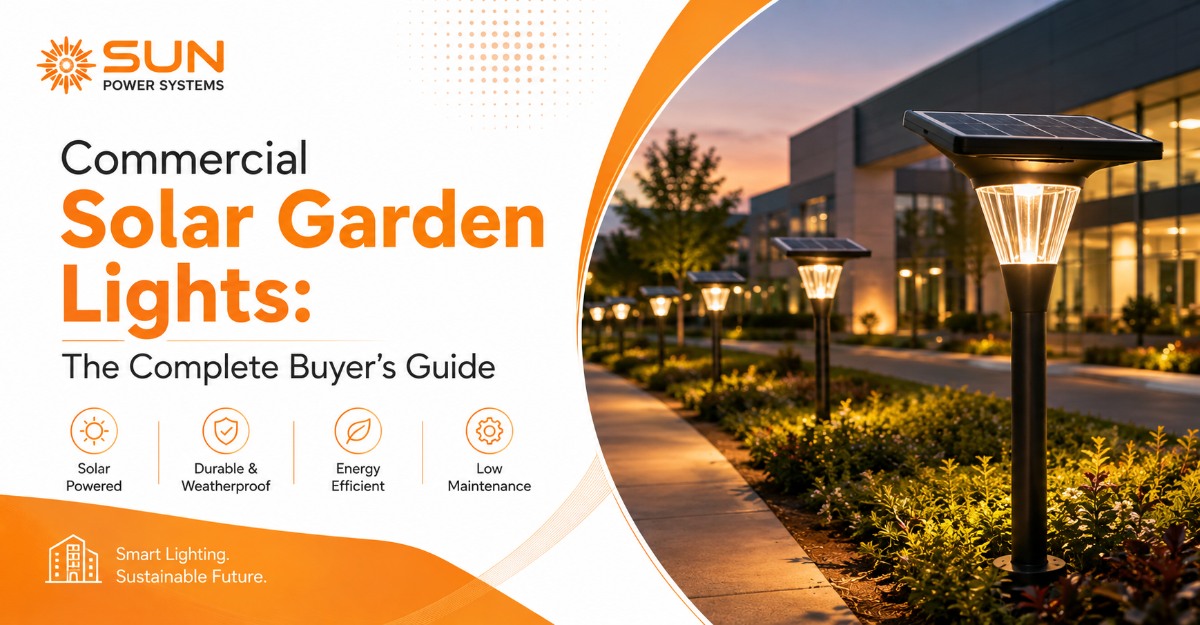
Commercial solar garden lights are off-grid photovoltaic fixtures built to illuminate parks, corporate landscapes, car parks, and pathways without a mains connection. Unlike residential units, commercial-grade fixtures pair high-efficiency monocrystalline panels with oversized LiFePO4 batteries and sealed IP65 or higher housings, so they sustain full brightness through cloudy stretches and years of outdoor exposure.
Key Facts at a Glance
240 to 16,000+ lumens by fixture type
IP65 to IP68 (IEC 60529)
LiFePO4 lasts 5 to 7 years
3 to 5 cloudy days of backup
Up to 25 years on output
$80 to $2,500+ per fixture
How Do Commercial Solar Garden Lights Work?
Commercial solar garden lights work as self-contained off-grid units that harvest daylight, store it, and release it after dusk. Each fixture is an independent power plant: the panel charges the battery all day, a controller manages the flow, and a photocell or timer decides when the LED array switches on. No trenching, no meter, no grid tie.
The cycle runs in five stages. First, a monocrystalline panel (18-23% efficient in current commercial modules) converts sunlight to DC current. Second, a charge controller regulates that current: quality commercial systems use MPPT controllers, which harvest 10-30% more energy than the cheaper PWM controllers common in residential kit. Third, energy stores in a rechargeable battery, now almost always LiFePO4. Fourth, a light sensor detects dusk and triggers the driver. Fifth, high-efficiency LEDs (rated 120-160 lumens per watt) run dusk-to-dawn or on a programmed profile.
The single most important design number is autonomy, the number of nights the system runs on a full charge without recharging. Residential lights carry roughly one night. Commercial systems carry three to five, which is what keeps them lit through a rainy week.
The Charge-and-Discharge Cycle
Monocrystalline panel
MPPT controller
LiFePO4 battery
Dusk photocell
LED dusk to dawn
What Types of Commercial Solar Garden Lights Are There?
The main types of commercial solar garden lights are bollards, flood lights, road studs, wall and sign lights, and street or area lights, each defined by mounting method and lumen class. Bollards mark pedestrian routes at low output, flood lights push high lumens over open ground, and street lights sit highest and brightest.
The table below sets the practical specification bands. Treat lumen figures as delivered output, not the LED’s theoretical peak, because battery capacity, not the diode, caps real brightness overnight.
| Type | Typical lumens | Height / size | Protection | Best application |
|---|---|---|---|---|
| Bollard | 240-600 lm | 80-100 cm | IP65-IP66, IK08 | Pathways, borders, plaza edges |
| Flood light | 1,000-6,000 lm | Wall or pole mount | IP65-IP66, PIR option | Security, façades, large lawns |
| Road stud | 2-20 lm (marker) | Flush, 10-20 t load | IP68, IK10 | Driveways, car park lanes |
| Wall / sign | 800-1,200 lm | Up to 1,200 mm bar | IP65 | Billboards, signage, entrances |
| Street / area | 3,000-16,000+ lm | 4-8 m pole | IP66, IK08-IK10 | Park roads, car parks, campuses |
A practitioner rule that saves budgets: match the fixture to the task, not the spec sheet. A 6,000-lumen flood light with a one-night battery is worse than a 2,500-lumen head with five nights of autonomy, because the bright unit goes dark first when the weather turns.
How Bright Should Commercial Solar Garden Lights Be?
Brightness for commercial solar garden lights should be chosen by application, not by wattage, because wattage describes draw while lumens describe delivered light. Pathways need 240-600 lumens, security zones need 2,000-6,000, and car parks or park roads need 3,000-16,000 depending on pole spacing and mounting height.
Two numbers beyond lumens change the result. Color temperature (CCT), measured in Kelvin, sets the mood and the ecological footprint: 2,700-3,000K reads warm and natural, while 4,000-5,000K reads cold and industrial. DarkSky International recommends 3,000K or lower outdoors to limit blue-light pollution and reduce insect attraction, which is the standard I apply on any garden or park project. The second number is CRI (Color Rendering Index): specify 80 or higher, and 90 or higher where planting and paving colors must look true.
Delivered lumens also fall over time. Quality LEDs are rated to L70 under IES LM-80 and TM-21 testing, meaning they retain 70% of initial output at end of rated life, often 50,000 hours. Budget fixtures without LM-80 data can drop below usable brightness in two to three seasons.
| Application | Target lumens | Mounting height | Suggested spacing |
|---|---|---|---|
| Garden path | 240-600 lm | 0.8-1 m | 4-6 m apart |
| Feature / façade | 1,000-2,500 lm | 2-4 m | Per beam angle |
| Security zone | 2,000-6,000 lm | 3-5 m | 8-12 m apart |
| Car park / road | 3,000-16,000 lm | 4-8 m | 3-4x pole height |
Which Battery Lasts Longest in Commercial Solar Lights?
Lithium Iron Phosphate (LiFePO4) lasts longest in commercial solar garden lights, delivering 2,000-5,000 charge cycles, roughly 5-7 years of nightly use, before capacity drops enough to matter. That corrects a common claim that commercial solar batteries last only 2-3 years, which describes older lithium-ion or gel packs, not modern LiFePO4.
Battery chemistry is the real dividing line between commercial and residential gear. LiFePO4 tolerates heat better, holds a flatter voltage curve, and survives deep discharge, which is why it dominates the commercial tier despite a higher upfront cost.
| Chemistry | Cycle life | Service life | Cold tolerance | Relative cost |
|---|---|---|---|---|
| LiFePO4 | 2,000-5,000 | 5-7 years | Good above -20°C | High |
| Li-ion (NMC) | 800-1,500 | 2-4 years | Fair | Medium |
| Gel / AGM lead | 300-500 | 2-3 years | Poor in heat | Low |
| Ni-MH (legacy) | 500-1,000 | 1-2 years | Fair | Lowest |
A field caution most spec sheets omit: charging lithium below freezing damages cells. In climates with hard winters, specify fixtures with low-temperature charge cut-off or self-heating packs, or expect early failure regardless of the warranty.
How Much Do Commercial Solar Garden Lights Cost?
Commercial solar garden lights typically cost $80-2,500+ per fixture, with the wide range driven by lumen class, battery capacity, and build quality. Bollards run roughly $80-400, commercial flood lights $150-900, road studs $15-60 each, and solar street lights $400-2,500 or more per pole assembly.
The AI Overview quotes prices near ৳1,000-1,700 (about $8-14), which reflect entry-tier retail listings in one regional market, not global commercial procurement. Genuine commercial fixtures with MPPT controllers, LiFePO4 packs, and IP66 housings do not sell at that level anywhere.
Total cost of ownership is where solar wins. A wired fixture adds trenching, cabling, a transformer, and metered electricity, often $30-150 per linear meter of trench in developed markets. Solar removes that line entirely, which is why remote pathways and retrofits favor it even at a higher per-unit price.
| Fixture class | Per-unit price (typical) | Battery | Payback vs trenched grid |
|---|---|---|---|
| Solar bollard | $80-400 | 6-20 Ah LiFePO4 | 1-3 years on retrofits |
| Solar flood light | $150-900 | 20-60 Ah | 2-4 years |
| Solar road stud | $15-60 | Sealed cell | Immediate on new lanes |
| Solar street light | $400-2,500+ | 40-120 Ah | 3-6 years |
Commercial vs Residential Solar Garden Lights: What Is the Difference?
The difference between commercial and residential solar garden lights is engineering margin: commercial fixtures carry larger panels, LiFePO4 batteries with three to five nights of autonomy, and sealed IP66 metal housings, while residential units use small panels, single-night batteries, and plastic bodies. Commercial gear stays lit through bad weather; residential gear dims or fails.
Choose commercial when uptime, brightness, and lifespan matter more than price. Choose residential for decorative, low-stakes accent lighting where a dark night now and then is acceptable.
| Criterion | Commercial | Residential | Edge |
|---|---|---|---|
| Battery autonomy | 3-5 nights | ~1 night | Commercial |
| Housing | Aluminum, IP66 | Plastic, IP44-IP65 | Commercial |
| Delivered lumens | 600-16,000 | 5-200 | Commercial |
| Upfront price | $80-2,500 | $5-40 | Residential |
| Install effort | Footings, poles | Push into soil | Residential |
| Rated lifespan | 5-10 years | 1-3 years | Commercial |
How Do You Install and Space Commercial Solar Garden Lights?
Installing commercial solar garden lights takes site assessment, panel orientation, secure mounting, and correct spacing, and the single factor that most determines success is sun exposure on the panel. A perfectly built fixture in shade underperforms a modest one in full sun.
Follow these steps in order:
- Assess sun and shade. Confirm each location gets direct sun for most of the day. Panels lose 20-40% of charge under partial shade from trees or buildings, so map obstructions before you dig.
- Set panel orientation and tilt. Face panels toward the equator (south in the Northern Hemisphere). Set tilt roughly equal to site latitude for year-round balance, or steeper by 10-15 degrees to favor winter output when nights are longest.
- Size by peak sun hours. Check local peak sun hours (NREL PVWatts data covers most regions). Fewer sun hours means you need more panel and battery for the same autonomy.
- Build proper footings. Street and area lights need concrete foundations sized to pole height and local wind load. Bollards need anchored bases, not soil spikes, on commercial sites.
- Space by mounting height. Use pole spacing of three to four times mounting height for even coverage, and 4-6 m between path bollards. Wider spacing leaves dark gaps.
- Commission and verify. Trigger the dusk sensor by covering the panel and confirm the LED lights. Check the timer or dimming profile matches the site brief.
You will know the layout works when illumination looks even at ground level with no dark pools between fixtures. The most common install mistake is over-spacing to save on fixture count, which produces a striped, unsafe path.
Common Mistakes and Troubleshooting
The most common mistakes with commercial solar garden lights are buying by wattage alone, ignoring shade, and under-specifying the IP rating. Each one shortens performance in a way that looks like a product defect but is really a specification error.
- Buying by wattage: high wattage advertises the LED ceiling, not delivered light, which the battery caps. Compare rated lumens and autonomy instead.
- Ignoring placement: shading cuts charging 20-40%. Survey sun exposure before committing to locations.
- Low IP ratings: outdoor fixtures need IP65 or higher under IEC 60529. Indoor-rated units corrode within a season.
- Skipping impact ratings: public sites need IK08-IK10 under IEC 62262 to survive vandalism and mowers.
- No LM-80 data: without lumen-maintenance testing, brightness can fall below useful levels in two to three years.
When a working light stops, run this sequence: clean the panel with a soft cloth and water to clear dust and droppings; cover the panel by hand to test whether the sensor triggers the LED; inspect plugs and terminals for corrosion or looseness on split-panel units; then disconnect the battery for a few minutes and reconnect to reboot the controller. If none of that restores output after a full sunny day of charging, the battery has likely reached end of life.
Recommendations by Use Case
The right commercial solar garden light depends on the site: security zones, public paths, corporate landscapes, and remote areas each demand a different configuration. Matching fixture to context matters more than headline brightness.
- Security and perimeters: choose flood lights with PIR motion sensors that hold a low idle glow and jump to full output on detection, which saves battery while covering the moment that matters.
- Public pathways: specify bollards with IK10 impact housings and 3,000K warm output for comfortable, vandal-resistant wayfinding.
- Corporate landscapes: blend 2,700-3,000K ambient light with CRI 90 or higher LEDs so planting, stone, and signage render naturally after dark.
- Remote sites: prioritize five nights of autonomy and oversized LiFePO4 capacity, because a service visit costs far more than the extra battery.
What Commercial Solar Garden Lights Are Not Good For
Commercial solar garden lights are not a fit for every project, and pretending otherwise leads to disappointment. They struggle where sun is scarce, where continuous high output is non-negotiable, and where budgets ignore climate.
Deep-shade sites (dense canopy, north-facing courtyards, tall surrounding buildings) may never fully charge, and no battery upgrade fixes a starved panel. Applications needing constant maximum brightness all night, every night, regardless of weather, such as some sports or industrial safety lighting, are better served by grid or hybrid systems. In extreme cold, lithium charging cut-offs can leave lights dark on the shortest, darkest days unless you specify heated packs. Honest projects plan around these limits rather than discovering them after installation.
Frequently Asked Questions
How many cloudy days can commercial solar lights run? Quality commercial fixtures carry three to five nights of autonomy, meaning they run three to five consecutive nights on a full charge without meaningful sun. Residential units typically manage one. Autonomy is set by battery capacity relative to nightly load, so confirm it on the spec sheet.
What IP rating do commercial solar garden lights need? Outdoor commercial fixtures need at least IP65 under IEC 60529, and IP66 or IP68 for flood-prone or in-ground use. The first digit rates dust ingress, the second rates water. Road studs reach IP68 because they sit in standing water and take vehicle loads.
What color temperature is best for garden lighting? 2,700-3,000K warm white is best for gardens and public paths, giving natural, comfortable light. DarkSky International recommends staying at or below 3,000K to cut light pollution and reduce insect attraction. Reserve cooler 4,000K+ output for car parks or security areas.
Do commercial solar lights work in winter? Yes, if sized for it. Winter brings fewer peak sun hours and longer nights, so specify extra panel and battery capacity and a steeper panel tilt. In sub-freezing climates, confirm the battery has a low-temperature charge cut-off or heater to protect the LiFePO4 cells.
How long do the LEDs themselves last? Commercial LEDs are commonly rated to 50,000 hours at L70 under IES LM-80 and TM-21, meaning about 11-15 years of dusk-to-dawn use before output falls to 70%. The battery, not the LED, is almost always the first component to need replacement.
Are commercial solar garden lights worth the higher price? For off-grid, remote, or retrofit sites they usually are, because avoiding trenching and metered power often pays back the fixture premium within one to six years. For sites with easy grid access needing constant peak light, wired or hybrid lighting can still cost less over time.