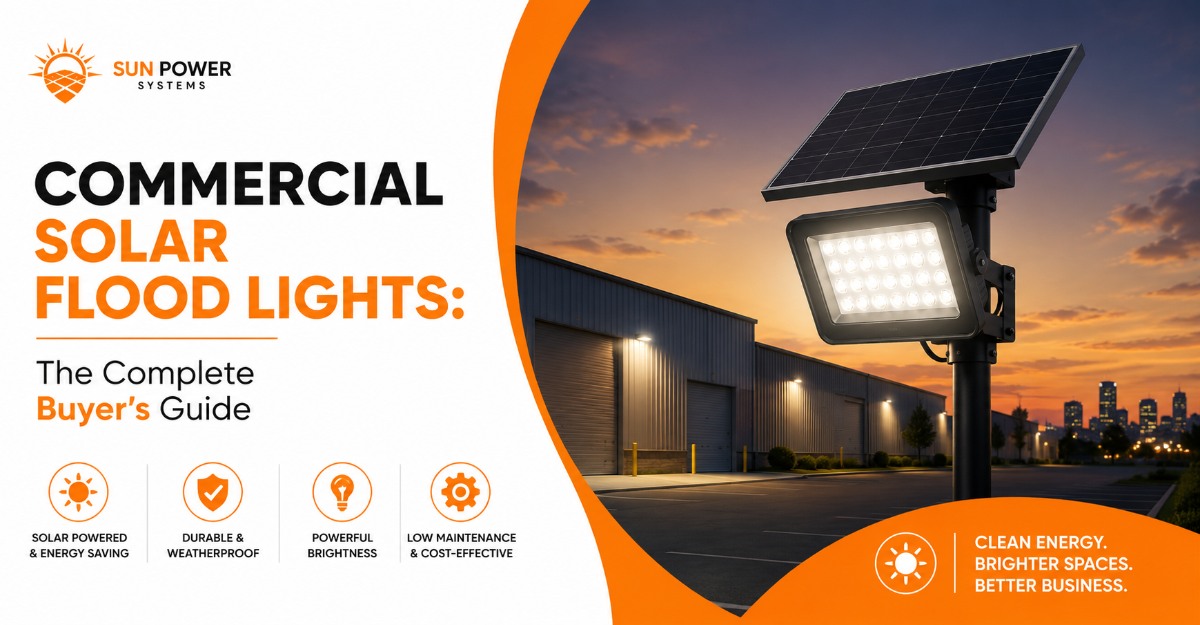
A commercial solar flood light is a self-contained, grid-independent fixture that captures daylight through a photovoltaic panel, stores it in a lithium battery, and drives a high-lumen LED array for broad-area illumination at night. Commercial-grade units deliver 2,000 to 15,000+ lumens and survive extreme weather, unlike decorative residential lights.
Quick Answer: Key Facts
- 💡 Output: 2,000 to 15,000+ lumens at 140-170 lm/W efficacy
- 🔋 Battery: LiFePO4, 2,000-3,000 cycles, 5-8 year life
- ☀️ Panel: Monocrystalline, 21-23% efficiency, 20-25 year life
- 🛡️ Protection: IP65-IP67 water, IK08+ impact resistance
- 💰 Price: $50 to $800+ per fixture by output tier
- ⚡ Ongoing energy cost: $0, no trenching or utility bill
How does a commercial solar flood light work?
A commercial solar flood light works by converting sunlight into stored electricity during the day, then releasing that stored charge to power LEDs after dark, all managed automatically by an internal charge controller. The panel doubles as a light sensor: when its voltage drops at dusk, the controller switches from charging to discharging. No external timer or wiring is required.
The controller is the component that separates a reliable commercial unit from a cheap one. A Maximum Power Point Tracking (MPPT) controller harvests roughly 15-30% more energy than a basic Pulse Width Modulation (PWM) controller in low light, which matters enormously on short winter days. Here is the full cycle.
- Energy harvesting: Photons strike the crystalline silicon cells and free electrons, producing direct current.
- Regulated charging: The MPPT or PWM controller matches voltage thresholds and pushes current into the LiFePO4 battery without overcharging.
- Dusk detection: As ambient light fades, the panel’s falling voltage signals the controller to flip into discharge mode.
- Controlled discharge: The battery feeds the LED driver, illuminating the array at a preset brightness.
- Intelligent conservation: Through the night the controller dims, brightens on motion (PIR or microwave), and rations reserve capacity until dawn.
What are the main types of commercial solar flood lights?
Commercial solar flood lights come in three layout architectures, defined by how the panel, battery, and light head are packaged: all-in-one, semi-split (all-in-two), and fully split. The right choice depends almost entirely on one question: does the spot with the best sun also have the best throw angle for the light? When it does, integrated wins. When it does not, splitting the panel wins.
- All-in-one (integrated): Every component sits in one chassis. Fast to mount, zero external wiring, but the panel faces wherever the light faces.
- Semi-split (all-in-two): Light, battery, and controller share one housing; the panel bolts on a separate tilting bracket connected by MC4 cable.
- Fully split: Panel, battery box, and light head are three separate units, letting the panel sit 5-10 meters away in full sun while the light works under a canopy.
| Attribute | All-in-One | Semi-Split | Fully Split |
|---|---|---|---|
| Panel placement | Fixed to light angle | Independent tilt, short cable | Up to 5-10 m away |
| Install time | 15-30 min | 30-60 min | 1-2 hours |
| Best for | Open sky, walls, fast jobs | Poles, billboards, perimeters | Shaded yards, deep canopy |
| Main weakness | Panel angle compromised | One cable joint to seal | Most cabling, highest labor |
| Typical fault point | Whole unit if battery fails | MC4 connector corrosion | Multiple connectors, theft risk |
In practice, the mistake most buyers make is defaulting to all-in-one because it looks tidy, then mounting it on a north-facing wall (in the Northern Hemisphere) where the integrated panel never sees a full sun window.
Key specifications that define commercial-grade performance
Commercial-grade performance is defined by four measurable specs, not by the wattage printed on the box: luminous output and efficacy, battery chemistry and capacity, panel type and efficiency, and ingress and impact protection ratings. Verified lumens, watt-hours of storage, and IP or IK codes tell you far more than a marketing “500W” claim, which usually refers to a theoretical LED ceiling the fixture never reaches.
How many lumens do you actually need?
Lumens measure total light produced, but lux (lumens per square meter on the ground) is what determines whether a space is usable. A fixture rated at 6,000 lumens might light a footpath beautifully and leave a parking lot in shadow, depending on mounting height and beam angle. Wide flood optics (100-120 degrees) spread light for area coverage, while narrower beams (60-90 degrees) push light farther for perimeters and facades.
| Space type | Target maintained lux | Typical lumens per fixture | Typical mounting height |
|---|---|---|---|
| Perimeter fence, path | 5-10 lux | 2,000-4,000 | 3-4 m |
| Storage yard, driveway | 10-20 lux | 5,000-9,000 | 4-6 m |
| Parking lot, loading bay | 20-30 lux | 10,000-15,000+ | 6-8 m |
Color rendering matters for security footage: look for a CRI of 70 or higher and a color temperature of 3000K-5000K. Cooler 5000K reads as “brighter” but produces more glare and skyglow.
Battery chemistry and cycle life
Lithium Iron Phosphate (LiFePO4) is the commercial baseline because it tolerates 2,000-3,000 full charge cycles and operates from roughly -20°C to 70°C. Standard lithium-ion degrades faster and can fail in cold, while lead-acid is heavy and short-lived. Battery safety is typically governed by standards such as IEC 62133 or UL 1642, worth confirming on the datasheet. Capacity is stated in watt-hours (Wh) or amp-hours (Ah) at a named voltage. That figure, not the LED wattage, sets how many cloudy nights the light survives.
IP, IK, and certification ratings explained
Protection ratings tell you how the fixture handles water, dust, and impact, and they follow published IEC standards. IP ratings come from IEC 60529: IP65 resists rain, while IP66 and IP67 handle torrential storms, heavy dust, and coastal salt spray. Impact resistance follows IEC 62262: IK08 withstands vandalism, hail, and flying debris.
| Rating | Standard | Meaning | Where required |
|---|---|---|---|
| IP65 | IEC 60529 | Dust-tight, low-pressure jets | Sheltered sites |
| IP66/IP67 | IEC 60529 | Powerful jets, temporary immersion | Coastal, industrial, storm zones |
| IK08 | IEC 62262 | 5 joule impact resistance | Vandalism-prone, hail-prone areas |
| DLC / UL listing | DLC Solar, UL 8802/1598 | Verified photometrics, safety | Rebate and code compliance |
For North American projects, a DesignLights Consortium (DLC) listing or a UL/ETL mark often determines rebate eligibility and code acceptance, so specify it early.
How to size a solar flood light system for your site
Sizing a solar flood light means matching battery storage and panel wattage to your nightly runtime, your worst-case sun month, and how many cloudy days you must survive. Undersizing is the single most common failure: a system that just tracks summer sun will die in December. Size for the worst month, not the annual average.
Calculating battery capacity and autonomy
Battery capacity in watt-hours follows a simple formula:
Wh needed = (LED watts × hours per night × days of autonomy) ÷ depth of discharge
Worked example: a 40W LED running 10 hours nightly, with 3 days of backup autonomy and 80% usable depth of discharge, needs (40 × 10 × 3) ÷ 0.8 = 1,500 Wh of storage. Buy less and the first stretch of overcast weather leaves the site dark before dawn. A good practitioner rule: set storage at 3x a single night’s demand so consecutive rainy days do not cause failure.
Setting panel wattage and tilt angle
Panel wattage must replace one night’s draw during your shortest solar window, with roughly 30% overhead for system losses:
Panel watts = nightly Wh ÷ (peak sun hours × 0.7)
Using 400 Wh nightly and 4 peak sun hours: 400 ÷ (4 × 0.7) ≈ 143W panel. Tilt angle should roughly equal your latitude, then add 10-15 degrees to favor low winter sun. Peak sun hours (PSH) vary sharply by region, and using the annual figure instead of the winter figure is a classic oversizing-in-summer, undersizing-in-winter error.
| Latitude band | Winter PSH (typical) | Suggested panel tilt | Winter derate to expect |
|---|---|---|---|
| 0-20° (tropical) | 4.5-5.5 | 15-25° | Minimal |
| 25-40° (temperate) | 3.0-4.0 | 40-55° | 25-40% |
| 45-55° (northern) | 1.5-2.5 | 55-70° | 50-65% |
These PSH figures are typical planning values; a source such as the U.S. National Renewable Energy Laboratory (NREL) solar resource dataset gives site-specific numbers worth pulling for any large deployment.
What do commercial solar flood lights cost over their lifetime?
Commercial solar flood lights cost $50 to $800+ per fixture upfront, but their lifetime cost is often lower than grid lighting because they carry no trenching, no wiring permits, and no monthly utility bill. The trade is a higher capital outlay against near-zero operating expense, with one recurring cost: a battery replacement every 5-8 years.
| Tier | Lumens | Price per fixture | Best for |
|---|---|---|---|
| Entry commercial | 2,000-4,000 | $50-$150 | Signs, paths, fence lines |
| Mid industrial | 5,000-9,000 | $150-$350 | Yards, driveways, security |
| High-output | 10,000-15,000+ | $350-$800+ | Parking lots, job sites |
10-year cost of ownership versus grid lighting
Over a decade the picture shifts, because grid lighting front-loads a large trenching and wiring bill and then charges electricity every month. Solar front-loads the fixture and pays almost nothing after. The table below uses typical values for a single mid-output fixture; local labor and power rates move these numbers.
| Cost line (per fixture, 10 yr) | Solar | Grid AC |
|---|---|---|
| Fixture + panel + battery | $300 | $120 |
| Trenching, conduit, wiring | $0 | $800-$3,000 |
| Electricity (10 yr) | $0 | $350-$900 |
| One battery replacement | $80-$150 | $0 |
| Approx. 10-year total | $380-$450 | $1,270-$4,020 |
The gap widens with distance from the nearest power source. Past roughly 30-50 meters of trenching, solar almost always wins on total cost.
Commercial solar vs traditional AC flood lights
Commercial solar flood lights win on installation cost, energy cost, and blackout resilience, while traditional AC flood lights win on peak brightness and weather independence. Solar output is capped by battery limits at around 15,000 lumens per fixture, whereas a wired fixture can draw continuous power to exceed 50,000 lumens. A third path, hybrid solar with grid or generator backup, exists for sites that need guaranteed uptime.
| Feature | Solar flood lights | Traditional AC | Hybrid |
|---|---|---|---|
| Upfront fixture cost | Higher | Lower | Highest |
| Install cost | Near zero | Very high | Moderate |
| Monthly energy bill | $0 | Variable | Reduced |
| Blackout resilience | Full | None | Full |
| Weather dependency | High | None | Low |
| Max output | ~15,000 lm | 50,000+ lm | 50,000+ lm |
| Light pollution control | Easy (dimming) | Manual | Easy |
| Fire/shock risk | Very low (DC) | Moderate (AC) | Low-moderate |
The honest limitation: for a 24/7 stadium, port terminal, or any site needing constant maximum output through a week of storms, solar alone is the wrong tool. That is a hybrid or grid job.
Best configurations by application
The right configuration follows the site, so match layout, lumens, and sensor logic to the operational goal rather than buying one spec for everything. Perimeter security wants wide coverage with motion boost; remote industrial wants ruggedness; parking wants intensity on a schedule.
| Use case | System type | Lumens | Sensor and schedule |
|---|---|---|---|
| Perimeter security | Semi-split | 4,000-6,000 | Microwave, 20% dim, 100% for 30 s on motion |
| Remote industrial (farm, mine, oil) | Fully split | 10,000+ | Timer, panel tilted 45-60° for rain self-clean |
| Parking lot, urban | All-in-one | 6,000-12,000 | 100% until 11 PM, then sensor eco mode |
A field rule worth keeping: mount motion-sensor security lights so no other lamp shines onto their solar panel. If a nearby wall pack lights the panel at night, the controller can read it as daytime and refuse to switch on.
Common procurement and installation mistakes to avoid
The costliest mistakes with commercial solar flood lights happen before installation, in spec sheets and mounting decisions, not in the hardware itself. Four errors account for most premature failures.
- Trusting marketing wattage: Ignore “400W” or “500W” claims. Verify certified lumens and the actual battery capacity in Wh or Ah at a stated voltage.
- Underestimating shade: Even 10% shading across a panel can cut charging output by roughly 50% because of internal cell resistance. Inspect the panel spot at noon and 3 PM for building or tree shadows.
- Ignoring winter derating: A system sized for summer sun fails in December at higher latitudes. Storage should be about 3x one night’s demand.
- Skipping wind-load (EPA) checks: Large panels act like sails. Confirm the Effective Projected Area rating against your pole before a storm proves the point.
One more trap lives in the warranty. A “5-year warranty” that covers the LED but not the battery is common; the battery is exactly the part that wears first, so read which components are covered and for how long.
How do you troubleshoot a solar flood light that fails?
Most solar flood light failures trace back to three causes: a dirty or shaded panel, an aging battery, or a sensor confused by nearby light. Diagnosing them takes a cloth, a look at the site at midday, and a check of the cable connectors, before any part gets replaced.
| Symptom | Likely cause | Fix |
|---|---|---|
| Dies before dawn | Dirty/shaded panel, tired battery | Clean panel; check noon and 3 PM shadows; load-test battery if over 5 years old |
| Will not turn on at night | Ambient light on panel, loose MC4 | Block nearby lamps from panel; reseat and clean MC4 connectors |
| Flickering or strobing | Low-voltage protection tripped | Disconnect LED head, leave panel charging 48 hours for deep recovery |
If a battery is more than five years old and the light no longer holds through the night after cleaning, replacement is almost always the answer rather than further tinkering.
Frequently Asked Questions About commercial solar flood lights
Do commercial solar flood lights work in winter and on cloudy days? Yes, if sized correctly for your latitude. High-end systems offer 3-5 days of autonomy on reserve capacity. At 45-55° latitude, expect 50-65% winter derating, so oversize the panel and battery for December rather than for the annual average.
How many solar flood lights do I need for a parking lot? Aim for 20-30 lux maintained across the surface. As a planning rule, one 10,000-15,000 lumen fixture at 6-8 m height covers roughly 200-400 square meters, depending on beam angle. A photometric layout using IES files gives exact spacing.
How long do commercial solar flood lights last? LED chips run 50,000+ hours (about 10-12 years), monocrystalline panels last 20-25 years with about 0.5% output loss per year, and LiFePO4 batteries last 5-8 years before capacity drops under 80%. The battery is the recurring replacement.
Can solar flood lights replace wired lighting for security? For most perimeters, yards, and lots, yes. For continuous maximum-output sites needing guaranteed uptime through extended storms, a hybrid or grid system is safer. Solar excels where trenching is expensive or blackout resilience matters.
What certifications should I look for when buying? Confirm IP65-IP67 and IK08 ratings under IEC 60529 and IEC 62262, a UL or ETL safety mark, and a DLC listing if you want utility rebates. Verified lumens and stated watt-hour capacity matter more than any wattage headline.
Are commercial solar flood lights bright enough for large areas? Individual fixtures cap near 15,000 lumens because battery storage limits output. For very large or high-mast areas needing 30,000+ lumens from one point, wired or hybrid lighting still leads. Solar covers most ground-level commercial needs with multiple fixtures.
Conclusion
Commercial solar flood lights make the strongest case wherever trenching is costly, grid resilience matters, or a site sits far from a power drop. Specify by verified lumens, watt-hours of LiFePO4 storage, and IP/IK ratings rather than headline wattage, size the battery and panel for your worst solar month, and the system will run for a decade with one battery swap. Match the layout to the site, confirm the certifications, and the math usually favors solar past 30-50 meters from the nearest line.