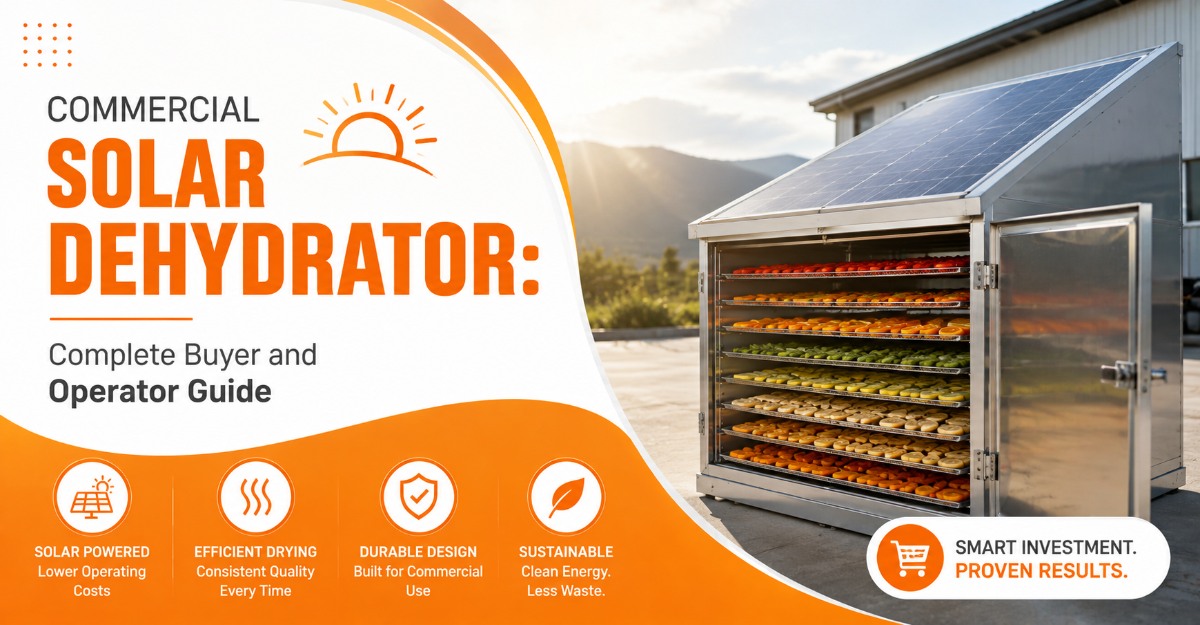
A commercial solar dehydrator is a large-scale drying system that uses solar radiation to remove moisture from food, processing 50 to 2,000+ kilograms per batch while holding the controlled temperatures, hygienic airflow, and food-safety standards that backyard units cannot reach. It replaces most or all of the fossil fuel or grid electricity a conventional dryer burns.
Beyond those headline numbers, four facts define the category. Commercial systems bring produce from an initial 75-90% moisture down to a safe storage level of 10-15%, equivalent to a water activity below 0.6 where mold and most bacteria stall. They cut drying energy cost by 60-100% against electric or LPG dryers, according to field data compiled by FAO and university trials. They come in four architectures: direct, indirect, mixed-mode, and solar-plus-backup hybrid. And unlike a home unit, they are built to a food-safety spec, using food-grade 304 stainless steel mesh and washable surfaces rather than wood or hobby plastic.
How does a commercial solar dehydrator work?
A commercial solar dehydrator works by converting sunlight into heat, pushing that heated air across loaded trays to evaporate water from the product, and then expelling the humid air before it recondenses. Three physical processes run in sequence: absorption (light becomes heat), evaporation (heat drives water out of the food), and convection (moving air carries that water away).
The mechanics are simple to picture. Sunlight passes through transparent glazing, often polycarbonate or tempered glass, and strikes a dark absorber plate that traps heat by the greenhouse effect, lifting air temperature into the 45-75°C band. That hot, dry air enters the drying chamber and sweeps over the product, forcing internal moisture to migrate to the surface and evaporate. The air, now saturated, is purged through active fans or a passive chimney so water leaves the system instead of settling back onto the food.
One design distinction matters more than most buyers realize: how the fans are powered. Many “solar” tunnels still draw grid power for their inline fans. A fully off-grid unit uses a small photovoltaic panel to run 12V or 24V DC fans, separating the thermal side (solar air heating) from the electrical side (solar-powered ventilation). In practice, that split is what lets a herb farm run in a location with no reliable grid.
What are the main types of commercial solar dryers?
Commercial solar dryers fall into four types, sorted by how they capture heat and where the product sits relative to the sun. Direct and indirect are the two base architectures; mixed-mode and solar-plus-backup hybrid combine them for speed or year-round reliability. The right choice depends almost entirely on whether your product tolerates ultraviolet light.
Direct solar dryers (cabinet and tent style)
Direct solar dryers place the product inside a glazed chamber that doubles as the collector, so sunlight hits the food itself. They are the cheapest to build and reach high internal temperatures, which suits robust, color-tolerant crops. Cocoa beans, coffee, grains, and hardy spices dry well here. Airflow is usually passive convection, though solar fans can be retrofitted. The trade-off: UV light bleaches pigments and destroys vitamin C.
Indirect solar dryers (separate collector and chamber)
Indirect solar dryers heat air in an isolated collector, then duct it into an opaque, shaded chamber where the food never sees direct sun. This protects color and heat-sensitive nutrients, making the design the default for mangoes, tomatoes, chili, tea leaves, and medicinal herbs. Ventilation is almost always active, using electric or PV-powered inline fans. Expect higher upfront cost and a fan power requirement in exchange for premium product quality.
Mixed-mode (hybrid airflow) dryers
Mixed-mode dryers give the chamber a transparent roof for direct gain while also feeding it pre-heated air from an attached collector. The combined heat load speeds up the aggressive early moisture removal that thick-cut fruit and root crops need. This is the workhorse for cassava, thick banana slices, and dense vegetables where drying time, not delicacy, is the constraint.
Solar-plus-backup hybrid systems
Solar-plus-backup hybrids add a secondary heat source, a biomass burner, LPG heater, or electric heat pump, to an indirect or mixed-mode base. When a cloud passes or night falls, the backup fires automatically to hold temperature and prevent spoilage. These systems serve year-round processors and exporters who cannot risk a half-dried batch molding overnight. They carry the highest capital and control-system cost.
| Type | Product sits in | Airflow | Best for | UV risk | Relative cost |
|---|---|---|---|---|---|
| Direct | Direct sunlight | Passive (retrofit fans) | Cocoa, coffee, grains, spices | High | Lowest ($) |
| Indirect | Shade | Active fans | Mango, tomato, herbs, tea | None | Medium ($$) |
| Mixed-mode | Partial sun | Active fans | Thick fruit, root crops | Moderate | Medium-high ($$$) |
| Solar + backup | Shade | Active + auxiliary heat | Year-round export processing | None | Highest ($$$$) |
Key specifications: temperature, airflow, capacity, efficiency
Commercial solar dehydrator specifications cluster around four numbers engineers use to size and validate a build: product temperature, airflow velocity, moisture endpoint, and collector efficiency. Getting temperature right by product is the single most important setting, because too hot ruins quality and too cool invites spoilage.
| Metric | Typical commercial range | Why it matters |
|---|---|---|
| Initial moisture | 75-90% | Sets the water mass you must evaporate |
| Target moisture | 10-15% | Shelf-stable endpoint for most produce |
| Water activity target | Below 0.6 aw | Below this, mold and most bacteria cannot grow |
| Airflow velocity | 0.5-1.5 m/s across trays | Faster evaporation without chilling the chamber |
| Collector efficiency | 40-60% thermal | Higher with selective black-chrome vs matte paint |
| Solar insolation needed | 4-6 kWh/m²/day | The practical minimum for reliable batch throughput |
The specification most operators overlook is water activity, not moisture percentage. Two batches at 15% moisture can behave differently in storage because bound water and free water are not the same thing. Shelf stability tracks water activity, and the practical line is 0.6 aw. A herbalist selling into export markets should measure aw with a meter, not assume that a moisture reading alone guarantees a mold-free product.
How do you size a commercial solar dryer for your volume?
You size a commercial solar dryer by working backward from the water you must remove, then matching collector area and tray area to that load. The governing quantity is evaporation demand: a 100 kg batch of tomatoes at 90% moisture dried to 12% must shed roughly 89 kg of water, which needs collector area proportional to your local solar irradiance.
Use this sequence in practice:
- Calculate water to remove: (initial moisture minus final moisture) times batch mass. A 100 kg load from 90% to 12% loses about 89 kg of water.
- Estimate daily evaporation potential per square meter of collector, typically 3-6 kg of water per m² per clear day in high-sun regions.
- Divide water load by daily evaporation to get collector days, then set area so a batch finishes inside your target window.
- Size tray area separately: allow roughly 4-8 kg of fresh product per m² of mesh so airflow can reach every slice.
- Add 15-25% headroom for cloudy days, or specify a backup heater if your schedule is fixed.
| Scale | Batch capacity | Collector area (guide) | Tray area (guide) | Land footprint |
|---|---|---|---|---|
| Small / farm | 50-100 kg | 15-30 m² | 12-25 m² | 40-80 m² |
| Mid commercial | 100-500 kg | 30-120 m² | 25-100 m² | 150-400 m² |
| Industrial | 500-2,000+ kg | 120-500+ m² | 100-400+ m² | 500-2,000+ m² |
The mistake most first-time buyers make is sizing the chamber to hold the crop while forgetting the collector. A dryer with generous trays but an undersized collector runs cool, stalls at high humidity, and produces the “hot but not drying” symptom covered below. Collector area, not tray count, sets throughput.
What does a commercial solar dehydrator cost, and when does it pay back?
A commercial solar dehydrator costs from $3,500 to $8,000 at farm scale (50-100 kg batches) and $20,000 to $85,000 or more at industrial scale (500-2,000+ kg tunnels and greenhouse dryers). Payback typically lands between 1.5 and 4 years, driven by the fuel or electricity you stop buying and the higher grade of product you can now sell.
| Scale | Capital cost | Typical form | Backup control | Payback range |
|---|---|---|---|---|
| Farm-scale | $3,500-$8,000 | Walk-in cabinet, modular unit | Optional PV fans | 1.5-3 years |
| Mid commercial | $8,000-$25,000 | Solar tunnel, hoop house | Optional heat source | 2-3.5 years |
| Industrial | $20,000-$85,000+ | Greenhouse dryer, PLC hybrid | Heat pump or LPG | 2-4 years |
A worked example makes the economics concrete. A mango processor drying 300 kg of fresh fruit daily to fetch premium dried slices might spend $30,000 on an indirect solar tunnel with a heat-pump backup. If that system displaces roughly $12,000-$18,000 a year in LPG or grid drying costs and reduces spoilage losses, the payback sits near 2 to 2.5 years, after which the energy is close to free for the system’s 12-20 year lifespan. Numbers shift with local fuel prices and sun hours, so treat these as typical rather than fixed.
Financing can shorten the wait. Agricultural solar drying qualifies for subsidies and grants in many regions: India’s programs through NABARD and state horticulture missions, development-agency schemes run by GIZ and FAO in Africa, and clean-energy or agri-processing incentives elsewhere. Check eligibility before you buy, because a 30-50% capital subsidy can cut payback below a year.
Solar drying vs electric, heat pump, and freeze drying
Solar drying beats electric and heat-pump dryers on running cost but loses to freeze drying on quality for delicate, high-value products. The right method depends on whether your priority is lowest energy cost, tightest quality control, or maximum nutrient and texture retention. No single machine wins on all three.
| Method | Energy cost | Quality retention | Speed / control | Capital | Best fit |
|---|---|---|---|---|---|
| Solar (indirect) | Very low | Good to very good | Weather-dependent | Low-medium | Fruit, veg, herbs, spices |
| Electric cabinet | High | Good | Precise, all-weather | Low | Small indoor batches |
| Heat pump dryer | Medium | Very good | Precise, low temp | High | Premium, consistent output |
| Freeze dryer | Very high | Excellent | Slow, exact | Very high | Berries, coffee, pharma, pet food |
The honest positioning: a solar dryer is the lowest lifetime-cost option for bulk fruit, vegetables, herbs, and spices in sunny regions. It is the wrong tool if you need the crisp, near-fresh texture of freeze-dried strawberries, or if your facility sits in a low-sun, high-humidity climate with no room for a backup heater. Many mature operations run a hybrid solar base and reserve a small freeze dryer for their top-margin line.
Food safety and certification for solar-dried products
Commercial solar-dried food must meet the same safety standards as any processed food, which shapes both the build and the operating log. Materials, temperature records, and contamination control are the three areas auditors examine, and passive backyard designs almost never satisfy them without modification.
Key requirements to plan for:
- Food-contact materials: food-grade 304 stainless steel mesh for trays, not wood or hobby-grade plastic, per guidance in FAO food-processing publications and most national codes.
- HACCP plan: documented critical control points for temperature and drying time, especially for meat and fish where 65-75°C is needed to reduce pathogens.
- Certification bodies: FSSAI in India, FDA and USDA guidance in the United States, and EC Regulation 852/2004 on food hygiene in the European Union.
- Good Manufacturing Practice (GMP): insect screening on intakes and exhausts, washable surfaces, and a cleaning schedule logged between batches.
- Water activity verification: aw below 0.6 documented for shelf-stable claims and export paperwork.
The practitioner rule here is that certification is easier to design in than to retrofit. Specify stainless mesh, sealed insect screening, and a temperature logger at purchase; adding them to a running dryer costs more and interrupts production.
Named commercial systems and manufacturers
Several proven commercial solar dryer designs anchor the market and are worth naming when you shop or benchmark. The University of Hohenheim solar tunnel dryer, developed in Germany, is the reference tunnel design copied worldwide for fruit and grain. The Solar Bubble Dryer, developed by GrainPro with IRRI and Hohenheim, is a low-cost inflatable tunnel for rice and grain in humid Asia. In India, S4S Technologies commercializes solar conduction dryers for smallholder aggregation, and manufacturers such as RSFP and Rudra Solar Energy supply cabinet and dome systems. Referencing these established designs gives you a spec baseline before you evaluate a local fabricator.
Common operational mistakes and how to fix them
The most common commercial solar drying failures are case hardening, tray overloading, running against high ambient humidity, and uneven drying from poor airflow. Each has a clear cause and a fast correction, and all four show up in the first weeks of a new operation before staff learn the machine.
Case hardening happens when the surface flash-dries above 70°C while the core stays wet, trapping moisture that molds later. Drop the early-stage temperature and ramp gradually. Overloading, stacking or overlapping slices, blocks horizontal airflow and creates humid pockets where bacteria grow. Load a single layer with gaps. Running a passive dryer on a rainy day above 80% ambient humidity makes food absorb water instead of shedding it, so a fixed schedule needs auxiliary heat. And uneven drying between front and back trays traces to short-circuiting airflow.
| Symptom | Root cause | Correction |
|---|---|---|
| Air hot, food not drying | Chamber at 100% RH, no purge | Raise fan speed, clear exhaust, widen tray spacing |
| Front trays dry, back wet | One-directional airflow | Rotate trays mid-batch or fit auto-reversing fans |
| Temperature drops when clouds pass | Low thermal mass | Add dark stone, brick, or water-tube heat storage |
| Surface hard, inside moist | Case hardening from early overheating | Lower start temperature, extend drying time |
What a commercial solar dehydrator is not good for
A commercial solar dehydrator is not a good fit for delicate texture-critical products, low-sun climates without backup heat, or operations needing minute-by-minute repeatability. Solar heat is variable by nature, so any process that cannot tolerate a slower day will fight the technology rather than benefit from it.
Freeze-dried crispness is out of reach for solar heat. Regions below roughly 4 kWh/m²/day of insolation, or with long monsoon seasons, force so much backup fuel use that the “solar” savings shrink. And pharmaceutical-grade or contractually rigid export timelines usually demand a heat-pump or hybrid system where solar is a cost-reducer rather than the sole heat source. Knowing these limits up front prevents an expensive mismatch.
Recommendations by operation size
The best commercial solar dehydrator depends on batch size, crop value, and how many days a year you must produce. Small artisans should prioritize quality and off-grid independence; large exporters should prioritize uptime and uniformity. Match the architecture to the constraint that actually threatens your business.
| Operation | Batch size | Recommended system | Why |
|---|---|---|---|
| Artisan / specialty | 20-50 kg | Active indirect cabinet with PV-powered 12V fans | Protects color and flavor of high-value crops, runs off-grid |
| Fruit / veg producer | 100-500 kg | Solar tunnel (hoop house) with integrated air heaters | Maximizes tray surface for high-volume slicing |
| Year-round exporter | 1,000+ kg | Hybrid greenhouse dryer with heat pump or LPG, PLC control | Guarantees delivery dates through cloud, night, and monsoon |
Frequently Asked Questions About commercial solar dehydrator
Can a commercial solar dehydrator run at night or during monsoon? Only a solar-plus-backup hybrid can. Pure solar and PV-fan systems stop drying without sun and can reabsorb moisture in high humidity. Year-round operations pair the solar collector with a heat pump, biomass burner, or LPG backup that fires automatically when irradiance drops.
How long does a commercial solar dryer last? A well-built commercial solar dryer lasts 12-20 years, with the collector glazing and structure outlasting fans, controls, and seals. Polycarbonate glazing typically needs replacement around 10-15 years. Stainless steel trays and a galvanized frame carry the longest service life with routine cleaning.
What is the difference between moisture content and water activity? Moisture content is the total water mass as a percentage; water activity (aw) measures only the free water available to microbes. Shelf stability tracks water activity, not moisture percentage, and the safe line is 0.6 aw. Two products at 15% moisture can differ in aw and storage life.
How much land does a commercial solar dryer need? Land footprint runs roughly 40-80 m² for a farm-scale unit and 500-2,000+ m² for industrial tunnels or greenhouse dryers, including collector, chamber, and clearance. Collector area, which sets throughput, usually drives the footprint more than tray area does.
Do solar-dried products qualify for organic or export certification? Yes, when the build and records meet the standard. Use food-grade 304 stainless mesh, a documented HACCP plan, insect screening, and verified water activity below 0.6. Certification bodies include FSSAI in India, FDA and USDA in the United States, and EC 852/2004 in the European Union.
How much can a commercial solar dehydrator cut energy costs? A commercial solar dehydrator cuts drying energy cost by 60-100% versus electric or fossil-fuel dryers, reaching 100% only when no backup fuel is used. Hybrid systems that lean on a heat pump during poor weather save less, typically 40-70%, but gain year-round reliability.