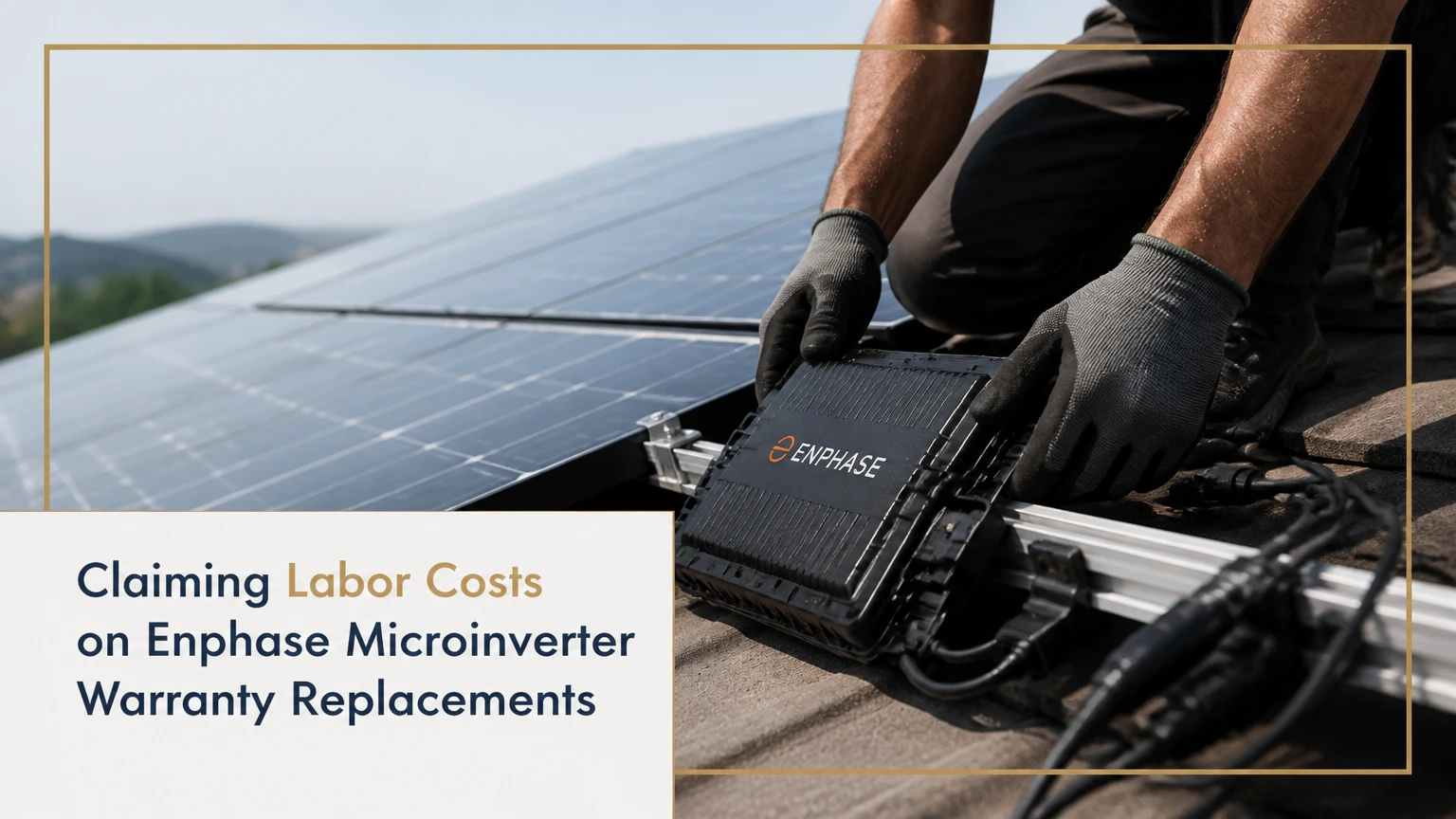
Enphase labor reimbursement for a microinverter warranty replacement is usually claimed by an eligible solar professional through the Enphase Installer Portal after an approved RMA, completed replacement, and returned defective unit. The Enphase hardware warranty and labor reimbursement are separate benefits, and the applicable payout, deadline, and eligibility depend on the product, country, program terms, and activation date.
Key Facts at a Glance
- Enphase IQ Microinverter hardware coverage can extend to 25 years under applicable limited-warranty terms.
- A hardware warranty does not automatically reimburse every diagnostic, travel, roof-access, or installation charge.
- The installer or authorized maintainer usually files the RMA and labor claim, not the homeowner.
- Enphase labor reimbursement uses a defined schedule rather than an installer’s unrestricted hourly invoice.
- An approved RMA, accurate serial number, completed replacement, and returned defective unit are central claim records.
- Labor Protection Program terms, factory reimbursement terms, and an installer’s workmanship warranty are separate obligations.
What Is Enphase Labor Reimbursement?
The Enphase Labor Reimbursement Program, commonly abbreviated LRP, is a warranty-service program that offsets eligible field labor associated with replacing covered Enphase equipment. Enphase describes the relevant support process as “Labor Reimbursement for Warranty Service,” but the program is not the same as a promise to pay the installer’s full service invoice.
The practical distinction matters. Enphase may replace a defective IQ Microinverter while the installer remains responsible for diagnosis, scheduling, roof access, travel, administration, and customer communication. The reimbursement is therefore a contribution governed by program rules, not necessarily a complete repair-price guarantee.
Enphase documentation differs by market. United States, Australia and New Zealand, India, and other regions publish separate labor or warranty materials, so a payout listed in one document cannot safely be applied worldwide.
Does Enphase pay the homeowner directly?
Usually, no. The normal claimant is the solar installation professional, authorized service provider, or active maintainer with the appropriate Enphase account and site access. A homeowner should first ask the installer to open the warranty case and disclose any customer charge before work begins.
A self-installer may have a different route if Enphase has verified the account and permits that customer to use the relevant portal workflow. Account status alone does not guarantee labor eligibility.
How Does the Claim Process Work?
An Enphase labor claim normally follows five linked events: confirm the failure, obtain an RMA, replace the unit, return the defective hardware, and submit the reimbursement request. The strongest claim file connects the same site, serial number, RMA, replacement serial number, field date, and return tracking number across every record.
Step 1: Confirm the microinverter failure
Start with Enlighten production data, the Enphase Installer Portal, and the Enphase Installer Toolkit app. A “Microinverter Not Reporting” alert identifies a communications or production problem, but it does not prove that the microinverter itself has failed.
Check the IQ Cable, branch circuit, AC disconnect, gateway communications, panel connection, and utility status before requesting an RMA. Record the affected serial number, module position, event history, photographs, voltage observations, and the date of diagnosis.
Success checkpoint: The fault remains associated with one identifiable unit after connector, circuit, and communications checks.
Common mistake: Treating one missing data point as proof of hardware failure.
Step 2: Submit the RMA
Open the customer site in the Enphase Installer Portal, select the affected equipment, and submit the return authorization request using the exact serial number. Include diagnostic notes and supporting evidence when the portal or support representative requests them.
An RMA authorizes a hardware-replacement process. It does not automatically establish that every labor charge will be reimbursed. Confirm the applicable labor program, covered product, installation date, and claim deadline before dispatching a technician.
Success checkpoint: The RMA status, approved product, and shipping address match the failed unit and customer site.
Common mistake: Filing against a replacement serial number or a neighboring microinverter.
Step 3: Replace and map the hardware
Follow the installer’s electrical safety procedures and local code requirements. Record the removed serial number, installed replacement serial number, module position, field date, technician identity, and any unusual roof-access condition.
Use Enphase Installer Toolkit to update the array map and commission or scan the replacement where the system workflow requires it. A physically successful swap can still produce an administrative failure if the portal retains the old serial number.
Success checkpoint: The replacement appears in the correct array position and begins reporting through the gateway.
Common mistake: Leaving the digital array map unchanged after the physical replacement.
Step 4: Return the defective unit
Use Enphase’s designated return packaging and shipping instructions. Retain the tracking receipt, shipment date, delivery confirmation, and photographs of the packaged unit until the claim is paid.
The exact return period is controlled by the applicable RMA or warranty instructions. A 30-day return rule appears in some program guidance, but it should not be treated as a universal rule for every country, product, or revision.
Success checkpoint: The returned serial number shows as received or otherwise accepted by Enphase.
Common mistake: Discarding the failed unit after installing the replacement.
Step 5: Submit the labor claim
After the field work and core return satisfy the applicable terms, access the claim function associated with the closed or eligible RMA. Review the pre-populated site, product, field date, and payment details before submission.
Save the confirmation number and a PDF or screenshot of the submitted claim. If the portal does not generate a claim, contact Enphase support rather than creating a duplicate RMA, because duplicate cases can complicate ownership of the service record.
What Evidence Should You Collect?
A reimbursement claim is strongest when the service record proves both a covered equipment failure and a qualifying field intervention. The following evidence also helps separate a hardware defect from a connector, grid, or communications problem.
| Evidence item | Specific record | Why it matters | Retention point |
|---|---|---|---|
| Failed-unit identity | Original serial number and module position | Links diagnosis to RMA | Keep through payment |
| System diagnosis | Enlighten alert, event history, and test notes | Shows reason for replacement | Save before removal |
| Authorization | RMA number, approval date, and approved model | Establishes warranty case | Match every invoice |
| Field work | Technician, field date, photos, and replacement serial | Proves installation occurred | Keep with service ticket |
| Array update | Installer Toolkit scan or updated site map | Confirms digital commissioning | Save portal confirmation |
| Core return | Carrier receipt and delivery tracking | Proves defective unit was returned | Retain until claim closes |
| Payment profile | Legal entity, tax, and banking details | Prevents payout administration errors | Reconcile quarterly |
An installer should also retain the customer work authorization and invoice, even when Enphase does not request the full document. Those records establish what the installer actually charged and what the homeowner was told.
How Much Can You Claim?
Enphase reimbursement is a scheduled allowance, not an automatic payment of actual labor cost. Published figures vary by geography and program revision; the frequently repeated US figures of approximately $200 for a truck roll and $25 per additional microinverter should be treated as source-specific examples until the current Enphase schedule confirms them.
A claim can therefore be approved while still leaving a service deficit. For example, a $450 steep-roof service visit with a $225 applicable allowance leaves $225 for the installer or the contract holder to absorb, recover under a workmanship agreement, or charge under disclosed service terms.
| Cost component | Typical field amount | Possible Enphase treatment | Verification needed |
|---|---|---|---|
| Diagnostic visit | $125-$300 | May be included or excluded | Current regional schedule |
| Standard roof replacement visit | $250-$450 | Flat allowance may apply | Approved RMA and labor terms |
| Steep or tile roof access | $400-$750 | Extra complexity may not increase payout | Written program exceptions |
| Additional microinverter | $25-$75 each | Per-unit allowance may apply | Same-visit schedule |
| Lift, scaffolding, or specialty access | $150-$1,000 | Often requires separate contract treatment | Installer agreement |
| Return shipping | $15-$60 | May be prepaid or excluded | RMA shipping instruction |
These are typical practitioner ranges, not Enphase promises. Roof pitch, array height, travel distance, regional wages, permitting, and whether a second technician is required can change the actual cost substantially.
How Long Does Labor Coverage Last?
The often-cited standard US LRP term covers the first two years from system activation, while the hardware warranty may continue for 25 years. That distinction is the most important financial fact in an Enphase replacement claim, but the activation definition and current regional terms must control the final decision.
The activation date may be documented in the Enphase site record, commissioning history, permission-to-operate file, or installer handover documents. Do not substitute the panel purchase date, inverter shipment date, or date of the first service call without checking the applicable warranty language.
| Coverage or obligation | Common duration or trigger | Pays for | Main risk |
|---|---|---|---|
| IQ Microinverter hardware warranty | Up to 25 years in applicable terms | Covered replacement hardware | Product and regional exclusions |
| Standard labor reimbursement | Often first 2 years from activation | Scheduled service allowance | Expiration or wrong activation date |
| LPP extension | Published options may add 3 or 8 years | Scheduled labor offset | Purchase, tier, and certificate terms |
| Installer workmanship warranty | Contract-specific, often 5-25 years | Installer-defined labor and defects | Contract exclusions and transfer terms |
The table shows why “25-year warranty” is incomplete sales language. A homeowner can have replacement hardware coverage in year 15 while still needing to pay for diagnosis and rooftop labor under the installer contract.
What Are LRP, LPP, and Installer Warranties?
LRP is the factory labor reimbursement mechanism, LPP is an optional or program-linked extended labor protection product where available, and an installer workmanship warranty is a separate customer contract. These programs may cover the same service event but allocate cost to different parties.
Enphase’s LPP page describes extended labor protection associated with eligible installer relationships and purchased coverage, while the exact duration, price, territory, and enrollment conditions require confirmation from the current program document.
| Arrangement | Contract holder | Typical purpose | Payment limit |
|---|---|---|---|
| Factory hardware warranty | Product owner or covered system | Replace defective hardware | Hardware terms and exclusions |
| Standard LRP | Eligible installer or maintainer | Offset qualifying field service | Published flat-rate schedule |
| LPP | Eligible installer or program participant | Extend labor protection | Certificate and program terms |
| Workmanship warranty | Homeowner and installer | Cover installation-related defects | Installer contract language |
| Service agreement | Homeowner and service provider | Fund post-warranty maintenance | Agreed visit and hourly rates |
An LPP purchase does not automatically rewrite the homeowner’s workmanship contract. Likewise, an installer cannot generally describe a factory labor allowance as unlimited free service unless the customer agreement expressly says so.
How Do Regional Rules Change the Claim?
Regional Enphase documents can use different reimbursement values, forms, eligible products, return rules, and claimant requirements. United States guidance should not be used to price an Australian, New Zealand, Indian, or other international claim without checking the regional document linked to the account and product.
Before sending a technician, verify four items: country, product family, current program revision, and system activation date. Enphase’s Australia and New Zealand material and India material demonstrate why regional documentation exists separately rather than as one universal labor schedule.
For a commercial system, also check whether the account belongs to the original installer, an acquired service company, or a current maintainer. Portal access and warranty entitlement can follow different administrative paths.
What Happens After the Factory Labor Period?
After the applicable factory labor period expires, the installer’s contract, an LPP enrollment, a service agreement, or homeowner payment usually determines who funds the field work. Enphase may still replace covered hardware, but the replacement does not by itself create a free labor obligation.
A homeowner should request a written estimate before approving the visit. The estimate should separate diagnostic time, travel, roof access, microinverter replacement, commissioning, permit work, and any non-warranty repair.
| System situation | Hardware position | Labor payer likely to assess | Customer action |
|---|---|---|---|
| Activation age 18 months | Potentially within factory labor term | Eligible installer claim | Confirm RMA and schedule |
| Activation age 4 years, no LPP | Hardware may remain covered | Contract or homeowner | Request written service quote |
| Activation age 7 years with LPP | Depends on certificate term | Eligible LPP claimant | Verify enrollment and limits |
| Failed connector, good microinverter | Hardware claim may fail | Installer or homeowner | Diagnose workmanship first |
| Installer no longer operating | Hardware claim may remain | New maintainer or customer | Ask Enphase about account transfer |
The installer should not promise reimbursement before checking eligibility. The homeowner should not assume a denied labor claim means the hardware warranty was denied.
Why Are Enphase Claims Denied?
Claims are commonly delayed or denied when the returned unit tests functional, the wrong serial number is submitted, the core is late, the array map is not updated, the claimant lacks program eligibility, or the request misses the applicable deadline. Each failure has a different remedy, so resubmitting the same form without correcting the record rarely helps.
The “no fault found” problem deserves special attention. A loose connector, tripped breaker, gateway failure, utility interruption, or grid event can imitate a dead microinverter; replacing hardware before isolating those causes creates avoidable labor and return risk.
| Failure mode | Observable symptom | Corrective action | Prevention |
|---|---|---|---|
| Wrong serial number | RMA does not match field unit | Submit portal correction | Photograph label before removal |
| No fault found | Returned unit tests operational | Provide diagnostic test record | Verify circuit and communications |
| Core not returned | Claim remains pending | Submit tracking and contact support | Ship immediately after replacement |
| Array map mismatch | Replacement does not report correctly | Rescan and update site | Record module position |
| Deadline missed | Portal rejects claim | Request written exception review | Calendar field and submission dates |
| Payment mismatch | Approved claim is unpaid | Correct legal and banking profile | Match account to tax entity |
A claim denial should be answered with a structured evidence packet: RMA number, serial photographs, diagnostic timeline, field invoice, replacement record, return tracking, and a concise explanation of the disputed condition.
Which Costs Should the Installer Recover Separately?
Installers should price the full service event, not the expected Enphase allowance. A flat reimbursement may cover a normal single-story visit but fail to cover tile removal, steep-roof fall protection, long-distance travel, a second technician, or repeated visits caused by unavailable site access.
The customer contract should state whether warranty service includes diagnostic labor, travel, roof access, equipment rental, permitting, and communications troubleshooting. A separate service schedule prevents the homeowner from interpreting “parts warranty” as “no-cost repair.”
Expert operating rules
- Do not replace before isolating the fault. A missing production report is a symptom, not a component diagnosis.
- Capture the serial number twice. Photograph the original label before removal and the replacement label after installation.
- Price the roof, not the reimbursement. The roof-access method determines cost more reliably than the number of microinverters.
- Close the digital record on the same day. Array mapping, commissioning, and field notes become harder to reconstruct later.
- Batching is a margin tactic, not a warranty rule. Combining nearby service calls can reduce travel cost, but urgent outages and claim deadlines take priority.
How Should Homeowners Handle a Replacement?
Homeowners should ask the installer for the diagnosis, RMA status, labor coverage basis, estimated customer charge, and written workmanship position before approving the replacement. The homeowner should also obtain the system activation date and confirm whether LPP or another service agreement was purchased.
A practical request can be short: “Please identify the failed serial number, Enphase RMA, applicable labor program, covered amount, excluded charges, and my balance before dispatch.” That wording separates Enphase’s reimbursement from the installer’s contract obligation.
Do not independently remove rooftop equipment. Electrical isolation, roof safety, commissioning, and local code compliance require qualified personnel, and unauthorized work can create a separate workmanship or insurance dispute.
Claim Cost Scenarios
The following examples use typical service costs and illustrative allowances, not guaranteed Enphase payouts. They show why the same failed component can produce different customer balances.
| Scenario | Service cost | Illustrative allowance | Remaining balance |
|---|---|---|---|
| One unit, easy single-story roof | $325 | $225 | $100 |
| One unit, tile roof and 60-mile travel | $575 | $225 | $350 |
| Four units, same visit | $650 | $300 | $350 |
| Connector diagnosis, no replacement | $225 | $0 | $225 |
| Year-6 replacement without LPP | $450 | $0 factory labor | $450 |
The figures are useful for planning, not for quoting an Enphase entitlement. The current program schedule and customer contract decide the actual reimbursement and charge.
FAQ
Can a homeowner file an Enphase labor claim without the installer?
Usually, the homeowner cannot use the standard installer claim route unless Enphase has approved the account as a qualifying self-installer or service claimant. The homeowner should contact Enphase Support and the original installer first, then ask for written instructions if the installer is unavailable or refuses to act.
Does a 25-year Enphase warranty include free rooftop labor?
No. The 25-year figure generally describes eligible hardware coverage for certain IQ Microinverters under applicable terms. Labor reimbursement may have a shorter duration, and diagnostic, travel, roof-access, commissioning, or contract charges may remain outside the hardware warranty.
Can I claim labor if the failed microinverter is still reporting?
Possibly, but reporting status alone does not establish failure. Production data, event history, electrical checks, and installer diagnostics must support the RMA. Enphase may reject a returned unit that tests functional, leaving the service cost governed by the installer agreement.
What if the original solar installer closed?
The hardware warranty may still remain available, but the original installer’s workmanship obligations and portal access may not transfer automatically. Ask Enphase about an authorized maintainer, account access, RMA ownership, and regional labor-claim procedure before hiring a replacement contractor.
Are travel and roof-access fees reimbursed separately?
Not necessarily. Many labor programs use a flat schedule that may include a visit allowance without separately pricing mileage, tile removal, lifts, fall protection, or unusually difficult access. Obtain the current regional schedule and request a written customer estimate for excluded amounts.
How long should I keep the replacement records?
Keep the RMA, serial photographs, diagnostic notes, field invoice, array-map confirmation, return tracking, claim confirmation, and payment record for at least the duration of the installer or service contract. Retaining the records through the hardware warranty period is safer when ownership or service responsibility may change.
The Bottom Line
Claiming Labor Costs on Enphase Microinverter Warranty Replacements requires more than proving that an IQ Microinverter failed. The installer must connect a valid diagnosis, approved RMA, correct serial numbers, completed field replacement, updated array map, returned defective unit, and timely labor submission under the correct regional program.
Enphase hardware coverage can last far longer than labor reimbursement. Confirm the current schedule, activation-date rule, claimant status, return deadline, and customer contract before promising free service or dispatching a technician.