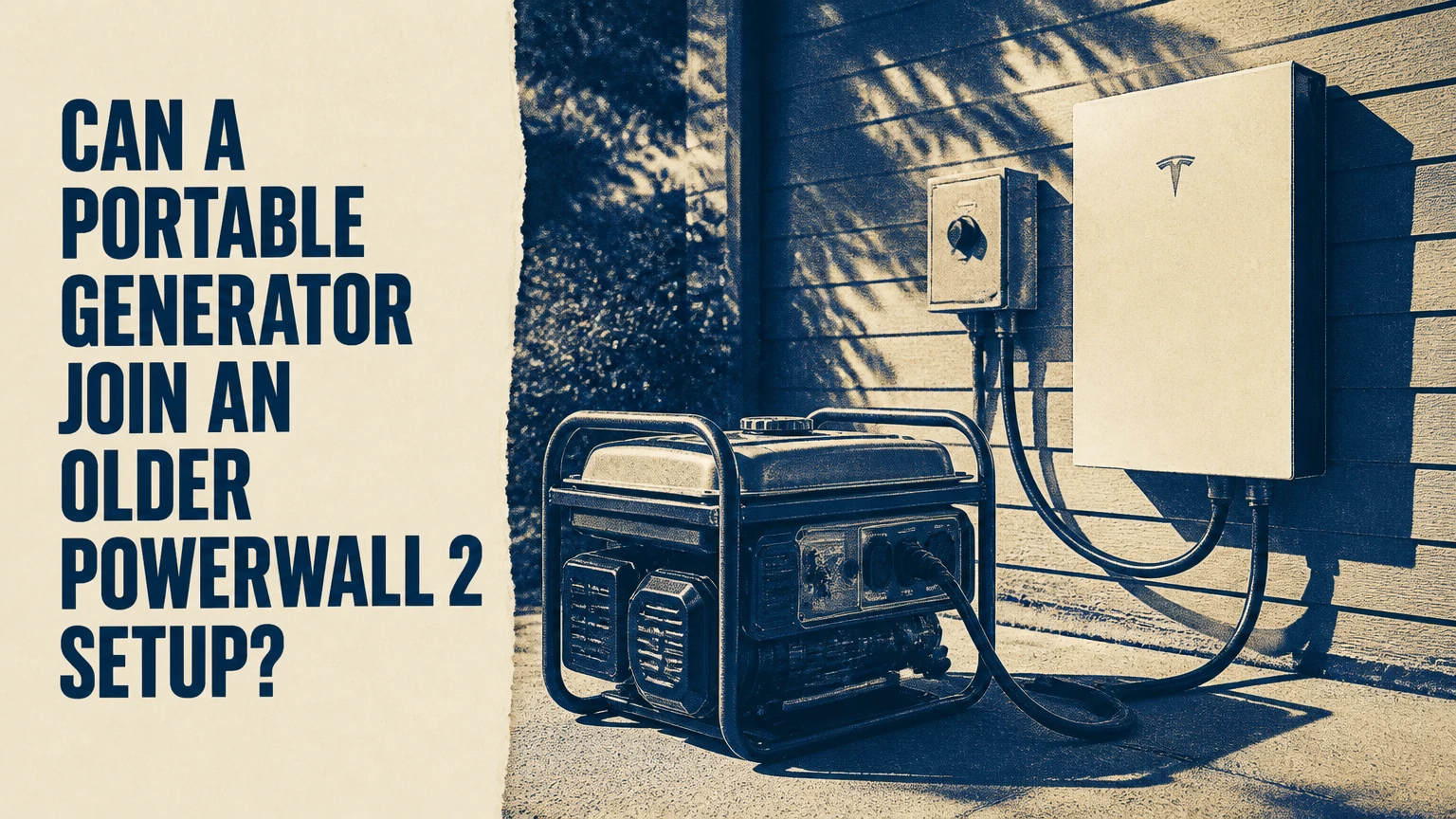
Yes, a third-party portable generator can usually be added to an older Tesla Powerwall 2 installation, but the generator and Powerwall 2 should operate as isolated backup sources rather than directly charging or controlling one another. A transfer switch, correct neutral arrangement, approved generator inlet, and site-specific Tesla and electrical-code review determine whether the retrofit is safe.
Key Facts at a Glance
- Tesla Powerwall 2 is an AC-coupled battery system that normally forms a backup microgrid through Backup Gateway 2.
- A conventional portable generator should not be connected through a wall receptacle or wired so generator power can reach an active Powerwall inverter.
- A manual transfer switch is the lowest-cost retrofit, while an automatic arrangement requires a compatible electric-start generator and control logic.
- A 30-amp, 120/240-volt inlet provides a theoretical 7,200 watts, while a 50-amp inlet provides a theoretical 12,000 watts.
- Generator operation commonly causes rooftop solar to disconnect because anti-islanding controls do not permit unsafe parallel operation.
- A 90-amp generator output is not a universal Powerwall requirement; generator sizing depends on the backed-up loads, service equipment, and transfer-switch ratings.
Can You Add a Third-Party Portable Generator to an Older Powerwall 2 Setup?
A third-party portable generator can supplement an older Powerwall 2 system when a transfer arrangement prevents the generator from energizing the Powerwall side of the installation. The practical design is usually sequential: Powerwall 2 supplies selected or whole-home loads first, then a person or automatic controller disconnects that source before the generator supplies the loads.
Tesla’s published guidance on combining energy systems requires installers to evaluate the specific system design, equipment, and jurisdiction rather than treating every Powerwall installation as interchangeable. Older installations can also have different Gateway hardware, firmware, solar topology, service ratings, and permitted load arrangements.
The key distinction is supplementation, not integration. The portable generator normally does not become a second energy source that Powerwall 2 freely accepts for charging. A qualified electrician must verify whether the proposed arrangement is supported by Tesla, permitted by the local authority, and covered by the installer’s warranty terms.
What Does Backup Gateway 2 Actually Control?
Backup Gateway 2 monitors grid status, separates the home from utility conductors during an outage, and coordinates Powerwall backup behavior. Backup Gateway 2 is not automatically a universal generator controller, and its presence does not prove that a portable generator can be connected to its terminals.
During a utility outage, Powerwall 2 can energize a protected home circuit or backed-up main panel. The Powerwall inverter maintains voltage and frequency for compatible household loads, while solar inverters may operate only when the microgrid conditions and Powerwall limits allow them.
A generator retrofit adds a second source that must be electrically interlocked. The design must prevent generator voltage from reaching the Tesla inverter while the inverter is active, and it must prevent utility voltage from reaching the generator inlet. National Electrical Code Article 702 addresses optional standby systems, transfer equipment, and prevention of inadvertent interconnection.
Can a generator charge Powerwall 2?
A third-party portable generator should be treated as unable to charge Powerwall 2 unless Tesla has specifically approved the equipment and configuration. A generator connected downstream of a transfer switch normally powers the home’s loads after the Powerwall source is isolated, rather than feeding energy into the battery.
This limitation protects against unstable voltage, frequency mismatch, neutral problems, uncontrolled backfeed, and conflicting source controls. “Clean” inverter-generator output reduces waveform risk, but low total harmonic distortion does not create Tesla communications compatibility or authorize battery charging.
What Architecture Is Safest?
The safest general architecture places a listed transfer device between the protected loads and the generator inlet, with source positions that cannot be active simultaneously. The generator feeds the transfer equipment, while the Tesla system remains isolated whenever generator power supplies the home.
A typical arrangement has four functional sections:
- Utility service and Tesla Backup Gateway 2.
- Powerwall-protected main panel or load center.
- Listed manual or automatic transfer equipment.
- Outdoor generator inlet connected to a portable generator.
The exact physical order varies by service design. Some homes need a selected-load panel because the portable generator cannot start or sustain the entire house. Other homes can use a whole-home transfer switch if the generator, service equipment, and load-management system are appropriately rated.
Manual transfer switch or interlock
A manual transfer switch is usually the most practical portable-generator retrofit. The homeowner starts the generator, connects a listed cord to an outdoor inlet, confirms the Powerwall source is isolated, and moves the transfer mechanism to the generator position.
A panel interlock can work when the electrical panel manufacturer lists the interlock for that panel and the installation meets local requirements. A generic bracket is not equivalent to listed transfer equipment. The interlock must physically prevent both source breakers from closing together.
Automatic transfer switch
An automatic transfer switch can reduce outage workload, but the system is more complex than a manual inlet. The switch must detect the relevant source condition, disconnect the Tesla-backed source, start the generator, wait for stable voltage and frequency, and transfer the loads.
A portable generator needs electric start, remote two-wire or manufacturer-approved start capability, an automatic choke or equivalent starting system, adequate battery charging, and a control interface compatible with the ATS. Many recreational inverter generators lack these features.
Which Integration Method Fits the Home?
Manual transfer equipment suits an owner who can reach the generator, monitor fuel, and perform a controlled changeover. Automatic equipment better suits remote properties, medical loads, frequent outages, or households where no trained person can safely operate a generator at night.
| Decision factor | Manual switch or listed interlock | Automatic transfer system |
|---|---|---|
| Typical equipment and labor | $800-$1,500 | $2,000-$4,000, excluding generator |
| Start method | Human-operated recoil or electric start | Electric start with approved auto-start input |
| Transfer time | 5-20 minutes after arrival | Typically 30-120 seconds after stable generation |
| Generator location | Must be accessible outdoors | Must remain fueled and ready outdoors |
| Maintenance burden | Manual testing and fuel checks | Battery, controls, fuel, and ATS testing |
| Best outage profile | Occasional, attended outages | Overnight, extended, or unattended outages |
The manual option wins on cost and generator flexibility. The automatic option wins when response time and unattended operation justify additional equipment and maintenance.
What happens during a long outage?
Powerwall 2 supplies the protected loads until its state of charge reaches the configured reserve or usable lower limit. At that point, the home either loses backed-up power or changes to generator supply through a properly operated transfer sequence.
The generator does not automatically inherit Powerwall load management. High-demand devices such as heat pumps, well pumps, electric ranges, resistance water heaters, and vehicle chargers can overload a portable unit even when their average wattage appears acceptable.
A staged load plan is therefore important. A selected-load panel can preserve refrigeration, lighting, communications, garage doors, sump pumps, and medical equipment while excluding discretionary loads.
How Large Should the Generator Be?
Generator sizing should begin with starting watts and transfer equipment ratings, not with a universal Powerwall number. A portable generator must support the simultaneous running load plus the largest motor-starting surge, while remaining below the inlet, breaker, panel, and generator continuous ratings.
| Generator connection | Maximum theoretical input | Approximate continuous planning range | Typical use |
|---|---|---|---|
| 30A, 120/240V L14-30 | 7,200W | 5,000-6,000W | Refrigerator, lights, furnace, selected pumps |
| 50A, 120/240V 14-50 | 12,000W | 8,000-10,000W | Larger selected-load or modest whole-home backup |
| 50A, 120/240V generator rated 12kW | 12,000W nameplate | 9,600-10,800W continuous | Larger motor and appliance combinations |
| 90A, 120/240V source | 21,600W theoretical | Site-specific | Large standby or engineered service equipment |
The 90-amp figure sometimes repeated in generator discussions is not a standard minimum for adding a generator to Powerwall 2. A 90-amp circuit represents a very large source and may exceed the capacity of many portable generators, inlets, transfer switches, and residential load centers.
Which loads create sizing problems?
| Load | Typical running watts | Typical starting or surge demand | Planning consequence |
|---|---|---|---|
| Refrigerator | 100-400W | 800-1,800W | Usually manageable, but several units overlap |
| Gas furnace blower | 400-900W | 1,200-2,700W | Needs 120V circuit and startup allowance |
| Well pump | 700-1,500W | 2,100-6,000W | Often determines generator size |
| Sump pump | 500-1,000W | 1,500-3,500W | Test during transfer operation |
| Heat pump | 2,000-5,000W | 5,000-15,000W | May need soft-start or exclusion |
| Electric water heater | 3,800-4,500W | 3,800-4,500W | Usually excluded on portable units |
Portable generator wattage also falls at altitude and in extreme heat. Fuel type matters: a dual-fuel model may produce different output on gasoline and propane, so the electrician and owner should use the lower applicable rating.
What Generator Features Matter?
An inverter generator is often preferable because its electronic output can provide tighter voltage and frequency control than a basic open-frame construction generator. The generator still needs a compatible transfer method, correct grounding, adequate capacity, and manufacturer-approved operating conditions.
| Feature | Preferred specification | Why it matters |
|---|---|---|
| Output type | Inverter or documented low-THD design | Reduces waveform and frequency concerns |
| Rated output | 7,000-10,000W for many selected-load plans | Supports common household circuits |
| Voltage | 120/240V split phase | Required for many 240V pumps and appliances |
| Connection | Listed L14-30 or 14-50 receptacle | Matches approved inlet cord systems |
| Start capability | Electric start plus remote auto-start | Required for most automatic transfer designs |
| Fuel | Dual fuel or large gasoline tank | Extends outage flexibility |
| Neutral configuration | Manufacturer-documented bonded or floating neutral | Prevents objectionable current and protection faults |
A generator’s total harmonic distortion rating is only one input. The installation also needs stable frequency, correct phase configuration, appropriate grounding, and source switching that prevents the generator from seeing an energized Powerwall microgrid.
What Happens to Solar During Generator Operation?
Rooftop solar commonly disconnects when a generator supplies the home through a transfer device. Solar inverters are required to stop exporting when they detect an unstable or absent utility reference, and a portable generator generally cannot coordinate with the Tesla system like the utility and Powerwall controls do.
Solar may also be curtailed by Powerwall controls during an outage when battery state of charge, load, or inverter limits require it. The generator must not be used to “trick” solar equipment into reconnecting. Such an arrangement can create uncontrolled generation, overvoltage, or dangerous backfeed.
A solar-plus-Powerwall owner should ask the installer exactly which conductors are transferred and whether the photovoltaic system belongs on the generator-backed side. In many practical retrofits, the generator supplies selected loads while PV remains disconnected until the grid or approved battery operating conditions return.
How Should an Electrician Plan the Retrofit?
A licensed electrician should map the existing Tesla equipment, service conductors, backed-up loads, generator rating, and local permit requirements before selecting a transfer switch. A typical design review takes several hours, while a straightforward installation often requires one working day after equipment is available.
- Identify the existing topology. Record Backup Gateway 2, Powerwall count, solar inverter model, service rating, main-panel layout, and backed-up circuits.
- Calculate the load. Measure running and starting demand for pumps, compressors, heating equipment, and other motor loads.
- Select the transfer point. Decide between whole-home transfer and a selected-load panel downstream of the Tesla equipment.
- Choose the inlet and conductor. Match a 30-amp or 50-amp inlet, breaker, cord, conduit, and wire size to the generator and code requirements.
- Resolve neutral and grounding. Confirm whether the generator neutral is bonded, whether the transfer switch switches the neutral, and where grounding connections belong.
- Install listed equipment. Use a manufacturer-approved interlock or transfer switch, weather-resistant inlet, proper overcurrent protection, and required labeling.
- Test every source state. Verify grid operation, outage operation, Powerwall discharge, generator transfer, return to Powerwall, and return to utility.
- Document the procedure. Leave the owner a written start sequence, shutdown sequence, fuel instructions, and emergency contact information.
The success checkpoint is simple: no test condition permits utility, Powerwall, and generator sources to energize one another in an unauthorized combination. A common mistake is testing only the normal operating state and never validating a low-battery transfer under actual household load.
What Should You Verify Before Installation?
Older Powerwall 2 systems require more verification than new installations because the original installer may have configured only part of the service for backup. Tesla’s current support documentation and the local authority having jurisdiction should be checked against the exact Gateway, Powerwall, solar, and transfer equipment combination.
Use this pre-installation checklist:
- Photograph equipment labels and record model numbers.
- Confirm whether the home has Backup Gateway 1 or Backup Gateway 2.
- Check whether the Tesla system is under warranty or a service agreement.
- Ask Tesla or the certified installer whether the proposed topology is supported.
- Obtain the generator’s continuous watts, surge watts, voltage, neutral configuration, and start controls.
- Check local permit, inspection, gas-storage, noise, and placement rules.
- Confirm that the generator will operate outdoors, away from doors, windows, and air intakes.
- Decide which loads must operate if the generator starts automatically.
- Plan fuel storage and runtime for at least the expected outage duration.
- Test the generator under load before the next emergency.
The Centers for Disease Control and Prevention warns that portable generators produce carbon monoxide and must remain outdoors away from openings. Carbon monoxide safety is independent of the electrical design and cannot be solved by a transfer switch.
What Does a Retrofit Typically Cost?
A manual generator inlet and listed transfer device commonly costs $800-$1,500 in a straightforward North American retrofit, while an automatic downstream transfer arrangement commonly costs $2,000-$4,000 before the generator. Regional labor rates, panel relocation, trenching, load-center replacement, permitting, and difficult Tesla equipment access can move the total substantially.
| Project component | Typical cost range | Typical labor duration | Main cost driver |
|---|---|---|---|
| 30A inlet and manual transfer | $800-$1,200 | 4-6 hours | Short conduit run and accessible panel |
| 50A inlet and manual transfer | $1,000-$1,800 | 5-8 hours | Larger conductors and load calculation |
| Automatic transfer equipment | $2,000-$4,000 | 6-10 hours | Controls, commissioning, and auto-start wiring |
| Portable inverter generator | $1,200-$3,500 | Owner setup | Output, fuel type, and auto-start capability |
| Selected-load subpanel | $500-$1,500 | 3-8 hours | Number of circuits being moved |
These are planning ranges, not quotations. A required service upgrade or replacement of an unsuitable panel can add several thousand dollars.
What Commonly Goes Wrong?
The most dangerous error is backfeeding through a household receptacle or homemade cord. A “suicide cord” can energize exposed prongs, bypass overcurrent protection, damage the Tesla inverter, and place utility workers at risk.
Other failure modes are less dramatic but still consequential:
- Generator overload: Remove electric water heating, large HVAC, and vehicle charging before adding a larger generator.
- Wrong neutral arrangement: Have the electrician match generator bonding with transfer-switch design and local code.
- Auto-start failure: Test the starter battery, choke, fuel valve, communication cable, and cold-start behavior monthly.
- Solar conflict: Confirm that PV disconnects or curtails during generator operation instead of assuming the transfer switch solves every control issue.
- Incompatible inlet: Match L14-30 or 14-50 hardware to actual generator output; an adapter cannot create missing capacity.
- Unexpected Powerwall drain: Configure a higher reserve or shed discretionary loads before the battery reaches its lower operating limit.
An expert rule of thumb is to size for the largest simultaneous motor start, then add essential running load, rather than adding appliance nameplates blindly. A second is to test the exact outage sequence quarterly, because a generator that starts alone may fail when a transfer controller and loaded panel are involved.
Which Backup Strategy Should You Choose?
| Household situation | Recommended arrangement | Generator planning range | Reason |
|---|---|---|---|
| Budget-conscious, attended outages | Manual transfer or listed interlock | 7,000-10,000W | Lowest retrofit complexity |
| Remote cabin or vacant property | Automatic transfer with auto-start | 8,000-12,000W | Reduces dependence on occupant response |
| Medical refrigeration or powered equipment | Selected-load panel plus ATS | Load-calculated | Protects priority circuits |
| Large electric HVAC home | Engineered standby system | 12,000W or higher | Portable units may not handle motor starts |
| Short outages with modest loads | Keep Powerwall only or add manual inlet | 5,000-7,000W | Generator may not justify retrofit cost |
A portable generator is not a substitute for more Powerwall capacity when the main problem is short, frequent outages and silent automatic operation. A generator becomes more valuable when outages last many hours, fuel is available, and the owner can accept noise, maintenance, and manual operating constraints.
FAQ
Will adding a generator automatically void the Powerwall warranty?
Not automatically, but an unapproved wiring change, backfeed event, or equipment fault can complicate warranty service. Tesla and the installing contractor should review the proposed topology in writing, especially when the generator connects near Backup Gateway 2 or changes the backed-up load panel.
Can a 5,000-watt generator run one Powerwall?
A 5,000-watt generator should not be selected based on Powerwall quantity. The generator normally supplies household loads after isolation, so the correct question is whether 5,000 watts supports the selected circuits and their starting surges, not whether it can “run” the battery.
Can I use a standard construction generator?
A standard generator may work for isolated selected loads if its voltage, frequency, grounding, connection hardware, and transfer arrangement meet the design requirements. An inverter generator is often easier to justify, but the label alone does not establish compatibility with Tesla equipment.
How long will a portable generator run the house?
Runtime depends on fuel tank size, fuel type, generator loading, and the loads transferred. A gasoline portable unit may run roughly 8-15 hours at moderate load, while propane runtime varies by cylinder size and output derating; verify the manufacturer’s loaded-runtime data.
Can the generator run while Powerwall still has charge?
The generator should not supply the same backed-up loads while Powerwall 2 remains electrically connected as an active source. A manual or automatic transfer sequence must isolate the Tesla source first, even if the battery has remaining state of charge.
Is a generator inlet safer than plugging appliances directly into a generator?
A listed inlet and transfer device is safer for connected household circuits because the transfer equipment controls source separation and the inlet uses protected, rated conductors. Direct extension cords can be appropriate for isolated appliances, but they do not integrate with Powerwall-backed circuits.
The Bottom Line
Can you add a third-party portable generator to an older Powerwall 2 setup? Usually yes, provided the generator supplies the home through listed transfer equipment and remains isolated from the active Tesla Powerwall 2 and Backup Gateway 2 source. Choose a manual transfer arrangement for lower cost and attended outages, or an automatic transfer system for remote and unattended operation.
Do not use a wall-outlet backfeed, assume that low THD permits battery charging, or rely on the often-repeated 90-amp figure without a load calculation. Have a qualified electrician verify the older Tesla topology, neutral and grounding scheme, generator capacity, solar behavior, permits, and complete outage sequence before installation.