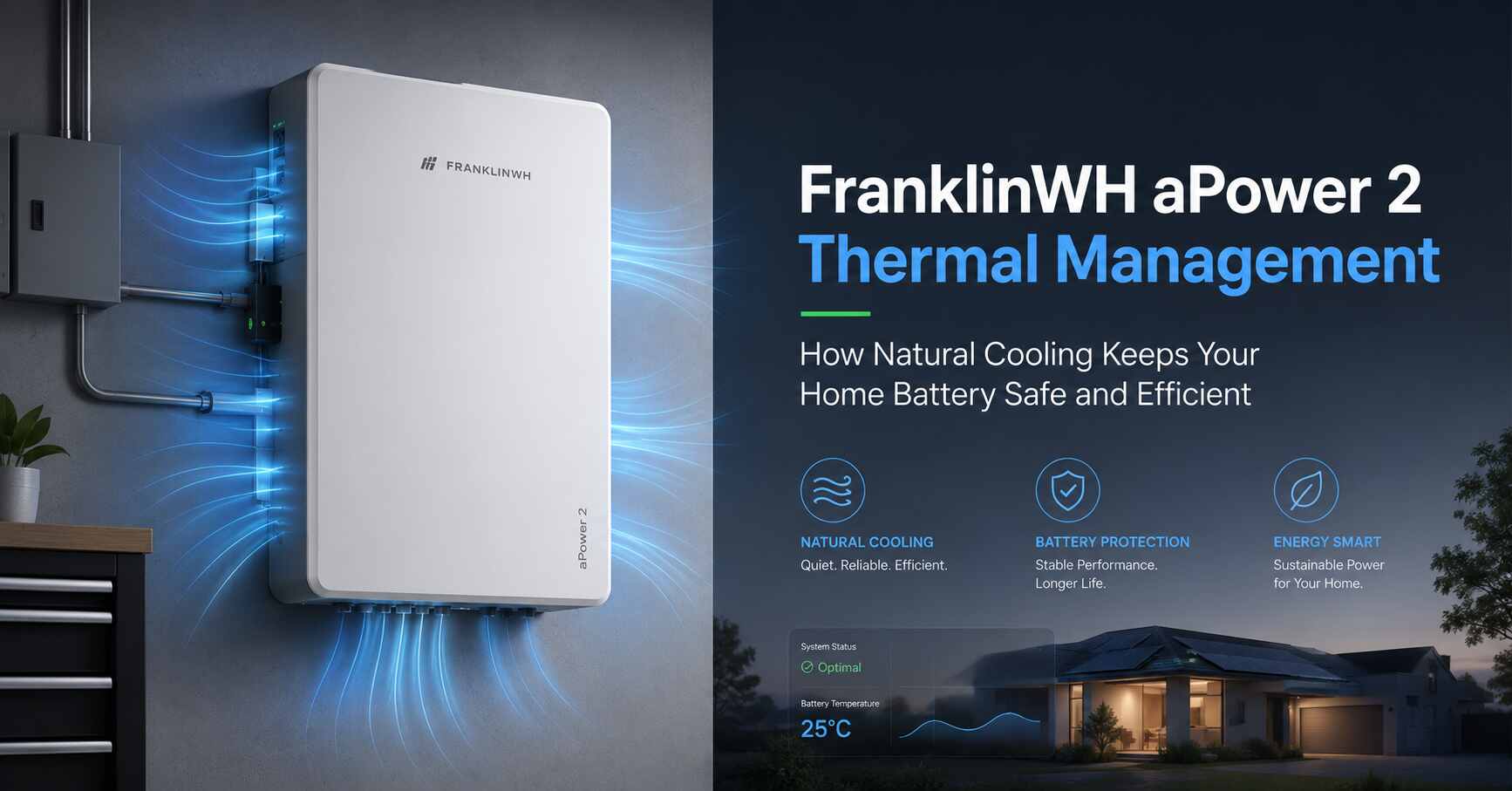
If you are shopping for a home battery, you have probably noticed that most marketing pages talk about capacity, backup hours, and price, but say very little about what actually keeps a battery safe over ten or more years of daily cycling: heat control. The FranklinWH aPower 2 takes a different approach to this problem with a natural cooling, passive thermal management design instead of the fans, pumps, and liquid cooling loops used by many competitors.
This guide goes deeper than the manufacturer’s own product page. We explain the engineering behind natural convection cooling, why it matters for lithium iron phosphate (LFP) batteries specifically, how it compares to active cooling systems from other brands, and what it actually means for your home’s safety, noise levels, maintenance costs, and long term battery health. Whether you are an homeowner evaluating a solar and storage system or a solar installer researching specs for a client, this article gives you the full picture.
What Is Battery Thermal Management and Why It Matters
Every battery generates heat when it charges and discharges. Left unmanaged, that heat accelerates chemical degradation inside the cells, reduces usable capacity over time, and in worst case scenarios can trigger thermal runaway, a self sustaining chain reaction that the National Fire Protection Association (NFPA) has documented as a leading cause of energy storage fires.
A thermal management system is the set of hardware and software that keeps every cell inside a battery pack within its optimal temperature window, typically between 15°C and 35°C for lithium iron phosphate chemistry. There are two broad approaches used across the residential energy storage industry:
- Active cooling uses fans, pumps, refrigerant, or liquid coolant loops to physically move heat away from the cells.
- Passive or natural cooling relies on the physical design of the enclosure, thermally conductive materials, and airflow driven by convection rather than mechanical parts.
The FranklinWH aPower 2 falls into the second category, and understanding why that matters requires looking at both the chemistry inside the unit and the engineering of the enclosure itself.
FranklinWH aPower 2 Thermal Management: The Natural Cooling Approach Explained
The aPower 2 uses lithium iron phosphate (LFP) battery chemistry, which is inherently more thermally stable than older nickel manganese cobalt (NMC) chemistries. According to research published by the U.S. Department of Energy’s National Renewable Energy Laboratory, LFP cells have a significantly higher thermal runaway onset temperature and a lower risk of self heating compared to NMC cells. This chemistry choice is what makes a natural cooling strategy viable in the first place.
Natural cooling in the aPower 2 works through a combination of design elements:
- Thermally engineered enclosure. The outer casing is designed with materials and internal geometry that conduct heat away from the cell modules toward the exterior, where ambient air absorbs it.
- Convection driven airflow. Instead of a fan forcing air through the unit, temperature differences inside the enclosure create natural air movement, drawing cooler air in at lower points and releasing warmer air higher up.
- Cell spacing and module layout. Individual battery modules are arranged with enough physical separation to prevent heat from one module transferring directly into a neighboring one.
- Battery management system (BMS) monitoring. Software continuously tracks the temperature of individual cell groups and adjusts charge and discharge rates to avoid pushing the pack into a temperature range where passive cooling would not keep pace.
The result is a system with no moving mechanical parts dedicated to cooling, which has direct consequences for reliability, noise, and long term maintenance that we cover below.
Natural Cooling vs Active Cooling: A Side by Side Comparison
Homeowners researching home battery storage thermal management often assume that more complex cooling equals better performance. That is not always true. Here is how the two approaches actually compare across the factors that matter most to homeowners.
| Factor | Natural (Passive) Cooling | Active Cooling |
|---|---|---|
| Moving parts | None | Fans, pumps, compressors |
| Noise level | Silent or near silent | Audible fan or pump noise |
| Maintenance | Minimal, no filters or coolant | Periodic filter cleaning, coolant checks |
| Failure points | Fewer mechanical failure risks | Additional parts that can wear out or fail |
| Energy overhead | None, no parasitic power draw | Small but continuous power draw to run fans/pumps |
| Best suited climates | Moderate to warm climates with good ventilation | Extreme heat, high power density, or fast charging applications |
| Typical use case | Residential storage with moderate cycling | Commercial storage, EV fast charging, high density racks |
This comparison highlights an important nuance that competing content tends to skip: natural cooling is not simply a cheaper substitute for active cooling. It is a deliberate engineering tradeoff that suits the specific chemistry, form factor, and duty cycle of a residential battery like the aPower 2. A residential unit that cycles once or twice a day does not generate the sustained thermal load that a commercial fast charging station or EV battery pack does, so the case for active cooling is weaker in this context.
Why Passive Thermal Design Improves Home Battery Safety
Fewer moving parts is not just a convenience feature, it is a safety feature. Every fan, pump, or coolant seal in an active cooling system is a potential point of failure. If a cooling fan dies or a coolant line develops a leak, the battery can silently lose its ability to manage heat while continuing to operate, which increases risk over time.
Underwriters Laboratories (UL), which certifies safety standards for battery energy storage systems including UL 9540 and UL 9540A, specifically evaluates thermal runaway propagation and containment as part of certification testing. A simpler thermal architecture with fewer components gives engineers fewer variables to validate and fewer parts that can degrade unpredictably in the field, which is one reason natural cooling systems can achieve strong safety certifications despite their apparent simplicity.
The Consumer Product Safety Commission has also noted that mechanical component failure is a recurring theme in home energy storage product recalls, reinforcing the value of designs that minimize dependency on active mechanical cooling wherever the chemistry and use case allow it.
Real World Benefits for Homeowners
Noise Free Operation
One of the most immediate, tangible benefits homeowners notice is silence. Active cooling fans, especially in units mounted in a garage or near a bedroom wall, can produce a persistent hum, especially during peak solar charging in summer afternoons. Because the aPower 2 relies on natural convection, there is no fan noise associated with thermal regulation, which matters for anyone installing the unit close to living spaces.
Lower Long Term Maintenance
Active cooling systems typically require periodic maintenance, such as replacing air filters, checking coolant levels, or servicing pump seals. A natural cooling system eliminates these tasks entirely. Over a 10 to 15 year product lifespan, this can represent meaningful savings in both money and homeowner time, and it removes a common source of installer service calls.
Improved Long Term Reliability
Because there are no cooling specific components that wear out, the failure modes associated with fans and pumps simply do not apply. This does not mean the system is immune to all issues, but it does narrow the list of things that can go wrong purely from a thermal management standpoint.
Better Suited to Outdoor and Garage Installations
Natural cooling systems that rely on enclosure design and convection tend to perform predictably across a wide range of ambient conditions common in residential installations, whether the unit is mounted outdoors, in a garage, or in a utility room, provided basic clearance and ventilation guidelines are followed during installation.
Where Natural Cooling Has Limitations
No engineering approach is without tradeoffs, and a genuinely useful comparison should say so. Passive cooling systems are generally less effective than active systems in these specific scenarios:
- Extreme sustained heat. In climates with consistently high ambient temperatures above the battery’s rated operating range, passive systems have less headroom than active systems, which is why installation guidelines around shade, clearance, and ventilation matter more for naturally cooled units.
- Very high power draw applications. Systems designed for continuous high power discharge, such as commercial or industrial storage, generate more sustained heat than passive cooling can dissipate as efficiently as liquid cooling.
- Rapid back to back cycling. Homes with unusually heavy backup demand or frequent full charge and discharge cycles in a short window put more thermal stress on any battery, and active systems have a theoretical edge in these edge cases.
For the vast majority of residential use cases, which involve one daily cycle tied to solar production and evening use, these limitations rarely come into play, but homeowners in exceptionally hot climates should factor local temperature data into their installation planning and consult the manufacturer’s site placement guidelines.
How This Compares to Industry Trends
The broader residential battery storage industry has been moving toward LFP chemistry specifically because it enables safer, simpler thermal management strategies. The U.S. Department of Energy has highlighted LFP’s growing dominance in stationary storage applications precisely because of its thermal stability advantages over older chemistries. Natural cooling designs like the one used in the aPower 2 are best understood as part of this larger industry shift rather than an isolated feature.
Frequently Asked Questions
Does natural cooling reduce the aPower 2’s lifespan compared to actively cooled batteries?
Not inherently. Because the system is built around LFP chemistry and paired with a battery management system that limits charge and discharge rates when temperatures rise, the passive design is engineered to keep cells within their safe operating range across the product’s intended lifespan.
Do I need to leave extra clearance around the unit for cooling to work properly?
Yes. Like any passively cooled system, proper airflow clearance during installation is important. Always follow the manufacturer’s site placement and ventilation guidelines.
Is natural cooling less safe than liquid cooling?
Not necessarily. Safety depends on the full system design, chemistry, and certification testing, not on the cooling method alone. Fewer mechanical parts can actually reduce certain failure risks.
Final Thoughts
The FranklinWH aPower 2’s natural cooling thermal management system reflects a deliberate engineering decision rather than a cost cutting shortcut. By pairing thermally stable LFP chemistry with a passive, convection based enclosure design, the system delivers silent operation, lower long term maintenance, and fewer mechanical failure points, while still meeting the demands of typical residential solar and battery use.
Understanding these tradeoffs, and the specific scenarios where active cooling still has an edge, helps homeowners make a genuinely informed decision rather than relying on marketing claims alone.
Ready to Explore Home Battery Storage Options?
If you are comparing home energy storage systems and want a deeper technical breakdown tailored to your home’s climate, energy use, and backup needs, reach out to a certified solar and storage installer for a personalized consultation, or download our free home battery buyer’s checklist to compare thermal management, warranty terms, and safety certifications side by side before you decide.