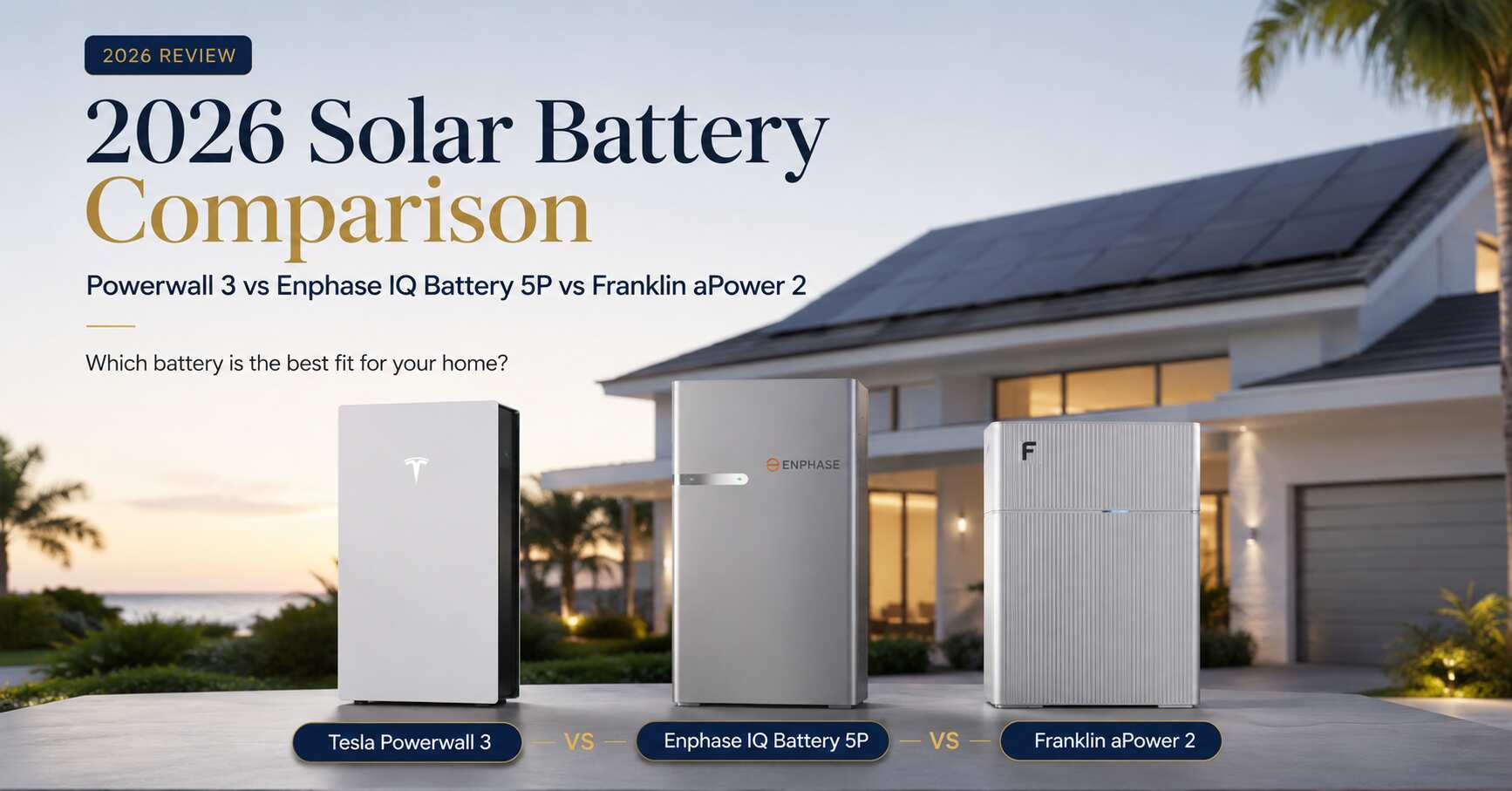
As utility rates climb and power grids become increasingly unreliable, investing in a residential energy storage system is no longer just a luxury it’s a necessity. If you are shopping for the best home solar battery in 2026, you have likely narrowed your choices down to the three heavyweights dominating the industry: the Tesla Powerwall 3, the Enphase IQ Battery 5P, and the FranklinWH aPower 2.
At first glance, these batteries might seem similar. They all store solar energy, provide backup power during outages, and help you avoid peak utility rates. However, when you look under the hood, their architectural philosophies, power outputs, and ecosystem integrations are wildly different.
In this comprehensive guide, we will break down the Powerwall 3 vs Enphase 5P vs Franklin aPower 2 debate. We’ll analyze their technical specifications, compare their real-world performance, and help you determine which energy storage system is the perfect fit for your home.
Home Battery Storage
Quick Comparison: Powerwall 3 vs Enphase 5P vs Franklin aPower 2
Overview of the Contenders
Before diving into the granular metrics, let’s establish what makes each of these home energy storage systems unique.
- Tesla Powerwall 3: The undisputed king of brand recognition, Tesla’s third-generation battery is an all-in-one powerhouse. Unlike its predecessor, the Powerwall 3 features a fully integrated hybrid solar inverter, eliminating the need for a separate solar inverter on your wall. It is designed for brute strength, boasting the highest continuous power output on the market.
- Enphase IQ Battery 5P: Enphase has taken a radically different approach. Instead of one massive battery, the 5P is a modular system. Enphase rules the microinverter market, and the 5P is built to integrate flawlessly into that ecosystem. It prioritizes granular control, extreme reliability, and scalability.
- FranklinWH aPower 2: The “dark horse” that has rapidly earned the respect of elite solar installers. FranklinWH delivers massive storage capacity in a single, elegantly designed cabinet. Paired with its proprietary aGate smart panel, it offers unmatched flexibility, including the unique ability to seamlessly integrate with a standby gas generator.
Usable Battery Capacity Comparison
When evaluating a solar battery, the first spec most homeowners look at is capacity. Think of capacity as the size of your car’s fuel tank—it determines how long you can run your appliances before the battery dies.
- Tesla Powerwall 3: 13.5 kWh
- Franklin aPower 2: 13.6 kWh
- Enphase IQ Battery 5P: 3.84 kWh (per module)
If you are looking for maximum storage in a single footprint, both Tesla and FranklinWH are closely matched, offering enough juice to run a typical home’s essential loads through the evening and night.
Enphase’s lower capacity per unit is intentional. Because it is modular, most homeowners install two to four 5P units to achieve a comparable 7.68 kWh to 15.36 kWh total capacity. This modularity is a massive advantage if you want to start small and add more storage later, but it does require more wall space.
To understand exactly how much capacity your specific home needs, check out this guide on How to Calculate Your Home’s Energy Load.
Solar Battery Continuous Power Output: The Real Differentiator
While capacity is the fuel tank, solar battery continuous power output is the horsepower. It dictates what you can turn on. Can you run your 5-ton central air conditioner, well pump, and electric oven at the same time? That depends entirely on power output.
- Tesla Powerwall 3: 11.5 kW continuous / 22 kW peak (for 10 seconds)
- Franklin aPower 2: 5.0 kW continuous / 10.0 kW peak (for 10 seconds)
- Enphase IQ Battery 5P: 3.84 kW continuous / 7.68 kW peak (per module)
Here is where the Powerwall 3 completely dominates. With 11.5 kW of continuous power from a single unit, it is a true whole-home backup solution. It can easily start heavy motor loads like a massive HVAC system without flinching.
The Franklin aPower 2 offers a respectable 5.0 kW continuous. While it can handle most standard loads (lights, fridges, outlets, microwaves), starting a large central AC unit on a single Franklin battery might require adding a soft-start device to your HVAC.
To match Tesla’s power output, you would need to stack three Enphase 5P units (giving you 11.52 kW continuous). However, Enphase’s architecture means that if one microinverter inside the battery fails, the rest keep running. Tesla’s single-inverter design is a single point of failure.
Tesla Powerwall 3 Review: The All-in-One Powerhouse
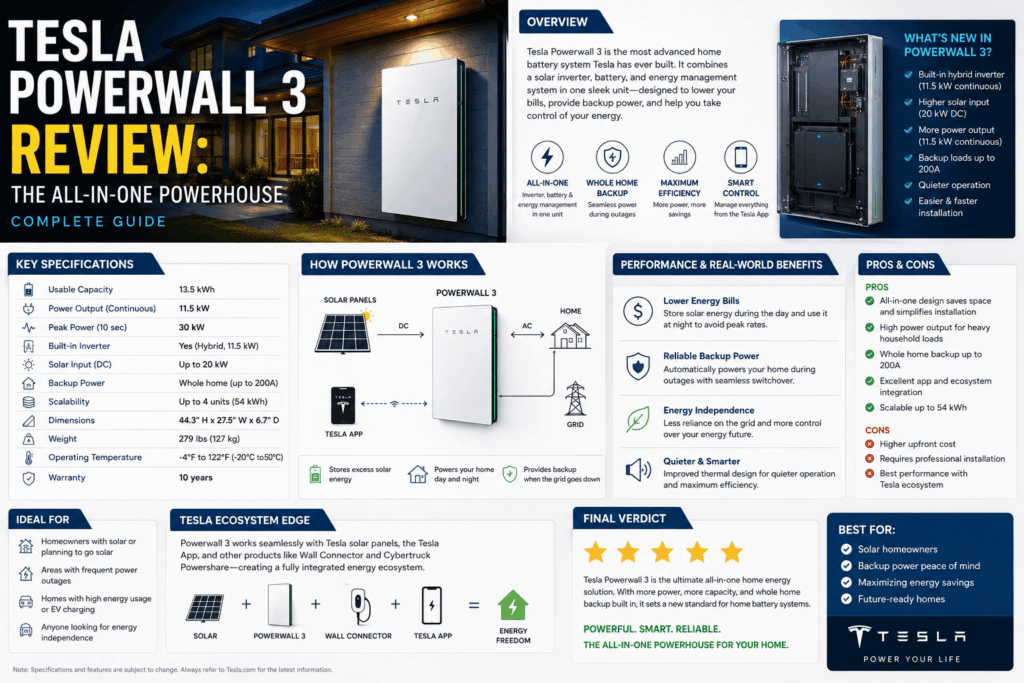
The Tesla Powerwall 3 is the most significant redesign in Tesla’s battery lineup since the original Powerwall. Unlike its predecessor, Powerwall 3 includes a built-in solar inverter capable of handling up to 20kW of DC solar input meaning for many homes, you no longer need a separate string inverter at all.
Powerwall 3 Capacity and Performance
Each Powerwall 3 unit delivers 13.5 kWh of usable capacity with an integrated 11.5kW continuous / 30kW peak output enough to start large loads like air conditioners and well pumps without hesitation. You can stack up to four expansion units alongside one Powerwall 3 (which houses the inverter), reaching 54 kWh of total storage for larger homes.
Where Powerwall 3 Falls Short
- No panel-level redundancy. Because the inverter is centralized rather than distributed, a single point of failure can take down more of your system than a microinverter-based design.
- Installer availability. Tesla requires certified installers, and in some regions wait times still stretch several weeks longer than for Enphase or Franklin installs.
- Shorter warranty. At 10 years, Powerwall 3’s warranty trails both competitors by 2-5 years.
Enphase IQ Battery 5P Review: Modular and Fault-Tolerant
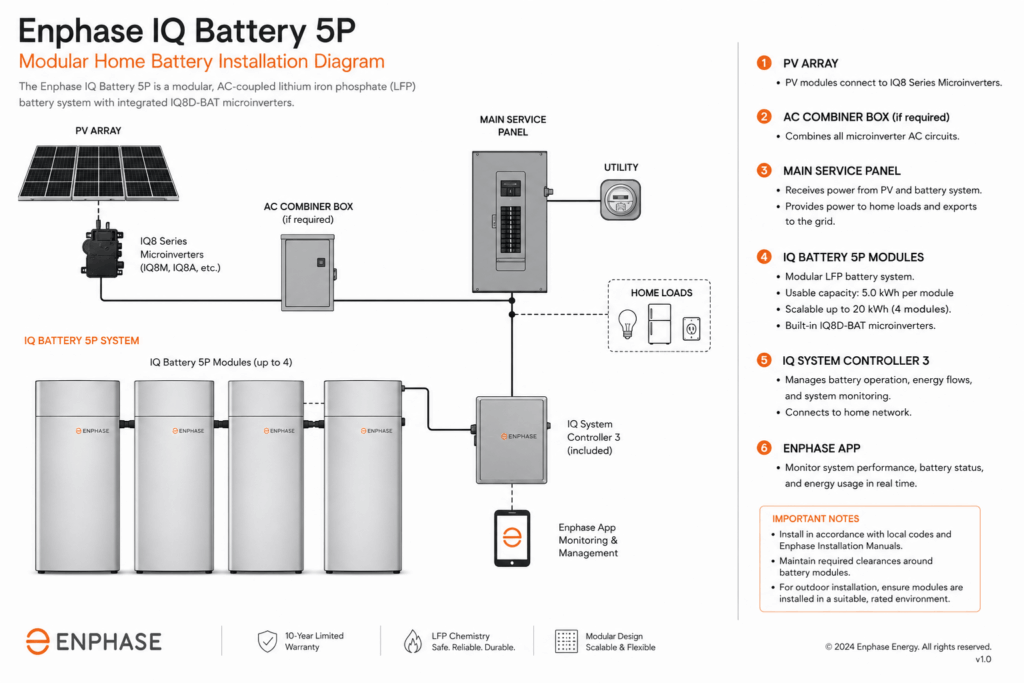
Enphase built its reputation on microinverter technology, and the IQ Battery 5P extends that same philosophy to storage. Instead of one large battery with a centralized inverter, the 5P is a modular 5kWh unit that pairs with Enphase’s IQ8 microinverters at the panel level.
Why Modularity Matters for Enphase 5P
Because each solar panel has its own microinverter, a shading issue, panel fault, or partial system failure doesn’t take out your entire array’s production the way it can with a string-inverter system. This same resilience philosophy carries over to the battery: you can add 5P units one at a time as your energy needs grow, rather than committing to a large single unit upfront.
Enphase 5P Backup Power Considerations
The tradeoff for modularity is per-unit output. A single 5P delivers up to 3.84kW continuous noticeably less than a single Powerwall 3 or Franklin aPower 2. Homes wanting to run large HVAC loads or well pumps during an outage typically need at least 3 units stacked together, which increases both cost and physical installation footprint. Enphase’s Sunlight Backup feature also allows the system to intelligently prioritize solar charging to extend backup runtime, a genuinely useful feature not matched identically by the other two systems.
Franklin aPower 2 Review: The Flexible Retrofit Option
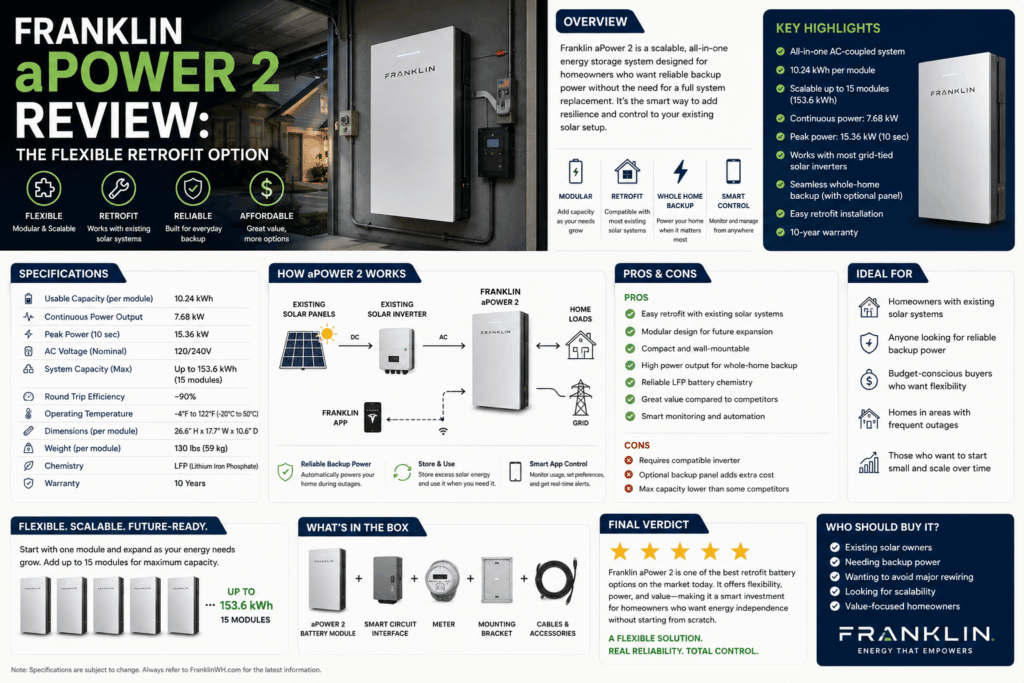
Franklin Home Power’s aPower 2 (the successor to the original FranklinWH aPower) takes a middle-ground approach: it’s an all-in-one battery like the Powerwall 3, but it doesn’t include a built-in solar inverter, making it inverter-agnostic. This is a major advantage for homeowners who already have solar installed and don’t want to replace a functioning inverter just to add storage.
The aGate Smart Panel Advantage
Franklin’s standout feature is the aGate smart panel, which handles load management, generator integration, and whole-home backup switching in one unit. Unlike systems that require a separate transfer switch and load center rework, aGate consolidates this into a single point of control often simplifying installation labor and reducing electrician hours.
Franklin aPower 2 Generator Compatibility
For homeowners in wildfire-prone or hurricane-prone regions who already own a backup generator, Franklin aPower 2’s native generator integration is a genuine differentiator. The system can automatically bring a generator online to recharge the battery during extended outages a capability neither Powerwall 3 nor the Enphase 5P handles as natively out of the box.
Battery Chemistry: Lithium Iron Phosphate (LFP) Batteries
In the past, the battery industry relied heavily on Nickel Manganese Cobalt (NMC) chemistry. However, in 2026, the standard has shifted.
We are pleased to report that the Powerwall 3, Enphase 5P, and Franklin aPower 2 all utilize Lithium iron phosphate (LFP) batteries.
Why does this matter? According to the Department of Energy, LFP chemistry is infinitely superior for stationary home storage. LFP batteries boast a drastically lower risk of thermal runaway (they do not easily catch fire), they operate efficiently across a wider temperature range, and they degrade much slower than NMC batteries. Tesla’s switch from NMC (in the Powerwall 2) to LFP (in the Powerwall 3) leveled the playing field, making all three options incredibly safe.
Hybrid Solar Inverter vs Microinverters: Ecosystem Integration
How the battery talks to your solar panels is perhaps the most critical factor for installation and long-term efficiency. This brings us to the hybrid solar inverter vs microinverters debate.
Tesla: The Hybrid Approach
The Powerwall 3 is DC-coupled and features a built-in hybrid string inverter. This means you plug your solar panels directly into the battery unit.
- Pros: Highly efficient (less energy lost in DC-to-AC conversion), fewer boxes on your wall, lower installation costs for new systems.
- Cons: Not ideal for retrofitting. If you already have solar panels with microinverters, the Powerwall 3 is incredibly difficult (and sometimes impossible) to cleanly integrate.
Enphase: The Microinverter King
The Enphase 5P is an AC-coupled battery that pairs seamlessly with Enphase IQ microinverters on your roof.
- Pros: If you already have an Enphase solar system, this is the ultimate plug-and-play addition. You get everything—solar production, battery storage, and consumption monitored at the panel level in one beautifully designed app.
- Cons: AC coupling has a slight efficiency loss during the conversion process compared to Tesla’s DC setup.
FranklinWH: The Retrofit Master
The Franklin aPower 2 is AC-coupled but completely brand-agnostic. It works beautifully alongside existing SolarEdge string inverters, Enphase microinverters, or just about anything else.
- Pros: The aGate panel makes retrofitting an absolute breeze. Plus, it has a dedicated port to plug in a gas generator, allowing you to use solar, battery, grid, and generator power simultaneously.
- Cons: You will have to use Franklin’s app for battery monitoring, which means you might be toggling between two different apps (one for solar, one for storage) depending on your setup.
Warranty, Lifespan, and Customer Support
When spending over $10,000 on a piece of technology, you need to know it will last. Solar battery warranty and cycle life are heavily competitive among these three brands.
- Enphase IQ Battery 5P: 15-year warranty (Industry-leading). Enphase guarantees the battery will retain at least 60% of its original capacity after 15 years or 6,000 cycles.
- Franklin aPower 2: 12-year warranty (or 43 MWh of energy throughput). Guaranteed to retain 70% capacity.
- Tesla Powerwall 3: 10-year warranty. Guaranteed to retain 70% capacity.
Enphase takes the crown here. Their 15-year warranty is a testament to the longevity of their hardware. However, it is worth noting that Tesla has an established, robust service network nationwide. FranklinWH, while newer to the market, has actively prioritized dedicated installer support, meaning local technicians often get faster answers from Franklin than they do from Tesla’s massive corporate bureaucracy.
The Cost of Solar Battery Installation
The cost of solar battery installation varies wildly based on your home’s electrical panel, the need for trenching, and local permitting fees. However, assuming standard installation parameters, here is what you can expect to pay (before incentives like the federal ITC or local state rebates):
- Tesla Powerwall 3: ~$11,500 – $15,000 (Includes the built-in solar inverter, saving you money if buying solar simultaneously).
- Enphase IQ 5P (Two Modules / 7.68 kWh): ~$9,000 – $13,000.
- Franklin aPower 2: ~$12,000 – $15,500.
Because the Tesla Powerwall 3 negates the need to buy a separate solar inverter, it generally offers the best “bang for your buck” on new solar-plus-storage installations. To see real-time pricing for your zip code, check out this 2026 Solar Battery Pricing Calculator.
Best Battery for NEM 3.0 and Changing Utility Policies
Across the country, utility companies are moving away from traditional net metering (where they pay you retail rate for excess solar) and adopting Net Billing Tariffs (like California’s infamous NEM 3.0). Under these new rules, exporting solar to the grid during the day pays pennies, but buying power during peak evening hours (4 PM – 9 PM) costs a fortune.
If you are looking for the best battery for NEM 3.0 environments, your main goal is self-consumption storing your daytime solar power to use in the evening.
Because both the Tesla Powerwall 3 and Franklin aPower 2 offer roughly 13.5 kWh of capacity, a single unit is perfectly sized to get a standard home through the expensive 4 PM to 9 PM window. If you opt for Enphase, you will want at least two (and ideally three) 5P modules to achieve the necessary capacity to dodge peak rates effectively. For more context on utility shifts, review the EIA’s report on residential energy markets.
Which Home Battery Is Best for Your Situation?
- Choose Powerwall 3 if: You’re installing solar and storage together and want the simplest single-vendor experience with one integrated inverter.
- Choose Enphase IQ Battery 5P if: You already have (or want) Enphase microinverters, prioritize fault tolerance, and prefer scaling capacity gradually over time.
- Choose Franklin aPower 2 if: You have existing solar with a functioning inverter, own a backup generator, or want the most robust whole-home load management out of the box.
None of these batteries is objectively “best” each optimizes for a different homeowner priority: simplicity (Tesla), modularity and resilience (Enphase), or retrofit flexibility and generator integration (Franklin). The right answer depends on your existing solar equipment, your backup power priorities, and how your local utility structures net metering and time-of-use rates.
Common Questions About Powerwall 3, Enphase 5P, and Franklin aPower 2
Can I mix and match these batteries with any solar panel brand? Franklin aPower 2 is the most inverter-agnostic of the three. Enphase 5P requires Enphase IQ8 microinverters. Powerwall 3 includes its own inverter, so it works with most panel brands but locks you into Tesla’s inverter hardware.
Which battery has the longest warranty? Enphase IQ Battery 5P currently leads with a 15-year warranty, followed by Franklin aPower 2 at 12 years and Tesla Powerwall 3 at 10 years.
Do I need multiple units for whole-home backup? It depends on your home’s load profile. A single Powerwall 3 or Franklin aPower 2 can often back up most essential and even whole-home circuits for average-sized homes, while Enphase’s lower per-unit output typically requires 2-3 stacked 5P units for comparable whole-home coverage.
Final Verdict
For most homeowners installing solar and battery storage at the same time, Tesla Powerwall 3 remains the simplest path. If you value system-level resilience and already lean toward Enphase’s microinverter ecosystem, the Enphase IQ Battery 5P is the stronger long-term bet. And if you’re retrofitting storage onto existing solar or want tight generator integration, Franklin aPower 2 is purpose-built for that use case.
Before signing any contract, get itemized quotes for all three systems from a licensed local installer battery pricing and incentive eligibility can shift significantly based on your specific home and utility territory.
Ready to Compare Quotes for Your Home?
Every home’s solar setup, roof orientation, and backup power needs are different. Contact our solar advisors for a free, no-obligation comparison of Powerwall 3, Enphase 5P, and Franklin aPower 2 pricing for your specific home, or explore our complete home battery buying guide to keep researching before you decide.