Why is Your FPL Bill So High in Florida in 2026?
If you opened your Florida Power & Light (FPL) statement this year and immediately felt a wave of sticker shock, you are not alone. Across the Sunshine State, residents are collectively asking the exact same question: Why is your FPL bill so high in Florida in 2026?
Over the last few years, the cost of keeping the lights on and the air conditioning running has evolved into a full-blown affordability crisis. In fact, data reveals that from December 2020 to January 2026, the average FPL residential customer using 1,000 kWh per month saw their bills skyrocket by an astonishing 45%.
While Florida boasts no state income tax and famously beautiful weather, skyrocketing utility bills are rapidly becoming a major burden for working families, retirees on fixed incomes, and small business owners. To take back control of your finances, you need to understand exactly what is happening behind closed doors at the Florida Public Service Commission (PSC) and within the global energy markets.
In this comprehensive guide, we are pulling back the curtain on the FPL rate hike of 2026, the hidden fees buried in your statement, and the most effective, actionable strategies you can deploy today to drastically lower your FPL bill.
What’s Actually Driving Your FPL Bill Higher in 2026
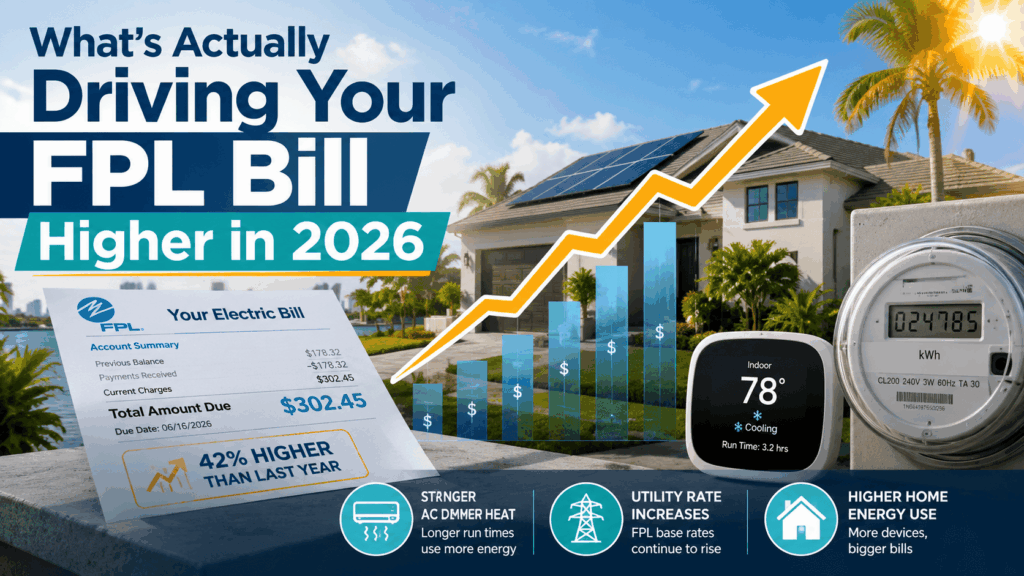
Your bill isn’t going up for one single reason. It’s a stack of separate charges, each rising at once. Here’s the breakdown.
- Base Rate Increases Approved by the Florida PSC
The single biggest driver is FPL’s base rate, which is the portion that covers the cost of building and maintaining power plants, poles, wires, and substations plus FPL’s profit margin. The Florida Public Service Commission (PSC) approved a multi-year base rate settlement that phases in increases through the mid-2020s, and 2026 sits squarely inside that phase-in period. Unlike a one-time hike, these are pre-scheduled step increases, meaning your bill is programmed to rise again even if nothing else changes.
FPL argues the increases fund grid modernization and rapid population growth. Consumer advocates argue the return on equity baked into the rate structure is more generous than what regulators approve in most other states a point worth understanding before you assume the increase is purely about infrastructure.
- Fuel and Purchased Power Costs
Even though FPL relies heavily on natural gas, the fuel charge line item on your bill still moves with global energy markets. When natural gas prices spike due to winter demand, LNG export demand, or geopolitical supply shocks FPL passes that cost directly to customers through the fuel adjustment clause. This is a pass-through cost with no profit margin for FPL, but it still shows up as a bigger number on your bill.
- Storm Restoration and Grid-Hardening Surcharges
Florida’s hurricane exposure means FPL routinely recovers storm restoration costs through surcharges approved after major storm seasons. Grid-hardening investments burying lines, replacing wooden poles with concrete, upgrading substations are marketed as resilience spending, but they’re recovered from ratepayers over time. If Florida experienced named storms or significant tropical activity in the prior season, expect a storm-related line item on your 2026 bill.
- Record Heat and Rising Air Conditioning Usage
This is the piece most articles skip. Florida has experienced some of its hottest summers on record, and NOAA data consistently shows Florida among the fastest-warming states for average summer temperatures. Air conditioning already accounts for roughly half of a typical Florida home’s electricity use. Every additional degree of sustained heat means your AC runs longer, more often, and less efficiently especially if your unit is more than 10 years old. Higher rates combined with higher usage compound into the bill shock many households are reporting.
- Florida’s Explosive Population and Data Center Growth
Florida added hundreds of thousands of new residents over the past several years, and utility infrastructure has to expand to serve them. Less discussed is the rise of data centers and large commercial loads connecting to Florida’s grid, which increases overall system demand and can influence how aggressively utilities pursue capital spending spending that eventually flows back to residential customers through base rates.
How FPL Compares: Florida and National Context
It’s easy to feel like FPL is uniquely expensive, but the full picture is more nuanced.
- FPL has historically marketed itself as having bills below the national average on a monthly basis, largely because Florida homes use more electricity (AC-heavy climate) but pay a lower rate per kilowatt-hour than many other states.
- However, other Florida utilities including Duke Energy Florida and Tampa Electric (TECO) have also filed for and received rate increases in the same period, suggesting this is a statewide trend, not an FPL-only problem.
- According to the U.S. Energy Information Administration, average U.S. residential electricity prices have risen nationwide, driven by grid investment, extreme weather adaptation, and natural gas price volatility Florida isn’t isolated from these forces, even though its rate structure has unique features.
Rate (¢ per kWh)
Average monthly bill ($)
The Legislative Pushback: The Affordable Energy Reform Act
Floridians are not taking these historic hikes lying down. Recognizing the severe affordability crisis, state lawmakers have begun pushing for structural changes.
In early 2026, Senator Carlos Guillermo Smith introduced the Affordable Energy Reform Act (SB1532), heavily endorsed by organizations like Food & Water Watch and The CLEO Institute.
This landmark legislation aims to fundamentally restructure how utilities operate in Florida by:
- Capping Excessive Profits: Lowering the maximum allowable return on equity to prevent utilities from price-gouging working families.
- Holding Utilities Accountable for Fuel Costs: Requiring electric utilities to assume partial financial responsibility for natural gas cost fluctuations, rather than passing 100% of the risk to ratepayers.
- Increasing Transparency: Giving the public a stronger, clearer voice in the rate-setting decisions made by the Florida Public Service Commission.
While the legislative battle is ongoing, tracking the progress of the Affordable Energy Reform Act is vital for any consumer hoping for long-term statewide relief [External Link: Read the full text of the Affordable Energy Reform Act here].
How to Read Your FPL Bill Like an Expert
Before you can lower your bill, you need to know what you’re actually paying for. Your FPL bill typically breaks into:
- Customer charge — a flat fee for being connected to the grid, regardless of usage.
- Base rate charge — covers infrastructure and FPL’s approved profit margin; scales with kWh used.
- Fuel charge — a pass-through cost tied to natural gas and purchased power prices.
- Storm restoration/grid-hardening surcharge — recovers hurricane and resilience-related capital costs.
- Taxes and franchise fees — set by local government, not FPL.
Log into your FPL account and look at the itemized PDF bill rather than the summary — this is where the real story lives.
FPL Bill Line-Item Breakdown — 2026
Estimated cost components for a typical 1,000 kWh residential Florida Power & Light bill.
Per-kWh Rate Ranges
Cents per kWh, low–high estimate by component
Estimated Cost Share
Based on midpoint rates, 1,000 kWh bill
3 Actionable Strategies to Lower Your FPL Bill Right Now
While waiting for legislative reform is important, it won’t pay next month’s utility bill. If you want to know how to lower your FPL bill in Florida today, you must take proactive steps to reduce your reliance on the grid. Here are three proven methods.
1. Lock in Your Rates with Residential Solar Panels
The single most effective way to insulate yourself from future FPL rate hikes in 2026 and beyond is to generate your own electricity. By installing residential solar panels, you essentially replace a fluctuating, ever-increasing utility bill with a fixed, predictable solar payment.
If FPL rates climb to 15¢ per kWh or higher by the end of the decade, a homeowner with solar energy remains locked in at the much lower rate they secured when purchasing their system. Furthermore, solar energy is immune to global natural gas market spikes and utility “fuel surcharges”.
2. Capitalize on Florida Residential Solar Net Metering
Florida currently boasts excellent net metering laws. Net metering is a billing mechanism that credits solar energy system owners for the electricity they add to the grid.
During peak sunlight hours, your solar panels will likely produce more energy than your home can consume. That excess energy is sent back to the FPL grid, and the utility is required to credit your account for it. These credits can drastically offset any remaining fees on your statement, sometimes reducing your overall FPL bill to just the minimal basic connection charge.
3. Implement Deep Home Energy Efficiency Upgrades
If solar isn’t an option for your property right now, minimizing your energy consumption is your best defense against the 2026 FPL base rate increase. Consider the following high-impact home upgrades:
- HVAC Optimization: In Florida, air conditioning accounts for over 50% of an average home’s energy usage. Schedule biannual HVAC maintenance, change air filters every 30 days, and consider upgrading to a high-efficiency variable-speed unit.
- Seal the Envelope: Keep the Florida heat out and the expensive conditioned air in. Invest in professional weatherstripping, seal gaps around doors and windows, and upgrade your attic insulation to at least an R-38 rating.
- Smart Thermostats: Install a Wi-Fi-enabled smart thermostat that automatically adjusts temperatures when you are asleep or away from the house, saving you hundreds of dollars a year without sacrificing comfort.
Taking Back Your Power in 2026
The reality is harsh but clear: the days of the predictable, low-cost $100 FPL power bill in Florida are likely gone forever. Driven by the historic $7 billion base rate hike, massive utility profit margins, the strain of tech data centers, and relentless storm recovery charges, Florida electricity bills in 2026 have reached a painful new peak.
However, you are not powerless. By understanding exactly how the Florida Public Service Commission and FPL structure these rates, you can adapt. Whether it is by supporting consumer advocacy legislation like the Affordable Energy Reform Act, drastically improving your home’s energy efficiency, or making the leap to residential solar power, you have the tools to fight energy inflation and protect your household budget.
Next Step
Are you tired of unpredictable, skyrocketing utility bills? Stop renting your power and start owning it. [Contact us today for a free, no-obligation solar consultation] to see exactly how much money you can save by locking in your energy rates in 2026!
This video from WPBF 25 provides a news breakdown of the recently approved rate increases for Florida Power & Light customers starting in 2026.