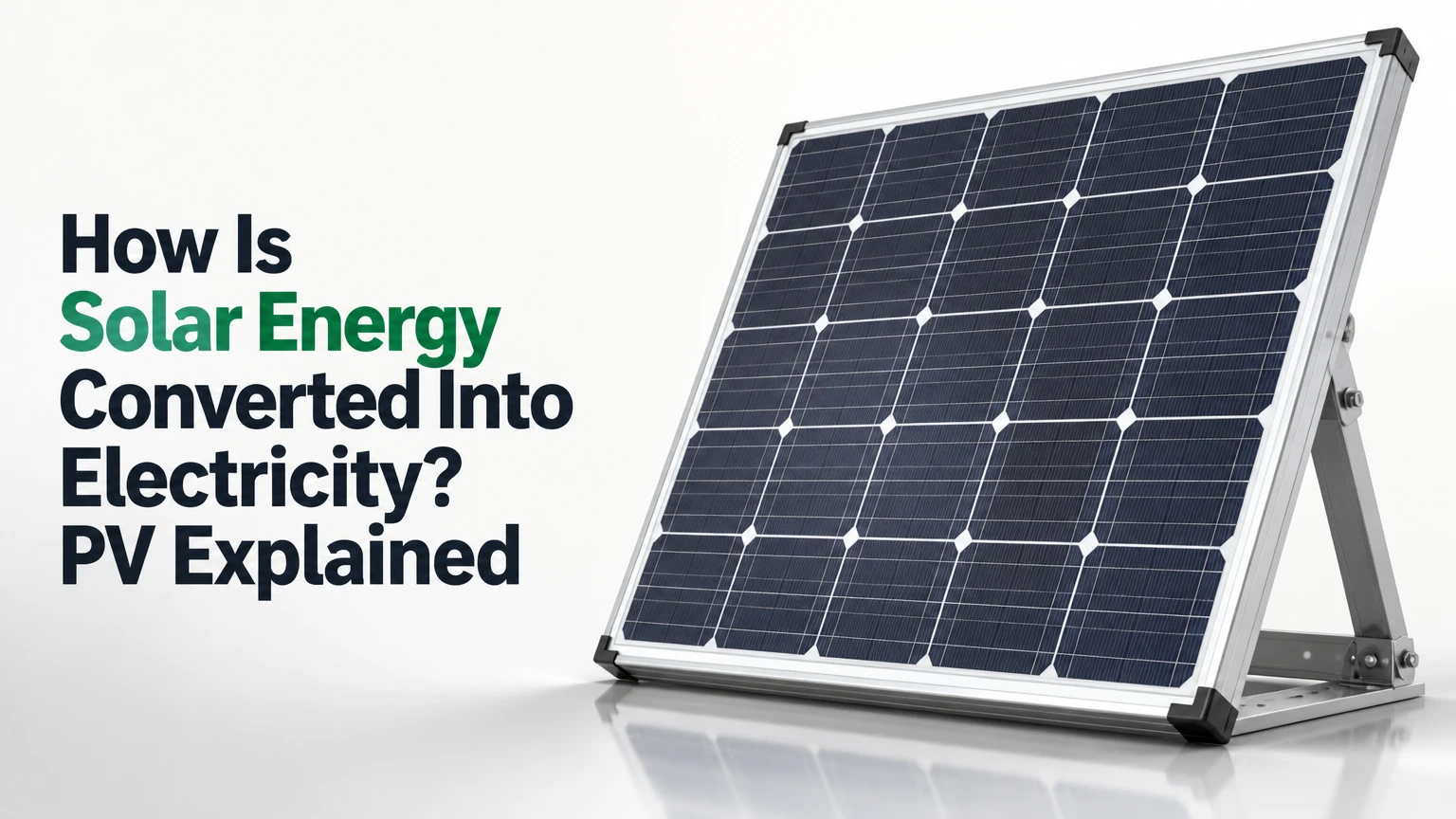
Solar energy is converted into electricity mainly through the photovoltaic effect, in which semiconductor solar cells absorb photons and release charge carriers. An internal electric field separates those carriers, metal contacts collect them as direct current (DC), and an inverter changes the DC into alternating current (AC) for appliances, batteries, or the utility grid.
Key Facts at a Glance
A photovoltaic cell converts light directly into DC electricity without an intermediate turbine.
Silicon solar cells use a p-n junction to separate electrons and holes created by absorbed photons.
A solar inverter converts panel DC into grid-compatible AC and controls important safety functions.
Concentrated solar power converts sunlight into heat first, then uses a thermal engine and generator.
Panel efficiency is measured under Standard Test Conditions of 1,000 W/m² irradiance and 25°C cell temperature.
A home solar array can produce electricity during a blackout only when paired with correctly configured backup equipment.
What Does Solar Energy Conversion Mean?
Solar energy conversion means transforming sunlight’s electromagnetic radiation into electrical energy that a load can use. Photovoltaic systems perform that conversion directly in semiconductor cells, while concentrated solar power systems perform it indirectly by creating heat that drives a generator.
The word “solar” describes the energy source, not one specific machine. A rooftop PV array, a solar calculator, and a utility-scale parabolic trough plant all use sunlight, but their conversion pathways differ substantially.
| Conversion pathway | First energy form | Generator mechanism | Typical application |
|---|---|---|---|
| Photovoltaic, PV | Light to DC electricity | Semiconductor charge separation | Rooftops, satellites, solar farms |
| Concentrated solar power, CSP | Light to thermal energy | Steam turbine or heat engine | Large, high-sun utility plants |
| Solar thermal | Light to heat | Usually no electricity generator | Water heating, space heating |
| Solar fuels | Light to chemical energy | Electrochemical or catalytic process | Hydrogen and fuel research |
The U.S. Department of Energy describes photovoltaic cells as devices that convert sunlight directly into electricity. That direct pathway explains why PV panels have no combustion chamber, steam cycle, or moving generator at the panel level.
How Is Solar Energy Converted Into Electricity?
Solar energy becomes electricity in five linked stages: photons enter a semiconductor, electron-hole pairs form, the p-n junction separates charge, metal contacts collect current, and power electronics deliver usable electricity. The solar cell creates DC power; the inverter and electrical system determine how that power reaches equipment.
How Does the Photovoltaic Effect Create Electricity?
The photovoltaic effect creates electricity when absorbed photons give semiconductor electrons enough energy to move from a bound state into a mobile conduction state. The solar cell’s internal electric field then directs electrons and holes toward opposite contacts, creating voltage and allowing current through an external circuit.
A photon carries energy according to its frequency. Silicon absorbs photons with energy above its band gap, approximately 1.12 electronvolts at room temperature. Photons with insufficient energy pass through or are not absorbed, while excess photon energy becomes heat rather than additional electrical voltage.
The result is not an electron stream flowing straight from the Sun to a house. The sunlight changes the electrical condition of the silicon, and the circuit’s electric field drives charge through the external conductors.
What Happens Inside a Solar Cell?
A crystalline silicon cell generally contains a light-facing n-type region, a p-type region, an active junction, front metal contacts, a rear contact, and protective optical layers. Doping introduces controlled impurities that alter the number of mobile electrons or holes within the silicon lattice.
| Cell component | Physical function | Electrical consequence | Typical material |
|---|---|---|---|
| Anti-reflective coating | Reduces reflected light | More photons enter silicon | Silicon nitride |
| N-type layer | Provides electron-rich region | Directs electrons toward front contact | Phosphorus-doped silicon |
| P-type layer | Provides hole-rich region | Directs holes toward rear contact | Boron-doped silicon |
| Depletion region | Contains the built-in electric field | Separates photogenerated carriers | P-n junction |
| Metal contacts | Collect separated carriers | Transfers DC into circuit | Silver, aluminum, copper |
When a photon is absorbed, it can create an electron-hole pair. The electron is a mobile negative carrier, while the hole represents a missing electron and behaves as a positive carrier. If the pair recombines before collection, its energy becomes heat and the cell produces no useful current from that pair.
How Does a P-N Junction Separate Charge?
A p-n junction separates charge through a built-in electric field in the depletion region. The field pushes electrons toward the n-type side and holes toward the p-type side, reducing recombination and establishing the voltage that drives current through an external circuit.
A useful precision matters here: the junction does not “manufacture” electrons. Light supplies the energy that creates mobile carriers, while the junction separates them. The external circuit provides the path through which electrons travel from the negative contact through a load and back to the positive contact.
Solar cell voltage depends strongly on material properties and temperature. Current depends more directly on the number of absorbed photons, so bright sunlight generally raises current, whereas heat usually lowers silicon cell voltage.
How Does a Panel Produce Usable DC Current?
A solar panel connects many cells in series and sometimes combines multiple cell strings in parallel. Series connections raise voltage, parallel connections raise current, and the resulting direct-current output changes continuously with sunlight, temperature, shading, and electrical load.
A module’s power is calculated as:
Power in watts = voltage in volts × current in amperes
For example, a module operating at 40 V and 12 A produces approximately 480 W at that operating point. The inverter uses maximum power point tracking, or MPPT, to adjust electrical loading so the array operates near its highest available power.
| Electrical stage | Example value | Main variable | Practical effect |
|---|---|---|---|
| One module voltage | 40 V DC | Cell temperature | Voltage falls as cells heat |
| One module current | 12 A DC | Irradiance | Current falls in shade and clouds |
| Module output | 480 W DC | Voltage × current | Peak rating under test conditions |
| Ten-module string | 400 V DC | Series voltage | Must remain within inverter limits |
| Two parallel strings | 24 A DC | Parallel current | Requires correct conductor and fuse sizing |
Panel ratings are laboratory reference values, not guaranteed hourly production. A 480 W module will produce less power during low sun, high temperature, snow cover, or partial shading.
How Does Solar DC Become Household AC?
A solar inverter converts variable DC from the array into synchronized AC by switching semiconductor devices at high frequency, filtering the waveform, and matching the utility’s voltage and frequency. The inverter also monitors grid conditions and disconnects during an outage unless a permitted backup circuit is operating.
In a grid-connected home, the inverter performs four jobs: DC-to-AC conversion, maximum power point tracking, electrical protection, and communications or monitoring. Modern inverters commonly achieve peak conversion efficiencies around 97-99%, although whole-system output is lower after wiring, temperature, mismatch, and conversion losses.
| Inverter architecture | Typical efficiency | Strong use case | Main limitation |
|---|---|---|---|
| String inverter | 97-99% peak | Unshaded roof with uniform orientation | One shaded string can reduce output |
| Microinverter | 95-98% peak | Complex roof or panel-level shade | More rooftop electronics |
| DC optimizer plus string inverter | 97-99% combined peak | Mixed orientations and moderate shade | More components and design cost |
| Hybrid inverter | 95-98% conversion range | Solar plus battery backup | Battery and backup controls add cost |
| Central inverter | 98-99% peak at utility scale | Large solar farms | High consequence of central failure |
An inverter is not the same as a transformer. An inverter changes DC into AC, while a transformer changes AC voltage. Some solar systems use both functions, especially when electricity must move from a low-voltage inverter output to a higher-voltage distribution network.
Where Does Solar Electricity Go?
Solar electricity first serves active electrical loads, then charges a battery or flows to the grid according to system controls, tariffs, and local interconnection rules. A home does not need to route each solar electron to a particular appliance because the electrical panel balances generation and demand continuously.
If a house is consuming 3 kW while the array produces 5 kW, approximately 3 kW serves local loads and the remaining 2 kW may charge a battery or export through the meter. If consumption rises to 7 kW, the array supplies 5 kW and the grid or battery supplies the remaining 2 kW.
| Operating condition | Solar output | Home load | Likely power flow |
|---|---|---|---|
| Sunny morning | 2 kW | 4 kW | 2 kW solar, 2 kW grid |
| Bright midday | 6 kW | 2 kW | 2 kW loads, 4 kW export or storage |
| Cloudy afternoon | 1 kW | 3 kW | 1 kW solar, 2 kW grid |
| Evening | 0 kW | 3 kW | 3 kW battery or grid |
| Outage with no backup | 4 kW available | 2 kW requested | Inverter shuts down |
| Outage with islanded backup | 4 kW available | 2 kW protected load | Microgrid supplies selected circuits |
Grid-tied inverters use anti-islanding protection. That safety function prevents a rooftop system from energizing utility lines while workers repair an outage.
Can Solar Panels Work Without the Grid?
Solar panels can work without the utility grid when a battery, suitable inverter, and controlled electrical island provide voltage and frequency reference. Ordinary grid-tied panels shut down during outages because their inverters require a stable grid and must satisfy anti-islanding rules.
An off-grid system must balance generation, storage, and demand across hours or days. Designers usually calculate daily energy in kilowatt-hours, peak power in kilowatts, battery usable capacity, inverter surge capacity, and backup generation for extended cloudy periods.
A battery rated at 10 kWh may provide less than 10 kWh to loads because depth-of-discharge limits and inverter losses reduce usable energy. Large motors, heat pumps, and well pumps can also require several times their running power during startup.
Solar panels alone are therefore unsuitable for guaranteed nighttime power or long periods of poor weather. A hybrid inverter can coordinate PV, batteries, a generator, and the grid, but the system requires professional electrical design and local code compliance.
Which Solar Cell Technologies Are Used?
Monocrystalline silicon dominates many modern rooftops because it offers high power density, while thin-film cells serve weight-sensitive or specialized installations. Polycrystalline silicon remains technically functional but has lost market share as monocrystalline manufacturing costs and efficiency improved.
| Technology | Typical module efficiency | Physical characteristic | Best-fit application |
|---|---|---|---|
| Monocrystalline silicon | 19-23% typical | Uniform dark appearance | Space-limited rooftops |
| Polycrystalline silicon | 15-19% typical | Blue, visibly textured cells | Older or cost-sensitive systems |
| CdTe thin film | 17-19% typical | Thin deposited semiconductor layer | Utility-scale solar fields |
| CIGS thin film | 12-18% typical | Lightweight flexible substrate possible | Specialized surfaces |
| Tandem research cells | Above 30% laboratory range | Multiple light-absorbing layers | Emerging high-efficiency designs |
Efficiency ranges vary by product generation and test method. Thin film can perform well in hot conditions or diffuse light, but lower power density can require more area and supporting structure.
Monocrystalline and polycrystalline cells both use silicon, not different electricity principles. Their manufacturing crystal structures affect cost, appearance, area requirements, and efficiency.
How Does Concentrated Solar Power Generate Electricity?
Concentrated solar power uses mirrors or lenses to focus direct sunlight onto a receiver, where a fluid becomes hot enough to produce steam or drive a heat engine. The thermal system then turns a turbine or generator, so CSP converts light to electricity indirectly.
CSP requires strong direct normal irradiance and large tracking structures. It performs poorly in locations with frequent cloud cover because diffuse sunlight cannot be focused efficiently.
| CSP design | Heat-transfer medium | Generation equipment | Storage characteristic |
|---|---|---|---|
| Parabolic trough | Synthetic oil or molten salt | Steam turbine | Thermal storage possible |
| Solar power tower | Molten salt or air | Steam turbine | High-temperature storage possible |
| Linear Fresnel | Water or thermal fluid | Steam turbine | Lower optical complexity |
| Dish engine | Heated gas | Stirling engine | Usually smaller modular units |
PV generally fits rooftops and distributed generation better because it has no thermal cycle and scales from watts to gigawatts. CSP can provide dispatchable evening generation with thermal storage, but its land, water, direct-sunlight, and capital requirements limit suitable locations.
How Much Sunlight Becomes Electricity?
A modern silicon module typically converts about 19-23% of incident sunlight into DC electricity under Standard Test Conditions, while complete systems deliver less after heat, wiring, inverter, mismatch, soiling, and shading losses. STC uses 1,000 W/m² irradiance, a 25°C cell temperature, and an air-mass spectrum of 1.5.
A 20% efficient 1 m² module receiving 1,000 W of sunlight produces about 200 W under those test conditions. The same module may produce less at a hot midday roof temperature because crystalline silicon power commonly falls by roughly 0.3-0.4% for each 1°C above the rated cell temperature, depending on the module datasheet.
| Loss factor | Typical planning effect | Primary cause | Mitigation |
|---|---|---|---|
| Temperature | 5-15% seasonal loss in hot periods | Cell temperature above 25°C | Ventilated mounting, suitable design |
| Inverter conversion | 1-3% | Switching and thermal losses | Correct inverter loading |
| Wiring | 1-3% | Conductor resistance | Correct conductor sizing |
| Soiling | 1-5% typical, higher in dust | Dirt, pollen, bird deposits | Inspection and cleaning |
| Shading and mismatch | 0-30% or more locally | Trees, chimneys, uneven modules | Shade analysis, optimizers |
| Availability | 0.5-2% | Faults and maintenance | Monitoring and service |
The National Renewable Energy Laboratory’s PVWatts model accounts for system losses such as soiling, wiring, mismatch, availability, and inverter losses rather than treating panel nameplate power as annual production. That distinction prevents a common sizing error: multiplying array kilowatts by every hour in a year.
Panel degradation is also gradual rather than an immediate failure. A planning assumption near 0.3-0.5% of output per year is common, but the manufacturer’s warranty and technology-specific degradation data should control the financial model.
How Much Does a Solar Electricity System Cost?
A typical U.S. residential rooftop system may cost approximately $2.80-$3.20 per watt before incentives, producing a gross price of $16,800-$32,000 for a 6-10 kW installation. Local labor, permitting, roof complexity, electrical upgrades, financing, battery capacity, and incentive rules can move the final figure substantially.
A simple example illustrates the arithmetic. A 10 kW system priced at $2.90 per watt costs $29,000 before incentives. If annual bill savings equal $2,000, a $20,300 net cost after a hypothetical 30% incentive would imply a simple payback of about 10.2 years.
| System element | Typical residential range | Cost driver | Timing implication |
|---|---|---|---|
| PV array | 6-10 kW | Annual electricity use and roof area | Design stage |
| Battery | 10-20 kWh nominal | Backup circuits and outage duration | Adds equipment and commissioning |
| Installation | 1-3 days onsite | Roof, wiring, crew access | After approvals |
| Permitting and utility review | 3-8 weeks typical | Local authority and utility workload | Often longest phase |
| Inspection and permission to operate | 1-4 weeks typical | Utility scheduling | Required before export |
Tax credits and export compensation are jurisdiction-specific. The U.S. Department of Energy recommends checking current federal, state, local, and utility incentives rather than assuming a national program applies to every project.
Why Does Solar Output Fall?
Solar output falls when irradiance decreases, module temperature rises, shade covers cells, surfaces become dirty, or electrical equipment limits power. A sudden drop points more strongly to a tripped breaker, inverter fault, communication failure, wiring problem, or new obstruction than to normal panel aging.
Practitioners should compare the system’s current production with the same month, weather conditions, and time of day rather than relying on one low reading. Cloud cover can reduce irradiance dramatically, while partial shade can affect a whole series string when bypass diodes activate.
Common diagnostic sequence:
- Check the monitoring portal for a system-wide or single-module pattern.
- Confirm the inverter display, solar disconnect, and main breaker status.
- Inspect panels visually from ground level for leaves, snow, heavy dust, or new shade.
- Compare voltage and current readings with the installer’s expected operating range.
- Stop and call a qualified electrician for ground-fault, arc-fault, insulation, or water-ingress warnings.
Do not open energized DC equipment. Solar strings can remain at hazardous voltage whenever light reaches the modules, even when the grid supply is disconnected.
What Are the Main Solar System Design Mistakes?
The most expensive design mistake is sizing from panel wattage alone instead of modeling annual load, roof orientation, temperature, shade, inverter limits, and utility compensation. A system can have a large nameplate array yet deliver poor financial results if export credits are low or afternoon shade is severe.
| Design mistake | Observable consequence | Better practice | Typical remedy |
|---|---|---|---|
| Ignoring future shade | Annual yield declines | Model trees and obstructions | Trim, redesign, or relocate |
| Oversized DC array | Inverter clipping | Check DC-to-AC ratio | Accept planned clipping or resize |
| Roof near replacement | Removal cost later | Inspect roof first | Replace roof before PV |
| No outage design | Panels shut off in blackout | Specify protected loads | Add hybrid inverter and battery |
| Undersized conductors | Voltage drop and heating | Follow code calculations | Rewire with approved conductors |
| Flat mounting without drainage | Dirt and water retention | Follow racking limits | Correct tilt and drainage |
One counterintuitive rule matters: adding a battery does not automatically increase solar generation. Storage changes when electricity is used and can provide backup, but round-trip losses commonly reduce the energy returned to loads.
Another practitioner rule is to reserve inverter capacity for the actual operating environment. A rooftop array may reach nameplate power only under laboratory conditions, but excessive DC oversizing can still cause clipping during high-irradiance hours.
What Is the Difference Between Solar PV and Other Generation?
Solar PV differs from combustion, wind, hydroelectric, and CSP because PV has no rotating prime mover at the point of conversion. The semiconductor produces DC directly, while an inverter supplies the AC waveform and grid controls needed by conventional loads.
| Generation method | Primary input | Conversion mechanism | Dispatch characteristic |
|---|---|---|---|
| Solar PV | Sunlight | Semiconductor to DC, inverter to AC | Variable by sunlight |
| CSP | Direct sunlight | Heat, steam turbine, generator | Dispatchable with thermal storage |
| Wind | Moving air | Rotor, gearbox or direct drive, generator | Variable by wind |
| Natural gas | Chemical fuel | Combustion turbine or engine | Dispatchable on fuel supply |
| Hydroelectric | Stored or flowing water | Turbine and generator | Dispatchable within water limits |
PV is advantageous where modular installation, low operating noise, and distributed generation matter. PV is not a complete replacement for firm capacity in every grid because nighttime production is zero and output can change quickly with weather.
Frequently Asked Questions
Do solar panels produce electricity on cloudy days?
Yes, photovoltaic panels produce electricity on cloudy days because clouds block or scatter part of the sunlight rather than eliminating all irradiance. Output may fall substantially, depending on cloud thickness, solar angle, panel technology, and system temperature. A monitoring system should compare actual output with weather-adjusted expectations.
Why do solar panels produce DC instead of AC?
Solar cells produce DC because the photovoltaic effect creates a directional flow of charge between separated semiconductor contacts. Household circuits and utility grids generally use AC, so an inverter electronically switches and filters the DC into a synchronized alternating waveform before distribution.
Does a solar panel generate electricity from heat?
A conventional photovoltaic panel generates electricity primarily from photons, not from heat. Excess heat usually reduces crystalline silicon voltage and power. Solar thermal and concentrated solar power technologies use heat as an intentional intermediate energy form, but they are different from rooftop PV.
How long does a solar panel take to pay for itself?
A residential solar system often has a simple payback period of roughly 7-12 years, but the result depends on installed cost, incentives, electricity rates, annual production, financing, maintenance, and export compensation. A payback calculation should use modeled annual kWh and current tariff rules, not panel wattage alone.
Can solar panels charge an electric vehicle?
Solar panels can charge an electric vehicle through a home charger when the inverter, electrical service, and charger are correctly sized. Direct solar charging varies with weather and vehicle demand, so grid-connected charging or a battery may supply energy when PV output is below the vehicle’s charging requirement.
What happens to solar panels at night?
Solar panels produce no meaningful electricity at night because they receive insufficient photons. A grid-connected property then imports electricity from the utility, while a battery-backed property can use stored energy until its state of charge reaches the configured reserve.
The Bottom Line
Solar energy is converted into electricity mainly when photovoltaic semiconductor cells absorb sunlight, create electron-hole pairs, separate those charges through a p-n junction, and collect the resulting DC current. An inverter converts that DC into AC for appliances, batteries, or the grid. Concentrated solar power follows a different thermal route, using focused sunlight to produce heat, steam, and generator output.
The most accurate answer to how is solar energy converted into electricity therefore includes both the cell-level physics and the system-level equipment. Panel efficiency, temperature, shade, inverter behavior, storage controls, and local grid rules determine how much of the Sun’s incoming energy becomes useful electricity.