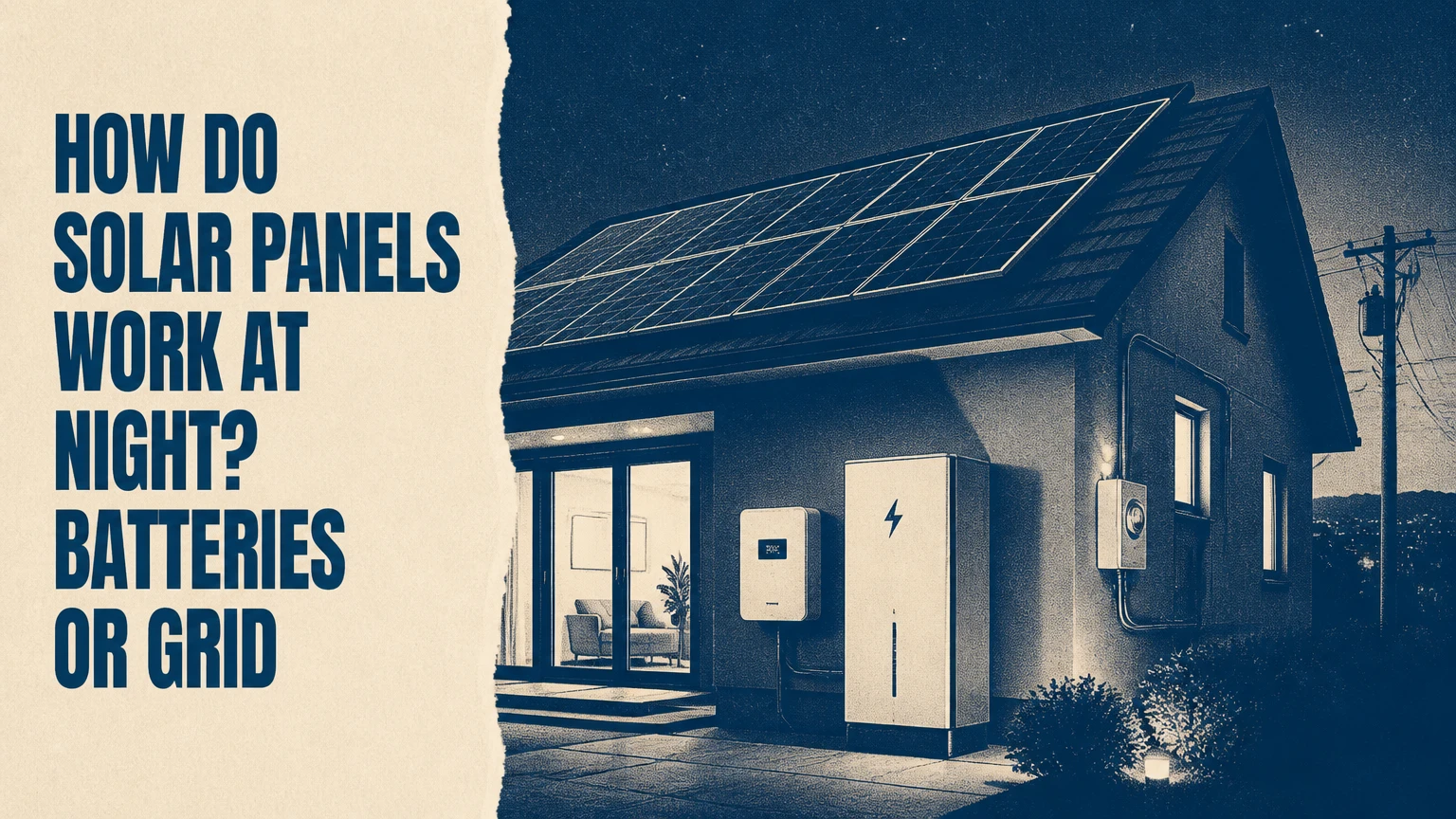
Solar panels do not generate useful electricity at night because photovoltaic cells need incoming sunlight to produce current. A home can still use solar energy after sunset when daytime electricity is stored in a battery, or when daytime exports earn utility credits that offset nighttime grid consumption.
What Happens to Solar Panels After Sunset?
Solar panels produce little to no usable power after sunset, while the rest of the electrical system either draws from the grid or uses stored energy. The panels remain connected and physically intact, but their photovoltaic output falls below the inverter’s operating threshold as irradiance disappears.
Why does the photovoltaic effect stop?
Crystalline-silicon solar cells convert photon energy into electrical current. Photons with enough energy create mobile charge carriers in the semiconductor, and the cell’s electric field directs those carriers through an external circuit. Without sufficient incoming photons, current falls sharply.
Moonlight is reflected sunlight, so it contains the same general wavelengths but vastly lower irradiance. Starlight is weaker still. A panel may register a tiny electrical signal under a bright full moon, but that signal is far below the power needed for a household inverter or appliance.
The silicon band gap is approximately 1.1 electron volts, but band-gap energy alone does not determine useful nighttime production. Photon quantity, panel temperature, electrical losses, and inverter startup requirements determine whether the system can deliver practical power. In ordinary darkness, the answer is effectively zero watts.
Does a panel produce any electricity from moonlight?
A solar panel can respond to moonlight in laboratory-sensitive conditions, but moonlight does not provide meaningful residential electricity. A full moon illuminates the ground at roughly a fraction of a watt per square meter, whereas strong midday sunlight can approach 1,000 watts per square meter under standard test conditions.
That contrast is several thousand-fold before conversion losses. A rooftop array rated at 8 kilowatts therefore cannot run a refrigerator, heat pump, or lighting circuit from moonlight. The array’s nighttime role is to wait for morning irradiance while another source supplies the home.
How Do Solar Panels Work at Night in a Complete System?
A solar energy system works at night by changing energy sources, not by making the panels generate electricity. A grid-tied inverter imports alternating current from the utility, while a hybrid inverter can discharge a battery and coordinate grid support, reserve capacity, and household loads.
What happens during the transition at sunset?
Solar output declines continuously as the sun’s angle lowers, rather than switching off at one universal clock time. Panel voltage and current fall with irradiance, and the inverter eventually stops maximum-power-point tracking when the array can no longer meet its startup or operating requirements.
The typical sequence is:
- Solar generation falls as irradiance decreases.
- Household loads consume the remaining photovoltaic output.
- The grid supplies any shortfall, or the battery begins discharging.
- The inverter stops PV conversion when array conditions fall too low.
- Monitoring software records production near zero and records imports or battery discharge.
A hybrid system does not usually need a person to operate a mechanical transfer switch at sunset. Its energy-management controls make the source decision electronically. Exact behavior depends on the inverter, battery state of charge, tariff settings, and whether the utility grid is available.
What does the inverter do at night?
The inverter stops converting panel DC when the array cannot provide usable input, but it may remain energized to monitor the grid, communicate with the battery, and maintain backup controls. A hybrid inverter can also convert battery DC into household AC after dark.
Nighttime standby consumption varies by model and operating mode. A typical system may use approximately 5-50 watts continuously, although gateway devices, communications hardware, and backup panels can change the total. Over 12 hours, a constant 25-watt standby load consumes 0.3 kilowatt-hours.
| Electrical stage | Daytime condition | Nighttime condition | Typical energy direction |
|---|---|---|---|
| Solar array | 4-8 kW residential rating | 0-10 W practical output | Sun to DC bus |
| MPPT controller | Tracks maximum power | Stops or enters standby | DC optimization |
| Battery | Charges at 1-5 kW | Discharges at 0.1-5 kW | DC storage to inverter |
| Inverter | Converts DC to 120/240 V AC | Converts battery DC or imports grid AC | DC to AC or grid to loads |
| Utility meter | Export or import | Usually import | Grid to home |
| Home loads | 0.3-10 kW demand | 0.2-5 kW typical demand | AC consumption |
Can a Grid-Tied Solar System Power a Home at Night?
A standard grid-tied solar system can power a home at night through the utility grid, but the panels themselves are not supplying instantaneous nighttime electricity. Daytime exports may create billing credits under net metering, yet the physical nighttime electricity still travels from the utility network to the property.
How does net metering offset nighttime use?
Net metering measures electricity exported to and imported from the grid over a defined billing period. If a household exports 20 kilowatt-hours during daylight and later imports 20 kilowatt-hours at night, a 1:1 tariff may offset those quantities, subject to the utility’s rules, fixed charges, credit expiration, and settlement schedule.
Net metering is financial accounting, not a storage device. The grid does not hold the household’s specific electrons for later retrieval. The utility supplies power whenever the home needs it, and the bill applies the relevant export credit to later consumption. The U.S. Energy Information Administration identifies net metering as a policy arrangement whose compensation rules vary among states and utilities.
| Grid arrangement | Daytime export value | Nighttime import treatment | Blackout operation |
|---|---|---|---|
| 1:1 net metering | 1 kWh credit per 1 kWh | Credit offsets 1 kWh, tariff dependent | Grid-tied inverter shuts down |
| Avoided-cost credit | $0.02-$0.08/kWh typical utility range | Retail electricity may cost $0.15-$0.40/kWh | No backup without islanding equipment |
| Time-of-use tariff | Credit based on export period | Peak import may cost $0.25-$0.60/kWh | Grid outage disables standard system |
| No export arrangement | $0 credit or curtailed export | Full retail purchase after sunset | Requires battery for backup |
These price ranges are typical planning values, not universal tariffs. A local utility’s interconnection agreement controls the actual outcome.
Why does rooftop solar shut down during a blackout?
A conventional grid-tied inverter shuts down during a utility outage, even when sunlight is available, because it must prevent unintentional islanding. If rooftop equipment continued energizing a disconnected distribution line, utility workers could encounter an unexpected voltage source.
The IEEE 1547 interconnection standard establishes requirements for distributed energy resources connected to electric grids, including abnormal-voltage and abnormal-frequency behavior. A battery system provides outage power only when it includes approved islanding controls, a gateway or transfer device, and a designated backup circuit.
How Does a Battery Solar System Operate at Night?
A battery solar system stores surplus daytime electricity, then sends battery DC through an inverter to supply AC household loads after sunset. The battery does not create energy; it shifts available daytime generation to a later time, with approximately 5-15% of stored energy commonly lost across charging, storage, and discharge.
What is the nighttime energy path?
The physical nighttime path is:
Battery cells → battery management system → hybrid inverter → AC breaker panel → household loads
The battery management system monitors cell voltage, temperature, current, and state of charge. The inverter then converts direct current into synchronized alternating current, commonly 120/240 volts at 60 hertz in North America or 230 volts at 50 hertz in many other regions.
A battery’s nameplate capacity is not the same as its usable capacity. A 13.5 kWh battery might provide roughly 12 kWh within its permitted operating window, and inverter conversion losses reduce the energy reaching appliances further.
How long will a solar battery last overnight?
A solar battery’s runtime equals usable energy divided by average load, with additional allowance for inverter losses and reserve settings. A 10 kWh usable battery supplying a steady 0.8 kW average load provides approximately 10-12 hours under ideal arithmetic, but high-load cycling and reserve limits can shorten that result.
| Nighttime load | Energy used in 10 hours | Runtime from 10 kWh usable battery* | Example loads |
|---|---|---|---|
| 0.3 kW average | 3.0 kWh | 25-30 hours | Refrigerator, router, LED lights |
| 0.8 kW average | 8.0 kWh | 10-12 hours | Essential-loads panel, modest HVAC |
| 1.5 kW average | 15.0 kWh | 6-7 hours | Larger home with heat-pump cycling |
| 3.0 kW average | 30.0 kWh | 3-3.5 hours | Electric heating or heavy appliances |
*Runtime is a typical planning estimate after conversion losses, reserve capacity, and load variation. A 10 kWh battery cannot supply 30 kWh of nighttime demand.
An electric vehicle charger, resistance water heater, clothes dryer, or electric furnace can consume several kilowatts by itself. A 7.2 kW EV charger could theoretically exhaust a 10 kWh usable battery in close to one hour after accounting for inverter limits and reserve capacity.
Which Solar System Works Best After Dark?
Grid-tied solar is usually the lowest-cost choice for bill reduction where export credits are favorable. Hybrid solar with batteries is the stronger choice where outages, evening electricity prices, or limited net metering justify storage, while off-grid solar requires the largest battery and a backup generator for reliability.
| System type | Nighttime source | Typical battery size | Outage protection | Best-fit condition |
|---|---|---|---|---|
| Grid-tied | Utility grid | 0 kWh | None | Reliable grid and favorable export credits |
| Hybrid | Battery, then grid | 10-30 kWh | Selected or whole-home loads | Outages or expensive evening power |
| Off-grid | Battery and generator | 20-100+ kWh | Full property | No practical utility connection |
| Grid-tied plus AC battery | Battery, then grid | 5-20 kWh | Critical circuits or whole home | Existing solar array needs storage |
Is a battery better than net metering?
A battery is technically better for physical nighttime independence, but net metering can be financially better when the utility credits exported electricity near the retail rate. Battery value increases when export compensation is low, evening rates are high, or outages impose significant costs.
Battery storage also introduces equipment cost, capacity degradation, conversion losses, fire-code requirements, and eventual replacement. Net metering avoids those hardware burdens but cannot provide power during a normal grid outage unless the system has separate backup capability.
Which battery chemistry is suitable?
Lithium iron phosphate, or LFP, is the common residential choice because it combines strong cycle life with comparatively stable thermal behavior. Nickel manganese cobalt, or NMC, provides greater energy density but has different thermal-management and degradation characteristics. Lead-acid batteries cost less initially but tolerate fewer deep cycles and provide less usable energy at high discharge rates.
| Chemistry | Usable fraction, typical | Cycle-life range, typical | Main advantage | Main limitation |
|---|---|---|---|---|
| LFP | 80-95% | 4,000-8,000 cycles | Long life and thermal stability | Higher upfront cost and weight |
| NMC | 80-95% | 2,000-5,000 cycles | High energy density | More demanding thermal protection |
| AGM lead-acid | 40-60% | 500-1,200 cycles | Simple, established technology | Limited depth of discharge |
| Gel lead-acid | 40-60% | 600-1,500 cycles | Low maintenance | Sensitive to charging conditions |
Manufacturers commonly provide 10-year residential battery warranties with an end-of-warranty capacity guarantee, often around 70% of original capacity. Warranty language differs, so inspect throughput limits, cycle limits, operating temperature, and replacement terms rather than relying on the warranty duration alone.
How Much Battery Capacity Is Needed for Nighttime Use?
Battery capacity should be sized from measured nighttime consumption, not from the solar array’s panel rating. The practical calculation is: required battery capacity = overnight load in kWh ÷ allowable depth of discharge ÷ battery and inverter efficiency, plus a reserve margin.
For example, a household using 8 kWh between 7 p.m. and 7 a.m. with a 90% usable operating window, 90% round-trip-related delivery assumption, and 20% planning margin would need approximately:
8 ÷ 0.90 ÷ 0.90 × 1.20 = 11.8 kWh
A 13.5 kWh nominal battery could therefore be a reasonable match, provided its continuous output rating can run the loads and its backup gateway supports the intended circuits.
| Design input | Example value | Effect on battery choice |
|---|---|---|
| Overnight energy demand | 8 kWh | Sets the energy-capacity requirement |
| Peak simultaneous load | 4.5 kW | Sets inverter continuous-output requirement |
| Motor starting surge | 8 kW | Sets surge capability for pumps or compressors |
| Minimum reserve | 15% | Protects backup availability and battery limits |
| Winter autonomy target | 1 night | Smaller system than three-day off-grid design |
| Battery usable capacity | 12 kWh | Determines actual delivered energy |
The National Renewable Energy Laboratory’s storage research emphasizes that battery sizing depends on load shape, dispatch strategy, solar resource, and reliability objective, not capacity alone. An installer should model hourly demand and winter production when the system must cover heating, well pumps, or multiple cloudy days.
How many solar panels are needed to recharge a battery?
A battery’s recharge requirement depends on its daily energy use, local peak-sun-hours, system losses, and the array’s effective capacity. A rough planning equation is array size in kW = daily battery energy required ÷ peak-sun-hours ÷ system efficiency.
To replace 10 kWh with 4 peak-sun-hours and 80% total system efficiency, the array needs about 3.1 kW of effective PV capacity. Winter shading, snow, roof orientation, temperature, and household daytime consumption may require a larger array.
What Does Nighttime Solar Storage Cost?
A residential battery installation commonly costs about $8,000-$18,000 before incentives, while a complete rooftop solar array with installation often falls near $15,000-$35,000 before incentives in the United States. Local labor, electrical upgrades, permitting, battery capacity, and utility requirements can move these ranges substantially.
| Project component | Typical installed range | Primary cost driver | Typical service period |
|---|---|---|---|
| 5 kWh battery | $5,000-$10,000 | Gateway and labor minimums | 10 years warranty target |
| 10-15 kWh battery | $8,000-$18,000 | Capacity and backup hardware | 10-15 years practical life |
| Critical-loads panel | $1,500-$4,000 | Circuit relocation and wiring | 15-30 years equipment life |
| Whole-home backup upgrade | $3,000-$8,000 | Transfer equipment and panel work | 10-20 years controls life |
| 8-12 kW solar array | $15,000-$35,000 | Roof, labor, permits, equipment | 25-35 years panel warranty range |
These are typical U.S. planning ranges, not quotes. The U.S. Department of Energy notes that storage value can come from bill management, resilience, and grid services, so a battery’s financial case should include the value of avoided outage losses rather than energy arbitrage alone.
Why Does a Solar Battery Drain Quickly at Night?
A solar battery drains quickly when nighttime consumption exceeds the design assumption, when the battery is undersized, or when hidden loads run continuously. Heat pumps, electric water heaters, pool equipment, well pumps, refrigerators, networking equipment, and inverter standby consumption can together produce a much larger overnight demand than a monthly bill reveals.
Use the monitoring application to identify:
- Average overnight kilowatt draw
- Largest 15-minute demand interval
- Battery state of charge at sunset and sunrise
- Grid imports while the battery is available
- Reserve percentage and backup-only settings
- HVAC, water-heating, and EV charging schedules
A counterintuitive field rule is that a battery can be full yet still refuse to discharge. Backup-only mode, minimum state-of-charge settings, tariff controls, low temperature, or a communications fault can reserve energy for an outage instead of serving routine loads.
How can homeowners reduce nighttime battery use?
Move flexible consumption into the solar window, usually late morning through mid-afternoon, when local production is highest. Schedule water heating, dishwashers, laundry, pool pumps, and EV charging after checking the inverter’s output limit and the utility’s time-of-use periods.
Do not move every load automatically. Running a large appliance during a low-production winter morning can increase grid imports, and exporting energy may be more valuable than self-consuming it under some tariffs.
What Should You Check When Solar Stops Working at Night?
A solar system that shows zero panel production after sunset is usually operating normally. A homeowner should investigate only when the system remains abnormal after sunrise, the battery will not discharge under its configured mode, or monitoring shows unexplained imports and fault codes.
| Symptom | Likely cause | Immediate check | Corrective action |
|---|---|---|---|
| Zero PV at 10 p.m. | Normal darkness | Check time and irradiance | No action required |
| Battery reaches 0% early | Excess load or small capacity | Review hourly load graph | Shift loads or resize storage |
| Battery stays full overnight | Backup-only mode | Inspect operating mode | Select approved self-consumption mode |
| Grid imports during outage | Standard grid-tied inverter | Check backup circuits | Add certified islanding equipment |
| Battery disconnects in winter | Low temperature protection | Review battery temperature | Follow manufacturer heating limits |
| No PV after sunrise | Fault, breaker, shading, snow | Read inverter code | Contact installer, do not open equipment |
Never bypass an inverter fault, open a battery enclosure, or alter anti-islanding settings without a qualified electrician. Lithium battery systems contain high-energy DC circuits that can remain hazardous even when the utility supply is disconnected.
Can Solar Panels Work Without a Battery?
Solar panels can work without a battery when the home uses power during daylight or remains connected to a functioning utility grid. A battery is necessary only when the design requires stored nighttime energy, outage backup, or greater control over time-of-use electricity purchases.
Without storage, the home consumes solar power immediately and exports surplus generation. At night, the home imports electricity from the grid. For many households with strong daytime loads, a battery may provide limited additional financial value unless the tariff heavily penalizes evening consumption.
Solar water heating, thermal storage, load shifting, and controlled EV charging are alternatives to electrochemical storage. These options do not provide full electrical backup, but they can reduce the amount of battery capacity needed.
FAQ
Do solar panels work on cloudy nights?
Solar panels do not produce useful electricity on cloudy nights because clouds block direct sunlight and nighttime irradiance is already extremely low. Panels can still generate electricity during a cloudy day from diffuse skylight, usually at a reduced output that varies with cloud thickness, panel orientation, and weather conditions.
Can solar panels charge a battery during a blackout?
Solar panels can charge a battery during a blackout only when the system includes an inverter and controls designed for islanded operation. A conventional grid-tied inverter shuts down for anti-islanding protection, so adding a battery to an existing array may require a compatible hybrid inverter, backup gateway, rewiring, and utility approval.
Do solar-powered lights work at night?
Solar-powered lights work at night because a small panel charges an internal battery during daylight. The light does not receive electricity directly from the panel after dark. A charge controller stores daytime energy, and a light sensor or timer releases that stored energy after sunset.
Is a 10 kWh battery enough for one night?
A 10 kWh battery can cover one night of low to moderate essential loads, but it may not cover a whole home using electric heating, air conditioning, water heating, or EV charging. Divide usable capacity by measured overnight demand and check the inverter’s continuous and surge ratings before choosing the battery.
Why does my solar system use grid power at night?
A solar system uses grid power at night when the panels are inactive and the battery is absent, depleted, reserved for backup, too cold, faulted, or configured for tariff management. Grid imports are normal for grid-tied systems. Review battery mode, reserve percentage, fault messages, and the utility meter before assuming equipment failure.
Can solar panels power a house overnight without batteries?
Solar panels cannot directly power a house overnight without batteries or a utility connection because the panels produce no useful nighttime output. A grid-tied system can keep the house supplied through utility imports, while an off-grid system needs stored energy or a generator to bridge the dark hours.
The Bottom Line
Solar panels do not generate practical electricity after sunset, so the answer to how do solar panels work at night is that the wider solar system relies on a different supply path. Grid-tied systems import utility electricity, hybrid systems discharge batteries, and off-grid systems combine batteries with generator backup.
Choose the architecture from your nighttime load, outage frequency, local export tariff, and required autonomy. Measure overnight kilowatt-hours before buying storage, size the inverter for peak and surge demand, and treat net metering as billing compensation rather than a physical battery.