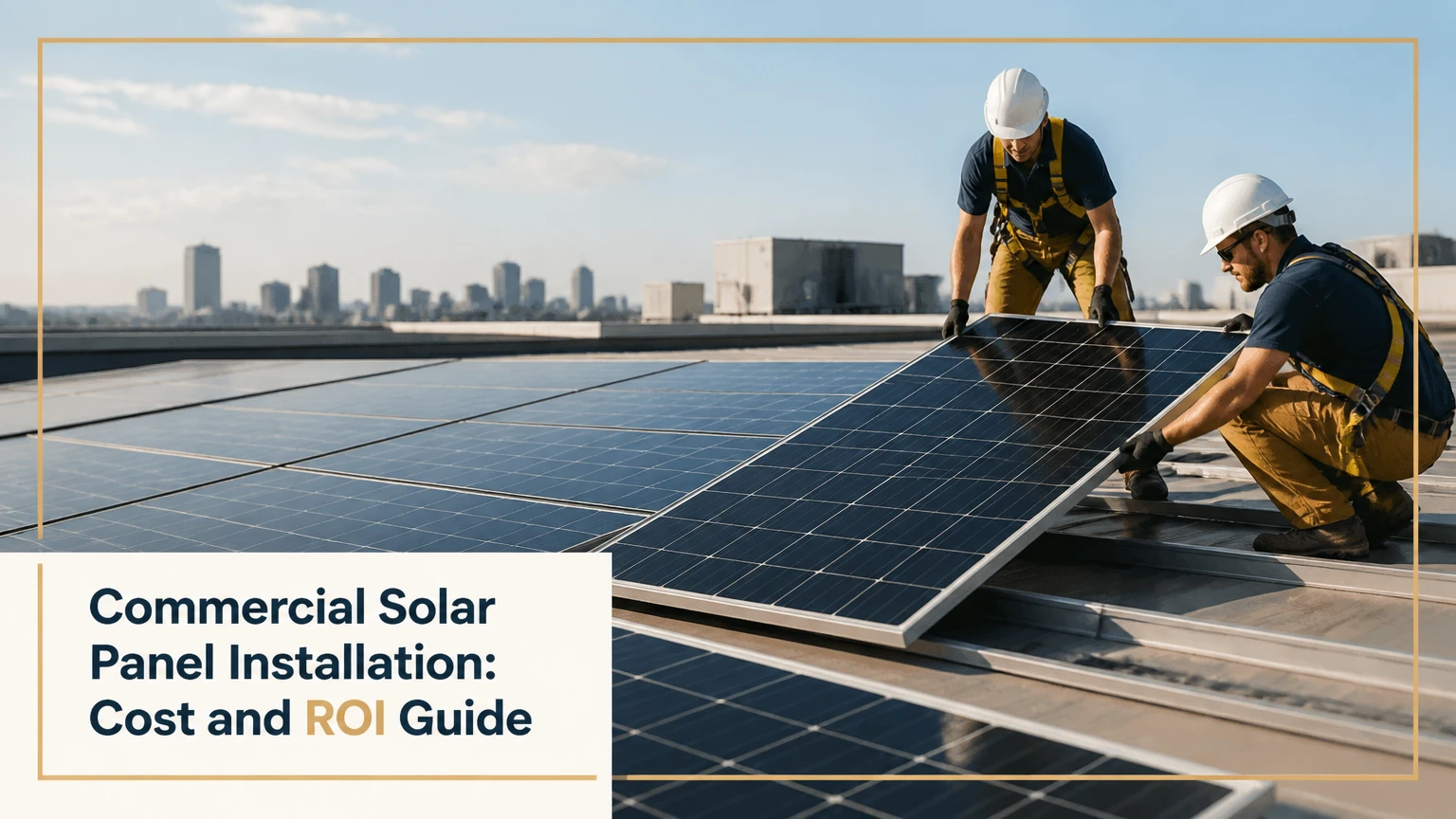
Commercial solar panel installation is the engineering, permitting, construction, and commissioning of a photovoltaic system for a business, warehouse, factory, nonprofit, school, or institutional facility. Most projects range from roughly 25 kW to more than 1 MW and reduce purchased electricity by serving on-site loads before exporting surplus power to the grid.
Key Facts at a Glance
- Commercial solar systems commonly connect behind the facility’s main electrical service and offset electricity consumed on-site.
- A credible design requires interval utility data, a structural review, an electrical study, and utility interconnection approval.
- U.S. planning costs commonly range from about $1.45 to $3.25 per watt before incentives, depending on size and site complexity.
- Solar production lowers energy consumption, but batteries or controls may be needed to reduce demand charges.
- Roof condition can determine project economics because a reroof may require panel removal, storage, and reinstallation.
- Permission to Operate comes only after required inspections, testing, metering, and utility approval.
What Is Commercial Solar Panel Installation?
Commercial solar panel installation is the deployment of photovoltaic modules, racking, inverters, electrical protection, monitoring, and related equipment at a nonresidential property. The system may be rooftop-mounted, ground-mounted, installed over parking, or distributed across several buildings under one utility account.
The central design objective is usually self-consumption rather than maximum panel count. A system creates the most immediate value when solar generation overlaps with refrigeration, HVAC, production machinery, pumps, lighting, or other daytime loads. Surplus electricity may receive an export credit, but that credit is often lower than the retail purchase rate.
Commercial projects also differ from residential systems because they interact with larger switchgear, transformers, three-phase distribution, protective relays, fire-access requirements, and utility studies. A 150 kW warehouse array can therefore require more engineering than its panel count suggests.
What Size System Does a Business Need?
A business needs a system sized from its interval load profile, available area, utility export rules, and financial objective, not from roof size alone. A preliminary commercial array may occupy approximately 60-100 square feet per kilowatt on a flat roof, depending on module wattage, row spacing, setbacks, and access paths.
A 100 kW system might contain approximately 180-250 modules if each module is rated between 400 and 550 watts. Annual production varies substantially by location, orientation, shading, weather, soiling, and system losses. NREL’s PVWatts tool provides location-specific production estimates, but a bankable proposal should use a documented production model and stated loss assumptions.
How Does a Commercial PV System Work?
A commercial photovoltaic system converts sunlight into DC electricity, uses inverters to produce grid-compatible AC electricity, and sends that power through the facility’s distribution equipment to active loads. Solar power typically serves building demand first, while batteries, export controls, or the utility grid handle the difference between generation and consumption.
The Electrical Sequence
- Photovoltaic modules create DC power. Semiconductor cells respond to sunlight and generate direct current.
- Combiner equipment groups circuits. String fuses, disconnects, and monitoring devices protect and organize module circuits.
- Inverters convert DC to AC. Commercial string or central inverters synchronize voltage and frequency with the facility and utility.
- Switchgear distributes electricity. AC power enters a panel, switchboard, or medium-voltage system serving the building.
- Loads consume available power. HVAC equipment, compressors, motors, process lines, and lighting use solar power instantly when operating.
- Controls manage excess or shortfall. Surplus power may charge batteries or export to the grid; insufficient solar power comes from the utility.
- Monitoring records performance. An energy-management platform compares production, consumption, alarms, and expected output.
Grid-tied solar normally shuts down during a utility outage unless the project includes an approved islanding design and battery-backed loads. A standard grid-connected array is therefore not automatically an emergency generator.
Why Do Demand Charges Matter?
Demand charges bill a facility for its highest measured power draw during a utility-defined interval, often 15 or 30 minutes. Solar can reduce demand when the monthly peak occurs during strong production, but an evening peak or a brief simultaneous motor start may remain unchanged.
This creates a common design error. A proposal that models only annual kilowatt-hours can overstate savings for a factory with large non-solar peaks. Interval data must identify when demand occurs, how long it lasts, and whether automated controls or batteries can respond.
What Happens During Commercial Solar Installation?
A commercial solar project usually takes 4-12 months from preliminary assessment to Permission to Operate, although physical construction may take only several days to several weeks. Utility study queues, structural reinforcement, transformer upgrades, planning approvals, and roof repairs usually create more schedule risk than panel installation.
Step 1: Gather Utility and Facility Data
Provide the installer with 12-24 months of electricity bills and, preferably, 15-minute or 30-minute interval data. The project team should identify annual consumption, monthly peaks, demand charges, tariff changes, seasonal loads, operating hours, and planned electrification such as heat pumps or EV chargers.
Success checkpoint: the load model reconciles closely with billed consumption and explains the facility’s highest demand intervals.
Common mistake: sizing from a single annual kWh figure while ignoring a future production expansion or a seasonal shutdown.
Step 2: Inspect the Site and Roof
Engineers assess roof age, membrane type, drainage, penetrations, wind exposure, snow load, structural capacity, fire lanes, access routes, shading, and nearby obstructions. A roof with less than 10-15 years of practical service life may require replacement before panel installation.
Ground projects require geotechnical information, grading analysis, drainage design, fencing, vegetation management, underground utility locating, and equipment access. Carports add foundations, steel columns, vehicle-clearance dimensions, lighting, and stormwater considerations.
Success checkpoint: a stamped structural opinion or equivalent engineering review confirms the proposed array loads and attachment method.
Common mistake: accepting ballasted rooftop racking without checking concentrated loads, parapet wind effects, drainage paths, or roof warranty conditions.
Step 3: Develop Electrical and Structural Engineering
The design package should include a site plan, module layout, string map, equipment schedule, conductor sizing, voltage-drop calculations, grounding design, one-line diagram, arc-fault and rapid-shutdown approach where required, and interconnection protection.
The engineer must confirm whether the existing service can accept the proposed generation. A 480-volt, three-phase facility may still need switchgear modifications, a transformer change, protection coordination, or a utility-side upgrade.
Success checkpoint: the design passes internal engineering review and gives the utility enough information to study export, fault current, protection, and voltage effects.
Common mistake: selecting module wattage first and discovering later that inverter voltage limits, string lengths, or switchgear space cannot accommodate the design.
Step 4: Secure Permits, Financing, and Interconnection
The project may require building, electrical, fire, zoning, environmental, stormwater, or land-use approvals. The authority having jurisdiction reviews code compliance, while the utility evaluates the electrical connection and grants permission to operate after commissioning.
Financing can proceed through direct purchase, a loan, a lease, or a power purchase agreement. Each structure changes tax treatment, maintenance responsibility, asset ownership, roof obligations, and the customer’s ability to claim incentives.
Success checkpoint: the contract identifies every approval, responsible party, expected milestone, and cost allowance for utility upgrades.
Common mistake: treating an installer’s interconnection submission as guaranteed approval. Export limits and upgrade costs can materially change project economics.
Step 5: Build and Connect the System
Construction includes mobilization, fall protection, roof protection, racking, module placement, DC wiring, inverter installation, AC equipment, communications, labels, grounding, and connection to the facility’s distribution system. Large sites may require cranes, trenching, medium-voltage equipment, or scheduled shutdowns.
The construction plan should protect active business operations. Warehouses need clear loading routes, factories need outage windows, and retail sites need pedestrian and vehicle controls.
Success checkpoint: installation records, torque logs, insulation tests, grounding tests, equipment serial numbers, and as-built drawings are complete.
Common mistake: postponing documentation until handover, when missing test results and labeling corrections delay inspection.
Step 6: Test, Inspect, and Receive Permission to Operate
Commissioning verifies polarity, insulation resistance, grounding, inverter settings, communications, emergency shutdown functions, protective devices, and production data. The utility or inspector may require witness testing, meter replacement, relay settings, or a final inspection.
Permission to Operate is the formal authorization to operate in parallel with the utility. Turning on an array before PTO can violate the interconnection agreement and create safety or billing problems.
Success checkpoint: the utility confirms PTO, the meter records the intended direction of energy flow, and monitoring shows production from every inverter or monitored circuit.
Which Commercial Solar Design Fits a Facility?
Rooftop systems usually suit warehouses and offices with usable roof area, ground mounts suit properties with available land, and solar carports suit parking-heavy campuses that also want shade or EV charging. The best choice depends on structural capacity, land value, energy timing, construction access, and roof replacement risk.
| System type | Typical application | Typical cost driver | Main benefit | Main limitation |
|---|---|---|---|---|
| Flat-roof ballast | Warehouse, retail, office | $1.60-$2.60/W | Avoids many roof penetrations | Adds distributed roof weight |
| Mechanically attached roof | Sloped or engineered roof | $1.60-$2.70/W | Strong wind resistance | Attachment and warranty review |
| Fixed-tilt ground mount | Factory parcel, rural site | $1.45-$2.30/W | Easy access and expansion | Grading, fencing, trenching |
| Single-axis tracker | Large open parcel | $1.70-$2.60/W | Typical 15%-25% production gain in suitable sites | More moving parts and maintenance |
| Solar carport | Campus, hospital, retail parking | $2.50-$4.50/W | Shade, visibility, EV integration | Steel and foundation costs |
Rooftop Arrays
Rooftop solar uses otherwise unproductive building area and often has shorter cable runs than a remote ground array. Ballasted systems reduce penetrations, but ballast weight, wind uplift, roof membrane condition, and drainage must be engineered together.
A roof is a poor solar platform when replacement is imminent, structural capacity is uncertain, skylights consume much of the usable area, or the building owner cannot guarantee access for maintenance. The cheapest mounting method can become the most expensive option if the roof requires removal and reinstallation.
Ground-Mounted Arrays
Ground-mounted systems offer better access, flexible orientation, and simpler module cleaning. Fixed-tilt racking usually has fewer mechanical components than trackers and can produce a stronger risk-adjusted return where land is inexpensive.
Ground mounting is not automatically cheaper. Civil works, pile testing, access roads, fencing, drainage, erosion control, underground collection circuits, and land-use approvals can outweigh the savings from easier installation.
Carports and Canopies
Solar carports create a second-use structure over existing parking and can accommodate EV chargers, lighting, and covered pedestrian routes. Their economics depend heavily on steel quantity, foundation depth, stormwater requirements, and whether parking improvements were already planned.
Carports are often a poor fit for sites with frequent truck movements, limited turning radii, severe snow loads, or high collision exposure. A canopy should be priced as a structural parking project with solar added, not as a rooftop array with taller posts.
How Much Does Commercial Solar Cost?
Commercial solar installation commonly costs about $1.45-$3.25 per watt in U.S. planning estimates before incentives, with smaller and more complex projects costing more per watt. The final price depends on system size, roof work, interconnection upgrades, labor, electrical equipment, civil construction, financing, and local permitting.
| System scale | Capacity | Typical gross price | Typical gross project cost |
|---|---|---|---|
| Micro-commercial | 25-50 kW | $2.45-$3.25/W | $75,000-$150,000 |
| Small commercial | 50-250 kW | $1.85-$2.60/W | $150,000-$550,000 |
| Large commercial | 250 kW-1 MW | $1.60-$2.15/W | $550,000-$1.80 million |
| Industrial | More than 1 MW | $1.45-$1.80/W | $1.80 million and above |
These figures are planning ranges, not bids. A credible proposal should separate modules, inverters, racking, electrical balance of system, labor, design, permits, interconnection, roof work, contingencies, monitoring, and operations and maintenance.
What Determines Payback?
Payback depends on avoided energy rates, demand charges, export compensation, degradation, maintenance, financing cost, tax position, incentives, and future utility tariffs. A simple payback calculation divides net installed cost by first-year savings, but a serious investment model uses discounted cash flow, escalation assumptions, replacement reserves, and tax effects.
A typical commercial project may show a simple payback of 4-8 years in favorable markets, but export-limited sites or low-rate facilities can take longer. NREL’s Annual Technology Baseline and PVWatts resources help frame production and cost assumptions, while the actual utility tariff determines the value of each kilowatt-hour.
Which Components Affect Performance?
Commercial PV performance depends on module quality, inverter architecture, electrical losses, racking orientation, monitoring, and maintenance access. A higher-efficiency module does not automatically produce the best return if roof setbacks, inverter clipping, shading, or export limits dominate the design.
| Component | Common commercial choice | Useful specification | Decision consequence |
|---|---|---|---|
| Module | Monocrystalline half-cut | About 20%-23% efficiency | More watts in constrained roof area |
| String inverter | Distributed units | Commonly 25-125 kW per unit | Easier segmentation and replacement |
| Central inverter | Large plant equipment | Hundreds of kW per unit | Lower equipment count, larger outage exposure |
| Racking | Ballasted or attached steel | Wind and snow engineered | Determines roof risk and labor |
| Monitoring | Cloud data logger and meters | 5-15 minute data typical | Detects underperformance and alarms |
| Transformer | Pad-mounted or indoor | 480 V to medium voltage where required | May control interconnection cost |
String inverters are usually attractive where roof sections have different orientations or shading patterns. Central inverters can reduce equipment cost on large, uniform arrays, but a failure can remove a substantial block of production unless the plant has redundancy.
Module degradation is gradual, but soiling, shading, thermal stress, connector failures, and inverter outages can cause larger short-term losses. The contract should specify performance reporting, response times, replacement parts, and whether monitoring data remains available after the installer’s warranty ends.
When Does Battery Storage Make Sense?
Battery energy storage makes sense when a facility has expensive demand charges, time-of-use price differences, outage-resilience requirements, or export restrictions that leave solar energy undervalued. Batteries do not automatically improve every solar project because round-trip losses, degradation, controls, fire-code requirements, and replacement costs reduce the delivered energy benefit.
A battery can charge from solar or the grid, then discharge during a targeted demand interval. The system must have enough power in kilowatts to reduce the peak and enough energy in kilowatt-hours to sustain the discharge; a battery with 500 kWh of capacity may still provide little demand reduction if its inverter is limited to 100 kW.
Battery design also requires thermal management, clearances, emergency response planning, fire detection, and compliance with applicable editions of NFPA 855, NFPA 70, local fire codes, and utility requirements. Battery storage is a control system and safety project, not merely an oversized solar accessory.
How Are Savings Calculated?
Commercial solar savings equal avoided electricity purchases plus eligible demand reduction and export revenue, minus system operating costs, financing, degradation, and unusual utility charges. The calculation should use the facility’s tariff and interval load data rather than multiplying annual solar production by the highest retail rate.
A useful model contains:
- Monthly energy charges in dollars per kWh.
- Monthly demand charges in dollars per kW.
- Fixed customer, standby, and delivery charges.
- Solar production by interval or hour.
- Battery charging and dispatch assumptions.
- Export credits and interconnection limits.
- Annual degradation, typically modeled around 0.25%-0.50% for many modern modules.
- Inverter replacement and maintenance reserves.
- Tax credits, depreciation, grants, and financing costs.
The U.S. Department of Energy identifies energy burden, demand management, and resilience as separate value streams rather than treating solar production as the only benefit. A facility should therefore compare a solar-only case, a solar-plus-storage case, and a no-build case using the same tariff assumptions.
Which Financing Structure Fits the Owner?
Direct ownership generally gives the property owner control of the asset, tax benefits, maintenance decisions, and residual value. A loan preserves ownership while spreading payments, whereas a lease or power purchase agreement transfers much of the upfront cost and operational responsibility to a third party.
| Structure | Upfront customer payment | Asset owner | Typical customer benefit | Main issue |
|---|---|---|---|---|
| Cash purchase | 100% of project price | Business | Full tax and energy value if eligible | Capital tied up |
| Solar loan | Low to moderate | Business or lender | Ownership with scheduled payments | Interest and underwriting |
| Operating lease | Often $0 | Financier | Predictable payment | Limited tax control |
| PPA | Often $0 | Financier | Buys generated kWh | Escalator and term restrictions |
| Shared or virtual arrangement | Varies | Owner or subscriber group | Allocates off-site production | Complex eligibility and billing |
A leased building requires written rights for roof access, insurance, repairs, inverter replacement, roof restoration, assignment on sale, and removal at lease end. Multi-tenant properties also need rules for allocating benefits among utility meters and tenants.
What Tax Credits and Incentives Apply?
U.S. commercial solar incentives depend on the project’s placed-in-service date, ownership structure, tax status, location, domestic-content facts, labor compliance, and current federal law. The federal Investment Tax Credit, depreciation rules, state incentives, utility rebates, and transferability provisions must be verified with a tax professional and the Internal Revenue Service before contract signing.
The Inflation Reduction Act established the technology-neutral Clean Electricity Investment Credit under Section 48E for qualifying projects placed in service after 2024, subject to statutory eligibility and applicable labor and domestic-content rules. The older Section 48 credit may apply to earlier qualifying timelines, but eligibility is date-sensitive.
The IRS states that prevailing-wage and apprenticeship requirements can affect the credit rate for applicable projects. A project team should retain wage records, apprenticeship documentation, procurement evidence, placed-in-service records, and commissioning documents rather than attempting to reconstruct compliance later.
Five-year MACRS depreciation may accelerate deductions for eligible business property, but depreciation is not the same as a cash rebate. A nonprofit, school, or tax-exempt entity may need direct pay or transfer mechanisms, each with separate filing requirements.
What Are the Most Common Project Mistakes?
The most expensive commercial solar mistakes usually occur before construction, when poor data, roof assumptions, or contract gaps become embedded in the design. Correcting a layout after interconnection approval can trigger redesign, permitting, equipment changes, and schedule delays.
- Ignoring roof replacement timing. Confirm roof warranty, membrane condition, attachment details, and remaining service life before accepting a solar proposal.
- Using annual consumption alone. Request interval data and model demand peaks, tariff periods, shutdowns, and future electrification.
- Assuming export has retail value. Verify the utility’s avoided-cost rate, net-billing formula, monthly caps, and export application.
- Underpricing interconnection. Require a clear allowance for transformer, switchgear, relay, trenching, and utility upgrade costs.
- Accepting vague production guarantees. Define the weather dataset, degradation rate, availability exclusions, shading assumptions, and compensation method.
- Leaving operations undocumented. Require as-built drawings, test reports, serial numbers, monitoring credentials, and emergency procedures at handover.
One practitioner rule is especially useful: compare bids by net present value and guaranteed annual production, not by lowest dollars per watt. A cheaper system with a weaker roof scope or optimistic export assumption can have a higher lifetime cost.
What Maintenance and Troubleshooting Does Solar Require?
Commercial solar maintenance usually includes remote monitoring, visual inspections, electrical testing, vegetation control, roof checks, equipment cleaning where justified, and corrective repair. A practical service agreement often schedules detailed inspections annually and investigates unexplained production loss within one business day.
| Symptom | Likely cause | First diagnostic | Typical corrective action |
|---|---|---|---|
| One string underperforms | Connector, fuse, shading, module fault | Compare string current | Repair connector or replace fuse/module |
| Inverter offline | Grid fault, communications, temperature | Review fault code and AC voltage | Reset only under procedure, then service |
| Hot module area | Soiling, cell defect, bypass diode | Infrared scan and visual inspection | Clean, replace, or isolate failed component |
| Production below model | Soiling, shading, clipping, sensor error | Compare irradiance and peer inverters | Clean, recalibrate, or investigate layout |
| Repeated rapid shutdown alarm | Wiring or code-device fault | Inspect DC circuit and shutdown devices | Qualified electrical repair |
Drone thermography can locate thermal anomalies, but an infrared image is a diagnostic lead rather than proof of a specific failure. Potential-induced degradation, connector heating, insulation faults, and inverter isolation events require qualified testing and should not be corrected by changing protection settings without utility and engineering approval.
Which Facility Types Benefit Most?
Warehouses often have large, unobstructed roofs and daytime refrigeration or material-handling loads, making rooftop PV attractive when structural capacity and roof life are adequate. Manufacturing facilities may gain more from combining solar with demand management because motors and process equipment can create short, expensive peaks.
Office buildings frequently have lower daytime energy density per square foot and more shading from neighboring structures. Solar can still work, but the design may prioritize common-area loads, parking canopies, tenant allocation, or resilience rather than maximum roof coverage.
Hospitals and data centers require a different evaluation. Critical loads, standby generation, reliability requirements, and electrical isolation can make resilience more important than simple annual bill reduction. Solar alone does not guarantee uninterrupted service.
How Should an Owner Compare Installer Proposals?
An owner should compare at least three proposals using identical assumptions for system size, annual production, roof scope, interconnection cost, equipment warranties, degradation, monitoring, and operations. Every bidder should state exclusions because the lowest headline price often omits structural reinforcement, utility upgrades, or reroofing.
Check the installer’s commercial references, license status, insurance, safety record, financial capacity, subcontractor responsibilities, warranty administration, and local service coverage. Ask for a sample commissioning package and a sample monthly performance report.
The contract should define:
- Guaranteed annual production and measurement method.
- Completion date, liquidated damages, and delay exclusions.
- Roof warranty responsibility and leak response.
- Equipment warranty terms and labor coverage.
- Monitoring ownership and data retention.
- Change-order approval procedures.
- Removal and restoration obligations.
- Insurance requirements and lien releases.
A qualified owner’s representative can often save more through scope normalization than through negotiating a small module-price reduction.
Frequently Asked Questions
Can a commercial building install solar if the roof is leased?
Yes, a leased commercial building can install solar when the owner, tenant, lender, insurer, and utility arrangements permit it. The documents should cover roof access, structural responsibility, roof replacement, maintenance, insurance, sale of the property, assignment, and removal. Written consent is preferable to relying on informal tenant-landlord approval.
How long do commercial solar panels last?
Commercial solar modules commonly carry product warranties around 12-25 years and performance warranties extending to 25-30 years, while actual service life can exceed those periods. Inverters generally have shorter expected service lives than modules, so financial models should include inverter repair or replacement reserves.
Does commercial solar work during a power outage?
A standard grid-tied solar system usually shuts down during an outage to prevent unsafe backfeeding onto utility lines. Continued operation requires properly engineered batteries, islanding controls, protected loads, transfer equipment, and utility-approved interconnection settings.
Is a solar PPA better than buying the system?
A PPA can suit an owner that prioritizes low upfront spending and predictable energy pricing, while direct ownership can produce more tax control and long-term residual value. Compare the PPA rate, escalator, term, buyout formula, roof obligations, production guarantee, and property-sale provisions.
Do businesses need to clean solar panels?
Businesses need cleaning when dust, pollen, bird droppings, industrial residue, or snow causes measurable production loss. Cleaning frequency varies by site, and a before-and-after production comparison is more reliable than an arbitrary monthly schedule. Abrasive methods or untreated water can damage modules and leave deposits.
What information should a business give an installer?
Provide 12-24 months of bills, interval data, site plans, roof drawings, roof warranty documents, electrical one-lines, operating schedules, planned expansions, utility account details, and ownership constraints. Accurate source data reduces redesign, improves demand-charge modeling, and exposes interconnection risks before contract award.
The Bottom Line
Commercial solar panel installation is a capital project involving energy analysis, structural and electrical engineering, permits, utility approval, construction, commissioning, and long-term operations. The strongest projects begin with interval load data and a roof or land assessment, then compare rooftop, ground-mount, carport, battery, ownership, and PPA options against the facility’s tariff and operating pattern.
A business should not choose a system from annual kWh production or dollars per watt alone. It should confirm roof life, demand peaks, export value, interconnection cost, tax eligibility, maintenance obligations, and performance guarantees before signing. When those conditions are modeled accurately, commercial solar can reduce purchased electricity while creating a measurable, maintainable energy asset.