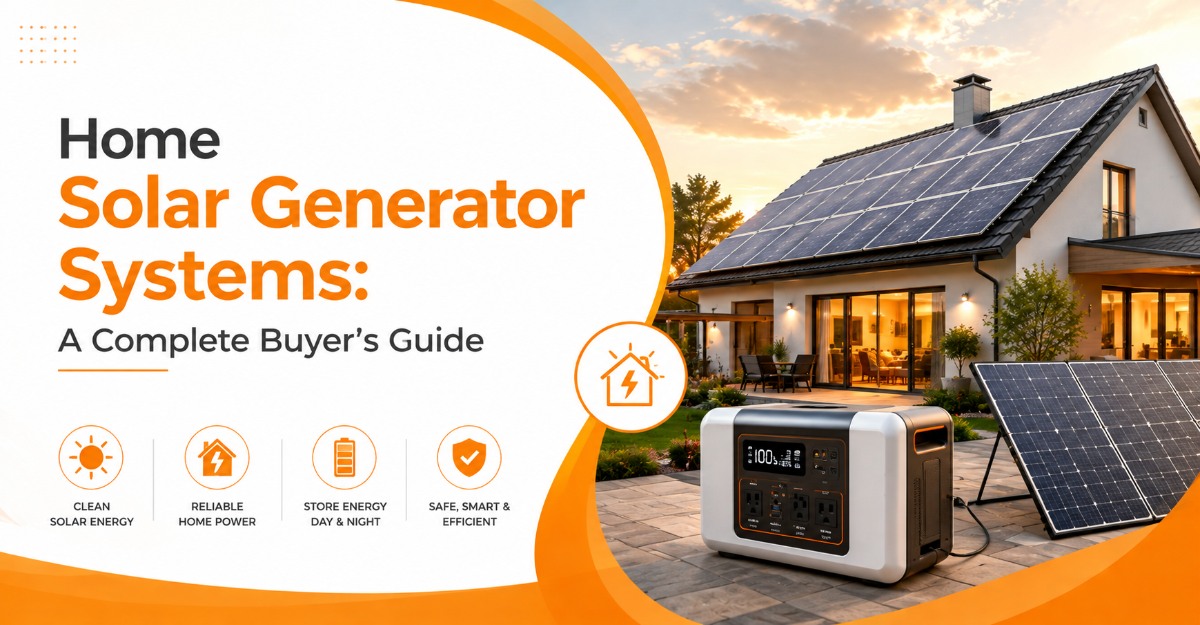
A home solar generator system is a self-contained power unit that captures sunlight through photovoltaic panels, stores it in a lithium battery bank, and converts it to household AC electricity through an inverter. Unlike rooftop solar built to lower monthly bills, this system is engineered for backup power during grid outages and for off-grid living.
Key Facts: Quick Answer
- A home solar generator combines four parts working in sequence: solar panels, a charge controller, a battery bank, and an inverter that outputs standard household AC power.
- Real usable runtime is lower than the sticker math. Multiply battery watt-hours by roughly 0.85 to account for inverter and conversion losses, then divide by the appliance’s wattage.
- Choose LiFePO4 (LFP) chemistry: it delivers 3,000 to 6,000 charge cycles and 10 to 15 years of service, versus 500 to 1,000 cycles for older NMC lithium-ion cells.
- Typical 2026 pricing runs $400 to $2,000 for portable stations (500Wh to 2,000Wh), $2,500 to $5,500 for expandable backup units (3,600Wh to 5,000Wh), and $8,000 to $25,000 or more for installed whole-home systems (10kWh and up).
- The U.S. federal Residential Clean Energy Credit (IRC Section 25D) was ended for property placed in service after December 31, 2025 under 2025 tax law. Confirm the current rule with a licensed tax professional before you buy.
- A solar generator is poor at running continuous central air conditioning, electric furnaces, or multi-day off-grid loads without a large panel array and oversized battery.
What Is a Home Solar Generator System?
A home solar generator system is a battery-based power source that stores solar or grid energy and releases it as usable household electricity when the grid fails or where no grid exists. The system coordinates photovoltaic panels, a charge controller, a lithium battery, and an inverter inside one package. The term covers two form factors: a portable all-in-one power station, and a permanently installed hybrid system wired into the breaker panel.
The distinction from rooftop grid-tied solar matters, and most buyers miss it. A standard grid-tied array feeds power to your panel and the utility to offset your bill, and it shuts down automatically during an outage to protect line workers, a safety behavior called anti-islanding. A solar generator does the opposite job: it is designed to keep your critical loads alive precisely when the grid goes dark. In practice, a rooftop system with no battery leaves you in the dark during a blackout, while a solar generator keeps the refrigerator, router, and lights running.
How Does a Home Solar Generator Work?
A home solar generator works by converting sunlight into stored direct current (DC), then inverting that stored energy into alternating current (AC) that household electronics accept. The process moves through four stages, and each stage loses a small amount of energy, which is why real runtime falls below the nameplate number.
The four operating steps run in order:
- Energy capture: photovoltaic cells generate DC electricity when sunlight strikes them. A 100W panel rarely delivers a full 100W in the field; angle, heat, and wiring losses typically drop real output to 60 to 80W.
- Regulation: a charge controller, usually an MPPT type in quality units, adjusts incoming voltage and current so the battery charges fast without overcharging. MPPT controllers harvest 15 to 30% more energy than older PWM controllers.
- Storage: the regulated power fills the LFP battery bank, which holds the charge until you need it.
- Conversion: the inverter draws DC from the battery and outputs AC. Pure sine wave inverters are required for sensitive electronics, medical devices, and motors.
Here is the practitioner truth the sticker math hides. Round-trip efficiency across the battery and inverter typically lands at 85 to 90%, so a “2,000Wh” unit delivers closer to 1,700 to 1,800Wh to your outlets. The common claim that a 2,000Wh battery runs a 500W load for 4 hours is optimistic. In real use, expect about 3.2 to 3.4 hours. Plan every load calculation on 80 to 85% of nameplate capacity, not 100%.
Types of Home Solar Generator Systems
Home solar generator systems fall into two categories: portable all-in-one power stations and permanently installed whole-house hybrid systems. Portable units serve renters and mobile use; installed systems back up an entire home and can run heavy 240V equipment.
| Attribute | Portable Power Station | Whole-House Hybrid System |
|---|---|---|
| Capacity range | 500Wh to 5,000Wh | 10,000Wh to 40,000Wh+ |
| Continuous output | 500W to 3,600W (120V) | 5,000W to 12,000W (120/240V split-phase) |
| Installation | Plug and play, none required | Professional wiring, permits, transfer switch |
| Time to deploy | Instant | 2 to 5 days |
| Best for | Apartments, camping, medical devices, single circuits | Full-home backup, well pumps, off-grid homesteads |
| Expandability | Daisy-chain extra batteries (brand-specific) | Add battery modules and panels to a fixed array |
| Representative models | EcoFlow Delta series, Jackery Explorer, Anker Solix | Anker Solix F3800 stacks, EcoFlow Delta Pro Ultra, Bluetti EP900 |
A middle tier bridges the two: expandable stations such as the EcoFlow Delta Pro and Anker Solix F3800 start around 3,600 to 3,840Wh, output split-phase 120/240V, and stack to 25kWh or more. Paired with a manual transfer switch or a smart home panel, they behave like a whole-house system without a fixed rooftop array.
Key Specifications and How to Size Your System
Sizing a home solar generator comes down to four numbers: watt-hours for total capacity, running watts for continuous output, surge watts for motor startup, and battery chemistry for lifespan. Get the surge figure wrong and the unit trips offline the instant a compressor kicks on.
Work through sizing in this order:
- List every device you must run at once and note each device’s running watts (check the label or a plug-in meter).
- Add the running watts together to find your continuous load, then confirm the inverter’s rated output exceeds it.
- Identify the single largest motor (fridge, well pump, AC) and add its surge watts to the running total to size for startup.
- Multiply your continuous load by the hours of backup you want, then divide by 0.85 to size the battery in watt-hours.
The table below gives representative draw figures. A refrigerator that runs at 150W can demand 3 to 5 times that at startup, which is where undersized units fail.
| Appliance | Running Watts | Surge Watts | Notes |
|---|---|---|---|
| LED lights (whole room) | 60W | 60W | Negligible surge |
| Wi-Fi router and modem | 20W | 20W | Priority load in outages |
| Refrigerator or freezer | 150W | 600 to 1,200W | Compressor motor surge |
| CPAP machine (no humidifier) | 40W | 60W | Common medical priority |
| 1/2 HP well pump | 1,000W | 2,000 to 3,000W | Needs split-phase 240V |
| Portable space heater | 1,500W | 1,500W | Resistive, no surge but heavy draw |
| Central AC (3 ton) | 3,500W | 10,000 to 12,000W | Rarely practical on a solar generator |
Battery chemistry decides how long the system lasts and how it behaves. LiFePO4 (LFP) is the standard for standby storage because it tolerates deep discharge, resists thermal runaway, and holds capacity across thousands of cycles.
| Chemistry | Cycle Life (to 80%) | Usable Depth of Discharge | Typical Lifespan | Fire Risk |
|---|---|---|---|---|
| LiFePO4 (LFP) | 3,000 to 6,000 | 90 to 100% | 10 to 15 years | Very low |
| NMC lithium-ion | 500 to 1,000 | 80 to 90% | 3 to 6 years | Moderate |
| Sealed lead-acid (AGM) | 300 to 500 | 50% | 3 to 5 years | Low |
One cold-weather rule catches new owners off guard. LFP cells should not charge below 32F (0C); doing so plates lithium and permanently damages the pack. Quality units include low-temperature charge protection or a self-heating pack, so verify that feature before buying for a cold climate. Discharging in the cold is fine; charging is the hazard.
How Much Does a Home Solar Generator Cost in 2026?
A home solar generator costs $400 for a small portable kit and rises past $25,000 for an installed whole-home system. Battery capacity drives most of the price, and installed labor plus permits add the rest for hardwired systems.
| System Size and Type | Capacity Range | Typical Cost (2026) | Deployment Time |
|---|---|---|---|
| Small portable kit | 500Wh to 1,000Wh | $400 to $900 | Instant, no install |
| Medium emergency backup | 2,000Wh to 5,000Wh | $1,500 to $5,500 | Same day with transfer switch |
| Large whole-house system | 10,000Wh and up | $8,000 to $25,000+ | 2 to 5 days, permits required |
Two cost factors sit outside the sticker price. First, panels are usually sold separately: a 200W foldable panel runs $300 to $500, and you often need 400 to 800W of panels to recharge a mid-size unit in a single sunny day. Second, the U.S. tax picture changed. The federal Residential Clean Energy Credit (IRS Section 25D), which returned 30% on qualifying installed battery storage of 3kWh or more, was terminated for property placed in service after December 31, 2025 under 2025 legislation. Portable stations generally never qualified because they are not permanently installed. Because tax law shifts and state incentives vary, confirm current eligibility with a licensed tax professional before counting on any credit.
On lifetime cost, a silent point favors solar. A gas generator burns roughly $30 to $60 in fuel per day of continuous outage, so a week-long event can cost $200 to $400 in fuel alone plus oil changes. A solar generator recharges for free from the sun and near-zero from the grid, which changes the math for anyone who faces frequent multi-day outages.
Solar Generators vs Other Backup Power Options
A solar generator is one of four main backup options, and each wins in a different situation. Solar generators trade high upfront cost for silent, emission-free, low-maintenance power. Gas units cost less to buy but demand fuel, ventilation, and upkeep.
| Feature | Solar Generator | Portable Gas Generator | Standby Generator (Generac) | Home Battery (Powerwall) |
|---|---|---|---|---|
| Upfront cost | $1,500 to $25,000 | $500 to $2,000 | $5,000 to $15,000 installed | $10,000 to $18,000 installed |
| Ongoing cost | Free solar recharge | $30 to $60/day fuel | Fuel plus annual service | Near zero |
| Noise level | Near silent (30 dB) | Loud (65 to 75 dB) | Loud when running | Silent |
| Indoor safe | Yes | No, carbon monoxide risk | No | Yes |
| Runtime limit | Battery plus daily sun | As long as fuel lasts | Days on natural gas | Battery plus solar |
| Maintenance | Minimal | Oil, spark plugs, fuel | Annual professional service | Minimal |
| Best for | Quiet backup, apartments, off-grid | Cheap high-output, remote work | Automatic whole-home, gas line homes | Grid-tied homes with rooftop solar |
The honest comparison: if you have a natural gas line and want hands-off automatic backup for an all-electric home, a standby generator or a large battery beats a portable solar unit. If you want silent, indoor-safe power you can move, deploy in minutes, and refuel from the sky, the solar generator is the clear pick.
Common Mistakes and How to Avoid Them
Most solar generator failures trace back to sizing and wiring errors, not defective hardware. The following mistakes account for the majority of returns and support tickets.
- Ignoring surge watts: a fridge that runs at 150W may need 1,200W to start. An inverter rated only for the running load trips into overload fault the moment the compressor engages.
- Exceeding the charge controller voltage: wiring too many panels in series can push past the controller’s maximum open-circuit voltage (Voc), often 150V on portable MPPT units, which can destroy the circuit board instantly. Check panel Voc times string count against the spec.
- Storing the battery at 0% or 100%: leaving an LFP pack fully drained for months can lock it into a low-voltage state, and long-term storage at full charge accelerates aging. Store at 50 to 60% and top up every 3 to 6 months.
- Undersizing the solar array: pairing a 5,000Wh battery with a single 100W panel means over 50 hours of ideal sun to refill. Match panel wattage to battery size so a day of sun replaces a day of use.
- Overlooking split-phase needs: 240V loads like well pumps and some HVAC require a split-phase 120/240V unit. A standard 120V station cannot run them regardless of its wattage.
Troubleshooting Common Problems
Most solar generator problems come from overload, shading, or idle drain, and each has a fast fix. Read the error code first, since these units report faults on their display.
When the unit shuts off as you plug something in, you have hit an overload. Disconnect high-draw resistive items first, such as space heaters and hair dryers, then check whether a motor’s surge exceeded the inverter rating. When solar charging runs far below spec, look for shade: a shadow across even 5% of a series-wired panel can cut output by half or more, so reposition panels to face the sun cleanly and clear obstructions. When the battery drains with nothing plugged in, the inverter is drawing phantom power to stay ready; switch off the AC inverter when you only need the DC or USB outputs. If the pack refuses to charge in winter, the low-temperature cutoff has likely engaged, and the unit will resume once the cells warm above freezing.
Which Home Solar Generator System Is Right for You?
The right home solar generator depends on where you live, what you must power, and whether you want portability or permanent integration. Match your profile below.
The apartment renter should buy a mid-size portable station of 1,000Wh to 2,000Wh from a brand like EcoFlow, Jackery, or Anker, paired with a 200W foldable panel for a balcony or window. This covers a fridge, router, phones, and lights through most urban outages without any wiring.
The suburban homeowner facing storm outages should choose a 3,600Wh to 5,000Wh expandable unit with a manual transfer switch or a smart home integration kit. This routes power safely through the breaker panel to keep the furnace fan, well or sump pump, internet, and refrigerator running.
The medical-dependent household should prioritize a pure sine wave inverter, low idle drain, and enough capacity to cover the device overnight plus a margin, then add panels sized to recharge fully in one day. A CPAP or oxygen concentrator user should size for at least two nights of autonomy in case of cloud cover.
The off-grid homesteader needs a fixed hybrid system with 10kWh to 20kWh of LFP storage, a permanent rooftop or ground array, and a split-phase 120/240V inverter to run deep-well pumps and heavy machinery.
What a Home Solar Generator Is Not Good For
A home solar generator system is a genuinely strong backup tool, and it is honest to name where it struggles. These units are poor at sustaining large resistive and continuous motor loads. Central air conditioning, electric furnaces, electric water heaters, and electric ranges draw 3,500 to 12,000W continuously and will drain even a large battery in under an hour or exceed the inverter outright.
The second weakness is a long stretch of bad weather. Solar recharge collapses under heavy cloud or snow cover, so an off-grid setup that relies solely on panels can run dry during a week of storms without a gas or grid backup to bridge the gap. The third limit is cost per delivered watt-hour during rare, brief outages: if you lose power once a year for two hours, a $150 gas generator may be the rational choice over a $2,000 battery. Buy a solar generator for silence, indoor safety, frequent outages, or off-grid independence, not to replace whole-home electric heat.
Frequently Asked Questions About home solar generator systems
Can a home solar generator power a whole house? Yes, but only a large installed system can. A 10kWh to 20kWh hybrid unit with a split-phase 120/240V inverter and a rooftop array can run a typical home’s essentials, though central AC and electric heat may still exceed its output. Portable stations back up circuits, not entire homes.
How long does a home solar generator last? An LFP battery pack rated for 3,000 to 6,000 cycles lasts 10 to 15 years under daily use before dropping to 80% capacity. The inverter and electronics often outlast that. Standby-only use, cycling less often, can push practical life beyond 15 years.
Can a solar generator recharge without sunlight? Yes. Nearly all units accept AC wall charging and 12V car charging in addition to solar, so you can top up from the grid, a vehicle, or a gas generator when the sun is absent. Solar is the free option, not the only one.
How many solar panels do I need to recharge in one day? Match panel wattage roughly to battery capacity. A 2,000Wh unit refills in a sunny day on 400 to 600W of panels, while a 5,000Wh unit needs 800 to 1,200W. Real output sits below panel ratings, so size up by about 25%.
Can a solar generator run a refrigerator continuously? Yes. A fridge averages 1 to 2kWh per day, so a 2,000Wh unit runs one for about a day, and daily solar can extend that indefinitely. Confirm the inverter handles the 600 to 1,200W startup surge, not just the 150W running load.
Is a solar generator safe to use indoors? Yes. Solar generators produce no exhaust, carbon monoxide, or combustion, so they are safe inside apartments and bedrooms, unlike gas units that must run outdoors. Keep them ventilated for battery cooling and away from moisture.