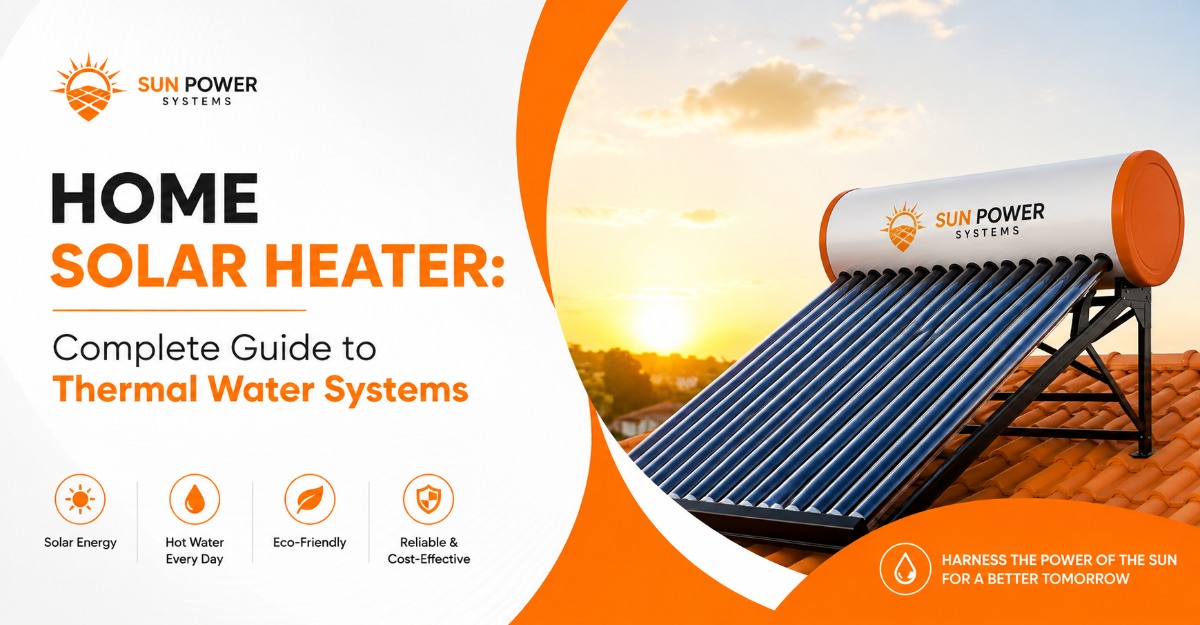
A home solar heater is a renewable thermal system that captures solar radiation to heat domestic water. Unlike photovoltaic panels that generate electricity, thermal systems absorb heat directly into a transfer fluid. This mechanism provides households with hot water while significantly reducing reliance on gas or grid electricity.
How Does a Home Solar Heater Work?
A home solar heater works by circulating a fluid through roof-mounted thermal collectors to absorb solar radiation, which is then pumped or gravity-fed into an insulated storage tank. The system relies on thermodynamic transfer rather than electrical generation.
The process follows a specific mechanical sequence to ensure heat reaches your taps safely.
- Solar Absorption: Solar irradiance strikes the dark absorber plate inside the roof-mounted collector. The special selective coating traps thermal energy while minimizing radiant heat loss.
- Fluid Heating: A fluid flows through copper pipes bonded to the absorber plate. In warm climates, this is often the actual domestic water. In freezing climates, the system uses a heat-transfer fluid like food-grade propylene glycol.
- Thermal Circulation: The heated fluid moves toward the storage tank. Active systems utilize a small electrical circulation pump activated by a differential temperature controller. Passive systems rely purely on natural thermodynamic convection where lighter, hot water rises.
- Heat Exchange: For systems using propylene glycol, the hot fluid enters a specialized heat exchanger (usually a copper coil) located inside or outside the domestic water tank. The heat transfers to the household water supply without cross-contamination.
- Storage and Backup: The heated domestic water waits in an insulated tank. When solar radiation is insufficient due to heavy clouds or high winter demand, a standard electric element or gas burner engages automatically to reach the thermostat set point.
What Are the Main Types of Solar Water Heaters?
Solar water heaters are categorized into passive and active systems, determined entirely by how the fluid circulates. You must select the system type based on your local winter temperatures, water hardness, and structural roof capacity.
Passive Thermal Systems
Passive systems contain no electrical pumps, moving parts, or electronic controllers. They operate entirely on water pressure and thermodynamic gravity.
Integral Collector Storage (ICS) systems combine the collector and the storage tank into one unit. The tank sits inside a glass-topped insulated box on the roof. Cold city water enters the tank, warms under the sun, and flows directly to the plumbing fixtures. Thermosiphon systems separate the collector and the tank. The tank sits physically higher than the collector on the roof. As water in the collector heats up, it naturally rises into the overhead tank.
These models are highly reliable but strictly limited to non-freezing climates. ICS systems also place thousands of pounds of water weight directly on the roof framing.
Active Thermal Systems
Active systems utilize circulation pumps and electronic differential controllers to move fluid between roof collectors and ground-level storage tanks.
Active direct (open-loop) systems pump the actual household water through the roof panels. They are efficient and inexpensive but extremely vulnerable to freezing and mineral scaling from hard water. Active indirect (closed-loop) systems circulate an antifreeze fluid (propylene glycol) through the collectors. The glycol travels to a heat exchanger, warming the domestic water safely. Closed-loop setups offer complete freeze protection and are standard in northern latitudes.
System Type Comparison
| System Classification | Primary Circulation Method | Freeze Tolerance | Ideal Climate & Use Case | Average Installed Cost |
| Passive ICS | City water pressure | None (Fails below 32°F) | Tropical regions, no freezing | $2,500 – $3,500 |
| Passive Thermosiphon | Natural convection | Low (Requires manual drain) | Mild climates, heavy roof support | $3,000 – $4,500 |
| Active Direct | Electric pump (Water) | None (Fails below 32°F) | Warm climates, soft water only | $4,000 – $5,500 |
| Active Indirect | Electric pump (Glycol) | High (Protects to -40°F) | Freezing climates, hard water regions | $5,500 – $8,000 |
Which Collector Panel Is Best for Your Climate?
The best collector panel for your climate depends entirely on ambient air temperatures and cloud cover frequency. Flat-plate collectors dominate warm, sunny regions, while evacuated tube collectors excel in freezing, overcast environments.
Flat-plate collectors are insulated, weatherproof boxes containing a dark absorber plate under tempered glass. They are rugged, handle high temperatures well, and naturally shed snow because the glass face radiates a small amount of heat. However, they lose efficiency rapidly when ambient outdoor temperatures drop near freezing.
Evacuated tube collectors consist of parallel rows of transparent glass tubes. Each tube contains an inner glass tube with an absorber coating. A vacuum exists between the inner and outer glass walls. Because a vacuum is a perfect insulator, these panels retain captured heat even in sub-zero weather. They perform exceptionally well in overcast conditions but are fragile and fail to melt accumulated snow quickly.
Collector Technology Specifications
| Collector Technology | Operating Efficiency | Winter Performance | Snow Shedding Capability | Expected Hardware Lifespan |
| Flat-Plate (Glazed) | 60% – 70% | Moderate (Loses heat to cold air) | Excellent (Glass warms slightly) | 20 – 25 years |
| Flat-Plate (Unglazed) | 40% – 50% | Poor (Summer use only) | N/A (Seasonal use) | 10 – 15 years |
| Evacuated Tube | 70% – 80% | Exceptional (Vacuum insulation) | Poor (Vacuum prevents melting) | 15 – 20 years |
| ICS Batch Collector | 50% – 60% | None (Pipes will rupture) | Good (High thermal mass) | 15 – 20 years |
How Do You Size a Thermal System Properly?
You size a thermal system by calculating your household’s daily gallons of hot water consumption and matching it to the square footage of the solar collector array. A properly sized system prevents severe summer overheating and excessive winter backup energy use.
The industry standard assumes each person in a household uses approximately 20 gallons of hot water per day. For a family of four, the daily demand is 80 gallons. In the Sun Belt (high solar insolation), you need roughly 40 square feet of collector area for the first two people, plus 8 additional square feet per subsequent person. In northern regions, you require 20 square feet per person.
The storage tank must also scale with the collector area. A standard rule requires 1.5 gallons of tank storage capacity for every square foot of flat-plate collector area. Undersizing the tank results in wasted thermal energy, as the system will shut down early on sunny days once the small tank reaches maximum temperature.
Household Sizing Matrix
| Household Occupants | Estimated Daily Demand | Collector Area (Southern US) | Collector Area (Northern US) | Recommended Tank Volume |
| 1 – 2 People | 40 Gallons | 40 sq. ft. (1 Panel) | 40 sq. ft. (1 Panel) | 50 – 60 Gallons |
| 3 – 4 People | 80 Gallons | 56 sq. ft. (2 Panels) | 80 sq. ft. (2 Panels) | 80 – 100 Gallons |
| 5 – 6 People | 120 Gallons | 72 sq. ft. (2-3 Panels) | 120 sq. ft. (3 Panels) | 120 – 150 Gallons |
| 7+ People | 140+ Gallons | 96 sq. ft. (3+ Panels) | 160 sq. ft. (4+ Panels) | 200+ Gallons |
How Much Does a Home Solar Heater Cost?
A home solar heater costs between $2,500 and $8,000 fully installed, depending heavily on the circulation technology and local labor rates. While the upfront investment exceeds traditional electric water heaters, the long-term energy savings yield a predictable financial return.
Equipment represents approximately 60% of the total cost, with labor and permitting accounting for the remaining 40%. Passive systems sit at the low end of the spectrum because they lack electronic controllers, pumps, and secondary heat exchange tanks. Active indirect systems represent the most expensive configurations due to the complex copper plumbing, glycol fluids, and specialized expansion tanks required.
When calculating costs, homeowners must factor in federal and local incentives. In the United States, the federal Investment Tax Credit (ITC) currently covers 30% of total installed costs for solar thermal systems, significantly reducing the final financial burden. Typical payback periods range from 5 to 10 years, influenced largely by the local cost of electricity or natural gas.
How to Troubleshoot Common System Failures?
Troubleshooting a home solar heater involves checking electronic controller inputs, verifying pump operation, and inspecting the fluid loop for leaks or blockages. Most operational failures occur in active systems, which rely on moving mechanical parts.
The most frequent complaint is a lack of hot water on a sunny day. In an active system, this almost always points to a failed circulation pump or a malfunctioning differential temperature sensor. The controller uses two sensors (one on the roof, one on the tank). If the roof sensor wire degrades from UV exposure, the controller will not command the pump to turn on.
Another common issue is system banging or knocking noises. This happens when the heat-transfer fluid stagnates and boils inside the collector, converting to steam. Boiling indicates a pump failure, a power outage, or an undersized thermal expansion tank unable to handle the pressure changes.
Diagnostics and Repair Actions
| System Symptom | Potential Root Cause | Actionable Fix & Verification | Estimated Repair Cost |
| No hot water (sunny day) | Failed differential controller sensor | Test sensor resistance with a multimeter, replace wiring. | $50 – $150 |
| Noisy banging in pipes | Fluid boiling from pump failure | Verify pump receives 120V power. Replace seized pump motor. | $250 – $400 |
| Gradual output decline | Degraded propylene glycol fluid | Test fluid pH level. Flush system and replace glycol mixture. | $150 – $300 |
| Leaking pressure valve | Ruptured thermal expansion bladder | Check tank pressure with a tire gauge. Replace tank if flooded. | $100 – $250 |
What Are the Maintenance Requirements?
Maintenance requirements for solar thermal systems center on preserving fluid integrity and protecting the storage tank from internal corrosion. Neglecting routine service dramatically shortens the lifespan of the equipment.
For active indirect systems, the propylene glycol heat-transfer fluid requires testing every three to five years. Over time, high stagnation temperatures break down the glycol, turning it highly acidic. This acidic fluid will eat through the copper piping from the inside out. A technician must test the pH using litmus paper and flush the system with fresh fluid when acidity levels rise.
Every solar storage tank contains a sacrificial anode rod made of magnesium or aluminum. This rod attracts corrosive minerals in the domestic water, sacrificing itself to prevent the steel tank from rusting. You must inspect the anode rod every three years. If the rod deteriorates completely, the tank will rust and rupture within months, necessitating a total replacement of the storage unit.
Additionally, homeowners should visually inspect the roof collectors annually. Clean dust or pollen from the glass surfaces with a standard garden hose, and ensure the pipe insulation remains intact, as birds often strip exposed foam insulation for nesting materials.
Is a Solar Thermal System Right for Your Climate?
A solar thermal system is appropriate for almost any climate, provided you select the correct configuration and engineering parameters. The technology scales from equatorial deserts to sub-arctic latitudes.
In hot, arid environments like Arizona or the Middle East, passive thermosiphon systems paired with flat-plate collectors offer extreme reliability and fast payback. The total lack of freezing weather eliminates the need for complex closed-loop plumbing.
In cold, northern climates like Canada or New England, an active indirect system is mandatory. Using a propylene glycol loop protects the exterior plumbing down to -40°F. In these regions, evacuated tube collectors provide an advantage by capturing ambient radiation efficiently during short, overcast winter days.
Regardless of climate, the roof must offer an unobstructed southern exposure (in the Northern Hemisphere). Trees or neighboring buildings blocking the sun between 10:00 AM and 3:00 PM will render the thermal investment mathematically unviable. The collectors must also angle correctly, typically set to a tilt equal to the local latitude to maximize year-round solar interception.
Frequently Asked Questions
Can I run a home solar heater completely off the grid?
Yes, you can operate a thermal system off the grid. Passive systems require zero electricity naturally. For active systems, you can install a small, dedicated 20-watt photovoltaic panel wired directly to a DC circulation pump. When the sun shines, the pump runs, making the entire thermal loop self-sustaining.
How long does the storage tank keep water hot?
A highly insulated solar storage tank will retain functional heat for up to three days without fresh solar input. High-quality tanks feature R-16 to R-24 foam insulation. However, heavy usage will deplete the hot water volume long before thermal standby losses cool the tank.
Do solar thermal panels work at night?
No, thermal collectors do not work at night. They require direct or diffused solar irradiance to generate heat. Once the sun sets, the differential controller senses the temperature drop and turns off the circulation pump, preventing the system from accidentally radiating your tank’s heat back into the night sky.
Can a solar water heater warm my entire house?
A standard domestic solar water heater cannot heat an entire house. Home space heating requires massive amounts of thermal energy. While solar combi-systems exist to provide both domestic water and radiant floor heating, they require drastically larger collector arrays, oversized tanks, and complex integration with a primary boiler.
What happens if I go on vacation during the summer?
If you stop using hot water during the summer, the storage tank reaches its maximum temperature quickly. The circulation pump shuts off, causing the roof panels to stagnate. To prevent fluid boiling and degradation, modern controllers include a vacation cooling mode that runs the pump at night to dump excess heat from the tank back through the roof panels.
The Bottom Line
A home solar heater represents a mature, highly efficient method for reducing domestic utility consumption. By capturing 60% to 80% of available solar radiation, these systems outperform standard photovoltaic panels in raw energy conversion. Success depends entirely on matching the technology to the environment: passive open-loop systems for tropical zones, and active closed-loop setups for freezing climates. While upfront costs sit between $2,500 and $8,000, federal incentives and avoided energy costs typically yield a full financial return within a decade. With proper sizing, regular fluid checks, and timely anode rod replacements, a thermal system will deliver clean hot water for over twenty years.