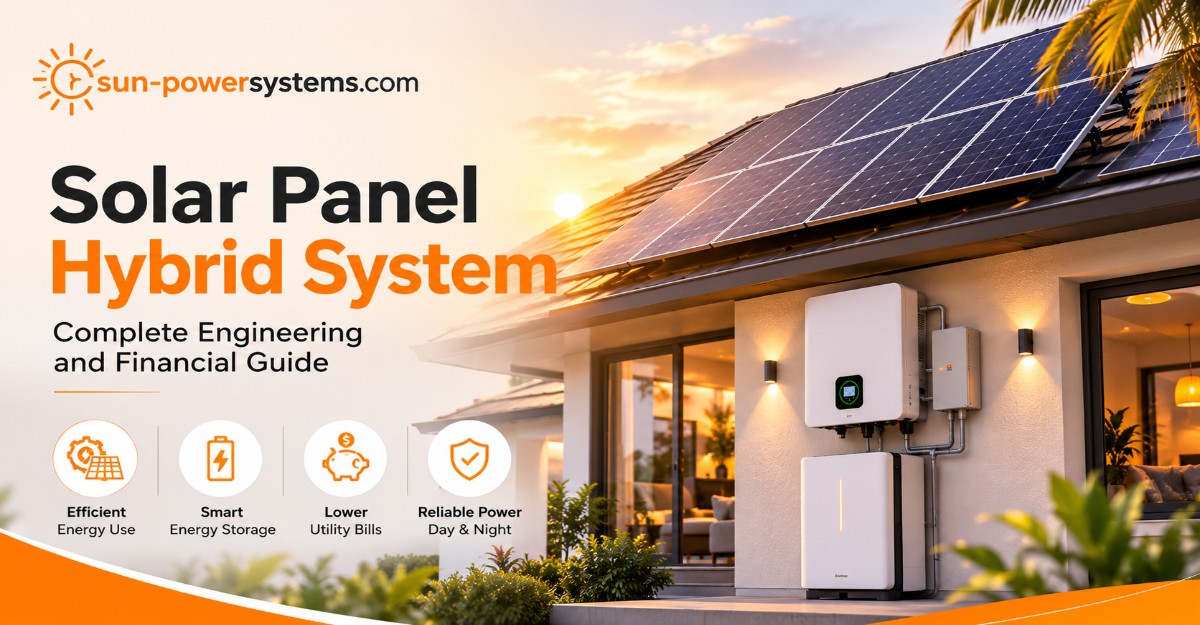
A solar panel hybrid system is a bidirectional energy management network that synchronizes photovoltaic generation, local battery storage, and the traditional utility grid. It utilizes an intelligent hybrid inverter to route direct current (DC) and alternating current (AC) electricity in real time. This configuration guarantees continuous backup power during grid failures while optimizing daily energy costs through load shifting and rate arbitrage.
What is a Solar Panel Hybrid System?
A solar panel hybrid system combines the continuous financial benefits of a grid-tied array with the energy security of an off-grid setup. Standard grid-tied systems must shut down during a utility blackout to protect linemen working on the wires. Completely off-grid systems lack the utility safety net and require massive battery banks to survive winter weather. The hybrid approach resolves this dilemma. It remains synchronized with the grid under normal conditions but physically disconnects via an internal transfer switch during an outage.
In practice, a hybrid setup operates as a microgrid. The core intelligence resides in the hybrid inverter. This device constantly reads home consumption data, solar production levels, and battery states of charge. Based on user-defined parameters, the hardware instantly dictates where every watt of power should travel. Homeowners rely on these systems to eliminate peak utility charges and keep critical medical devices or well pumps running when severe weather destroys utility infrastructure.
How Does the Hybrid Inverter Traffic Controller Work?
The operational logic of a hybrid system requires precision timing and continuous communication between components. A standard daily cycle follows a strict hierarchy of operations to maximize self-consumption and protect battery health.
- Generation: Photovoltaic modules absorb solar irradiance and generate high-voltage DC electricity.
- Conversion and Routing: The DC power travels down the conduit to the hybrid inverter. The internal Maximum Power Point Tracking (MPPT) charge controllers stabilize the voltage.
- Primary Self-Consumption: The inverter immediately converts the exact amount of DC needed into AC power to run active household appliances.
- Battery Charging: The inverter routes surplus DC power directly to the battery bank to recharge depleted cells.
- Grid Exportation: Once the battery bank reaches a 100% state of charge, the inverter pushes the remaining surplus AC power out to the utility grid for net metering credits.
- Load Shifting (Evening): As solar production drops at sunset, the inverter pulls stored DC power from the batteries, inverts it to AC, and powers the home to avoid expensive utility rates.
- Grid Supplementation: If household demand exceeds battery output limits, the system seamlessly blends stored energy with incoming utility power to meet the load.
- Island Mode (Blackout): Upon detecting a grid frequency collapse, the inverter opens its contactors within 20 milliseconds. It establishes an independent AC microgrid to power the home using only solar and battery reserves.
System Architecture: AC-Coupled vs. DC-Coupled
Engineers select between two distinct wiring topologies based on whether the project is a new installation or a retrofit of an existing solar array. Understanding the physical layout of these architectures prevents expensive redesigns.
A DC-coupled architecture runs the solar panels and the batteries through a single shared inverter. The solar panels generate DC power, and the batteries store DC power. Because the power stays in its direct current form until the final moment it enters the home electrical panel, this layout minimizes conversion losses. It represents the cleanest and most efficient design for brand new installations.
An AC-coupled architecture utilizes two completely separate inverters. The existing solar array uses a standard string inverter to convert DC to AC. A second, dedicated battery inverter then takes that AC power, converts it back to DC for storage, and inverts it back to AC when the home needs it. Homeowners use AC coupling exclusively to add backup capabilities to older solar arrays without ripping out the legacy equipment.
| Specification | DC-Coupled Architecture | AC-Coupled Architecture | Recommended Application |
| Component Count | Single Hybrid Inverter | Solar Inverter + Battery Inverter | New Installations |
| Round-Trip Efficiency | 94% to 97% | 88% to 92% | Retrofitting Legacy Systems |
| Installation Complexity | Moderate (Consolidated wiring) | High (Requires sub-panels) | Constrained Wall Space |
| Blackout Solar Charging | Native capability | Requires specific frequency shifting | High-Security Microgrids |
| Typical Equipment Cost | $3,500 (Single 12kW unit) | $5,000 (Two separate 7kW units) | Budget-Conscious Builds |
Battery Chemistry and Storage Capacity Metrics
Selecting the correct energy storage medium dictates both the physical footprint and the functional lifespan of the system. The industry has largely abandoned older technologies in favor of advanced lithium compounds.
Lithium Iron Phosphate (LiFePO4) dominates the modern residential market. This chemistry contains no cobalt, which eliminates the risk of thermal runaway and associated fire hazards. LiFePO4 batteries allow a 100% depth of discharge (DoD) without damaging the internal cell structure. They easily exceed 6,000 charge cycles, providing reliable daily cycling for over 15 years.
Lithium Nickel Manganese Cobalt (NMC) represents an alternative chemistry prized for its extreme energy density. NMC batteries pack more kilowatt-hours into a smaller physical enclosure. Homeowners with restricted garage space frequently choose NMC units like the Tesla Powerwall. However, NMC chemistry degrades slightly faster than LiFePO4 and requires aggressive liquid cooling systems to maintain safe operating temperatures.
| Battery Chemistry | Depth of Discharge (DoD) | Lifecycle Rating | Thermal Runaway Risk | Cost per kWh |
| Lithium Iron Phosphate (LiFePO4) | 95% to 100% | 6,000 to 8,000 cycles | Extremely Low | $350 to $500 |
| Lithium Nickel Manganese Cobalt (NMC) | 90% to 100% | 4,000 to 5,000 cycles | Moderate (Requires cooling) | $600 to $800 |
| Lithium Titanate (LTO) | 100% | 20,000+ cycles | Extremely Low | $1,200 to $1,500 |
| Absorbent Glass Mat (AGM Lead-Acid) | 50% | 500 to 800 cycles | Low | $150 to $200 |
Sizing for Continuous and Surge Loads
Proper hardware sizing requires differentiating between continuous wattage and peak surge demands. Homeowners frequently miscalculate their emergency power needs, resulting in immediate system shutdowns during a blackout.
Continuous power defines the sustained wattage an inverter can supply indefinitely without overheating. A typical residential hybrid inverter provides between 8 kW and 12 kW of continuous AC output. This easily handles standard baseloads including lighting, refrigerators, internet routers, and television sets.
Surge power measures the brief, massive spike in electricity required to start heavy electric motors. A central air conditioning compressor or a deep well pump demands up to four times its running wattage for the first three seconds of operation. Engineers refer to this spike as Locked Rotor Amps (LRA). If a 3 kW well pump requires a 12 kW surge to start, and the inverter is only rated for a 9 kW peak, the system will overload and collapse the microgrid instantly.
Hardware Selection: Evaluating Tier 1 Components
The market contains distinct tiers of equipment ranging from budget DIY units to enterprise-grade smart home managers. Matching the hardware to the specific site requirements prevents communication errors and premature failures.
Low-voltage 48V systems rely on heavy copper busbars to move large amounts of current. These components feature modular, rack-mounted battery blocks that require manual wiring. High-voltage systems (400V) utilize stackable tower batteries that snap together without exposed cables. High-voltage architectures operate more efficiently and allow for thinner gauge wire, but they lock the consumer into a closed, proprietary hardware ecosystem.
| Manufacturer & Model | Architecture Type | Continuous AC Output | Battery Voltage Range | Notable Feature |
| Sol-Ark 15K | DC-Coupled All-in-One | 15,000 Watts | 48V (Low Voltage) | Massive 200A passthrough capability |
| Tesla Powerwall 3 | AC or DC-Coupled | 11,500 Watts | Internal (High Voltage) | Integrated liquid thermal management |
| EG4 18KPV | DC-Coupled All-in-One | 12,000 Watts | 48V (Low Voltage) | Open-source battery communication |
| Victron MultiPlus-II | AC-Coupled | 3,000 to 10,000 Watts | 48V (Low Voltage) | Unmatched off-grid surge capacity |
| Enphase IQ8 Microinverters | AC-Coupled Distributed | 300 to 380 Watts (each) | Compatible with 384V | Panel-level rapid shutdown compliance |
Financial Investment and Installation Timelines
A solar panel hybrid system requires a substantially higher initial capital investment compared to standard grid-tied setups. The inclusion of heavy lithium storage and advanced power electronics heavily impacts the budget.
A standard suburban home requiring a 7 kW solar array and a 15 kWh battery bank faces typical equipment and installation costs between $22,000 and $28,000 before tax incentives. High-load smart homes requesting whole-home backup with a 15 kW array and 40 kWh of storage easily push project costs past the $45,000 mark. The federal Investment Tax Credit (ITC) currently offsets 30% of total system costs for United States residents, significantly altering the final return on investment.
System payback periods depend entirely on local utility rate structures. In regions with flat electricity rates, the battery provides pure security with little financial return. In regions with aggressive Time-of-Use pricing (where evening electricity costs triple), the battery performs daily arbitrage. This active load shifting can reduce the payback period from 12 years down to 7 years.
| System Scale | Solar Array Capacity | Storage Capacity | Estimated Total Cost (Pre-Tax) | Installation Timeframe |
| Essential Loads | 5 kW | 10 kWh | $16,000 to $22,000 | 1 to 2 Days |
| Standard Home | 8 kW | 20 kWh | $25,000 to $32,000 | 2 to 3 Days |
| Whole-Home Backup | 12 kW | 30 kWh | $35,000 to $45,000 | 3 to 4 Days |
| Luxury / Commercial | 20 kW | 60+ kWh | $60,000 to $85,000 | 1 Week |
Regulatory Compliance and Safety Standards
Installing heavy electrical equipment requires strict adherence to international safety codes. Ignoring these standards risks failed municipal inspections and denied homeowner insurance claims.
The National Electrical Code (NEC) governs all US installations. NEC Section 705 dictates the rules for interconnecting power production sources with the utility grid. Installers must carefully calculate busbar ratings to ensure the combined feed from the utility and the hybrid inverter does not exceed the physical limits of the main electrical panel.
Furthermore, UL 9540 certification is strictly enforced for residential energy storage systems. This standard tests the complete integration of the battery, the inverter, and the management software to guarantee they will not create a thermal runaway event. Modern systems must also comply with NEC Rapid Shutdown requirements. This rule mandates that all rooftop solar voltage must drop below 30 volts within 30 seconds of a grid failure, ensuring first responders can safely walk on the roof during a fire event.
Maintenance Protocols for Long-Term Operation
While hybrid systems are generally autonomous, proactive maintenance prevents gradual degradation. Firmware updates and physical inspections extend the life of the hardware significantly.
- Filter Cleaning: Active cooling fans on large hybrid inverters pull dust into the chassis. Homeowners must vacuum these intake filters quarterly to prevent internal components from overheating and derating their power output.
- Torque Verification: Thermal cycling causes metal connections to expand and contract. Electricians should verify the torque specifications on all battery terminals and breaker connections annually to prevent high-resistance arcing.
- State of Health (SoH) Monitoring: The Battery Management System (BMS) tracks internal cell resistance. Reviewing the SoH data via the manufacturer application helps identify single cell degradation before it compromises the entire battery bank.
- Firmware Updates: Inverter manufacturers routinely push software patches to refine MPPT algorithms and improve grid synchronization. Connecting the system to local Wi-Fi ensures automatic deployment of these critical updates.
Frequently Asked Questions About solar panel hybrid system
What happens to my hybrid solar system when the grid goes down?
The hybrid inverter detects the voltage drop and physically disconnects your home from the utility lines within milliseconds. It then shifts into island mode, drawing power from your battery bank and solar panels to keep your designated circuits running continuously without back-feeding dangerous power to utility workers.
Can I take my home entirely off-grid with a hybrid setup?
Yes, but doing so is financially inefficient in most climates. A hybrid setup allows you to rely primarily on solar and batteries while keeping the grid connected strictly as a backup source for weeks with heavy cloud cover. Severing the grid connection entirely requires buying massively oversized battery banks to survive winter production lulls.
What size hybrid inverter do I need for a 2,000 square foot house?
A typical 2,000 square foot home requires an inverter rated for 8 kW to 12 kW of continuous output. You must add the running wattage of all critical appliances you intend to use simultaneously. If you plan to run central air conditioning alongside an electric oven, you will need a 15 kW unit or multiple smaller inverters wired in parallel.
How do I clean and maintain my solar panels and battery bank?
Solar panels require a light rinse with deionized water twice a year to remove dust buildup, avoiding harsh chemicals. The battery bank requires virtually zero physical maintenance if it uses lithium chemistry, but you must keep the room temperature between 50 and 80 degrees Fahrenheit and ensure the inverter cooling vents remain clear of dust.
Will a hybrid system charge my electric vehicle during a blackout?
Yes, provided your battery bank is large enough and the inverter output can handle the load. However, EV chargers draw enormous continuous power (typically 7 kW to 9 kW). Most homeowners configure their smart energy management system to automatically disable the EV charger during a blackout to preserve limited home battery capacity for refrigerators and lighting.
Conclusion
A well-engineered solar panel hybrid system provides the ultimate combination of financial leverage and physical energy security. By bridging the gap between grid-tied efficiency and off-grid independence, this architecture allows consumers to dictate exactly how and when they consume power.
Success requires calculating accurate surge loads, selecting the proper AC or DC coupled topology, and utilizing safe LiFePO4 battery chemistry. As utility grids become increasingly unpredictable and peak electricity rates continue to climb, deploying a hybrid system ensures absolute resilience for modern residential properties.