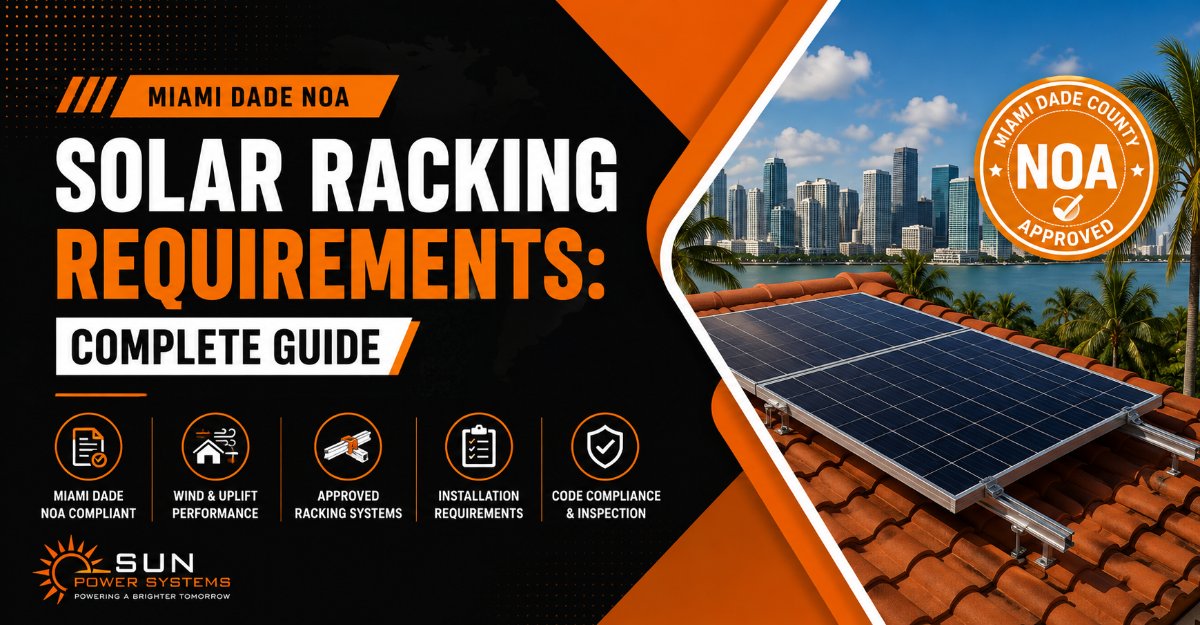
The Miami Dade NOA solar racking requirements mandate that any solar mounting system installed in Miami-Dade or Broward counties must hold an active Notice of Acceptance (NOA) proving it can withstand 175–185 mph hurricane wind forces. Without a valid NOA, or a site-specific Professional Engineer (PE) design proving equivalent High Velocity Hurricane Zone (HVHZ) compliance, building departments will automatically reject the solar permit application.
Key Facts / At a Glance:
- Wind Speed Threshold: Systems must be engineered for an Ultimate Design Wind Speed ($V_{ult}$) of 175–185 mph.
- Uplift Forces: Corner roof zones (Zone 3) routinely experience -50 psf to -100 psf of uplift pressure.
- Fastening Density: Miami-Dade arrays require roof attachments every 2–3 feet, nearly double the standard national spacing.
- Edge Setbacks: Solar panels generally cannot be installed within 3 feet of roof ridges or eaves.
- Engineering Cost: Site-specific PE stamps for HVHZ solar designs range from $500 to $800 per residential project.
What is the Miami-Dade NOA for Solar Racking?
The Miami-Dade Notice of Acceptance (NOA) is a rigorous product approval certification verifying that a construction material, including solar racking, meets the world’s strictest wind uplift and debris impact standards. Issued by the Miami-Dade County Product Control Section, this certification covers every structural component that secures a solar panel to the roof deck: the rails, L-feet mounts, clamps, roof penetrations, and fasteners.
High Velocity Hurricane Zone (HVHZ) Defined
The HVHZ is a distinct geographic jurisdiction comprising Miami-Dade and Broward counties. The Florida Building Code (FBC) separates the HVHZ from the rest of the state, requiring building components in this zone to undergo aggressive cyclic wind pressure testing that standard national systems fail. A solar racking NOA explicitly certifies that the hardware passed these HVHZ-specific tests.
NOA vs. Florida Product Approval (FPA)
The statewide Florida Product Approval (FPA) applies to the remaining 65 counties in Florida, but it is not automatically valid in Miami-Dade or Broward. While an FPA requires standard wind testing, an NOA mandates higher safety multipliers and specific testing protocols (like TAS 202). A racking system with an FPA can only be used in the HVHZ if accompanied by a “Miami-Dade Tech Tip” or a local PE’s site-specific engineering letter proving it meets the NOA threshold.
What Are the Core Structural and Engineering Requirements?
To survive a Category 5 hurricane, Miami-Dade NOA solar racking requirements rely on precise mathematics governing uplift, spacing, and placement. Every NOA includes a “Limitation of Use” document that dictates exactly how the system must be installed to maintain its certification.
How Much Wind and Uplift Must Racking Withstand?
Solar racking in Miami-Dade must resist an Ultimate Design Wind Speed ($V_{ult}$) of 175 to 185 mph, depending on the exact proximity to the coastline. Because wind flowing over a roof creates negative pressure (suction), the racking must counteract extreme uplift forces. In the center of the roof (Zone 1), uplift may be -30 psf (pounds per square foot). At the corners (Zone 3), uplift forces multiply, routinely hitting -50 psf to -100 psf, actively trying to tear the panels from the rafters.
How Does the HVHZ Alter Fastener Spacing and Roof Zones?
Standard national solar installations support rails with roof attachments every 4 to 6 feet. In the Miami-Dade HVHZ, rails must be supported every 2 to 3 feet to distribute the extreme wind loads safely into the roof trusses. Furthermore, the NOA strictly regulates “Zones.” Installers must maintain a mandatory 3-foot buffer from all roof edges, eaves, and ridges (Zone 3) to avoid placing panels in areas where wind vortexes are most destructive.
Which Solar Racking Brands Have an Active Miami-Dade NOA?
Not all Tier-1 US solar racking brands maintain a system-wide NOA, as the certification process costs hundreds of thousands of dollars and requires constant renewal. The following systems are verified for HVHZ applications.
| Brand & System | Certification Basis | Key Feature | Best Application |
| Unirac (SolarMount / NXT) | Full System NOA | First to secure full NOA; highly trusted by local inspectors. | Residential Shingle/Tile |
| SnapNrack (SpeedSeal / Ultra Rail) | Full System NOA | Incorporates chemical sealing tech, removing the need for metal flashing. | High-Rainfall Leak Prevention |
| K2 Systems (CrossRail) | Full System NOA | Versatile mounting options with explicit 2026 NOA renewals. | Complex Roof Shapes |
| Solar Stack (Solar Stack) | Full System NOA | Non-penetrating structural adhesive mount; zero roof drilling. | Flat / Membrane Roofs |
| QuickBOLT (QB2) | Component NOA | Specialized mounting bolt with Microflashing technology. | Concrete Tile Roofs |
| IronRidge (XR Series) | FPA + Site Engineering | Relies on statewide FPA modified by a Florida PE for the HVHZ. | Highly Engineered Arrays |
The Expert Verdict on Racking Selection
For homeowners with standard shingle or tile roofs, Unirac SolarMount and SnapNrack SpeedSeal are the safest choices. Their NOAs are clean, comprehensive, and universally recognized by Miami-Dade plan reviewers, practically eliminating permitting delays. For commercial flat roofs, Solar Stack is the definitive winner; eliminating roof penetrations preserves the commercial roof warranty, which is critical in South Florida’s torrential summer climate.
How Do You Pass the Miami-Dade Solar Permitting Process?
Understanding the precise workflow of the Miami-Dade building department prevents costly permit rejections. The county routes solar permits through rigorous structural and electrical reviews, demanding exact documentation.
Step 1: Verify the NOA Expiration and Code Cycle
Before purchasing equipment, you must verify the NOA number on the Miami-Dade County Product Control search portal. The NOA must be active on the date the permit is submitted, and it must explicitly align with the current Florida Building Code (FBC 8th Edition – 2023). Submitting an expired NOA results in an automatic, immediate rejection.
Step 2: Obtain Florida PE Site-Specific Engineering
A Florida-licensed Professional Engineer must draft site-specific plans. The PE calculates the wind loads based on the home’s exact height, roof pitch, and exposure category. They will map out the roof zones, proving that the proposed racking layout complies with the maximum span lengths dictated by the NOA.
Step 3: Submit the “Limitation of Use” and Calculations
When filing the permit, the installer must upload the specific “Limitation of Use” pages from the racking NOA, alongside the PE’s signed and sealed engineering calculations. Plan reviewers check the PE’s math directly against the NOA’s structural capacity charts.
Step 4: Execute the Strict Fastening Schedule
During installation, crews must follow the exact fastening schedule outlined in the approved plans. If the NOA dictates a 5/16″ x 3″ stainless steel lag screw embedded 2.5 inches into a truss, any deviation voids the engineering. Inspectors increasingly require photographic evidence of torque wrenches set to the exact inch-pounds specified in the NOA.
What Are the Common Inspection Failures (and How to Fix Them)?
Most failed solar inspections in Miami-Dade and Broward counties do not stem from poor electrical work, but from structural deviations that violate the NOA’s “Limitation of Use.”
Using the Wrong Fastener or Substituting Parts
The most common failure occurs when an installer runs out of the specific lag screw listed in the NOA’s Bill of Materials (BOM) and substitutes a generic hardware store bolt. Inspectors check the head markings on fasteners.
- The Fix: You must use the exact manufacturer part number listed in the NOA. If a substitute was used, the entire array must be unbolted, and the correct fasteners installed and properly sealed.
Violating the Roof Edge Setback (Zone 3)
Installers trying to maximize solar production often push panels into the 3-foot roof edge buffer. Inspectors will measure this distance physically.
- The Fix: Redesign the array layout prior to installation to ensure all rails and modules terminate strictly within Zone 1 and Zone 2.
Flashing Failures on Concrete Tile Roofs
Miami-Dade enforces strict waterproofing standards. Simply sliding an aluminum flashing under a tile is often insufficient. Many inspectors require a “3-course method” (primer, fabric mesh, and roofing mastic) for penetrations unless the NOA explicitly approves a single-step flashing like SnapNrack’s SpeedSeal.
- The Fix: Always verify the waterproofing method against the local jurisdiction’s roofing code amendments before drilling.
How Much Do HVHZ Solar Racking Systems Cost?
Compliance with Miami-Dade NOA solar racking requirements increases the total cost of a solar installation compared to the rest of the country. Expect to pay a 10% to 15% premium for an HVHZ-compliant system.
Because the HVHZ requires rails to be supported every 2 feet instead of 4 feet, the system requires double the amount of L-feet, lag screws, and roof flashings. This doubles the hardware cost and drastically increases the labor time required for drilling and waterproofing. Additionally, mandatory site-specific engineering stamps cost between $500 and $800. Consequently, while standard Florida solar might cost $2.20 per watt, a fully permitted Miami-Dade system typically runs between $2.36 and $3.00 per Watt fully installed.
Frequently Asked Questions (FAQ)
Does Broward County require the Miami-Dade NOA?
Yes. Broward County is legally part of the High Velocity Hurricane Zone (HVHZ) under the Florida Building Code. Building departments in Fort Lauderdale, Hollywood, and surrounding areas enforce the exact same NOA documentation and 175+ mph wind requirements as Miami-Dade County.
Can I install solar panels myself in Miami-Dade?
DIY solar installation is highly discouraged and practically impossible in Miami-Dade. The permitting process requires a licensed Florida Professional Engineer to sign and seal structural plans. Furthermore, the liability for wind-borne debris is immense; a minor mistake in torque settings can result in catastrophic failure and voided homeowner’s insurance.
What happens if the NOA expires during my permit review?
If a racking system’s NOA expires while your permit is actively under review by the county, the permit is grandfathered in under the active status at the time of submission. However, if the permit expires or needs to be resubmitted after the NOA expiration date, a new, active NOA must be provided.
How do inspectors check solar mount torque?
Miami-Dade inspectors are highly scrutinized and will manually verify racking tightness. They often require the lead installer to present a calibrated torque wrench on the roof during the final inspection, demonstrating that mid-clamps and end-clamps are tightened to the exact inch-pound specification listed in the NOA.