Below is the complete, publish ready blog post with SEO metadata, keyword targeting, and two colorful, mobile responsive HTML modules (a phase table and a timeline bar chart) that you can drop straight into your CMS. The
If you are budgeting for a rooftop solar array on your office, warehouse, or retail building, the first question your CFO will ask is simple: how long does a commercial solar installation take before it starts cutting our power bill?
The honest answer is that a typical mid sized commercial system of 100 kW to 250 kW takes roughly 3.5 to 6 months from the day you sign a contract to the day the utility grants Permission to Operate. The physical work on your roof is the fastest part, often just 1 to 3 weeks. The waiting happens in engineering, permitting, and utility review.
This guide breaks down every phase of the commercial solar installation timeline, explains exactly why each step takes as long as it does, and gives you the insider details that competing articles skip, including the specific structural and interconnection rules that govern High Velocity Hurricane Zone (HVHZ) projects in South Florida.
The Short Answer: Commercial Solar Installation Timeline at a Glance
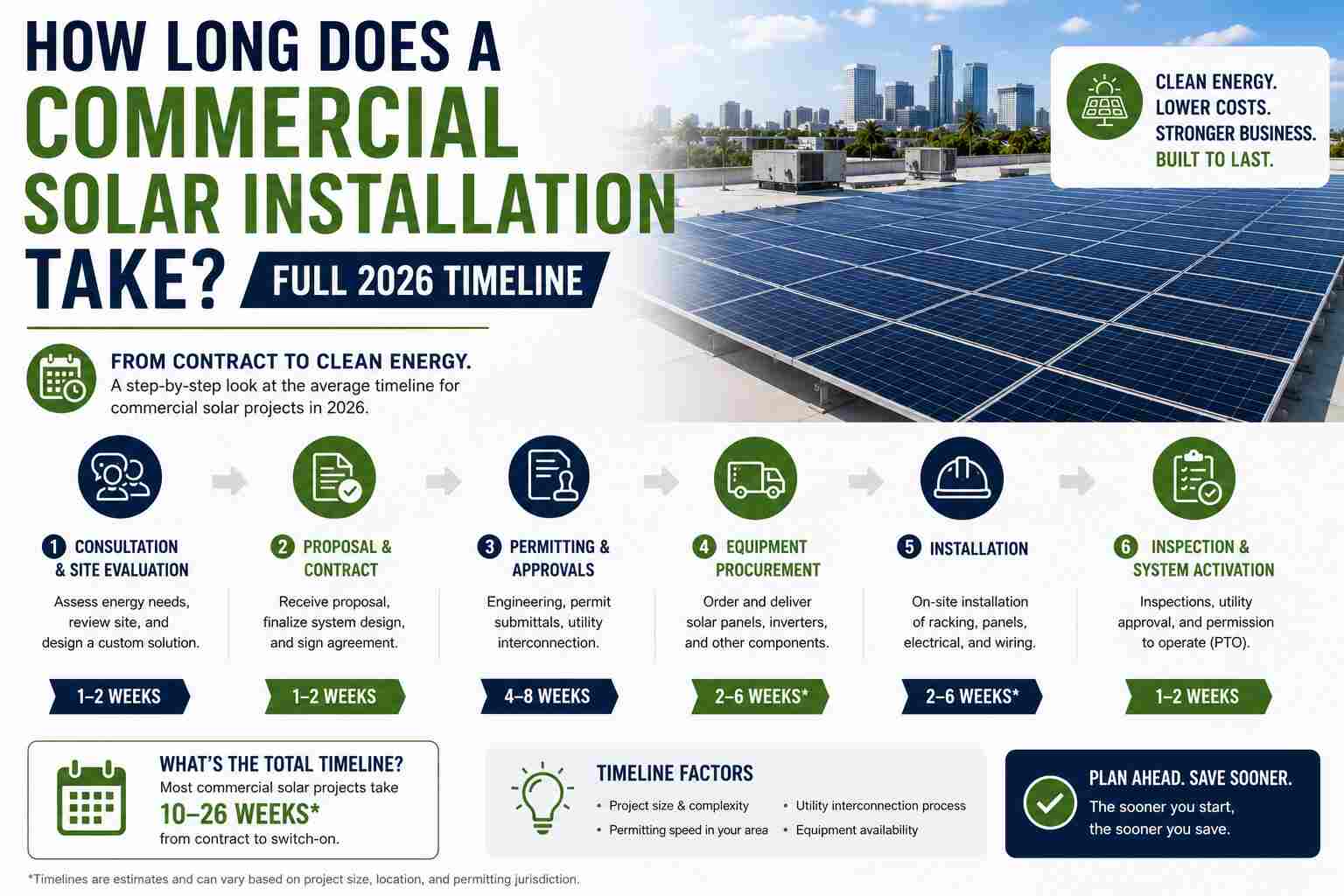
For a standard 100 kW to 250 kW rooftop project, plan for 14 to 18 weeks in most markets. Coastal Florida projects that must meet hurricane engineering codes and interconnect with Florida Power & Light (FPL) tend to land in the 3.5 to 4.5 month range, because expedited state permitting is offset by heavier structural and utility requirements.
Here is the full timeline visualized as a colorful, mobile responsive bar chart you can embed directly:
Commercial Solar Timeline (100 to 250 kW)
Total: roughly 14 to 18 weeks (3.5 to 4.5 months)
Phase 1: Design and Engineering (1 to 4 Weeks)
Every commercial solar project starts with a site assessment and a custom electrical layout. Engineers pull your utility bills, study your roof structure, and model where panels can sit for maximum production. For a straightforward flat roof in a mild climate, this can wrap in one to two weeks.
In a hurricane zone, this phase stretches to four full weeks, and this is where competitors gloss over the details. A licensed Florida Professional Engineer (P.E.) must run structural wind load calculations proving the array can survive 175 to 185 MPH gusts. Every panel, rail, clamp, and anchor has to carry a valid Miami Dade Notice of Acceptance (NOA) or an active Florida Product Approval. You cannot use generic off the shelf racking. That single requirement is the biggest reason HVHZ commercial solar engineering takes longer than a standard install.
Phase 2: Permitting and Municipal Approval (1 to 3 Weeks)
Permitting is where timelines historically went to die, sometimes stalling projects for six weeks or more. Florida changed that. Under Florida House Bill 683, municipal building offices must review qualifying single trade solar permit applications within 5 business days.
The catch is precision. If your plan set is missing the correct Miami Dade Electrical Category 34 fee sheets, or if it violates NEC Article 690 conductor rounding rules, the office rejects it and your clock restarts. A single sloppy submission can cost you two weeks. This is why choosing an installer who knows local portal requirements matters more than the headline permitting law.
Phase 3: Equipment Procurement (2 to 4 Weeks)
Once your permit is in motion, your installer orders the hardware: commercial grade panels, three phase inverters, and mounting systems. A mid sized project uses roughly 250 to 600 panels.
For coastal builds, procurement runs longer because storm rated attachments, ballast blocks, and heavy mechanical roof anchors with watertight structural seals ship slower than standard residential parts. Supply chain conditions and inverter lead times can also swing this window, so smart operators lock in orders the moment engineering is approved rather than waiting for the final permit.
Phase 4: Onsite Construction (1 to 3 Weeks)
This is the part most people picture, and it is the quickest. A crew of 5 to 10 installers runs the conduit, mounts the racking, sets the modules, and wires everything to your electrical room. For a 100 kW to 250 kW system, two weeks is typical.
The biggest variable here is weather. South Florida summers bring daily afternoon lightning and heavy rain that make roof work unsafe. Scheduling construction for spring (March to May) is a proven way to avoid weeks of weather related delays.
Phase 5: Utility Interconnection and Permission to Operate (3 to 4 Weeks)
Even after your panels are bolted down, you cannot flip the switch until the utility says so. This final phase is often the true bottleneck. A 100 kW to 250 kW system falls under FPL Tier 2 or Tier 3 net metering rules, which require a completed net metering application, an electrical one line diagram, an application fee of roughly 400 to 1,000 dollars, proof of a 1 to 2 million dollar commercial liability policy, and a three phase WYE service for systems 50 kW and above. Only after this review will FPL swap your meter and issue Permission to Operate (PTO).
Here is the full phase breakdown in a clean, mobile responsive table:
| Phase | Duration | Key Requirement |
|---|---|---|
| 1. Design & Engineering | 1 to 4 wks | Wind load P.E. calcs, NOA approved parts |
| 2. Permitting | 1 to 3 wks | 5 day review under HB 683 |
| 3. Procurement | 2 to 4 wks | Storm rated racking & inverters |
| 4. Construction | 1 to 3 wks | 5 to 10 installer crew, weather dependent |
| 5. Interconnection & PTO | 3 to 4 wks | FPL net metering, fees, insurance proof |
| Total Project | 14 to 18 weeks (3.5 to 4.5 months) | |
Two Utility Hardcaps That Can Derail Your Timeline
Beyond the phases, two FPL grid rules can force a redesign and add weeks if your system is sized wrong from the start:
- The 90 percent capacity rule: FPL limits total solar generation to 90 percent of your building’s dedicated transformer or service capacity. Exceed it, and you may have to pay out of pocket to upsize grid infrastructure before approval.
- The 115 percent annual generation cap: Your array cannot be designed to produce more than 115 percent of your building’s historical annual electricity usage.
Confirming both limits before blueprints are submitted is the single easiest way to avoid a mid project delay.
How to Speed Up Your Commercial Solar Installation
You cannot control utility queues, but you can shave weeks off the schedule. Order long lead equipment as soon as engineering is approved rather than after permitting. Choose an installer fluent in your county’s permit portal so submissions pass on the first try. Right size your system against the 90 and 115 percent caps up front. Finally, target a spring construction window to sidestep summer storm delays.
Conclusion
So, how long does a commercial solar installation take? For most 100 kW to 250 kW projects, expect 3.5 to 6 months from signature to switch on, with the bulk of that time spent in engineering, permitting, and utility interconnection rather than on the roof. In coastal Florida, hurricane grade engineering and FPL review shape the schedule far more than the physical build. Understanding each phase, and the caps and code rules behind it, lets you plan capital, cash flow, and construction with confidence instead of guesswork.
Next Step
Ready to lock in a realistic timeline for your building? Contact our commercial solar team for a free site assessment and a phase by phase project schedule tailored to your roof, your utility, and your energy goals. Request your consultation today and start counting down to lower energy bills.