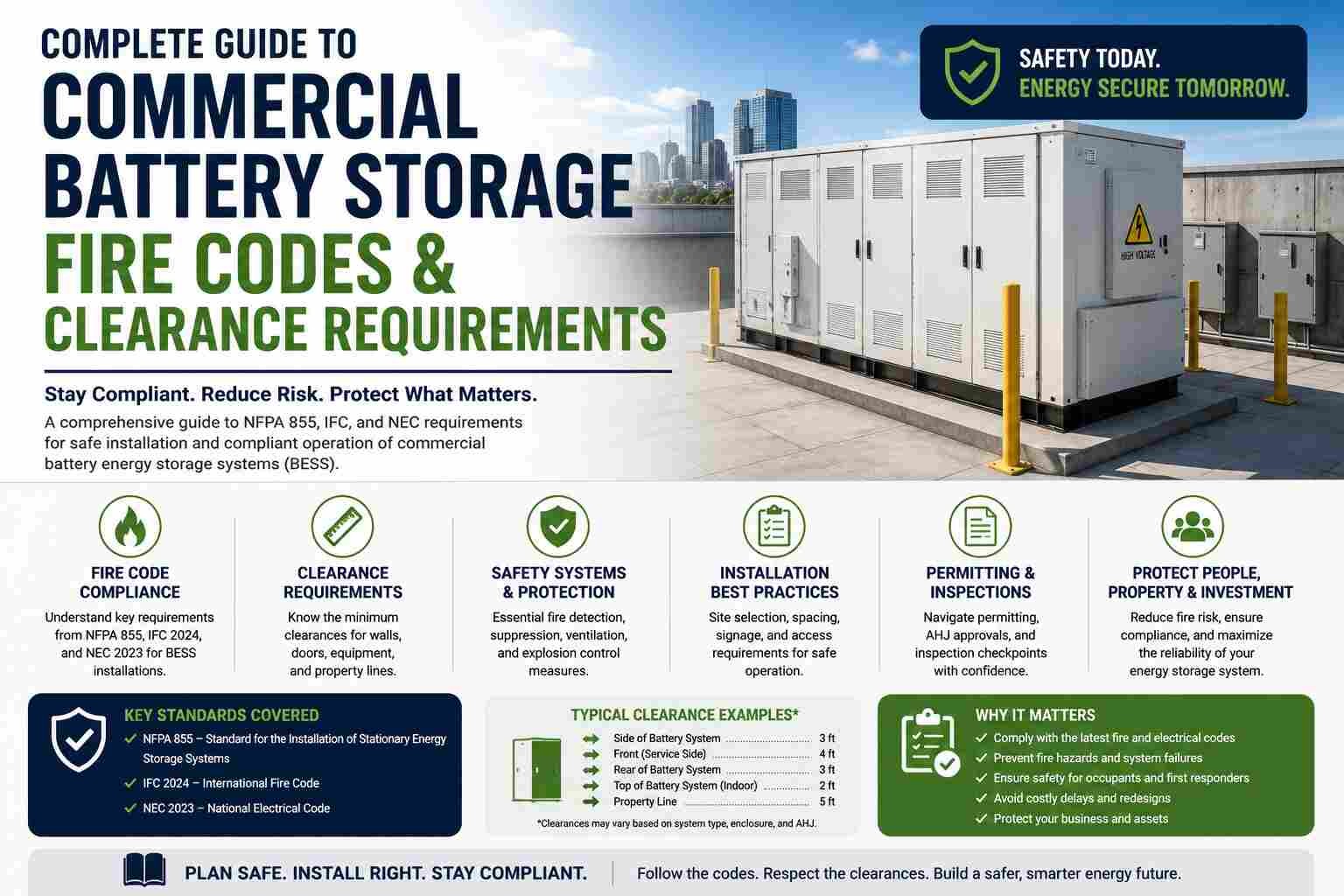
The global transition to renewable energy has triggered massive investments in large scale energy storage. However, deploying commercial battery installations brings complex safety challenges. Facility managers, developers, and engineers face rigorous regulatory hurdles when designing and deploying these high capacity systems. Securing project permits requires a deep understanding of commercial battery storage fire codes and NFPA 855 clearance requirements.
If your facility plans to install commercial battery systems, you must comply with strict fire safety standards designed to prevent catastrophic thermal events. Local fire marshals scrutinize every detail of a project footprint before granting approval. A single spatial violation can delay an entire project for months, costing thousands in redesign fees and lost revenue.
This comprehensive guide breaks down the critical regulations governing battery energy storage system fire safety. We explore exactly what you need to know about spatial separations, maximum capacity thresholds, hazard mitigation, and advanced fire suppression technology to keep your next commercial energy project fully compliant and inherently safe.
The Regulatory Baseline for Battery Energy Storage System Fire Safety
Commercial energy storage systems must navigate a complex web of strict building regulations. The two dominant standards governing these installations in the United States and internationally are the National Fire Protection Association standard 855 and the International Fire Code. Together, they create a robust framework for preventing, containing, and extinguishing severe battery fires.
The latest IFC 1207 battery storage regulations align closely with current NFPA 855 standards. These codes apply to almost all commercial scale electrochemical storage systems. According to the regulatory text, any lithium ion installation with a combined capacity exceeding 20 kilowatt hours falls strictly under these commercial regulations. Once you cross this 20 kilowatt hour threshold, your project must incorporate specialized safety engineering, automatic fire suppression, and highly precise spatial layouts.
Understanding these foundational documents is merely the first step. Translating their extensive chapters into an actionable site plan requires deep knowledge of how local inspectors interpret the rules. As the technology evolves rapidly, fire codes adapt constantly, meaning engineering teams must stay completely up to date with the latest code cycles to ensure successful deployments.
Navigating Commercial BESS Clearance Rules
Clearance and spacing dictate the physical footprint of any energy storage facility. Proper spatial design prevents a fire in one unit from spreading to an adjacent unit or a nearby building. Commercial BESS clearance rules are absolute, though they offer specific engineering pathways for layout exceptions.
The fundamental rule requires a 3 foot separation distance between individual battery enclosures, adjacent racks, and room walls. Planners must divide energy storage units into distinct groups, with each group capped at a maximum of 50 kilowatt hours. Between each of these 50 kilowatt hour groups, you must maintain the mandatory 3 foot clearance gap.
For outdoor installations, the setbacks become even more restrictive. Code requires a minimum clearance of 10 feet between the battery enclosure and any public way, lot line, combustible vegetation, or building opening. This 10 foot boundary acts as a critical safety buffer to protect the general public and surrounding infrastructure. Inspectors also enforce vertical clearances, meaning any overhanging tree branches or building elements protruding into this space must be removed.
However, if a facility locates the system 100 feet or more away from any building or property line, inspectors classify it as a remote installation. Remote installations often receive complete waivers for the strict capacity limits and spacing rules because they pose minimal exposure risk to the surrounding community.
Unlocking UL 9540A Spacing Exceptions
System designers often find the standard 3 foot clearance requirement impossible to meet in tight urban environments or inside small commercial electrical rooms. Fortunately, the fire codes provide a mechanism to drastically reduce these distances. You can achieve highly compact footprints by utilizing UL 9540A spacing exceptions.
UL 9540A is a rigorous large scale fire test method that evaluates exactly how a specific battery system handles severe thermal runaway. The test features four distinct stages testing the cell, the module, the unit, and the installation level. If a manufacturer subjects their battery unit to this extreme testing and proves that a fire will not propagate to an adjacent unit, the local fire official may permit heavily reduced clearances.
In many cases, successful UL 9540A test data allows engineers to place battery cabinets just a few inches apart or even completely back to back. Obtaining this test report from your equipment manufacturer is the single most valuable step you can take to optimize your system layout.
Managing Maximum Allowable Quantity MAQ Battery Storage Limits
In addition to physical spacing, fire codes strictly limit the total amount of energy you can store in one specific area. The maximum allowable quantity MAQ battery storage limits are explicitly designed to cap the total combustible load a fire department might face during an emergency response.
For indoor installations, the standard code limits total combined capacity to 600 kilowatt hours per designated fire area. If your commercial facility requires significantly more power, you cannot simply pack additional batteries into the same room.
Exceeding the 600 kilowatt hour threshold triggers advanced architectural requirements. You must separate the batteries into dedicated rooms built with heavily fire rated walls, floors, and ceilings. Furthermore, these high capacity rooms demand sophisticated explosion venting architectures and dedicated emergency power off circuits.
Understanding your MAQ limits early in the design phase prevents costly structural modifications later. Facility owners should consult with their electrical engineering teams to divide large commercial systems intelligently across multiple fire areas to stay safely below these critical safety thresholds.
Thermal Runaway Propagation LFP vs NMC Chemistries
Not all lithium ion batteries behave identically during a catastrophic failure. The chemical composition of the battery dictates its thermal stability and how it reacts under severe stress. Code officials evaluate project risks based heavily on the specific chemistry you choose. The two most common commercial chemistries offer a stark contrast in thermal runaway propagation LFP vs NMC.
Nickel Manganese Cobalt batteries pack a highly dense energy profile but suffer from lower thermal stability. An NMC cell can enter thermal runaway at temperatures around 150 to 180 degrees Celsius. When it fails, the chemical reaction releases its own oxygen, feeding an intense, fast spreading fire. NMC fires require massive amounts of continuous cooling and rarely qualify for zero clearance spacing exceptions.
Conversely, Lithium Iron Phosphate batteries feature a much more robust and stable chemical structure. They require much higher temperatures to fail, typically between 270 and 300 degrees Celsius. When LFP cells experience thermal runaway, they rarely ignite immediately. Instead, they release massive volumes of thick, flammable off gas. Because LFP cells do not release oxygen during failure, manufacturers frequently pass the UL 9540A tests without dangerous fire propagation, allowing for highly compact system layouts.
Battery Storage Explosion Control Deflagration and Ventilation
Because modern battery failures often result in heavy off gassing before a fire actually breaks out, managing these toxic and flammable vapors is critical. Battery storage explosion control deflagration requirements form a major pillar of commercial fire safety.
When a battery module vents, it rapidly releases hydrogen, carbon monoxide, and other highly volatile chemical compounds. If these gases accumulate inside an enclosed electrical room or a walk in container, a single spark can cause a devastating deflagration event. To prevent this dangerous buildup, codes mandate continuous mechanical exhaust ventilation systems. These systems must consistently limit the concentration of flammable gases to well below 25 percent of the lower flammable limit.
For indoor rooms and large walk in outdoor enclosures, engineers must also incorporate deflagration venting panels designed strictly to NFPA 68 standards. These specially engineered panels blow outward during an overpressure event, directing the blast force safely outside and protecting the structural integrity of the surrounding building.
To ensure these critical ventilation systems never fail during a grid outage, they must be permanently hardwired into a legally required standby power source such as a backup generator or uninterruptible power supply. All electrical components inside the space must also feature explosion proof ratings.
Commercial ESS Fire Suppression Requirements
Even with perfect ventilation and spacing, active fire fighting systems remain a non negotiable code requirement. Commercial ESS fire suppression requirements demand multilayered approaches tailored uniquely to the specific hazards of the installation.
Standard commercial smoke alarms simply do not react fast enough for battery applications. Code requires early warning fire detection systems. Engineers typically specify gas speciation sensors that detect battery off gassing long before visible smoke appears. Some advanced designs also utilize radiant energy sensors integrated directly into the master fire alarm control panel for instant activation.
Once a fire begins, the suppression system must activate instantly. For highly volatile chemistries, local codes mandate automatic water sprinkler systems engineered to deliver a heavy density of cooling water over the entire battery area.
While clean agent suppression systems like Novec 1230 can quickly extinguish open electrical flames in the room, they provide absolutely no cooling effect. Because intense cooling is essential to stop a cascading thermal runaway reaction inside a tightly packed battery module, water based suppression remains the gold standard required by most fire marshals.
Achieving Authority Having Jurisdiction AHJ Approval ESS
The final hurdle in any commercial battery project is convincing the local fire official that your design is fundamentally safe. Authority having jurisdiction AHJ approval ESS is never guaranteed simply by submitting a standard blueprint. Inspectors wield significant discretionary power to demand additional safety measures beyond the written code if they feel the site poses unique risks.
To secure this approval smoothly, developers must submit a comprehensive hazard mitigation analysis HMA BESS. This extensive engineering report serves as the absolute foundation of your safety pitch. A quality hazard mitigation analysis maps out every possible failure scenario, detailing exactly how the system will contain a fire, where toxic gases will vent, and how emergency responders should approach the site safely.
Providing a detailed hazard mitigation analysis alongside passing UL 9540A test reports demonstrates a highly proactive commitment to safety. It builds immediate trust with the reviewing officials, eliminates guesswork, and dramatically accelerates the permitting timeline for your facility.
Below is a quick reference guide breaking down the vital commercial battery code thresholds:
Conclusion
Designing and installing a commercial energy storage project requires far more than just connecting heavy wires to a utility grid. The rapidly evolving landscape of commercial battery storage fire codes demands meticulous spatial planning, advanced hazard mitigation analysis, and highly robust fire suppression engineering.
Whether you are dealing with the rigid 3 foot clearance requirements or navigating the complex ventilation needs of different lithium ion battery chemistries, full compliance is the absolute key to a successful deployment. By mastering these regulations and working closely with local fire officials from the very beginning, you can protect your facility, ensure public safety, and bring your renewable energy vision to life without suffering costly delays or sudden regulatory rejections.
Next Step
Ready to streamline your next commercial energy storage project and guarantee complete fire code compliance? Contact our team of expert energy engineers today for a comprehensive site evaluation and let us help you design a safe, fully approved energy storage solution.