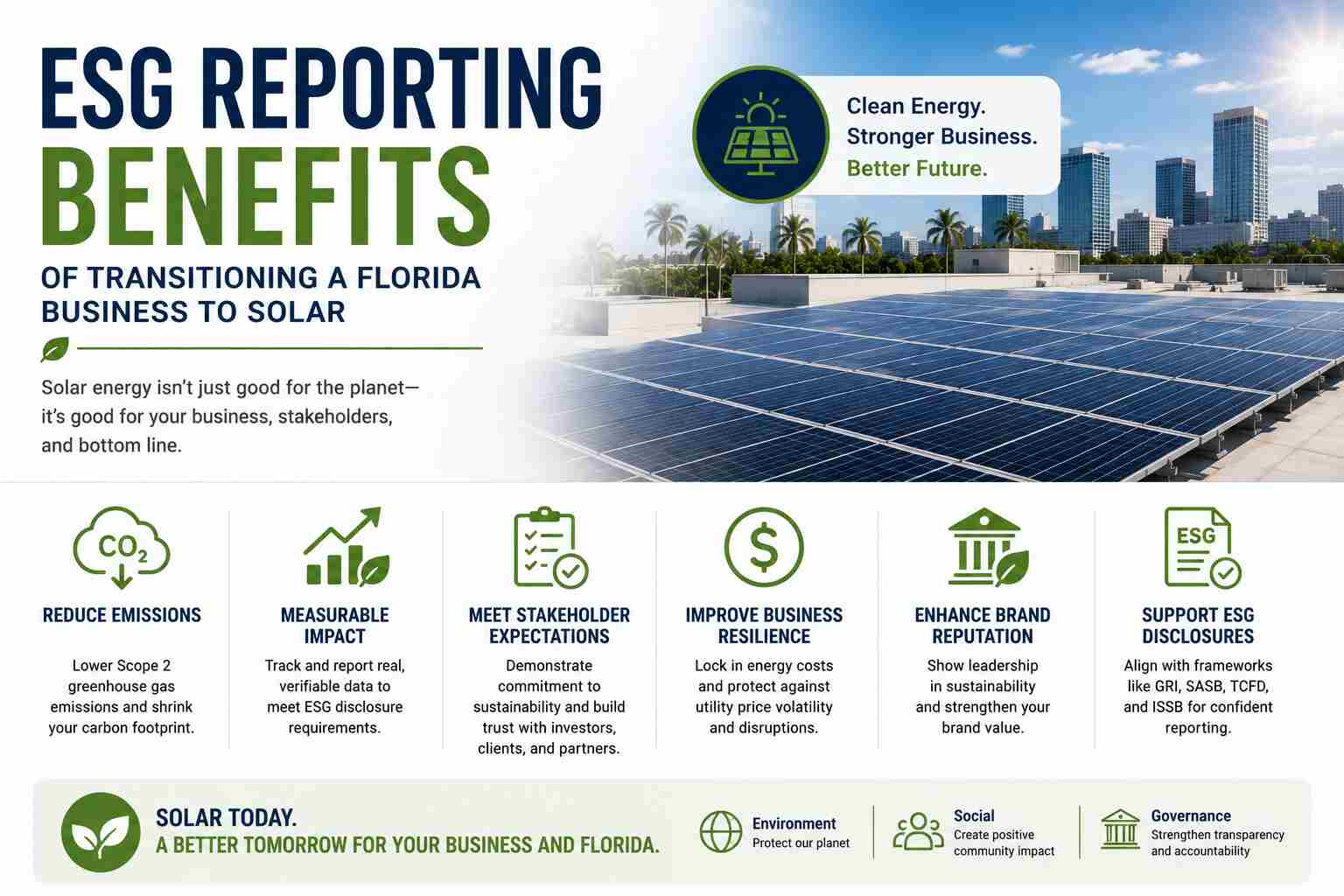
Environmental, Social, and Governance reporting is moving beyond broad sustainability promises. Customers, lenders, investors, employees, and corporate procurement teams increasingly want measurable evidence that a business is reducing risk and improving its environmental performance.
For Florida businesses, commercial solar provides that evidence in one of the most visible and measurable forms available.
A solar energy system generates trackable electricity at the property where the business operates. Its inverter records production in kilowatt hours, monitoring software documents performance, and utility bills show how much grid electricity the company continues to purchase. These data points can support emissions inventories, renewable energy disclosures, financial risk analysis, and progress toward corporate climate targets.
The strongest ESG reporting benefits of solar for Florida businesses come from replacing estimated sustainability claims with verifiable operational results.
How Commercial Solar Supports All Three ESG Pillars
Solar is often treated as an environmental initiative, but its value extends across all three ESG categories.
Environmental Value
Onsite solar reduces the amount of electricity a business purchases from the utility grid. This can lower reported Scope 2 greenhouse gas emissions, reduce dependence on fossil fuel generation, and increase the percentage of electricity supplied by renewable sources.
Solar monitoring also creates measurable energy data that can be used in annual sustainability reports and environmental performance dashboards.
Social Value
A visible rooftop array, solar carport, or ground mounted system demonstrates that a company is investing in cleaner local infrastructure. The project can support community engagement, employee pride, customer trust, and conversations about public health and responsible energy use.
Governance Value
Solar gives company leadership a physical asset with defined costs, performance targets, maintenance responsibilities, and reporting procedures. Executives can assign accountability for energy production, carbon reduction, financial savings, and system reliability.
This turns sustainability from a marketing concept into a managed business process.
Scope 2 Emissions Reduction Through Solar
Scope 2 emissions come from purchased electricity, steam, heat, and cooling. For most offices, warehouses, retail properties, medical facilities, and other commercial buildings, purchased electricity represents a major portion of operational emissions.
The GHG Protocol Scope 2 Guidance provides methods for measuring emissions associated with purchased electricity. It also requires careful treatment of contractual instruments such as renewable energy certificates.
When a Florida business generates solar electricity onsite and consumes that electricity at the property, it purchases fewer kilowatt hours from the grid. This lowers the electricity activity data used in its Scope 2 calculation.
A simplified calculation is:
Scope 2 emissions avoided equals solar electricity consumed onsite multiplied by the applicable grid emission factor
For example, suppose a commercial solar system produces 78,000 kilowatt hours annually and the reporting organization applies an illustrative grid factor of 0.40 kilograms of carbon dioxide equivalent per kilowatt hour.
The estimated reduction would be:
78,000 multiplied by 0.40 equals 31,200 kilograms
That equals approximately 31.2 metric tons of carbon dioxide equivalent per year.
The actual result should use the appropriate EPA eGRID subregion factor, reporting period, organizational boundary, and accounting method. EPA describes eGRID as a standard source for electricity emission rates, greenhouse gas inventories, carbon footprints, and avoided emissions estimates.
Location Based and Market Based Reporting
A company should not simply subtract solar production from emissions and stop there.
Organizations using formal Scope 2 accounting may need to report both location based and market based emissions.
The location based method reflects the average emissions intensity of the electricity grid serving the property. The market based method considers eligible contractual instruments and the electricity attributes the company owns or purchases.
CDP guidance states that companies operating in markets where market based reporting is possible generally report both methods.
This distinction makes renewable energy certificate ownership important.
Each megawatt hour of renewable electricity is associated with environmental attributes. If a business sells the renewable energy certificates connected with its solar production, it may no longer be able to claim the same renewable electricity benefit under the market based method.
ENERGY STAR Portfolio Manager similarly explains that renewable certificates associated with onsite generation can be sold separately from the electricity.
Florida businesses should therefore document:
- Total solar electricity generated
- Solar electricity consumed onsite
- Electricity exported to the grid
- Renewable energy certificate ownership
- Utility electricity purchased
- The emission factor and reporting year used
- Whether emissions are location based or market based
Solar Creates Auditable ESG Reporting Data
One of the most valuable commercial solar ESG benefits is improved data quality.
Many sustainability reports rely on estimates, spreadsheets, utility bill summaries, and manually collected information. A modern commercial solar installation can generate interval data through inverter and monitoring platforms.
Depending on the equipment and monitoring configuration, a company may be able to track:
- Daily, monthly, and annual solar production
- Current system output
- Individual inverter or panel performance
- Estimated avoided utility purchases
- System downtime and maintenance events
- Exported electricity
- Battery charging and discharging
- Renewable electricity as a percentage of total consumption
These records create a stronger audit trail than a general statement such as “our business supports renewable energy.”
An effective reporting system should reconcile solar monitoring data with utility meter data, invoices, renewable certificate records, and the company’s financial reporting period.
ESG Metrics Table
| ESG Metric | Data Source | Reporting Value |
|---|---|---|
| Solar electricity generated | Inverter monitoring portal | Annual kWh or MWh |
| Grid electricity purchased | Utility bills and meter data | Annual kWh or MWh |
| Scope 2 emissions | Energy data and emission factors | Metric tons of CO2e |
| Renewable electricity percentage | Solar and total consumption records | Percentage of electricity use |
| Financial savings | Utility bills and accounting records | Annual dollars saved |
| System availability | Monitoring and service records | Operating percentage |
Reporting Solar Under GRI, CDP, and IFRS S2
Commercial solar data can support several widely used sustainability frameworks.
GRI Energy Reporting
GRI energy reporting recognizes that energy can be purchased or generated by the organization and can come from renewable or nonrenewable sources. Solar generation can therefore support disclosures concerning self generated renewable electricity, total energy consumption, and energy reduction initiatives.
Businesses should report the calculation methodology and avoid presenting all production as consumed onsite when some electricity was exported.
CDP Climate Reporting
Solar data can support CDP disclosures concerning electricity consumption, renewable electricity, Scope 2 emissions, emissions reduction initiatives, and progress toward climate targets.
Companies should maintain evidence for the reporting boundary, meter readings, certificate ownership, emission factors, and calculation methodology.
IFRS S2 Climate Disclosures
IFRS S2 requires reporting organizations applying the standard to disclose Scope 1, Scope 2, and Scope 3 emissions using the GHG Protocol framework, subject to the standard’s requirements and available transition relief. It also addresses governance, strategy, risk management, metrics, targets, and capital deployed toward climate opportunities.
A commercial solar project can support several of these categories because it connects capital spending, energy risk, emissions performance, and management accountability.
How Solar Strengthens Supply Chain Competitiveness
Scope 3 reporting is increasingly important in business to business procurement.
A large corporation may count emissions from purchased products and services within its value chain. Suppliers that can document lower operational emissions may be better positioned to respond to sustainability questionnaires, proposal requirements, and vendor scorecards.
A Florida manufacturer, distributor, service provider, or logistics company can use solar records to provide customers with:
- Verified renewable electricity production
- Updated Scope 2 emissions data
- Facility level energy intensity
- Climate target progress
- Evidence supporting supplier sustainability questionnaires
Solar does not automatically guarantee preferred vendor status. However, it can make sustainability claims more credible and easier for corporate customers to evaluate.
Governance and Financial Resilience Benefits
Good governance includes identifying risks, assigning responsibilities, monitoring performance, and protecting long term business value.
Commercial solar can support these objectives by reducing exposure to a portion of future electricity purchases. It can also create a predictable energy asset with performance guarantees, maintenance procedures, insurance requirements, and measurable financial results.
In May 2026, the national average commercial electricity price was 13.54 cents per kilowatt hour. Actual Florida rates and commercial tariffs vary by utility, customer class, demand charges, fuel adjustments, and usage pattern.
Solar savings should therefore be modeled using the company’s actual tariff rather than a simple statewide average.
For businesses with demand charges, solar may reduce energy charges without fully eliminating the monthly demand peak. Load analysis, battery storage, and demand management may be needed to improve peak reduction.
Illustrative 50 kW Florida Commercial Solar Scenario
Consider a Florida business spending approximately $700 per month on electricity.
A preliminary solar concept might include:
- System size: Approximately 50 kW DC
- Roof area: Approximately 3,000 to 3,500 square feet
- Estimated annual generation: Approximately 70,000 to 80,000 kWh
- Illustrative project cost: Approximately $115,000 to $135,000
- Illustrative annual emissions reduction: Approximately 28 to 35 metric tons of CO2e
- Potential simple payback: Often several years, depending on rate structure, financing, tax position, system production, and maintenance
These figures are examples rather than a project quotation. A professional model should include roof condition, shading, structural capacity, utility interval data, demand charges, insurance requirements, degradation, inverter replacement assumptions, and the company’s tax situation.
Solar ESG Impact Chart
Illustrative Annual ESG Impact of a 50 kW Solar System
Illustrative values only. Actual results depend on system design, consumption, weather, equipment, and the selected emission factor.
Federal and Florida Commercial Solar Incentives
The federal Clean Electricity Investment Credit under Section 48E applies to qualified facilities and energy storage placed in service after December 31, 2024.
The IRS states that the base credit is 6 percent and may increase to 30 percent when applicable prevailing wage and registered apprenticeship requirements are satisfied. Additional bonuses may be available for qualifying domestic content or energy community projects. Credit transfer and elective payment provisions may also be available in eligible situations.
Eligibility should be confirmed with a qualified tax professional because project size, construction timing, labor compliance, ownership, tax basis, bonus qualifications, and placed in service dates can affect the result.
Florida also provides useful state tax treatment.
Qualifying solar energy systems and eligible components are exempt from Florida sales and use tax.
For qualifying nonresidential property, Florida law generally excludes 80 percent of the property value attributable to a renewable energy source device when determining real property assessment. Florida also provides an exemption for 80 percent of qualifying renewable energy tangible personal property in applicable circumstances.
These provisions do not mean every project receives an automatic 80 percent reduction in its total property tax bill. They apply to the qualifying value attributable to the renewable energy equipment.
Property Owners Versus Commercial Tenants
Building ownership determines who approves, finances, owns, maintains, and reports the solar asset.
Property Owner
A property owner may use cash, conventional financing, a solar loan, eligible Commercial Property Assessed Clean Energy financing, or a third party agreement.
Florida law recognizes renewable energy improvements as qualifying commercial property improvements under applicable financing programs.
The owner should review mortgage terms, assessment obligations, insurance, roof warranties, and property sale disclosures before using property assessed financing.
Commercial Tenant
A tenant usually needs written landlord approval and a lease amendment.
The agreement should clarify:
- Who owns the solar equipment
- Who receives electricity savings
- Who owns the renewable energy certificates
- Which party reports renewable generation
- Who handles maintenance and insurance
- What happens when the lease expires
- Whether equipment transfers with the property
Without these provisions, both parties may attempt to claim the same environmental benefit.
Florida Roof Design and Hurricane Resilience
Solar ESG performance depends on the system continuing to operate safely throughout its expected life.
Florida commercial projects require careful evaluation of wind loads, roof condition, drainage, corrosion exposure, equipment attachment, and local building requirements.
Flat commercial roofs may use attached or engineered ballasted systems. Standing seam metal roofs may allow specialized clamps, while shingle roofs normally require flashed structural attachments.
The best mounting method depends on:
- Structural load capacity
- Roof membrane and warranty requirements
- Wind design pressure
- Building height and exposure
- Roof age and replacement schedule
- Equipment access and fire pathways
A roof that will need replacement soon should generally be addressed before solar installation. Removing and reinstalling a commercial array later can add expense and disrupt ESG performance data.
A Practical Solar ESG Reporting Roadmap
Florida businesses can follow a clear reporting process.
- Establish a baseline using at least 12 months of utility bills and interval data.
- Define organizational and operational reporting boundaries.
- Complete a structural, electrical, roof, and shading assessment.
- Model production using site specific assumptions.
- Compare solar output with hourly and monthly electricity use.
- Document renewable energy certificate ownership.
- Select approved emission factors and reporting standards.
- Connect inverter, utility, and accounting records.
- Assign responsibility for monthly data review.
- Report actual results against the original baseline and target.
This process helps prevent double counting, unsupported carbon claims, and inconsistent reporting periods.
Conclusion
Transitioning a Florida business to solar can strengthen ESG reporting by delivering measurable renewable electricity, lowering purchased grid energy, supporting Scope 2 emissions calculations, and improving the quality of sustainability data.
Solar can also support governance objectives by connecting climate performance with capital investment, operating costs, asset management, risk oversight, and executive accountability. Its visibility can strengthen employee engagement, customer confidence, community reputation, and supply chain competitiveness.
The greatest reporting value comes from treating solar as more than an installation project. Businesses should create a documented system for collecting energy data, protecting renewable energy attributes, selecting appropriate emission factors, and reporting progress consistently.
Next Step
Contact a qualified Florida commercial solar professional for a customized solar and ESG assessment. A complete review should evaluate your utility bills, demand profile, roof condition, structural capacity, tax position, financing options, annual solar production, and projected Scope 2 emissions reduction.
With the right design and reporting process, commercial solar can become both an energy asset and a credible foundation for long term ESG performance.