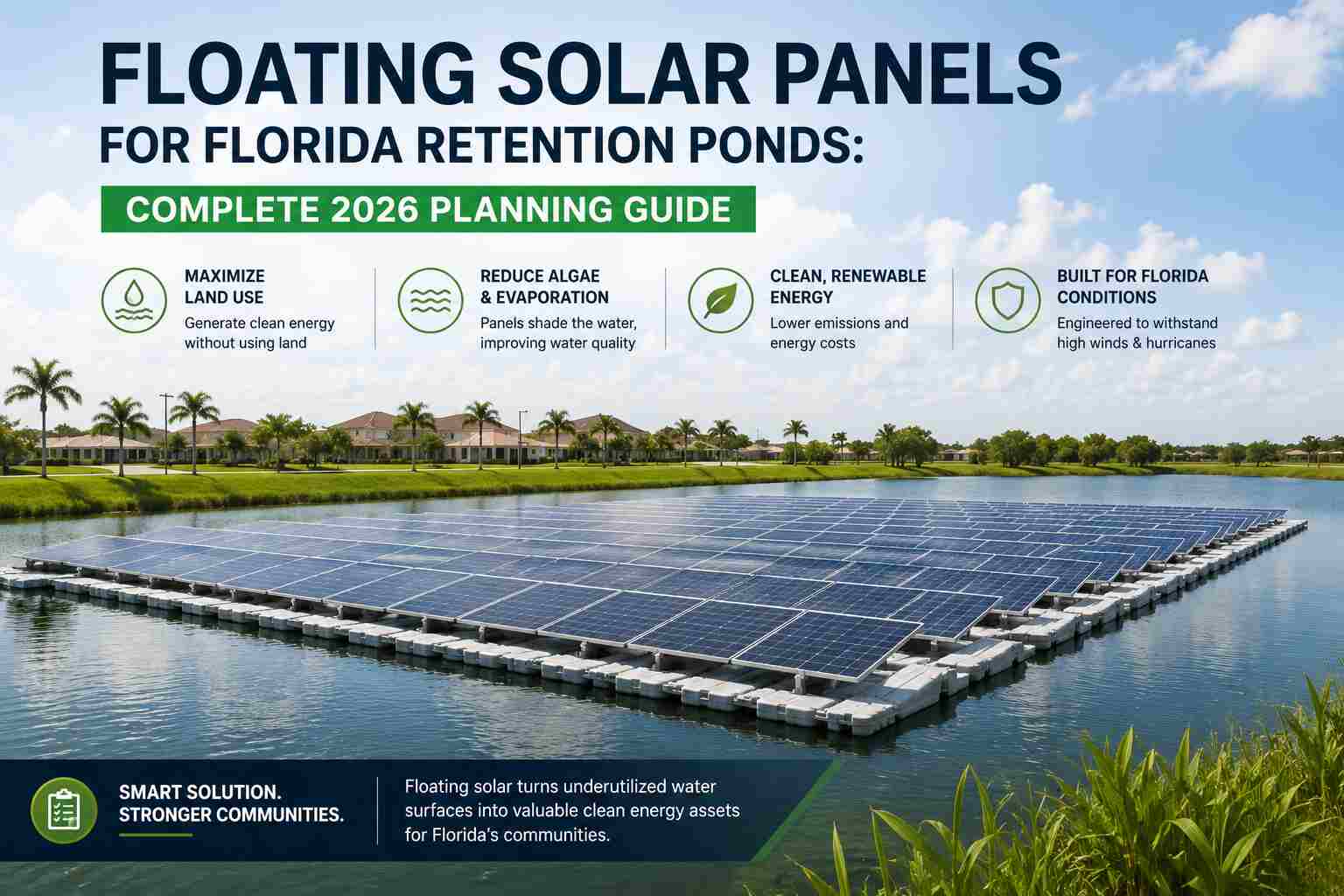
Florida has thousands of retention ponds, stormwater basins, reclaimed water reservoirs, wastewater treatment ponds, and artificial lakes occupying land that cannot easily support buildings or conventional commercial activity. Floating solar panels offer property owners a way to turn some of these underused water surfaces into productive energy assets.
Also known as floating photovoltaic systems or floatovoltaics, these installations place solar modules on buoyant platforms secured by anchors and flexible mooring lines. Electricity is carried from the floating array to shore, where inverters and switchgear connect the system to a building, utility meter, battery, or local electrical distribution system.
Floating solar should not be confused with agrivoltaics. Agrivoltaics combines solar panels with crops, livestock, or agricultural land. Floating solar uses a water surface. A farm may use both technologies, but they are separate system types.
Florida law specifically recognizes the potential value of floating solar on stormwater treatment ponds, wastewater ponds, reclaimed water ponds, abandoned limerock areas, and other water storage reservoirs. The law identifies cooling, evaporation reduction, and harmful algae suppression as potential benefits and encourages local governments to treat suitable floating solar facilities as appropriate uses of these areas.
Why Florida Retention Ponds Are Strong Candidates for Floating Solar
Retention ponds are normally designed for drainage, stormwater treatment, flood control, nutrient management, and water storage. They are not automatically suitable for solar simply because open water is available.
However, a properly selected pond can offer several advantages over a rooftop or ground mounted solar site.
Productive Use of Existing Space
Commercial solar projects can require significant roof area or undeveloped land. Ground mounted installations may compete with parking expansion, landscaping, agriculture, recreation, or future construction.
Floating solar uses an artificial surface that may otherwise produce little direct revenue. This can be particularly valuable for:
- Industrial parks
- Distribution centers
- Office campuses
- Golf communities
- HOAs and residential developments
- Airports
- Municipal facilities
- Water treatment plants
- Agricultural operations
- Large retail developments
- Resorts and entertainment properties
A pond close to an electrical load is generally more valuable than a remote pond because shorter cable routes can reduce trenching, conductor, and electrical infrastructure costs.
Potential Solar Panel Cooling
Solar modules lose some power as cell temperature rises. Water beneath a floating array can create a cooler local environment than a hot roof or exposed field.
This does not mean every floating system will automatically generate 5 percent, 10 percent, or 15 percent more electricity. Actual performance depends on panel height, airflow, humidity, module technology, array coverage, water temperature, wind, and the system used for comparison.
The cooling benefit should therefore be modeled using site specific weather and equipment data rather than inserted as a guaranteed percentage. National Renewable Energy Laboratory research also notes that floating solar performance and environmental effects remain dependent on system design and site conditions.
Reduced Water Evaporation
Floating modules shade part of the water and reduce direct exposure to solar radiation and wind. This can lower evaporation, particularly when array coverage is substantial.
The result cannot be represented by one universal percentage. A modeling study found that full coverage under the conditions studied could reduce evaporation by approximately 52.8 percent, but actual savings vary with climate, coverage ratio, panel spacing, wind, and float design.
For a Florida retention pond, evaporation reduction may be helpful, but it must be evaluated alongside the pond’s original drainage and water level management requirements.
Possible Algae Suppression
Shading can limit the sunlight available for algae and aquatic plant growth. This may be useful in nutrient rich stormwater ponds receiving nitrogen and phosphorus from fertilizer, landscaping, roads, or developed property.
Floating solar is not a complete algae treatment program. Excess nutrients, sediment, stagnant areas, temperature, and low dissolved oxygen may still create water quality problems.
Water quality monitoring should be included when a large percentage of a pond will be covered.
Floating Solar Benefits and Limitations
How Floating Photovoltaic Systems Work
A floating solar installation contains many of the same electrical components as a rooftop or ground mounted system. The primary difference is the support structure and the way the array responds to wind, waves, and changing water levels.
Modular HDPE Floating Platforms
Most commercial systems use modular floats manufactured from high density polyethylene. HDPE is commonly selected because it is lightweight, corrosion resistant, UV resistant, and has very low water absorption.
The main floats support the solar modules. Secondary floats can create maintenance walkways and provide access to electrical connections.
The materials should be evaluated for long term UV exposure, heat, moisture, chemical conditions, expected service life, recyclability, and compatibility with the pond’s water quality requirements.
Flexible Mooring and Anchoring Systems
The array cannot be rigidly fixed in one position without accommodating water movement. Mooring lines must allow controlled motion while preventing the solar island from reaching the shoreline, drainage structures, pond bottom, fountains, or neighboring infrastructure.
Possible anchoring locations include:
- The pond bottom
- The shoreline
- Concrete structures
- Driven anchors
- Engineered ballast blocks
The design depends on soil conditions, pond liner restrictions, water depth, level variation, wind direction, wave action, and available shoreline space.
Claims about self expanding or elastic anchor systems should be reviewed carefully. Some systems use flexible components, but the complete mooring design must be calculated by qualified engineers for the specific pond.
Electrical Equipment and Cabling
Floating arrays require cables and connectors suitable for continuous outdoor moisture exposure. Cable routes should prevent abrasion, excessive tension, unintended submersion, and contact with sharp float components.
Research has shown that unsuitable cable materials can experience accelerated degradation when submerged, emphasizing the importance of correct insulation, routing, inspection, and environmental selection.
Inverters are often installed on shore to simplify access, cooling, replacement, and emergency isolation. Larger projects may use floating electrical equipment, but this adds engineering and maintenance complexity.
Florida Hurricane and Stormwater Engineering Requirements
Florida wind exposure is one of the most important differences between a floating solar concept and a buildable project.
The array should be designed for site specific wind speed, exposure category, pond geometry, wave formation, fetch distance, water level change, shoreline conditions, and anchor loads.
Water Level Fluctuation
Retention ponds may rise rapidly during heavy rainfall and fall during dry periods. Mooring lines must accommodate the full operating range without becoming excessively tight at high water or allowing uncontrolled movement at low water.
Dry detention and stormwater systems may also be subject to recovery requirements. Florida stormwater guidance frequently references recovery within 72 hours for certain systems, although the exact standard depends on the pond type, permit, water management district, and approved design.
The solar array must not prevent the pond from performing its permitted function.
Engineers should verify that the project will not obstruct:
- Inlets and discharge structures
- Emergency overflow areas
- Control structures
- Required maintenance access
- Sediment removal routes
- Bank stabilization
- Inspection points
- Aerators and fountains
- Water sampling locations
- Wildlife management areas
Pond Liner and Anchor Restrictions
Some retention ponds contain geomembrane or clay liners. Penetrating the bottom may damage the liner and create leakage.
A geotechnical and civil review should determine whether bottom anchors are acceptable or whether shoreline anchors, ballast, or another nonpenetrating method is required.
Coverage Ratio
Covering the maximum possible water area is rarely the best starting point.
A responsible design preserves open water around drainage infrastructure, shorelines, maintenance paths, and environmentally sensitive areas. Partial coverage can also support airflow and reduce the risk of major changes in dissolved oxygen or water temperature.
Is Your Retention Pond Suitable for Floating Solar?
A preliminary feasibility study should answer the following questions before detailed design begins:
- Who owns the pond and the surrounding land?
- Is the pond included in an active stormwater permit?
- What is its normal and maximum water depth?
- How much does the water level change?
- Does the pond have a liner?
- Is the bottom suitable for anchors?
- Is the shoreline stable?
- What percentage of the surface can remain unobstructed?
- How far is the nearest electrical service?
- What is the property’s daytime electricity demand?
- Does the site have enough utility interconnection capacity?
- Can maintenance crews safely reach the array?
- Are there wetlands, protected species, or water quality concerns?
- Will the array affect fountains, fishing, irrigation, or recreation?
A large pond is not necessarily a strong solar site. A smaller pond next to a commercial meter with high daytime consumption may deliver a better return than a remote pond requiring extensive electrical infrastructure.
Floating Solar Cost and Return on Investment
Floating solar generally costs more to install than a comparable conventional ground mounted array because it requires floats, mooring equipment, specialized engineering, water access, additional safety procedures, and moisture resistant electrical design.
However, the project may avoid other expenses, including land acquisition, extensive clearing, grading, fencing, or roof reinforcement.
The best financial analysis compares total lifetime value rather than installation price alone. It should include:
- Expected annual energy production
- Electricity consumed directly on site
- Demand charge reduction, when applicable
- Export credit value
- Utility interconnection costs
- Maintenance and inspection expenses
- Insurance costs
- Equipment replacement assumptions
- Tax incentives and depreciation
- Financing cost
- Potential land preservation value
Commercial properties with strong daytime electricity consumption usually receive more value by using the solar energy directly instead of relying heavily on exported electricity.
Florida Net Metering and Interconnection
Florida’s investor owned utility net metering framework covers eligible customer owned renewable generation up to 2 megawatts. The exact application requirements depend on system capacity and the serving utility.
A floating array is not exempt from interconnection studies simply because it is installed on water.
The utility may evaluate:
- Transformer capacity
- Feeder conditions
- Protection settings
- Disconnect equipment
- Meter configuration
- Export limits
- Insurance requirements
- System size relative to customer demand
Net metering should not be described as guaranteed retail compensation for every exported kilowatt hour under every Florida utility. Monthly credits, annual settlement, tariff terms, and municipal or cooperative utility policies can differ.
The current utility tariff should be reviewed before the array is sized.
Florida Solar Incentives and Federal Tax Rules for 2026
Florida provides favorable tax treatment for qualifying renewable energy equipment, but owners should verify how each provision applies to the ownership structure and property type.
Florida statutes include assessment rules for renewable energy source devices and an exemption for certain renewable energy equipment treated as tangible personal property.
Qualifying solar energy systems may also receive Florida sales tax treatment under the applicable renewable energy equipment provisions. A tax professional should confirm eligibility for floating platforms, electrical infrastructure, batteries, and associated construction costs.
Commercial Clean Electricity Investment Credit
For qualifying commercial facilities placed in service after December 31, 2024, Section 48E provides a base Clean Electricity Investment Credit of 6 percent. The credit can reach 30 percent when applicable prevailing wage and registered apprenticeship requirements are met. Potential bonus percentages may also be available for qualifying domestic content, energy community, and allocated low income projects.
Domestic content is not simply a requirement that every 2026 project must satisfy to retain a 30 percent credit. It is generally a potential bonus category, while separate prohibited foreign entity and sourcing restrictions may affect eligibility under newer federal rules.
Federal law also introduced accelerated deadlines affecting certain solar facilities that begin construction after July 4, 2026. Project owners should obtain current tax guidance before relying on older credit timelines.
Residential Solar Credit in 2026
The federal Residential Clean Energy Credit is not available for qualifying expenditures made after December 31, 2025. Therefore, an HOA, developer, homeowner, or community considering a 2026 installation should not automatically assume that the former 30 percent residential credit is available.
A project owned by a business, nonprofit, municipality, utility, HOA, or third party developer may receive different federal treatment. Ownership structure should be reviewed before contracts are signed.
Floating Solar for HOAs and Residential Communities
Florida communities often maintain ponds close to clubhouses, pools, entry lighting, irrigation pumps, and common area meters. Floating solar could offset these shared electrical loads without using individual homeowners’ roofs.
However, community projects require careful governance.
The association may need:
- Confirmation of pond ownership
- Review of development and stormwater documents
- Board and membership approval
- Local planning review
- Utility interconnection approval
- Insurance review
- Engineering certification
- A long term maintenance agreement
- Rules for access and emergency response
Florida law limits ordinances and certain private restrictions that prohibit renewable energy devices on buildings, but pond based systems involve different property, zoning, ownership, stormwater, and architectural issues. The rooftop protections in Section 163.04 should not be treated as automatic approval for a floating array.
Floating Solar Maintenance in Florida
Maintenance should address both solar equipment and marine conditions.
A complete plan should include:
- Drone and visual inspections
- Float and connector inspections
- Mooring tension checks
- Anchor movement checks
- Cable abrasion inspections
- Grounding and insulation testing
- Module cleaning when required
- Wildlife and nesting inspections
- Water quality observations
- Storm inspections
- Vegetation and shoreline management
- Emergency shutdown procedures
Inspections are especially important after hurricanes, severe thunderstorms, unusual water level changes, or impacts from floating debris.
The pond owner should also retain the ability to remove or reposition sections of the array when sediment removal, bank repair, drainage maintenance, or water treatment work is required.
Final Verdict: Is Floating Solar Right for Your Florida Property?
Floating solar panels can transform a suitable Florida retention pond into a productive clean energy asset while preserving valuable roofs and land. Potential benefits include electricity generation, reduced evaporation, lower sunlight exposure on the water, and more productive use of stormwater infrastructure.
Those benefits depend on correct site selection and engineering.
The strongest projects begin with the pond’s permitted purpose, not with the number of solar panels that can physically fit on the water. Stormwater performance, wind loading, water level variation, anchoring, electrical access, environmental conditions, utility rules, and maintenance access must all be evaluated before financial returns are calculated.
A well designed floating solar project can serve a commercial campus, municipality, water treatment facility, agricultural operation, or residential community for decades. A poorly planned system can create drainage conflicts, maintenance problems, unexpected interconnection costs, and hurricane exposure.
Next Step
Schedule a professional floating solar feasibility assessment for your Florida retention pond. A qualified team can evaluate usable water area, stormwater restrictions, anchor conditions, electrical demand, utility interconnection, projected production, incentives, and long term financial return before you commit to full engineering or construction.
Tax and Engineering Disclaimer: This article provides general educational information and does not constitute tax, legal, civil engineering, environmental, utility, or financial advice. Project requirements and incentive eligibility depend on site conditions, ownership, utility tariffs, construction dates, and current law. Consult qualified professionals before developing or claiming incentives for a floating solar project.