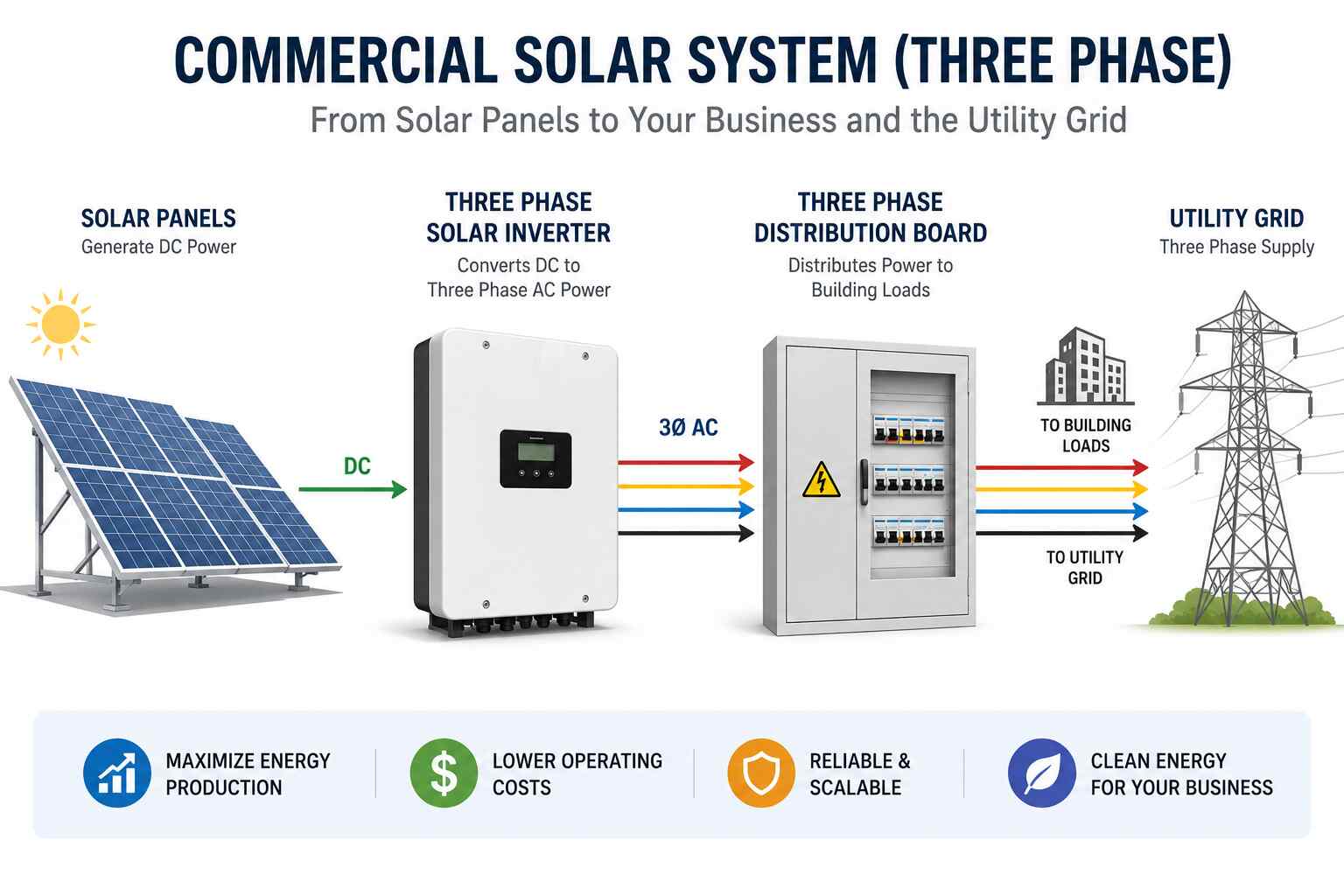
Commercial solar panel systems almost always require three phase inverters because commercial buildings are fed by three phase electricity, generate well above the single phase export limit, and must spread heavy loads evenly across all three lines to keep the utility happy. The exception is a small commercial site (typically under roughly 4 kW to 10 kW depending on your country) that only has a single phase supply. Everything larger, and every property already wired for three phase, needs a three phase solar inverter.
That is the snippet answer. The rest of this guide explains exactly when the rule bends, what the utility will and will not approve, how much the choice affects your wiring and running costs, and how modern three phase hybrid inverters now double as a backup power and storage hub. If you own or manage a building and want to brief an installer with confidence, this is the article to read first.
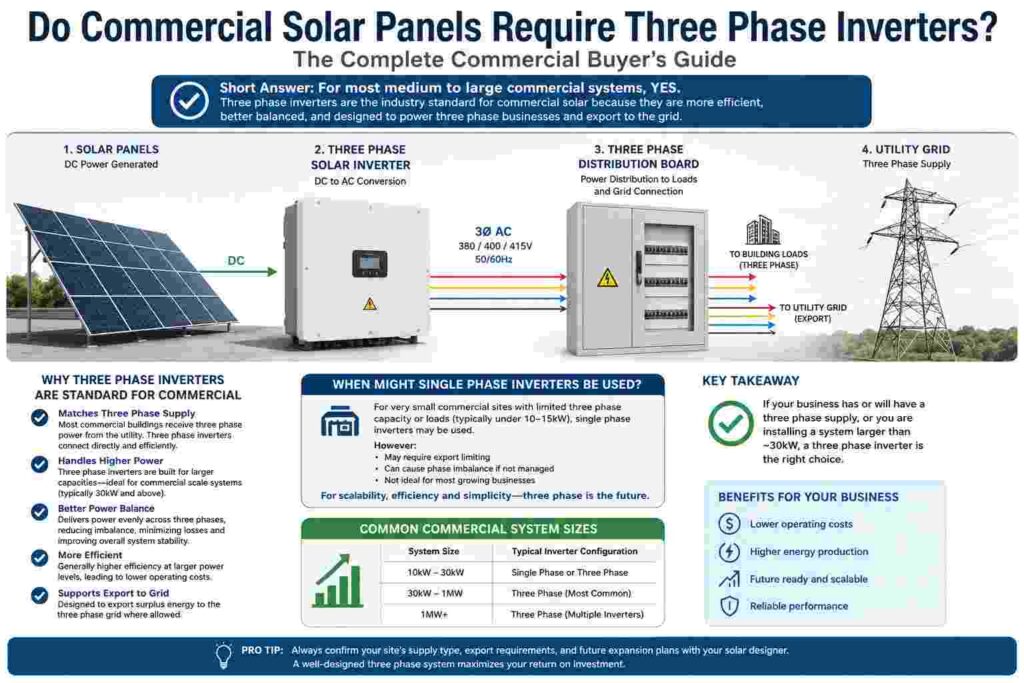
What Actually Decides It: Your Grid Connection, Not Your Panels
The single biggest misunderstanding in commercial solar is thinking the panels decide the inverter. They do not. The panels produce direct current. The inverter converts that into alternating current and pushes it into your building and the grid. So the question is never “what do my panels need?” It is “what does my incoming electricity supply look like?”
Commercial buildings are supplied differently from homes:
- A typical home has a single phase supply. One live wire and one neutral.
- A typical factory, warehouse, office block, retail unit, or farm has a three phase supply. Three live wires, each offset by 120 degrees, plus a neutral. Three phase delivers far more power and runs heavy motors smoothly.
If three phase power comes into your building, your solar inverter must output three phase to sync with it. Feeding single phase solar into a three phase board creates an unbalanced load that utilities across the UK, Europe, the US, Singapore, and Australia specifically limit or reject. That is the core reason commercial solar and three phase inverters go together.
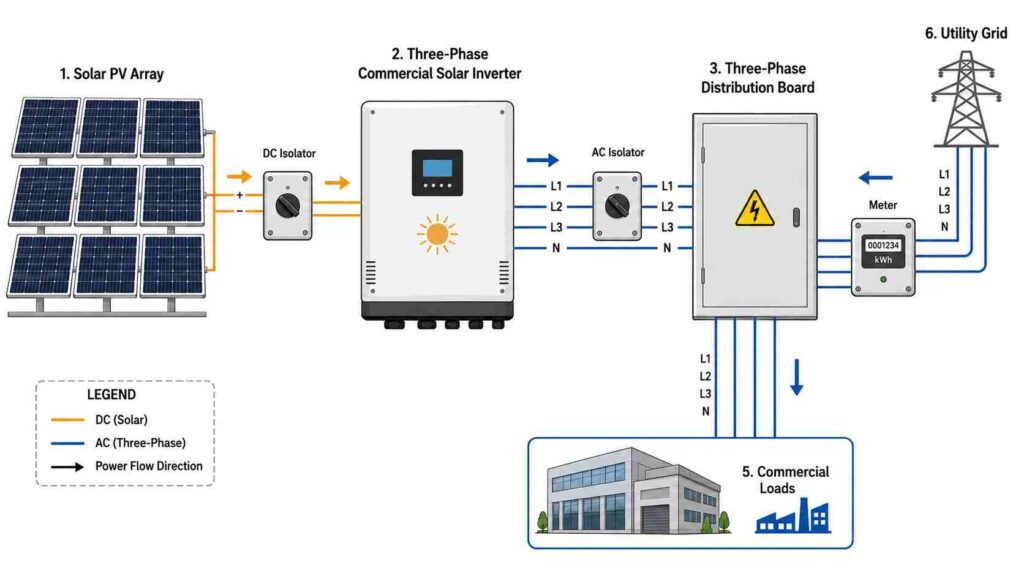
The Two Numbers That Force a Three Phase Solar Inverter
Two thresholds push nearly every commercial project onto three phase, no matter what the building owner would prefer.
1. System size above the single phase export limit
Grid operators cap how much power a single phase connection may export, because too much on one line pushes local voltage out of tolerance. Once your array beats that cap, three phase is mandatory.
2. Load balancing across three lines
A commercial site runs three phase machinery, HVAC compressors, lifts, chillers, and industrial lighting. A three phase inverter performs solar load balancing, splitting generation evenly across all three lines so no single phase spikes or sags. This protects motors from voltage drop and stops nuisance tripping.
Here is how the single phase ceiling varies by region. Anything above these figures effectively requires three phase inverters for commercial solar.
These figures are practical guidance. Always confirm with your local Distribution Network Operator or utility, because caps change and larger connections need formal approval.
Commercial Solar Grid Connection: The Rules Installers Wish Clients Knew
The commercial solar grid connection process is where single phase dreams die. Utilities do not simply let you bolt on any inverter you like.
- Phase imbalance limits. Networks restrict how much power any one phase may carry relative to the others. A big single phase array on a three phase supply breaches this instantly.
- Formal approval for larger systems. In the UK, small systems fall under G98 and larger ones need a G99 application with the network operator. Comparable rules exist elsewhere. Three phase inverters make approval smoother because the load is balanced by design.
- Export management. Many operators require your inverter to limit or dynamically control export. Three phase units handle this natively.
The practical takeaway: choosing a three phase solar inverter is not just a hardware preference. It is often the only configuration your grid operator will actually sign off for a commercial connection.
Three Phase vs Single Phase Solar: A Straight Comparison
For readers weighing three phase vs single phase solar, the difference is not marginal at commercial scale. Three phase delivers smoother power, better efficiency, thinner cabling, and fewer grid restrictions.
To make the efficiency and stability gap visual, here is a simple mobile responsive bar chart you can drop into the post.
Single Phase vs Three Phase Inverter (higher is better)
How a Three Phase Solar Inverter Actually Works
A three phase solar inverter produces three alternating current waves offset by 120 degrees. Because the waves overlap, one line is always near its peak while another dips, so the combined output never falls to zero. That is why three phase power feels constant and runs motors without vibration or heat spikes.
Most commercial units output at either 400V (UK, Europe, Australia, Singapore) or 208V and 480V (US). Higher output voltage carries the same power with less current, and less current means thinner copper cable. On a large roof with long cable runs, that voltage advantage cuts material and labour cost noticeably.
Commercial Solar Inverter Types: String, Central, Micro, and Hybrid
Choosing three phase is step one. Step two is choosing the commercial solar inverter architecture. This is the string inverter vs central inverter decision, plus the newer hybrid category.
Three phase string inverters
Several medium sized string inverters wired across the roof. Popular because a single fault only takes one unit offline, maintenance is simple, and upfront cost is reasonable. This decentralised layout is now the default for most commercial rooftops.
Central inverters
One large unit processing hundreds of kilowatts up to megawatts. Ideal for uniform ground mount farms and giant warehouse roofs where the whole array behaves the same. Lowest cost per watt at scale, but a single failure stops everything, so redundancy planning matters.
Microinverters
Small units mounted behind each panel that create AC on the roof. They shine on complex, shaded, or multi orientation roofs and can build three phase output across the array. Higher cost per watt, best for tricky sites rather than large clean roofs.
Three phase hybrid inverters
The fast growing category. A three phase hybrid inverter manages solar, battery, grid, and generator from one hub. If backup power or storage is on your roadmap, this is the unit to specify, and we cover it in depth below.
The Multi MPPT Commercial Inverter Advantage for Shaded Roofs
Real commercial roofs are messy. Parapet walls, plant rooms, HVAC units, chimneys, and multiple pitches all cast shade. A multi MPPT commercial inverter is the answer.
MPPT stands for Maximum Power Point Tracker. Premium commercial three phase inverters carry 4, 6, 8, or 10 plus independent MPPT channels. Each channel manages its own zone of the roof. Shade on the east wing only drags down that one channel. Every other channel keeps producing at full output.
This delivers real design freedom:
- Mix string lengths and tilt angles on the same inverter.
- Face some arrays east and others west to flatten your generation curve.
- Isolate shading so one dirty or shadowed area never crashes the whole roof.
For severe or unpredictable shade, add power optimisers on commercial solar panels. These small DC devices clip behind individual modules and track each panel locally, letting a shaded module pass full current without dragging its string down. Multi MPPT plus optimisers is the belt and braces solution for difficult sites.
Three Phase Hybrid Inverter: Storage, Backup, and Peak Demand Savings
Modern commercial solar is not just about cutting daytime bills. It is about resilience and dodging expensive peak charges. That is where the three phase hybrid inverter and a commercial energy storage system change the economics.
Commercial energy storage system integration
A three phase hybrid inverter links directly to high capacity commercial battery banks, often running at 1,000V DC and above. It manages large charge and discharge rates so you store cheap or self generated energy and discharge it during expensive peak demand windows. For many businesses, avoiding peak demand charges saves more money than the solar generation itself.
True phase balancing and black start
Advanced three phase hybrids can push different amounts of power to each phase independently. In a night time blackout with empty batteries, black start capability lets the inverter wake itself using the first morning sun, then keep single phase office and server loads alive even if a heavy three phase machine stays offline.
EPS vs UPS switchover: choose carefully
When you specify backup, you choose between two switchover speeds:
- EPS (Emergency Power Supply): a brief gap of roughly 20 milliseconds during changeover. Fine for most equipment, but it can trip sensitive computers or controls.
- UPS (Uninterruptible Power Supply): switches to battery within milliseconds so nothing ever cuts out. Essential for data centres, precision manufacturing, and medical or lab equipment.
Generator integration
Most commercial hybrid units include a relay port to tie in a diesel or gas backup generator. If solar is low and batteries drain during an outage, the inverter starts the generator automatically to keep the site running with no manual intervention.
When Do Commercial Solar Panels NOT Need Three Phase Inverters?
Honesty ranks. The competing pages imply three phase is always compulsory. It is not quite. A single phase commercial inverter is acceptable when all of these are true:
- The building only has a single phase supply and upgrading to three phase is not planned.
- The proposed array sits under the single phase export cap for your region (see the table above).
- The site load is light and evenly single phase, with no heavy three phase motors.
This describes small shops, single unit offices, cafes, and some agricultural buildings. The moment you exceed the cap, add three phase machinery, or the utility flags imbalance, you move to a three phase solar inverter. If growth is likely, many owners upgrade the supply to three phase at the start to avoid a costly rework later.
Cost Impact: Why Three Phase Often Pays for Itself
Three phase hardware can carry a modest premium over single phase, but the total installed cost picture usually favours it at commercial scale.
- Thinner cabling. Higher voltage and balanced current cut copper cost across long roof runs.
- Lower voltage drop. Less energy wasted as heat in the cables over the system lifetime.
- Higher efficiency. Up to two extra points of efficiency compounds across 25 years of generation.
- Fewer grid limits. More export headroom means you can build a bigger, better earning system.
- Future proofing. Adding batteries, EV chargers, or expansion later is far simpler on a three phase board.
Commercial Solar Power Installation: A Practical Decision Checklist
Use this quick checklist before your commercial solar power installation to confirm the right inverter.
- Confirm your supply. Ask your electrician or check the incoming meter. Single phase or three phase?
- Size the array. Compare the proposed kW against your region’s single phase cap.
- List heavy loads. Any three phase motors, chillers, or lifts point straight to three phase.
- Check the roof. Shade, multiple pitches, or mixed orientation call for a multi MPPT inverter or optimisers.
- Plan for storage. If backup or peak shaving matters, specify a three phase hybrid inverter now, not later.
- Confirm grid approval. Have your installer file the correct grid connection application early, since approval can take weeks.
Frequently Asked Questions
Do all commercial solar panels require three phase inverters? Not literally all, but the large majority do. Any commercial system above the regional single phase export cap, or any building already on a three phase supply, needs a three phase inverter. Only small single phase premises under the cap can use single phase.
Can I connect a single phase inverter to a three phase supply? Only for very small systems, and often only with utility permission, because it creates phase imbalance. For commercial sizes, use a three phase inverter to stay compliant and balanced.
What size system needs three phase? As a rough guide, above 3.68 kW in the UK and Australia and above roughly 10 kW to 15 kW in the US, though your local operator sets the exact limit.
Is a three phase hybrid inverter worth it? If you want battery backup, peak demand savings, or generator integration, yes. It becomes a single hub for solar, storage, grid, and backup power.
Conclusion
So, do commercial solar panels require three phase inverters? For nearly every genuine commercial installation, the answer is yes. Commercial buildings run on three phase power, generate above the single phase export limit, and need balanced load across all three lines to satisfy the grid and protect heavy machinery. Three phase inverters deliver higher efficiency, thinner cabling, smoother power, more export headroom, and a clear upgrade path to storage and backup. The only real exception is a small single phase site sitting under the regional cap.
Getting this decision right at the design stage saves you from failed grid applications, oversized cabling, and expensive retrofits. Match the inverter to your supply, your load, your roof, and your storage plans, and your commercial solar system will pay back faster and run cleaner for decades.
Next Step
Ready to find out exactly what your building needs? Book a free commercial solar consultation and we will assess your electrical supply, roof layout, and load profile, then recommend the ideal three phase inverter and storage configuration for your site. Get a tailored proposal with real numbers before you commit a penny.