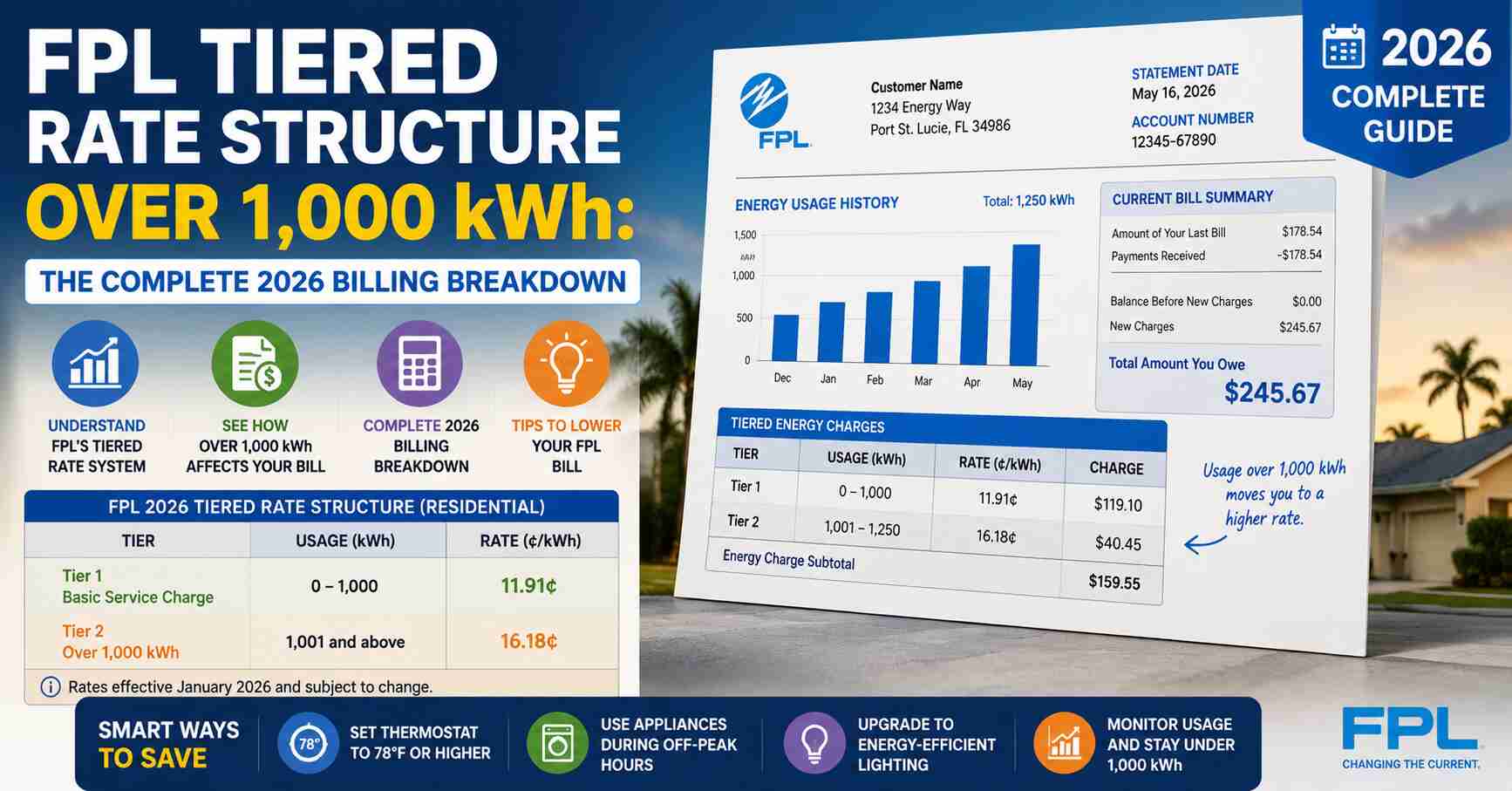
If your Florida Power & Light bill suddenly spiked even though your habits barely changed, there’s a good chance the culprit is a single number: 1,000 kWh. FPL uses what’s called an inverted tier, or inclining block, rate structure, and once your monthly usage crosses that 1,000 kWh line, part of your electricity starts getting billed at a noticeably higher rate.
This guide breaks down exactly how the FPL tiered rate structure over 1,000 kWh works, shows the real math with current per-kWh figures, and compares it against Time-of-Use pricing so you can decide which billing option actually saves you money. Unlike a quick AI summary, this article walks through full worked examples across a range of usage levels, explains every line item on your bill (not just the energy charge), and lays out a practical action plan you can use this billing cycle.
What Is the FPL Tiered Rate Structure, Exactly?
FPL’s standard residential plan (Rate Schedule RS-1) doesn’t charge one flat rate for every kilowatt-hour you use. Instead, it splits your monthly usage into two brackets:
- Tier 1 (0 to 1,000 kWh): Billed at the lower base energy rate, designed to cover essential, baseline household consumption.
- Tier 2 (1,001 kWh and above): Every kilowatt-hour beyond the 1,000 kWh mark is billed at a higher base rate.
This is often called an “inverted tier” because the price goes up as consumption goes up, the opposite of a volume discount. The idea behind it is conservation incentive: the more electricity a household pulls from the grid, especially during high-demand summer months, the more it costs per unit.
It’s important to understand that FPL does not apply the higher Tier 2 rate to your entire bill once you cross 1,000 kWh. It only applies to the kWh consumed beyond the threshold. This is a bracket system, similar to how income tax brackets work, and it’s one of the most common points of confusion for FPL customers.
How the Two-Tier Math Actually Works
Based on FPL’s current residential rate schedule, the two base energy rates are:
- Tier 1 base rate: approximately $0.07162 per kWh (first 1,000 kWh)
- Tier 2 base rate: approximately $0.08172 per kWh (every kWh above 1,000)
That’s roughly a 14% jump in the base energy rate the moment you cross the threshold. On top of the base rate, every kWh you use (in both tiers) also carries flat, non-tiered charges:
- Fuel charge: around $0.0350 per kWh, which recovers the cost of natural gas used to generate power
- Storm protection and environmental riders: around $0.0120 per kWh combined
- Fixed customer charge: approximately $9.61 per billing cycle, charged once regardless of usage
Put together, the formula for a standard RS-1 bill looks like this:
Total Bill = Fixed Customer Charge + (Tier 1 kWh x Tier 1 Base Rate) + (Tier 2 kWh x Tier 2 Base Rate) + (Total kWh x Flat Charges)
Worked Example: 1,800 kWh Monthly Bill
Here’s how a high-usage household consuming 1,800 kWh in a month would be billed:
- Tier 1 base cost: 1,000 kWh x $0.07162 = $71.62
- Tier 2 base cost: 800 kWh x $0.08172 = $65.38
- Flat charges: 1,800 kWh x $0.0470 = $84.60
- Fixed customer fee: $9.61
Total estimated bill: $231.21, before local municipal franchise fees and utility taxes, which typically add another 6% to 10% depending on your city.
Usage-by-Usage Rate Table
To see how the tier threshold affects households at different consumption levels, here’s a side-by-side breakdown:
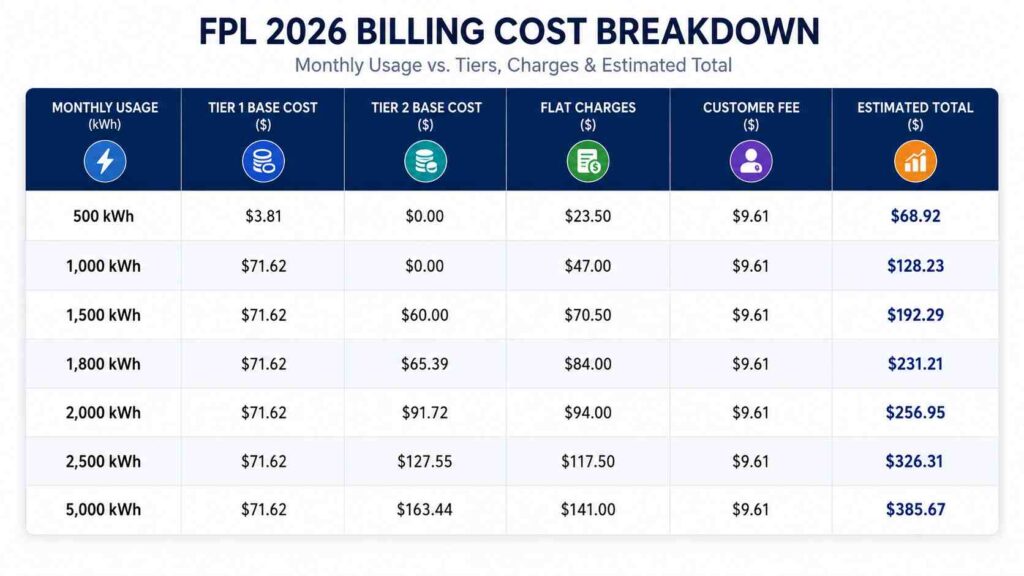
Notice that at exactly 1,000 kWh, you avoid the Tier 2 penalty entirely. Every kWh sits in the cheaper bracket, and your effective blended rate stays lower than a household using even slightly more. That’s why 1,000 kWh functions as a natural budgeting benchmark for FPL customers trying to keep costs down.
Why the Tier 2 Jump Feels Bigger in Summer
The base rate difference between Tier 1 and Tier 2 is only about 1 cent per kWh, but the real pain shows up in the volume. Florida households that stay under 1,000 kWh in spring and fall often blow past it in June, July, and August because of air conditioning load. If a family that normally uses 900 kWh jumps to 1,700 kWh during a heat wave, they’re not just paying for 800 extra kWh, they’re paying a higher rate on every one of those additional units. That combination (higher volume plus higher per-unit rate) is what produces the sticker shock so many customers report on their summer statements.
FPL Bill Components Beyond the Energy Charge
Your energy charge (the tiered part) is only one piece of the total bill. To fully understand your statement, it helps to know what each line item actually pays for:
- Customer charge: A flat fee that covers metering, billing, and account maintenance, regardless of how much power you use.
- Fuel charge: A pass-through cost tied to the price of natural gas, which fluctuates but does not change based on tier.
- Storm protection charge: Recovers costs for grid hardening projects designed to reduce outage duration after hurricanes.
- Environmental and franchise fees: Local surcharges and taxes that vary by city or county.
Only the base energy charge is affected by the tier you’re in. The rest of your bill scales uniformly with total kWh used, which is why even Tier 1-only households still see a meaningful bill even without crossing the 1,000 kWh line.
FPL Tiered Rate vs. Time-of-Use (TOU): Which Is Better?
FPL also offers a Residential Time-of-Use rate (RTR-1) as an alternative to the standard tiered plan. Switching to TOU eliminates the 1,000 kWh tier cap completely. Instead of being billed by volume, you’re billed by the clock.
FPL Peak and Off-Peak Windows
- Summer peak (April 1 to October 31): Monday through Friday, 12:00 PM to 9:00 PM
- Winter peak (November 1 to March 31): Monday through Friday, 6:00 AM to 10:00 AM and 6:00 PM to 10:00 PM
- Off-peak hours: All other hours, plus weekends and major holidays
The Rate Trade-Off
- Off-peak rate: roughly 5.5 cents to 6.5 cents per kWh, which is less than half the standard Tier 1 rate
- On-peak rate: roughly 14.5 cents to 16.5 cents per kWh, more than double the off-peak rate
Who Actually Benefits from TOU
TOU only pays off if you can shift the majority of your usage away from peak hours. As a rule of thumb, you need to move at least 75% to 80% of your total household consumption into off-peak windows to come out ahead.
Good fit for TOU:
- Your home is empty on weekday afternoons
- You own an electric vehicle that charges overnight
- Your pool pump can run strictly after 9:00 PM
- You can pre-cool your home before noon and coast through the afternoon
Poor fit for TOU:
- You work from home full-time
- Family members are home during the day
- You can’t tolerate raising your thermostat during hot afternoons
If your household is consistently near the 1,000 kWh mark and you can’t shift load, standard tiered billing is usually still your cheapest option. TOU tends to make the most sense for high-usage households (1,500 kWh and up) with flexible schedules and automatable appliances.
Other Ways to Manage a High FPL Bill
If switching to Time-of-Use isn’t realistic for your household, there are still ways to soften the impact of crossing the 1,000 kWh threshold:
- Budget Billing. This doesn’t lower your rate, but it averages your trailing 12 months of usage into a level monthly payment, which smooths out the sting of a Tier 2 summer spike.
- FPL OnCall Program. Enrolling major appliances like your central AC or water heater can earn a monthly bill credit in exchange for occasional load cycling during peak grid stress.
- Load automation. Programming pool pumps, EV chargers, and delayed-start dishwashers or dryers to run overnight reduces both your Tier 2 exposure and, if you’re on TOU, your peak-hour charges.
- Thermostat scheduling. Pre-cooling your home to around 72°F before noon and letting it drift to 78°F during peak afternoon hours can meaningfully cut both total kWh and peak-hour draw.
What Florida Customers Are Actually Saying
Beyond the official rate sheets, plenty of everyday feedback from Florida electricity customers online points to the same recurring themes: bills jump noticeably once a household crosses into the summer months and starts running AC longer, the flat fuel and rider charges are frequently underestimated when people mentally budget their bill, and opinions on Time-of-Use plans are mixed, generally positive for people with predictable overnight-shiftable loads like EV charging, and negative for anyone home during the day. That real-world pattern lines up closely with the math above: the tier threshold matters most for households whose usage regularly hovers near or just above 1,000 kWh.
Frequently Asked Questions
Does the higher Tier 2 rate apply to my whole bill once I cross 1,000 kWh? No. Only the kWh used beyond 1,000 are billed at the Tier 2 base rate. Your first 1,000 kWh always stay at the Tier 1 rate.
How much more expensive is Tier 2 electricity? The base energy rate increases by roughly 1 cent per kWh, or about a 14% jump on that portion of the base charge. Fuel charges and riders stay flat across both tiers.
Is Time-of-Use always cheaper for high-usage households? Not automatically. TOU only saves money if you can shift a large majority of your usage into off-peak hours. Otherwise, the higher on-peak rate can make your bill more expensive than standard tiered pricing.
Why did my bill jump so much in the summer? Air conditioning pushes many households past the 1,000 kWh threshold, so they’re paying both for more total electricity and a higher per-unit rate on the excess.
Final Takeaway
The FPL tiered rate structure over 1,000 kWh isn’t complicated once you break it into its parts: a lower rate for your first 1,000 kWh, a higher rate for everything after, plus flat fuel and rider charges that apply no matter which tier you’re in. Households that stay near or under 1,000 kWh get the best deal on standard billing, while consistently high-usage homes with flexible schedules may find real savings by switching to Time-of-Use.
The most useful thing you can do right now is check your last few bills against the usage table above to see how close you sit to the 1,000 kWh line, and whether your daily schedule realistically supports shifting load into off-peak hours.
Next step: Pull up your last FPL statement, find your total kWh usage, and compare it to the table in this guide. If you’re regularly crossing 1,500 kWh or more and your household has flexibility to run major appliances at night, it’s worth requesting a Time-of-Use rate comparison directly from FPL to see your personalized savings estimate.